Saturday, 21 April 2018

Betty Rhodes born 21 April 1921


Betty Jane Rhodes (April 21, 1921 – December 27, 2011) was an American actress and singer, most active in film during the late 1930s and the World War II era.  

This swinging singer from WWII was born on April 14, 1921 in Rockford, Illionois to non-professionals. A gorgeous, fresh-faced, blue-eyed blonde doll blessed with a natural vocal talent, Betty Jane Rhodes was initially discovered on radio and was recording by age 8. Her promising contralto helped her to earn a contract at age 15 with Paramount and immediately made her debut in _Forgotten Faces (1936)_ initially billing herself as Jane Rhodes.  

She played Marsha Hunt's kid sister in her second film The Arizona Raiders (1936) in which she sang "My Melancholy Baby". Still a teenager, she played the femme lead in the Universal serial Jungle Jim (1937) opposite Grant Withers's rugged hero. She went on to warble again in such lively film fare as The Life of the Party (1937), Having Wonderful Time (1938), and Oh, Johnny, How You Can Love! (1940)  where she sang the popular title song, a hit in 1917 but an even greater success when revived in the '30s. On radio she had her own musical show in 1939, and the following year she and bandleader David Rose headed the cast of the radio programme California Melodies. 

On screen, she had a song as Tim Holt's sweetheart in Along the Rio Grande (1941), and was one of the singers who performed the title tune of the Rodgers and Hart musical that proved a major disappointment, They Met in Argentina (1941). The Fleet's In
(1941), however, was one of Paramount's biggest hits, with a superior score by Victor Schertzinger and Johnny Mercer. Rhodes got the film off to a fine start with her sparkling rendition of the title song ("Hey there mister, you'd better hide your sister 'cause the fleet's in"), sung to an audience of appreciative, wolf-whistling sailors. 

Having been borrowed frequently by other studios, Paramount paid more attention to her by setting her up with the minor wartime musical Sweater Girl (1942), in which introduced the classic "I Don't Want to Walk Without You". An enormous hit, it was recorded by several stars including Rhodes, but the best-selling version was by Harry James and his orchestra, with Helen Forrest singing the vocal. 

After taking part in the all-star musical Star Spangled Rhythm, featuring Harold Arlen and Johnny Mercer's "On The Swing Shift", Rhodes was given co-star billing with Ann Miller and Johnnie Johnston in Priorities on Parade (1942), in which she and Johnstone sang Styne and Loesser's "You're in Love with Someone Else (But I'm in Love with You)", then she received top billing in Salute for Three (1943) as a radio singer romantically linked with a war hero (MacDonald Carey) for publicity. 


You Can't Ration Love (1944) co-starred her with Johnston in a weak script about college girls rationing dates because of the wartime shortage of eligible males. When her contract expired in 1944, Paramount let her go, but she continued a radio career, performing with Fred Allen, Red Skelton and others, and made recordings for Decca and RCA Victor, including two big sellers, "Rumours Are Flying" in 1946 and "Buttons and Bows" in 1948, her recording of the latter remaining in the hit parade charts for over two months. 

In 1945 she married Willet H Brown, a broadcasting pioneer who co-founded the Mutual Broadcasting System. Rhodes later had her own weekly show on NBC during the 1950s, which aired on Sunday nights. Her appearances, as well as other early television roles, earned her the nickname, "The First Lady of Television." She continued to appear in cabaret until the 1960s. Retired for some time, her husband died in 1993 and left her quite wealthy. 


She and Brown had one child, and Rhodes became stepmother to his three children from a former marriage. Betty Jane Rhodes died on December 27, 2011, at the age of 90. 

(Compiled and edited mainly from Wikipedia & IMdB) 


Friday, 20 April 2018

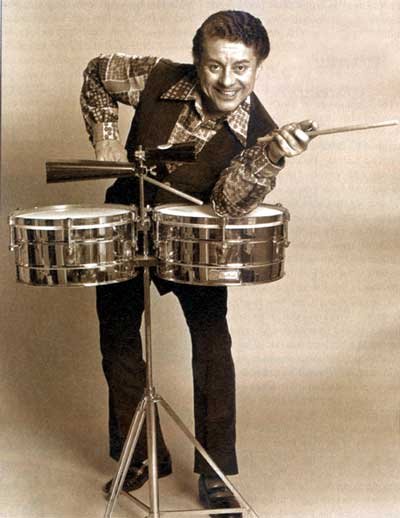
Tito Puente born 20 April 1923

 
Ernesto Antonio "Tito" Puente (April 20, 1923 – May 31, 2000) was an American musician, songwriter and record producer. Puente is often credited as "The Musical Pope", "El Rey de los imbales" (The King of the Timbales) and "The King of Latin Music". But he was also skilled at the bateria, congas, claves, piano, saxophone, and clarinet, which allowed him to create a school for every musical genre he entered. 

Tito Puente was born on April 20, 1923, at Harlem Hospital Centre
in the New York borough of Manhattan. His family moved frequently, but he spent the majority of his childhood in the Spanish Harlem area of the city. Puente's father was the foreman at a razorblade factory. 
 
As a child, he was described as hyperactive, and after neighbours complained of hearing seven-year-old Puente beating on pots and window frames, his mother sent him to 25-cent piano lessons. By the age of 10, he switched to percussion, drawing influence from jazz drummer Gene Krupa. He later created a song-and-dance duo with his sister Anna in the 1930s and intended to become a dancer, but an ankle tendon injury prevented him pursuing dance as a career. When the drummer in Machito's band was drafted to the army, Puente subsequently took his place.  

Puente served in the Navy for three years during World War II after being drafted in 1942. He was discharged with a Presidential Unit Citation for serving in nine battles on the escort carrier USS Santee (CVE-29). The GI Bill allowed him to study music at Juilliard School of Music, where he completed a formal education in conducting, orchestration and theory. In 1969, he received the key to the City of New York from former Mayor John Lindsay. In 1992, he was inducted into the National Congressional Record, and in 1993 he received the James Smithson Bicentennial Medal from the Smithsonian. 

During the 1950s, Puente was at the height of his popularity, and helped to bring Afro-Cuban and Caribbean sounds like mambo, son, and cha-cha-chá, to mainstream audiences. Puente was so successful playing popular Afro-Cuban rhythms that many people mistakenly identify him as Cuban. Dance Mania, possibly Puente's most well known album, was released in 1958. 


Among his most famous compositions are mambo "Oye como va" (1963), popularized by Latin rock musician Carlos Santana and later interpreted, among others, by Julio Iglesias, Irakere or Celia Cruz. 
 Later, he moved into more diverse sounds, including pop music, bossa nova and others, eventually settling down with a fusion of Afro-Cuban and Latin jazz. In 1979, Puente won the first of five Grammy Awards for the albums A Tribute to Benny Moré, On Broadway, Mambo Diablo, and Goza Mi Timbal. In 1982, he started reeling off a string of several Latin jazz albums with octets or big bands for Concord Picante that gave him greater exposure and respect in the jazz world than he ever had.


In 1990, Puente was awarded the James Smithson Bicentennial Medal. He was also awarded a Grammy at the first Latin Grammy Awards, winning Best Traditional Tropical Album for Mambo Birdland. An indefatigable visitor to the recording studios, Puente recorded his 100th album, The Mambo King, in 1991 amid much ceremony and affection (an all-star Latin music concert at Los Angeles' Universal Amphitheatre in March 1992 commemorated the milestone), and he kept adding more titles to the tally throughout the '90s. 

In early 2000, he appeared in the music documentary Calle 54, wearing an all-white outfit with his band. After a show in Puerto Rico on May 31, 2000, he suffered a massive heart attack and was flown to New York City for surgery to repair a heart valve, but complications developed and he died on May 31, 2000. He was posthumously awarded the Grammy Lifetime Achievement Award in 2003. 

Tito Puente's name is often mentioned in a television production called La Epoca, a film about the Palladium era in New York, Afro-Cuban music and rhythms, mambo and salsa as dances and music and much more. The film discusses many of Puente's, as well as Arsenio Rodríguez's, contributions, and features interviews with some of the musicians Puente recorded with Alfonso "El Panameno" Joseph.

Puente's son Richard "Richie" Puente was the percussionist in the 1970s funk band Foxy. Puente's youngest son, Tito Puente Jr., has continued his father's legacy by presenting many of the same songs in his performances and recordings, while daughter Audrey Puente is a television meteorologist for WNYW and WWOR-TV in New York City. (Info edited from AllMusic and mainly Wikipedia)


Thursday, 19 April 2018

Dickie Goodman born 19 April 1934


Richard Dorian Goodman (April 19, 1934 – November 6, 1989) known as Dickie Goodman was an American music and record producer born in Brooklyn, New York.  
 
Although Weird Al Yankovic gets most of the credit for popularizing novelty songs and parodies, the godfather of the genre is unquestionably Dickie Goodman.Born on April 19, 1934 in Hewlett, New York, Richard Dorian “Dickie” Goodman is still considered one of the earliest proponents of sampling in music, which is called the “break-in” record format. It consists of fragments of popular tunes meshed together and infused with dialog in the form of a radio show or an interview. Although Goodman attended New York University, he dropped out of college to pursue singing and songwriting. He later met Bill Buchanan, a struggling music publisher in New York City. 


 Co-written by Bill Buchanan, Goodman issued his debut record in the summer of 1956, “The Flying Saucer Parts 1 & 2.” The song was a breakthrough hit, peaking at #3 on the Billboard pop chart in the same year. Despite the success of the record, Goodman was caught in a controversy when different labels sued him for copyright infringement for reworking Orson Welles’ radio show, War of the Worlds. But eventually, the judge favoured Goodman affirming that the record was entirely a new work and that he did not copy another else’s work. 

With Mickey Shorr in 1959, Goodman recorded two singles under the name "Spencer and Spencer," both of which relied much less on sampling and more on sketch comedy. "Russian Bandstand" was a re-imagining of the then-popular TV series American Bandstand set in a totalitarian Soviet Union. "Stagger Lawrence" imposed Lloyd Price's recording of "Stagger Lee" onto a spoof of The Lawrence Welk Show, borrowing heavily from an earlier Welk parody done by Stan Freberg. Neither recording with Shorr would be as popular as the recordings Goodman made with Buchanan. 

Starting in 1961, Goodman released his pieces as a solo artist. He scored three Billboard Hot 100 hits based on the hit TV series The Untouchables: "The Touchables" (#60), "The Touchables In Brooklyn" (#42), and "Santa and the Touchables" (#99). 

In 1962 Goodman spoofed Ben Casey with "Ben Crazy" (#44). In 1966 his spoof of Batman resulted in "Batman & His Grandmother" (#70). During the late 1960s, Goodman recorded a mostly musical album featuring his wife, aptly entitled Dickie Goodman and His Wife Susan. Mr. Goodman sang one track on the record ("Never Play Poker with a Man Named Doc (or Eat at a Place Called Mom's)", paraphrasing Nelson Algren's novel A Walk on the Wild Side), and produced two break-in style pieces, with Susan singing the rest of the songs.  

In 1975, he scored another big hit with the song “Mr. Jaws” which peaked at #4 on the Billboard pop charts. By making a parody of the movie Jaws, it became a million-selling record, and was given with a gold disc. 

Goodman released another single “Kong,” which parodied the 1976 King Kong film remake.  It also happened to be his final chart record, reaching #48 on the US pop chart. After  "Kong," Goodman appeared to fall off the face of the earth, as he never managed to score another charting single. Throughout his career, all in all he had 17 hits which five of them made to the Top 40. 

On November 6, 1989 at a relative’s home in Fayetteville, North Carolina, Goodman died of a self-inflicted gunshot. He was 55 years old.  

Goodman's son, Jon Goodman, runs his father's estate, as his songs continue to be included on comedy compilations (especially via the Rhino label), while a biography, The King of Novelty, was issued as well. Goodman's influence continues to be felt, especially in the work of Yankovic and even radio personality Howard Stern, who has created quite a few parodies over the years patterned directly after Goodman's style

 (Compiled and edited from various sources mainly Wikipedia and mentalitch.com)

Tuesday, 17 April 2018

Chuck Higgins born 17 April 1924

 
Charles Williams Higgins (April 17, 1924 – September 14, 1999) was an American saxophonist. Higgins, who was noted for mixing elements of Latin Jazz with Blues, recorded in Los Angeles during the mid-fifties, notably for the Specialty, Combo and Doo-Tone labels. 

Saxophonist / bandleader Chuck Higgins was born in Gary, Indiana.  His first choice of instrument was the trumpet, which he took up at the age of ten and at which he became considerably more proficient than he ever did at playing the tenor saxophone. 

In 1940, the Higgins family moved to Los Angeles, where Chuck attended the L.A. Music Conservatory. He hooked up with a quartet of musicians that included Frank Dunn on piano and sax player Johnny Parker. When Parker quit this band, Higgins took on the sax blasting duties himself and became the leader of the band, soon to be called the Mellotones. Chuck's composition "Pachuko Hop" became his first record, on Jake Porter's fledgling Combo label in 1952. It is the definitive Higgins instrumental and his biggest seller, but due to Combo's poor distribution, sales were limited to the West Coast and insufficient to dent the national charts.


Many of Higgins' s recordings feature a vocal by varying members of his combo. This was also the case with the flip of "Pachuko Hop", which is a classic of early rock 'n' roll in itself. "Motorhead Baby" features the vocals of 17-year old John Jacob Watson Jr, who was still pounding the piano before taking up the instrument that would make Johnny "Guitar" Watson a household name. After switching from piano to guitar in 1953, Watson left the Mellotones, giving Frank Dunn the chance to rejoin the band. Of the eight singles that were released on Combo in 1952-53, the most interesting were those featuring a vocal : "Motor Head Baby" and "Just Won't Treat Me Right" by John Watson, "Big Fat Mama" and "Real Gone Hound Dog" by Daddy Cleanhead (Chuck's older brother Fred Higgins).  

In 1953, the combo switched to Aladdin, where they had three singles released (3215, 3224, 3283), and then, in 1954, to Art Rupe's Specialty label. Fourteen titles were recorded during three sessions (most of them with vocals by Daddy Cleanhead), eight of which were originally issued, on four singles (532, 533, 539, 541). Art Rupe was a perfectionist and replaced some of Higgins' band
members in the studio by up-and-coming session pros such as H.B. Barnum and Jimmy Nolen. 

In 1955-56, the Higgins combo recorded for Dootsie Williams's Dootone label. The second Dootone single, "Wetback Hop", became the subject of controversy because of the use of the derogatory term for Mexicans in the title. It was an attempt to associate the listener with the earlier success of "Pachuko Hop", which refers to Mexican zoot suiters of the 1940s. After a few sessions for various small labels in 1956, Higgins returned to Combo in 1957 with a mixed-race band that included future Canned Heat member Henry Vestine. "Long Long Time" (Combo 144, 1957) is a fine bluesy recording, featuring Frank Dunn on vocals. There were no Higgins releases until 1962, the year in which he reunited with Jake Porter for the opportunist "Pachuko Hop Twist" (Combo 170). 

Chuck temporarily retired from performing and became a music teacher at various L.A. high schools. For the last 20 years of his life he was a professor of music at UCLA, a job which he combined with a 1970s comeback as a honking saxblaster. In that decade, he had two LP releases (and one single, "Too Smart") on Ronnie Weiser's Rollin' Rock label. The second of these (1979) was called: "Chuck Higgins Is A PHD", PHD here standing for "Pretty Heavy Dude". 

 In August 1983, Higgins was part of Ace's "1950s R&B Jamboree", in the company of LA contemporaries Young Jessie, Willie Egan and fellow honker Big Jay McNeely. This was a great success and Higgins was finally discovered by European R&B fans, as his Combo recordings were released on an Ace LP. A collection of his early rare singles, Yak A Dak, was released on the Swedish Saxophonograph label in 1990. 

He died of lung cancer in 1999, leaving behind an estimable body of work, even though he never scored a national hit.  (Info taken mainly from BlackCat Rockabilly Europe)
 

Monday, 16 April 2018

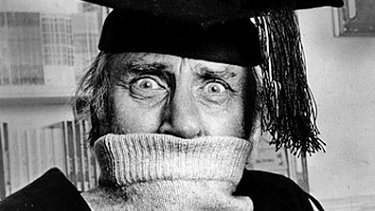
Spike Milligan born 16 April 1918


Terence Alan "Spike" Milligan KBE (16 April 1918 – 27 February 2002) was a British-Irish comedian, writer, poet, playwright and actor. 

One of two comic geniuses nicknamed "Spike" whose work was wildly successful in several mediums -- the other, of course, was Spike Jones -- Spike Milligan was also not the only brilliant comedian to suffer from mental instability. Others included the
Americans W.C. Fields and Jonathan Winters, but in all three cases these problems caused only temporary interruptions in the flow of madcap hilarity. 

To many listeners, Milligan is best known as part of the triumvirate that headed up the Goons, starring on The Goon Show over the British Broadcasting Corporation for nearly a decade beginning in 1952. He was also a wonderful writer, responsible for a string of books that may seem at first superficial but are quite deep, influencing such later British creative spirits such as Billy Childish and Peter Blegvad. In terms of material to slap on the record or CD player, all of the Milligan writings were recorded by the artist himself as audio books, while the complete history of the Goons on radio has been released more than once in a confusing series of reissues.  

Milligan was born in India to a father who was an Irish captain in the British army. Milligan lived in India until he was 15, an experience that later came in quite handy when he and Goons co-star Peter Sellers began the tradition of duelling Bengali accents. That Milligan more than held his own in the company of Sellers is an obvious tribute to the former man's comic gifts. The third main Goon was Sir Harry Secombe, a great musical and comic talent who is sometimes mistakenly called the group's straight man; but make no mistake about it, there was nothing straight at all about The Goon Show.

When his family moved back to England, Milligan's proclivity for entertaining came to the surface, beginning with an interest in jazz that he never lost, eventually even contributing liner notes to a Stan Getz album. Milligan spent much of his youth playing trumpet in various jazz bands. He joined the British Army at the outbreak of the Second World War, serving in the Royal Artillery through the North African and Italian campaigns, where he wound up hospitalized for shell shock.

Following the war, he joined the Goons at a time when the British nation was collectively wondering whether it would ever be able to laugh again. The show became a huge success, but created enormous pressures for Milligan, who was writing the lion's, or the loon's, share of the scripts as well as doing the enormous weekly work of editing in sound effects.

In 1953, these deadlines were blamed for a mental breakdown that resulted in his hospitalization. He was diagnosed with manic depression and became a patron of the Manic Depressive Fellowship. Looking back over his career in television, films, novels, memoirs, and poetry, it can hardly be said that the disease caused him much of a handicap. 


He was the favourite comic of Prince Charles despite the fact that upon accepting the British Comedy Award for Lifetime Achievement he referred to the prince as a "grovelling little bastard" on live television. Milligan is often referred to as the godfather of alternative comedy, his activities with and without the Goons paving the way for just about any kind of anarchic comedy, from Monty Python's Flying Circus to South Park.  

Following the end of The Goon Show, he went on to write and star in the television sketch series entitled Q. Several characters from The Goon Show also appeared in a film he made with Sellers, The Muckinese Battlehorn. In his later years, a more serious side emerged as Milligan became a vocal supporter of environmental issues and vegetarianism. 

He seemed to mellow in later years, but there was always a hint of the dangerous spark that had brought him to the brink of despair so many times and lit beacons of laughter to cleanse us all. In 2000, to a clutch of awards was added an honorary knighthood. It was honorary because - and earlier the cause of considerable furore - his father's Irish background meant that he was denied automatic British citizenship and thus the official title.
 

Milligan died from kidney failure, at the age of 83, on 27 February 2002, at his home in Rye, Sussex.

 (Mainly compiled from an AllMusic bio by Eugene Chadbourne)


Sunday, 15 April 2018

Casper Reardon born 15 April 1907


Casper Reardon (April 15, 1907 – March 9, 1941) was a classical and jazz harpist.
 
Casper Reardon was born to a vaudeville family in Little Falls, New York. At the age of five he trouped with his parents. His father, who was of Irish descent, presented him with a small Irish harp on his eighth birthday. His début as soloist was with the Philadelphia Orchestra, under the direction of Leopold Stokowski. As a result of winning a scholarship, he became one of the most brilliant pupils of the illustrious Carlos Salzedo at the Curtis Institute in Philadelphia. Graduating in 1926, he became first harpist of the Cincinnati Symphony under Fritz Reiner for five years, and head of the Harp Department at the Cincinnati Conservatory.
 
Newspaperman Edwin H. Schloss wrote (July 19, 1939), 'In Cincinnati, some of Reardon's Southern pupils interested him in jazz and he fell in love with the music of W.C. Handy. He found the percussive harp to be as well suited to Gershwin as to Debussy and the rest is history, mostly made via radio.'

 On his own, Reardon devised a technique of playing 'jazz.' The precedent for jazz music on the harp had not been explored to a significant degree. It wasn't unusual for a dance orchestra to utilize the harp for texture. (The dance orchestras of Leonard Joy, Richard Himber, Victor Young and Raymond Paige used harp regularly.) Reardon thought the harp had more potential than the usual flourishes and interludes that were expected of him. When he became a regular feature on the powerful Cincinnati station WLW, he used the nom de radio "Arpeggio Glissando," so as to not shock his classical harp students.


Reardon’s initial records were as a pianist accompanying tap dancers. He moved to New York City in 1931 and immediately created a niche for himself and his harp. On September 18, 1934, he recorded an unprecedented long harp solo on the Jack Teagarden recording of "Junk Man" for Brunswick Records. Although his name does not appear on the record, determined music lovers soon found out who the swing harpist was. By 1936 he recorded some dance records as Casper Reardon & His Orchestra, for Liberty Music Shop. He became known as the "Swing Harpist."
 
He was immortalized as "Cousin Caspar" in Alice Faye's film You're a Sweetheart (1937). He was a regular on radio shows such as 'Saturday Night Swing Club' with the orchestra of Bunny Berigan, and was often featured by Paul Whiteman and His Orchestra. George Gershwin featured Reardon on his popular Feenamint broadcast in 1934.
 
Casper Reardon met Dana Suesse in nineteen thirty-nine, through their friend, Gus Schirmer. Suesse told this writer, "Casper told me about having an engagement with the Philadelphia Symphony and wanted me to write something for him. At the time, Young Man with A Horn was a bestselling novel." It seemed logical to create a concert piece called Young Man with A Harp. Alexander Smallens, who would always be remembered as the original conductor of Gershwin's Porgy and Bess, conducted the concert at the Robin Hood Dell in 1939
 
Dana and Casper repeated their Young Man With A Harp on February 25, 1940 with Guy Fraser Harrison conducting the Rochester Civic Orchestra. In 1940 Reardon performed with Suesse at a Cabinet Dinner for President Franklin D. Roosevelt and his family.
 
One evening in March 1941 Reardon was late for a date with composer Dana Suesse to attend the New York opening of Crazy With The Heat, a show in which he appeared in Boston. He complained about feeling lousy, and stopped for a quick brandy to settle his stomach.  


A few days later he was taken to the hospital for an exploratory operation and it was discovered that both kidneys were seriously damaged, a condition unusual for someone who seldom drank alcohol. Four or five days later he died on March 8, 1941. He was 33 years old. A funeral was held March 11. On December 19 a memorial program was broadcast on WQXR, featuring a composition composed by Suesse and orchestrated by Robert Russell Bennett. The work was titled "Coronach, a Gaelic word for "A crying together."

(Edited from  a bio @ IMDb and YouTube posts) 


Recorded on disk, this selection by Casper Reardon is a previously unreleased, segment from a Hollywood studio recording session. Two songs, Ain't Misbehavin' (Fats Waller, Harvey Brooks, Andy Razaf) and St. Louis Blues (W.C. Handy) are heard in the released print of this feature film, starring Alice Faye, George Murphy, Ken Murray, Andy Devine and Oswald (Tony Labriola). The first song, Junk Man (by Joseph Meyer and Frank Loesser) was cut from the released print, but the audio survives on this playback disk dated October 9, 1937. Stills have been inserted into this video clip where film footage does not survive. The film, directed by David Butler, was released December 26, 1937. The voice of the conductor, Charles Previn (the cousin of André Previns father) is heard counting off the selection. 

Saturday, 14 April 2018

Gene Ammons born 14 April 1925


Eugene "Jug" Ammons (April 14, 1925 – August 6, 1974), also known as "The Boss", was an American jazz tenor saxophonist. The son of boogie-woogie pianist Albert Ammons, Gene Ammons is remembered for his accessible music, steeped in soul and R&B, but his career was hampered by two incarcerations on drugs charges.

Born in Chicago, Illinois, Ammons studied music with instructor Walter Dyett at DuSable High School. Ammons began to gain recognition while still at high school when in 1943, at the age of 18, he went on the road with trumpeter King Kolax's band. In 1944 he joined the band of Billy Eckstine (who bestowed on him the nickname "Jug" when straw hats ordered for the band did not fit), playing alongside Charlie Parker and later Dexter Gordon.

Notable performances from this period include "Blowin' the Blues Away," featuring a saxophone duel between Ammons and Gordon. After 1947, when Eckstine became a solo performer, Ammons then led a group, including Miles Davis and Sonny Stitt, that performed at Chicago's Jumptown Club. In 1949 Ammons replaced Stan Getz as a member of Woody Herman's Second Herd, and then in 1950 formed a duet with Sonny Stitt.

Considered by many jazz historians and critics as the first bebop
big band, Eckstine's group was the training ground for some of the most important and progressive jazz musicians of the 1940s, 1950s, and 1960s, including Ammons, Parker, and Gordon, as well as Fats Navarro, Art Blakey, Miles Davis, Howard McGhee, and vocalist Sarah Vaughan.

Eckstine disbanded the group in 1947, and Ammons then led a group, including Miles Davis and Sonny Stitt, that performed at Chicago's Jumptown Club. He also played several dates as a member of Stitt's group. He led several different jazz combos until 1949, when he replaced Stan Getz in Woody Herman's Second Herd. After six months as a member of Herman's group, Ammons formed a quintet featuring Stitt.

The 1950s were a prolific period for Ammons and produced some acclaimed recordings such as "The Happy Blues" (1955). Musicians who played in his groups, apart from Stitt, included Donald Byrd, Jackie McLean, John Coltrane, Kenny Burrell, Mal Waldron, Art Farmer, and Duke Jordan.

In 1954 Ammons had moved to Washington, D.C., from Chicago and became increasingly dependent on heroin. He continued to perform and record, however, and led several all-star jazz musician recordings that were released as a Prestige series entitled Hi Fi Jam Sessions. "The Happy Blues," a 1955 recording featuring Freddie Redd and Lou Donaldson, is among the most acclaimed performances from this era. Other musicians who played in Ammons's bands of the 1950s include Donald Byrd, Jackie McLean, John Coltrane, Kenny Burrell, Mal Waldron, Art Farmer, and Duke Jordan. 

His later career was interrupted by two prison sentences for narcotics possession, the first from 1958 to 1960, the second from 1962 to 1969. He recorded as a leader for Mercury (1947–1949), Aristocrat (1948–1950), Chess (1950–1951), Prestige (1950–1952), Decca (1952), and United (1952–1953). For the rest of his career, he was affiliated with Prestige.

When he was released from prison in 1969, Ammons signed the largest contract ever offered at that time by Prestige Records. Upon his release he was diagnosed with an enlarged heart and emphysema, but in spite of his health problems, he recorded a bulk of material for the label. That material included such ballads as "Long Long Time," which had been a popular recording by Linda Ronstadt; the Paul Anka-composed Frank Sinatra signature song "My Way"; an album of Nat "King" Cole songs; as well as the  ballad "Didn't We" and the instrumental "Jungle Strut," which was later covered by the San Francisco rock band Santana.


 Because of his criminal record, Ammons was prevented from playing in New York by the New York State Liquor Board, but he continued to play in Chicago with such artists as Gordon and Davis. In 1974 he played at the Ahus Jazz Festival in Sweden. Upon his return from Europe, Ammons entered the Michael Reese Hospital in Chicago, where he died from bone cancer and pneumonia on August 6, 1974.

(Compiled and edited from Wikipedia and mainly from an article by Bruce Walker @ musiciansguide.com)

Jug blows on this Ellington evergreen at the Montreux Jazz Festival. Hampton Hawes - keyboards; Bob Cranshaw - bass; Kenny Clarke - dms; Kenneth Nash - congas.