
Johnnie Lee Wills (September 2, 1912–October 25, 1984)
was an American Western swing fiddler popular in the 1930s and 1940s.
Wills was born in Hall County, Texas. He grew up loving
and playing music. As a young adult, he found himself picking cotton and
driving a delivery truck for Burris Mills, supplying grocery stores with flour.
At age nineteen, realizing he would rather do just about anything than remain
in the cotton patch, he went to work for his brother Bob, playing tenor banjo
in a small band. In 1934, this small band came to Tulsa, Oklahoma, and Johnnie
Lee Wills had the unique distinction as being one of the six truly original
members of the "Texas Playboys."
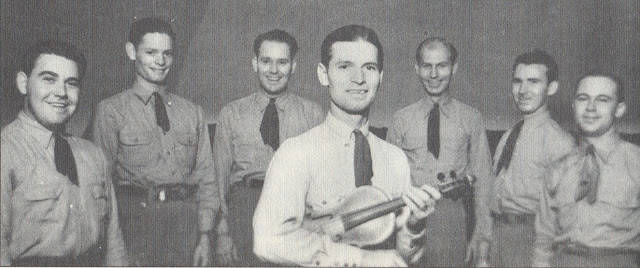
Bob Wills made an agreement with Mr. W.B. Way, to have a trial broadcast at midnight over Tulsa radio station powerhouse, KVOO. The agreement reached was, if the response to the band was favourable, Bob would have a job at the station. If not, no harm done, and Bob would move on. The response was not merely favourable, but positively overwhelming. The station received

Bob remained in
Tulsa for only eight years and in 1942, he left Tulsa to go to California. At
this time, Johnnie Lee took over the band and the live broadcast, replaced his
banjo with his fiddle, and renamed the band "Johnnie Lee Wills & All
The Boys." Johnnie Lee remained on the air with KVOO for 25 consecutive
years. When the live broadcasts ended in 1958, Johnnie Lee had the longest
running live radio broadcast in the nation. Johnnie Lee broadcasted Monday
through Saturday at noon and had the opportunity to promote where his band
would be performing on the weekends. "Johnnie Lee & All The Boys"
played to standing room only crowds throughout the Southwest for many years.

Johnnie Lee did syndicated transcriptions for General
Mills' Red Star Flour. These transcriptions were aired on radio stations all
over the United States. Johnnie Lee's recording career began in the 1940's, and
spanned three decades. He recorded for Bullet, Decca, Sims and Delta record
companies.

His most famous recordings were his hit songs "Rag Mop"
and "Peter Cottontail." During these years, "Johnnie Lee Wills
& All The Boys" travelled throughout the Southwest as one of the
nation's most versatile western swing bands. They played everything from
Johnnie Lee's signature song "Milk Cow Blues" to the band's pop hit,
"Blub Twist" featuring the saxophone of Glenn Rhees.


In 1982, the state of Oklahoma celebrated its Diamond
Jubilee
 Anniversary. Dr. Guy Logsdon, former head of libraries, at the
University of Tulsa, was appointed to assemble an entourage of people from
Oklahoma to travel to Washington D.C. to the Smithsonian Institute. The people
selected to go were to represent the most noteworthy facets of life in
Oklahoma. Dr. Logsdon invited "Johnnie Lee Wills & All The Boys"
to showcase Oklahoma's prominence in the development and contribution to the
longevity of "Western Swing" music. The band performed twice a day
for ten consecutive days to "standing room only" crowds.
Anniversary. Dr. Guy Logsdon, former head of libraries, at the
University of Tulsa, was appointed to assemble an entourage of people from
Oklahoma to travel to Washington D.C. to the Smithsonian Institute. The people
selected to go were to represent the most noteworthy facets of life in
Oklahoma. Dr. Logsdon invited "Johnnie Lee Wills & All The Boys"
to showcase Oklahoma's prominence in the development and contribution to the
longevity of "Western Swing" music. The band performed twice a day
for ten consecutive days to "standing room only" crowds.


Johnnie Lee has a display area devoted to him at the
"Cowboy Hall of Fame" in Oklahoma City, Oklahoma, and has a street
bearing his name directly in front of the main entrance of the Tulsa State
Fairgrounds where his rodeo was held for so many years. He died from heart
complications on October 25, 1984 in Tulsa.
He was inducted into The National Fiddler Hall of Fame in
2008.
(Edited from bio by John T. Wills & Wikipedia)

