
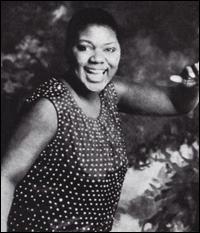
Bessie Smith (15 April, 1894* – September 26, 1937) was
the most popular American female blues singer of the 1920s and '30s,. Smith is
often regarded as one of the greatest singers of her era, and along with Louis
Armstrong, a major influence on subsequent jazz vocalists. (*Her date of birth
is uncertain and is variously given as 1894-6, 1898, and 1900.I have opted for
the most common date  given.)
 given.)
Bessie Smith earned the title of “Empress of the Blues”
by virtue of her forceful vocal delivery and command of the genre. Her singing
displayed a soulfully phrased, boldly delivered and nearly definitive grasp of
the blues. In addition, she was an all-around entertainer who danced, acted and
performed comedy routines with her touring company. She was the highest-paid
black performer of her day and arguably reached a level of success greater than
that of any African-American entertainer before her.
Smith was born in Chattanooga, Tennessee, in 1894. Like
many of her generation, she dreamed of escaping a life of poverty by way of
show business. As a teenager she joined a travelling minstrel show, the Moss
Stokes Company. Her brother Clarence was a comedian  with the troupe, and Smith
befriended another member, Gertrude “Ma” Rainey (a.k.a. the “Mother of the
Blues"), who served as something of a blues mentor. After a decade’s
seasoning on the stage, Smith was signed to Columbia Records in 1923.
with the troupe, and Smith
befriended another member, Gertrude “Ma” Rainey (a.k.a. the “Mother of the
Blues"), who served as something of a blues mentor. After a decade’s
seasoning on the stage, Smith was signed to Columbia Records in 1923.
 with the troupe, and Smith
befriended another member, Gertrude “Ma” Rainey (a.k.a. the “Mother of the
Blues"), who served as something of a blues mentor. After a decade’s
seasoning on the stage, Smith was signed to Columbia Records in 1923.
with the troupe, and Smith
befriended another member, Gertrude “Ma” Rainey (a.k.a. the “Mother of the
Blues"), who served as something of a blues mentor. After a decade’s
seasoning on the stage, Smith was signed to Columbia Records in 1923.
Her first recording - “Down Hearted Blues” b/w “Gulf
Coast Blues” - sold an estimated 800,000 copies, firmly establishing her as a
major figure in the black record market. Smith sang raw, uncut country blues
inspired by life in the South, in which everyday experiences were related in
plainspoken language - not unlike the rap music that would emerge more than
half a century later. She was ahead of her time in another sense as well. In
the words of biographer Chris Albertson, “Bessie had a wonderful way of turning
adversity into triumph, and many of her songs are  the tales of liberated
women.”
the tales of liberated
women.”
 the tales of liberated
women.”
the tales of liberated
women.”
Smith was unquestionably the greatest of the vaudeville
blues singers and brought the emotional intensity, personal involvement, and
expression of blues singing into the jazz repertory with unexcelled artistry.
Baby Doll and After You've Gone, both made with Joe Smith, and Nobody Knows You
When You're Down And Out, with Ed Allen on cornet, illustrate her capacity for
sensitive interpretation of popular songs. Her broad phrasing, fine intonation,
blue-note inflections, and wide, expressive range made hers the measure of
jazz-blues singing in the 1920s.

She made almost 200 recordings, of which her remarkable
duets with Armstrong are among her best. Although she excelled in the
performance of slow blues, she also recorded vigorous versions of jazz
standards. Joe Smith was her preferred accompanist, but possibly her finest
recording (and certainly the best known in her day) was Back Water Blues, with
James P. Johnson. Her voice had  coarsened by the time of her last session, but
few jazz artists have been as consistently outstanding as she.
coarsened by the time of her last session, but
few jazz artists have been as consistently outstanding as she.
 coarsened by the time of her last session, but
few jazz artists have been as consistently outstanding as she.
coarsened by the time of her last session, but
few jazz artists have been as consistently outstanding as she.
By 1930 her career had faltered due to the public's
changing musical tastes, mismanagement of her affairs, and her heavy drinking.
She had started drinking excessively in her teens and drank more heavily as
time passed. Gin was her perferred drink, downing tumbler fulls at a time. Her
odes to gin include Gin House Blues and Me and My Gin. In many ways Nobody
Knows You When You're Down and Out was an autobiographical confession for
Bessie.
Bessie's last recording session in 1933 billed as a
comeback, was in large measure a sentimental gesture by producer John Hammond.
 Her last New York appearance was in 1936 at a Sunday afternoon jam session
sponsored by United Hot Clubs of America at the original Famous Door on 52nd Street.
Her last New York appearance was in 1936 at a Sunday afternoon jam session
sponsored by United Hot Clubs of America at the original Famous Door on 52nd Street.

On the eve of John Hammond's departure to Mississippi to
bring her back to New York, September 27, 1937, to record again, Bessie Smith
was in an automobile accident just below Clarksdale, Mississippi on the main
road to Memphis. Her right arm was nearly severed in the crash, and Bessie died
from loss of blood. In a 1937 article by John Hammond he reported that Bessie
Smith died after being denied admission to a hospital because of her skin
color.  However Hammond has since admitted his report was based on hearsay, and
those since interviewed who had direct knowledge of the events have made it
clear that this was not the case.
However Hammond has since admitted his report was based on hearsay, and
those since interviewed who had direct knowledge of the events have made it
clear that this was not the case.
 However Hammond has since admitted his report was based on hearsay, and
those since interviewed who had direct knowledge of the events have made it
clear that this was not the case.
However Hammond has since admitted his report was based on hearsay, and
those since interviewed who had direct knowledge of the events have made it
clear that this was not the case.
An estimated 10,000 mourners filed past her coffin in the
Philadelphia funeral home where she lay in state, to pay their respects. Bessie, even in death, was dressed like an
Empress, in a long silk gown and slippers that went well with the pink two tone
velvet that lined her silver casket. Bessie's grave remained unmarked for 33
years while Jack Gee and her family fought over her estate. It wasn't until
1970 that Janis Joplin and the wife of an NAACP member paid for the stone.

She left behind a rich, influential legacy of 160
recordings cut between 1923 and 1933. Some of the great vocal divas who owe a
debt to Smith include Billie Holiday, Dinah Washington, Sarah Vaughan, Aretha
Franklin and Janis Joplin. In Joplin’s own words of tribute, “She showed me the
air and taught me how to fill it.” (info
edited, mainly from afroamhistory.about.com)

