
Johnny Henry Smith II (June 25, 1922 – June 11, 2013) was an American cool jazz and mainstream jazz guitarist. He was universally adored by Jazz guitarists and although he reappeared on the Jazz scene from time-to-time, most of his now-legendary recordings were made in the 1950s.
 During the Great Depression, Smith's family moved from
Birmingham, Alabama, United States, where Smith was born, through several
cities, ending up in Portland, Maine. Smith taught himself to play guitar in
pawnshops, which let him play in exchange for keeping the guitars in tune. At
thirteen years of age he was teaching others to play the guitar. One of Smith's
students bought a new guitar and gave him his old guitar, which became the
first guitar Smith owned.Smith joined Uncle Lem and the Mountain Boys, a local
hillbilly band that travelled around Maine, performing at dances, fairs, and
similar venues.
During the Great Depression, Smith's family moved from
Birmingham, Alabama, United States, where Smith was born, through several
cities, ending up in Portland, Maine. Smith taught himself to play guitar in
pawnshops, which let him play in exchange for keeping the guitars in tune. At
thirteen years of age he was teaching others to play the guitar. One of Smith's
students bought a new guitar and gave him his old guitar, which became the
first guitar Smith owned.Smith joined Uncle Lem and the Mountain Boys, a local
hillbilly band that travelled around Maine, performing at dances, fairs, and
similar venues.
Smith earned four dollars a night. He dropped out of high
school to accommodate this enterprise. Having become increasingly interested in
the jazz bands that he heard on the radio, Smith
 gradually moved away from
country music towards playing more jazz. He left The Mountain Boys when he was
eighteen years old to join a variety trio called the Airport Boys.
gradually moved away from
country music towards playing more jazz. He left The Mountain Boys when he was
eighteen years old to join a variety trio called the Airport Boys.

Having learned to fly from pilots he befriended, Smith
enlisted in the United States Army Air Corps in the hopes of becoming a
military pilot. He was invalidated from the flight programme because of imperfect
vision in his left eye. Given a choice between joining the military band and
being sent to mechanic's school, Smith opted to join the military band. Smith
claims that they gave him a cornet, an Arban's instructional book, and two
weeks to meet the standard, which included being able to read music. Determined
not to go to mechanic's school, Smith spent the
 two weeks practicing the cornet
in the latrine (as recommended by
two weeks practicing the cornet
in the latrine (as recommended by
the bandleader) and passed the examination.
 two weeks practicing the cornet
in the latrine (as recommended by
two weeks practicing the cornet
in the latrine (as recommended bythe bandleader) and passed the examination.
An extremely diverse musician, Johnny Smith was equally
at home playing in the famous Birdland jazz club or sight-reading scores in the
orchestra pit of the New York Philharmonic. From Schoenberg to Gershwin to
originals, Smith was one of the most versatile guitarists of the 1950s. He was
a staff studio guitarist and arranger for NBC from 1946 to 1951. During that
period he also served as guitarist for Benny Goodman's orchestra and sextet,
after which he played on a freelance basis thereafter until 1958, he played in
a variety of settings from solo to full orchestra and had his own trio, The
Playboys, with Mort Lindsey and Arlo Hults.

His most critically acclaimed record was Moonlight in
Vermont (one of Down Beat magazine's top two jazz records for 1952, featuring
saxophonist Stan Getz).His most famous musical composition is the track
"Walk Don't Run", written for a 1954 recording session as
counter-melody to the chord changes of
 "Softly, as in a Morning
Sunrise". Guitarist Chet Atkins covered the track, recording a
neo-classical rendition of the song on the electric guitar for his Hi Fi in
Focus album which preceded the Ventures' hit by three years..
"Softly, as in a Morning
Sunrise". Guitarist Chet Atkins covered the track, recording a
neo-classical rendition of the song on the electric guitar for his Hi Fi in
Focus album which preceded the Ventures' hit by three years..

In 1957, Smith's wife died in childbirth, along with his
second child. He sent his young daughter to Colorado Springs, Colorado to be
cared for temporarily by his mother, and the following year he left his busy performing
career in New York City to join his daughter in Colorado. There, Smith ran a
musical instruments store, taught music, and raised his daughter while
continuing to record albums for the Royal Roost and Verve labels into the
1960s.
 |
| Johnny with Arthur Godfrey |

Smith died of complications from a fall at his home in
Colorado Springs, Colorado, June 11, 2013, at the age of 90.
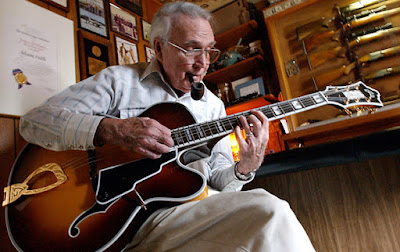

Guitarist Barney Kessel once said about Smith: "As
far as I'm concerned, no one in the world plays the guitar better than he. They
might play it differently, but nobody plays better. Johnny could easily
overplay because he's got chops unlimited, but his musical taste would not
allow him to make an overstatement. As a result, he makes beautiful
music." Kessel's comments were indicative of the universal respect that
Smith enjoyed among his fellow guitarists. While Smith himself steadfastly
maintained that he did not consider himself a jazz player, critics and
musicians alike continue to hail him as a giant among the jazz guitar elite. (Edited from Wikipedia and jazzprofiles)
Here’s a rare clip of legendary guitarist Johnny Smith at
a gig in Mobile Alabama in 1984. (Thanks to Bob Hardy @ YouTube)

