
Walter Maynard Ferguson (May 4, 1928 – August 23, 2006) was
a Canadian jazz musician and bandleader. He came to prominence playing in Stan
Kenton's orchestra, before forming his own band in 1957. He was noted for being
able to play accurately in a remarkably high register, and for his bands, which
served as stepping stones for up-and-coming talent.
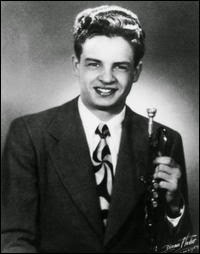 Ferguson was born in Verdun, Quebec (now part of Montreal). Encouraged by his mother and father, Maynard was playing piano and violin by
the age of four. Newsreel footage exists of Ferguson as a child prodigy
violinist. At nine years old, he heard a cornet for the first time in his local
church and asked his parents to purchase one for him. At age thirteen, Ferguson
first soloed as a child prodigy with the
Ferguson was born in Verdun, Quebec (now part of Montreal). Encouraged by his mother and father, Maynard was playing piano and violin by
the age of four. Newsreel footage exists of Ferguson as a child prodigy
violinist. At nine years old, he heard a cornet for the first time in his local
church and asked his parents to purchase one for him. At age thirteen, Ferguson
first soloed as a child prodigy with theCanadian Broadcasting Corporation Orchestra and was heard frequently on the CBC, notably featured on a "Serenade for Trumpet in Jazz" written for him by Morris Davis. Ferguson won a scholarship to the Conservatoire de musique du Québec à Montréal where he studied from 1943 through 1948 with Bernard Baker.
 Ferguson dropped out of Montreal High School at age 15 to
more actively pursue a music career, performing in dance bands led by Stan
Wood, Roland David, and Johnny Holmes. While trumpet was his primary
instrument, Ferguson also performed on other brass and reed instruments.
Ferguson later took over the dance band formed by his saxophonist brother
Percy, playing dates in the Montreal area and serving as an opening act for
touring bands from Canada and the USA. During this period, Ferguson came to the
attention of numerous American band leaders and began receiving offers to come
to the United States.
Ferguson dropped out of Montreal High School at age 15 to
more actively pursue a music career, performing in dance bands led by Stan
Wood, Roland David, and Johnny Holmes. While trumpet was his primary
instrument, Ferguson also performed on other brass and reed instruments.
Ferguson later took over the dance band formed by his saxophonist brother
Percy, playing dates in the Montreal area and serving as an opening act for
touring bands from Canada and the USA. During this period, Ferguson came to the
attention of numerous American band leaders and began receiving offers to come
to the United States. Ferguson finally moved to the United States in 1948
intending to join Stan Kenton's organization. But Kenton had just disbanded his
orchestra, so Ferguson initially played with the bands of Boyd Raeburn, Jimmy
Dorsey, and Charlie
Ferguson finally moved to the United States in 1948
intending to join Stan Kenton's organization. But Kenton had just disbanded his
orchestra, so Ferguson initially played with the bands of Boyd Raeburn, Jimmy
Dorsey, and CharlieBarnet. The Barnet band was notable for a trumpet section that also included Doc Severinsen, Ray Wetzel, Johnny Howell, and Rolf Ericson. Ferguson was featured on a notoriously flamboyant Barnet recording of Jerome Kern's "All The Things You Are" that showcased Ferguson's upper register playing. The recording reportedly enraged Kern's widow and was subsequently withdrawn from sale. When Barnet temporarily retired in 1949 and disbanded his orchestra, Ferguson was free to accept an offer to join Stan Kenton's newly formed Innovations Orchestra.
 When he debuted with Stan Kenton's Orchestra in 1950,
Maynard Ferguson could play higher than any other trumpeter up to that point in
jazz history, and he was accurate. Somehow he kept most of that range through
his career and since the 1970s has been one of the most famous musicians in
jazz. Never known for his exquisite taste (some of his more commercial efforts
are unlistenable), Ferguson nevertheless led some important bands and
definitely made an impact with his trumpet playing.
When he debuted with Stan Kenton's Orchestra in 1950,
Maynard Ferguson could play higher than any other trumpeter up to that point in
jazz history, and he was accurate. Somehow he kept most of that range through
his career and since the 1970s has been one of the most famous musicians in
jazz. Never known for his exquisite taste (some of his more commercial efforts
are unlistenable), Ferguson nevertheless led some important bands and
definitely made an impact with his trumpet playing.
In 1950, with the formation of Kenton's Innovations
Orchestra, Ferguson became a star, playing ridiculous high notes with ease. In
1953, he left Kenton to work in the studios of Los Angeles and three years
later led the all-star "Birdland Dreamband." In 1957, he put together
a regular big band that lasted until 1965, recorded regularly for Roulette (all
of the band's recordings with that label are on a massive Mosaic box set) and
performed some of the finest music of Ferguson's career. Such players as Slide
Hampton, Don Ellis, Don Sebesky, Willie Maiden, John Bunch, Joe Zawinul, Joe
Farrell, Jaki Byard, Lanny Morgan, Rufus Jones, Bill Berry, and Don Menza were
among the more notable sidemen.


After cutting back on his huge orchestra in the early '80s,
Ferguson recorded some bop in a 1983 session, led a funk band called High
Voltage during 1987-1988, and then returned to jazz with his "Big Bop
Nouveau Band," a medium-sized outfit with which he toured the world up until
his death from kidney and liver failure on August 23, 2006. (Info edited from
Wikipedia & All Music)

