Showing posts with label Buddy Holly. Show all posts

Wednesday, 13 May 2015

Ritchie Valens born 13 May 1941


Ritchie Valens (Richard Steven Valenzuela; May 13, 1941 – February 3, 1959) was an American singer, songwriter and guitarist.   

A rock and roll pioneer and a forefather of the Chicano rock movement, Valens' professional career lasted only eight months. During this time, however, he scored several hits, most notably "La Bamba", was a Chicano rock song that became a hit, making Valens a pioneer of the Spanish-speaking rock and roll movement.

Rock Musician, Singer. Born Richard Steven Valenzuela in a largely Hispanic community north of Los Angeles known as the San Fernando Valley, his father was a devotee of flamenco music and blues and instilled his love of music to Ritchie. At the age of eleven he started playing guitar and took it with him everywhere. 

During lunchtime at school he would practice or entertain his friends with his music. When he entered High School he was already an
accomplished musician and played often at school assemblies and after school parties. He was in a variety of bands and in his junior year he joined a local California Rock n Roll band called the “Silhouettes” and they quickly became local stars.
 

At a January 1958 'rent party' held in an American Legion Hall, the band was taped by a part time talent scout who worked for Bob Keane, the owner of Keen Records. Keane was looking for talent for his new label Del Fi Records and after hearing the tape, Keane decided he wanted to hear more of Ritchie so he auditioned him in Los Angeles. The audition went very well and shortly afterward Ritchie Valen’s first single 'Come On Lets Go' was released in the summer of 1958. 


The single did well and he released two more singles: 'Donna' for his high school sweetheart and 'La Bamba' which was reworking of a traditional Mexican folk song. Both singles became enormous hits and began moving towards the top ten and his record sold a half million copies.


A completely self-taught musician, Valens was an accomplished singer and guitarist. At his appearances he often improvised new lyrics and added new riffs to popular songs while he was playing. This is an aspect of his music that is, sadly, not heard in his commercial studio recordings. Due to his high-energy performances, Valens earned the nickname “The Little Richard of the Valley”.

In late January 1959 Ritchie Valens joined Buddy Holly,
J.P. "The 
Big Bopper" Richardson and “Dion and the Belmonts” for the 'Winter Dance Party' which was a tour of the upper Midwest. On February 2, 1959 the 'Winter Dance Party' arrived in Clear Lake, Iowa to play a dance at the Surf Ball Room. Due to a broken heater on the bus that they had been travelling on Buddy Holly arranged to fly to North Dakota in a leased four seat Beechcraft Bonanza airplane for himself and the band members, Waylon Jennings and Tommy Allsup.  
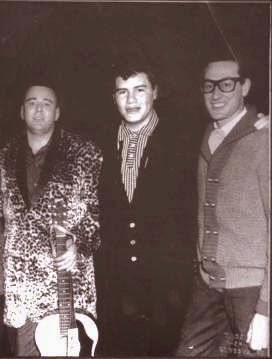
Jennings gave his seat up to Richardson, who was running a fever and had trouble fitting his stocky frame comfortably into the bus seats. When Ritchie heard of Buddy's intended flight, he tried to convince Allsup to give up his seat. Tommy didn't want to but finally agreed to flip a coin to decide who would go, provided he could use The Big Bopper's new sleeping bag if he lost. The Big Bopper agreed. Allsup flipped the coin, and Ritchie called "heads". "Heads" it was. Valens won the seat...and Allsup won the rest of his life.
The three stars arrived at the airport about 12.40 a.m. and were met by their 21-year-old pilot, Roger Peterson, and Jerry Dwyer the owner of the plane. It was a little before 1 a.m. when the single engine aircraft took off in a blinding snow storm. Peterson was inexperienced and was actually not supposed to fly under conditions requiring navigation by instruments, but did not see the special advisories concerning poor visibility. Peterson probably became confused in reading the unfamiliar gyroscope and may not have realised he was descending and not ascending. Just minutes after take-off, the plane plunged into the ground.

The wreckage was spotted at approximately 9:35 a.m. the next morning when a worried Dwyer decided to investigate, after not having heard from the airport of destination. Holly and Valens lay twenty feet from the plane while The Big Bopper was thrown forty feet away. Ritchie Valens was just 17 years old. February 3rd, 1959 would become known years later, in a song called 'American Pie' by Don McClean as "The Day The Music Died".
Valens only had about two albums worth of material in the can, as well as some lo-fi live tapes of a gig at a local junior high, before his death; undoubtedly some or many of these were demos or unfinished tracks. In the wake of his death, several further singles were issued, only two of which - "That's My Little Suzie" and "Little Girl" - were minor chart hits. Three albums - 'Ritchie Valens', 'Ritchie' and 'Ritchie Valens In Concert At Pacoima Junior High' - were released from sessions recorded for Del-Fi and at a performance for Valens' classmates.
Ritchie Valens was only seventeen when he died, his legacy was based primarily on "Donna" and "La Bamba." popular with teenagers. At the time of his death, his hard rocking style was being phased out in favour of teen idols like Fabian and Frankie Avalon. Valens image as an  early Latino rocker has lasted and inspired Los Lobos, Freddy Fender, The Midnighters, Trini Lopez and Sunny and the Sunglows. La Bamba became the model for the Isley Brothers' 1961 hit "Twist and Shout." Valens also inspired the Rascals, Bob Dylan and R.E.M.  His untrained voice and guitar style was a basis for the garage band revolution of the early 1960s.


 In 1987, he was the subject of the successful movie "La Bamba" and received a star on the Hollywood Walk of Fame in 1990. Ritchie Valens was inducted into the Rock and Roll Hall of Fame in 2001.       (Info edited from numerous sources)

Sunday, 7 September 2014

Buddy Holly born 7 September 1936


Charles Hardin Holley (September 7, 1936 – February 3, 1959) better known as Buddy Holly, was an American singer, songwriter, and a pioneer of rock and roll.  
Buddy Holly is considered one of the most influential founding fathers of rock 'n roll. Although his career was tragically cut short, his body of work is considered among the finest in rock. His works and innovations were copied by his contemporaries and those who were to follow, including The Beatles and The Rolling Stones, and had a profound influence on popular music.
Buddy Holly was born Charles Hardin Holley in Lubbock, Texas to Lawrence Odell Holley and Ella Pauline Drake in 1936. The Holleys were a musical family, and, as a young boy, Holley learned to play the violin (his brothers oiled the strings so much that no one could hear him play), piano and guitar. In the fall of 1949, he met Bob Montgomery in Hutchinson Junior High School. They shared a common interest in music and soon teamed up as the duo "Buddy and Bob." Initially influenced by bluegrass music, they sang harmony duets at local clubs and high school talent shows. His musical interests grew throughout high school while singing in the Lubbock High School Choir.
Holly turned to rock music after seeing Elvis Presley sing live in Lubbock in early 1955. A few months later, he appeared on the same bill with Presley, also in Lubbock. Holly's transition to rock was finalized when he opened for Bill Haley & His Comets at a local rock show organized by Eddie Crandall, who was also the manager for Marty Robbins. As a result of this performance, Holly
was offered a contract with Decca Records to work alone, which he accepted. According to the Amburn book (p. 45), his public name changed from "Holley" to "Holly" on February 8, 1956, when he signed the Decca contract. Among the tracks recorded for Decca was an early version of "That'll Be The Day," which took its title from a phrase that John Wayne's character said repeatedly in the 1956 film, The Searchers. 
Back in Lubbock, Holly formed his own band, The Crickets and began making records at Norman Petty's studios in Clovis, New Mexico. Norman had music industry contacts and believing that "That'll Be the Day" would be a hit single, he contacted publishers and labels. Coral Records, a subsidiary of Decca, signed Buddy Holly and The Crickets. This put Holly in the unusual position of having two record contracts at the same time. Before "That'll Be The Day" had its nationwide release, Holly played lead guitar on the hit-single "Starlight", recorded in April, 1957, featuring Jack Huddle. The initial, unsuccessful version of "That'll Be The Day" played more slowly and about half an octave higher than the hit version. 


Holly managed to bridge some of the racial divide that marked rock n' roll music. While Elvis made black music more acceptable to whites, Holly won over an all-black audience when the Crickets were accidentally booked at New York's Apollo Theatre. After the release of several highly successful songs, Holly and the Crickets toured the United Kingdom in 1958. 
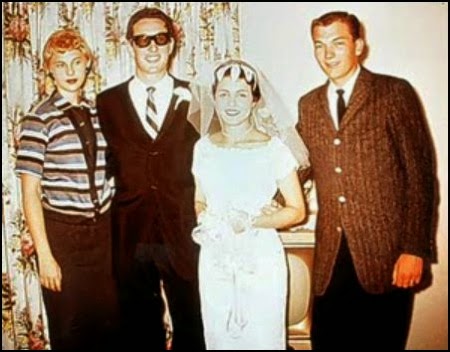
That same year, he met Maria Elena Santiago (born 1935 in San Juan, Puerto Rico) while she was working as a receptionist for a New York music publisher. He proposed to her on their very first date. She initially thought he was kidding, but they were married in Lubbock, Texas on August 15, 1958, less than two months after they met. Maria traveled on some of the tours, doing everything from the laundry to equipment set-up to ensuring the group got paid. 
The ambitious Holly became increasingly interested in the New
York music/recording/publishing scene, while his easy-going bandmates preferred to go back home to Lubbock. Holly acceded to their wishes and in 1959, the group split up. Holly began a solo tour with other notable performers, including Ritchie Valens and J.P. Richardson, "The Big Bopper". 
Two nights after a performance in Duluth, Minnesota, the three headliners gave their final show in Clear Lake, Iowa. Following the February 2, 1959 performance at the Surf Ballroom, Buddy Holly chartered a Beechcraft Bonanza to take him and his new back-up band (Tommy Allsup, Carl Bunch, and Waylon Jennings) to Fargo, North Dakota. Carl Bunch did not take the flight as he had been hospitalized for frostbite three days earlier. The Big Bopper asked Jennings for his spot on the four-seat plane, as he wasrecovering from the flu. Ritchie Valens had never flown on a small plane and requested Allsup's seat. They flipped a coin for it; Valens called heads and won. 
The four-passenger plane took off in light snow and gusty winds at around 12:55 A.M., but crashed only a few minutes after takeoff. The wreckage was discovered several hours later by the plane's owner, Jerry Dwyer, some 8 miles from the airport on the property of Albert Juhl. The crash killed Holly, Valens, Richardson, and the 21-year-old pilot, Roger Peterson. 
While theories abound as to the exact cause of the crash, an official determination of pilot error was rendered by the Civil Aeronautics Board (one of the predecessors of the Federal Aviation Administration). Although the crash received a good deal of local coverage, it was displaced in the national news by an accident that occurred the same day in New York City, when American Airlines Flight 320 crashed during an instrument landing approach at LaGuardia Airport, killing 65. 
Holly's pregnant wife became a widow after barely six months of marriage and miscarried soon after. 
Holly's funeral services were held at the Tabernacle Baptist Church in Lubbock, and his body was interred in the City of Lubbock Cemetery in the eastern part of the city. Holly's headstone carries the correct spelling of his surname (Holley) and a carving of his Fender Stratocaster guitar. (edit from Wikipedia. Mp3 and scan from Lord Of The Bootsale)

Sunday, 31 August 2014

Jerry Allison born 31 August 1939

 
Jerry Allison (born Jerry Ivan Allison, August 31, 1939, in Hillsboro, Texas) is an American musician, best known for being the drummer for The Crickets. 
 
In their early days at the Lubbock Youth Center, Buddy Holly's vocal and guitar were backed only by Allison's drumming, allowing for some of Holly's best guitar work. Over time, Allison's rhythm backup ranged from slapping hands-on-knees or hand-clapping the beat to a modal plainness of cymbal drumming. His snappy cracks at the snare drum gave power to the tough, vengeful songs released under the name The Crickets. Later songs, released under Buddy Holly's own name, were softer in tone and filled with innocence and longing. On these, Allison played only tom-toms in keeping with the vulnerable sound of the vocals. His work on The Crickets recordings gave the records much of their distinctiveness and has influenced subsequent generations of Rock and roll drummers.  
 
Norman Petty, the manager, often manipulated song-writing credits and Allison, although credited with another recording to which he contributed little, helped to compose the music for some of the famous songs, notably "That'll Be The Day" and "Peggy Sue" (Allison later married Peggy Sue Gerron, the namesake of the latter song). "That'll Be The Day" was originally recorded by Holly before he started working with Petty, so the latter's appearance on the song writing credits for the later version by The Crickets illustrates the point about manipulation of the credits. Allison has referred in several published interviews to his role in composing "Not Fade Away", whose credits show Norman Petty/Charles Hardin - the latter a pseudonym for Buddy Holly.  
 
Although Allison did not sing on The Crickets records made with Buddy Holly, in 1958 he did release the single "Real Wild Child" — having heard Johnny O'Keefe play the original during The Crickets brief visit to Australia that year — which he recorded under the pseudonym Ivan, with Buddy Holly on guitar and backing vocals. It was a minor chart entry in 1958 and the first studio recording of the song that would become a rock standard. Allison also sang on a few later releases by the Crickets, both singles and album tracks. 
 
Allison also worked as a session musician. For example, he played on the studio recording of The Everly Brothers' "Till I Kissed You" in 1959.   
 
After Holly's death in 1959. Allison continued his musical career. He retained control of the band's name, and has toured and recorded with a regularly-changing group as The Crickets - see the reference "been more Crickets than a dog's got fleas" in the band's "Three Piece" track from the 1980s. The most consistent members of this band have been bassist Joe B. Mauldin who was in Buddy Holly's Crickets, and guitarist-singer Sonny Curtis who played with Holly before The Crickets were formed in 1957, and rejoined shortly after Holly's death. Others who have been in and out of the band include Glen D. Hardin, also associated with Elvis Presley's last live band; Albert Lee, also once part of Emmylou Harris' Hot Band; and assorted lead vocalists including Earl Sinks, David Box, Jerry Naylor, and Gordon Payne.


The Crickets line up from 1962. left to right: Sony Curtis, Jerry Allison, Jerry Naylor & Glen D. Hardin. 
 
The band's last recordings for the Coral label included several singles which were incorporated in the 1960 album In Style with The Crickets. The rock classic "I Fought the Law" written by Sonny Curtis, first appeared here, and tracks from singles released after Holly's death included their version of Holly's "Love's Made a Fool of You", a chart entry for them in the UK in late 1959, and the Allison/Curtis composition "More Than I Can Say" which was later recorded by Leo Sayer and other artists.


Allison switched the band's contract to Liberty Records in 1960, after they had supported The Everly Brothers on a UK tour. He moved his base to Los Angeles, where an old Texas friend Snuff
Garrett was installed as a senior producer at Liberty. Allison, with Sonny Curtis and another former Holly sideman, Tommy Allsup, became effectively members of the core the Liberty house band, working with Bobby Vee, Johnny Burnette and others. In this period they also played as backing musicians on tracks by Eddie Cochran and, according to some reports, Conway Twitty. Both Allison and Sonny Curtis were drafted at different times in this period, limiting any possibility of continuity in the make-up of The Crickets. Sonny Curtis also began to establish a significant solo career as a songwriter and singer/guitarist. 
 
In the late 1970s, the band toured for a period with Waylon Jennings, another one-time Buddy Holly sideman. In more recent years, The Crickets have put out albums including collaborations with many artists who recognise their influence in early rock 'n' roll. These include Nanci Griffith, with whom they have also toured, Eric Clapton, Paul McCartney, Johnny Rivers, Waylon Jennings, Bobby Vee and many others.  
 
 
In 2007, Allison was inducted into the Musicians Hall of Fame and Museum in Nashville, TN as a member of the Crickets.  
 
 
In 2012, Allison was inducted into the Rock and Roll Hall of Fame as a member of the Crickets by a special committee, aimed at correcting the mistake of not including the Crickets with Buddy Holly when he was first inducted in 1986.  (Info edited from Wikipedia)