
Dion DiMucci (born Dion Francis DiMucci, 18 July 1939), better known as Dion, is an American singer-songwriter, now widely recognized as one of the top singers of his era, blending the best elements of doo-wop, pop, and R&B styles.
 Dion was born to an Italian-American family in the Bronx
borough of New York City. As a child, he used to accompany his father, a
vaudeville entertainer, on tour, and developed a love of country music –
particularly Hank Williams – and the blues and doo-wop stars he heard in local
bars and on the radio. His singing abilities were honed on the street corners
of Crotona Avenue, where he rounded up other local singers inventing acapella
licks, and in local clubs.
Dion was born to an Italian-American family in the Bronx
borough of New York City. As a child, he used to accompany his father, a
vaudeville entertainer, on tour, and developed a love of country music –
particularly Hank Williams – and the blues and doo-wop stars he heard in local
bars and on the radio. His singing abilities were honed on the street corners
of Crotona Avenue, where he rounded up other local singers inventing acapella
licks, and in local clubs.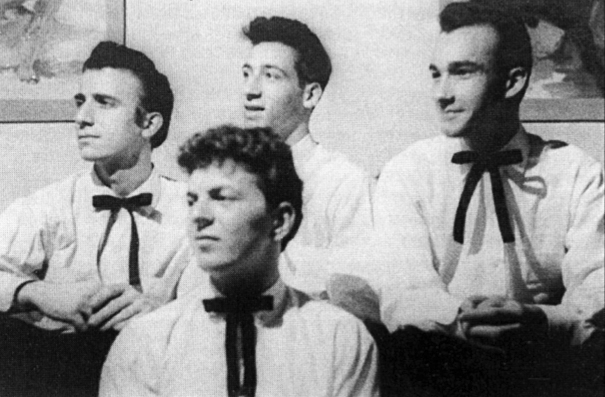
Schwartz also signed up Dion's friends, The Belmonts, named
after nearby Belmont Avenue. Their breakthrough together came in early 1958,
when "I Wonder Why" made # 22 on the national US charts, followed up
with "No One Knows" and "Don’t Pity Me" which were also
chart hits.
This success won Dion and the Belmonts a place on the "Winter Dance Party" tour with Buddy Holly, Ritchie Valens and the Big Bopper. On 2 February 1959, after playing at Clear Lake, Iowa, Dion decided that he could not afford the $36 cost of a flight to the next venue . The plane crashed, and Holly and the other stars were killed.
 |
| Dion with Buddy Holly |
This success won Dion and the Belmonts a place on the "Winter Dance Party" tour with Buddy Holly, Ritchie Valens and the Big Bopper. On 2 February 1959, after playing at Clear Lake, Iowa, Dion decided that he could not afford the $36 cost of a flight to the next venue . The plane crashed, and Holly and the other stars were killed.

In March 1959, Dion and the Belmonts’ next single, "A
Teenager In Love", was released, making # 5 in the US pop charts and # 28
in the UK. Their biggest hit, "Where or When", was released in
November 1959, and reached #3 on the US charts. However, in early 1960, Dion
checked in to hospital for heroin addiction, a
 problem he had had since his
mid-teens. Further single releases for the group that year were less
successful, there were musical and financial differences between Dion and
members of the Belmonts, and in October 1960 Dion decided to quit for a solo career.
problem he had had since his
mid-teens. Further single releases for the group that year were less
successful, there were musical and financial differences between Dion and
members of the Belmonts, and in October 1960 Dion decided to quit for a solo career.

He moved from doo
wop to more R&B/pop-oriented tunes with great success. He handled himself
with a suave, cocky ease on hits like "The Wanderer," "Runaround
Sue," "Lovers Who Wander," "Ruby Baby," and
"Donna the Prima Donna," which cast him as either the jilted,
misunderstood youngster or the macho lover, capable of handling anything that
came his way (especially on "The Wanderer").

In 1968, Dion had what he would later describe as a powerful
religious experience. He kicked heroin and re-emerged as a gentle folk-rocker
with a number four hit single, "Abraham, Martin and John." Dion would
focus upon mature, contemporary material on his late-'60s and early-'70s
albums, which were released to positive
 critical feedback, if only moderate
sales. The folk phase didn't last long; in 1972 he reunited with the Belmonts
and in the mid-'70s cut a disappointing record with Phil Spector as producer.
He recorded and performed fairly often in the years that followed (sometimes
singing Christian music), to indifferent commercial results.
critical feedback, if only moderate
sales. The folk phase didn't last long; in 1972 he reunited with the Belmonts
and in the mid-'70s cut a disappointing record with Phil Spector as producer.
He recorded and performed fairly often in the years that followed (sometimes
singing Christian music), to indifferent commercial results.
critical feedback, if only moderate
sales. The folk phase didn't last long; in 1972 he reunited with the Belmonts
and in the mid-'70s cut a disappointing record with Phil Spector as producer.
He recorded and performed fairly often in the years that followed (sometimes
singing Christian music), to indifferent commercial results.
Dion continued to be active as the 21st century opened,
releasing Déjà Nu in 2000, Under the Influence in 2005, and Bronx in Blue in
2006. His first major-label album since 1989's Yo Frankie, Son of Skip James
was released by Verve in 2007, while 2008's Heroes: Giants of Early Guitar Rock
saw him tackling 15 songs from the classic rock & roll era.
 Influenced by a
conversation with rock critic Dave Marsh about his long and still relevant
career, and a dare from his wife Susan to prove it, Dion cut Tank Full of
Blues, producing and playing the guitars himself on the recording and writing
or co-writing all but one track on the set. Issued on Blue Horizon, it is the
final recording in the trilogy that began with Bronx in Blue.
Influenced by a
conversation with rock critic Dave Marsh about his long and still relevant
career, and a dare from his wife Susan to prove it, Dion cut Tank Full of
Blues, producing and playing the guitars himself on the recording and writing
or co-writing all but one track on the set. Issued on Blue Horizon, it is the
final recording in the trilogy that began with Bronx in Blue.

Dion signed to Instant Records in 2015 and immediately set
to recording a new studio album. Entitled New York Is My Home, its first single
and title track -- a duet with Paul Simon -- was pre-released in November digitally
and as a striking video. The album was issued in the winter of 2016. (Edited from Wikipedia & All Music)

