Ray McKinley (June 18, 1910 –May 7, 1995) was an American
jazz drummer, singer, and bandleader.
Ray McKinley was born in Fort Worth, Texas. He entertained
himself at an early age by "drumming" on whatever was available, and
he received his first drum set at age nine from a family friend. His performing
career had begun even earlier, at age six, with a snare drum solo for several
thousand at the Elks Circus in the North Fort Worth Coliseum. At twelve he
started playing professionally with local bands and orchestras.
Whether deserved or not, his reputation was good enough that
when the Jimmy Joy Orchestra came to town and was strapped for a substitute
drummer, twelve-year-old McKinley got the job. McKinley left town for the first
time on a tour with the Duncan-Marin band in 1926. While performing in a
Chicago nightclub, he was caught in the crossfire of a gang shoot-out and shot
in the leg. During his convalescence, he wandered the clubs and listened in on
sets. He met Benny Pollack, Benny Goodman, Glenn Miller and others.
He left the Duncan-Marin group in 1927 for the Beasley Smith Orchestra, and joined the Tracy-Brown Orchestra in 1929. He played with Milt
Shaw's Detroiters for a time in 1930, followed by a stint with Dave Bernie's
band. With Bernie, he made two trips to England.
McKinley's first sides were recorded with Red Nichols for
the Brunswick record label. Glenn Miller and Jimmy Dorsey were also members of
this nine piece Nichols group that waxed five sides over two sessions in the
spring and early summer of 1931. In 1932 McKinley again worked with Glenn
Miller in the Smith-Ballew band as well as in the Dorsey Brothers Orchestra in
1934-5. In May of 1934 he recorded four sides with a Benny Goodman small group
that included Charlie and Jack Teagarden, Teddy Wilson and others.
When the feuding Dorsey Brothers broke up in 1935 McKinley
joined Jimmy Dorsey, in his new orchestra, where he remained until 1939.
Although the Jimmy Dorsey band did not achieve the fame that brother Tommy’s
band did, it waxed some fine swinging sides driven by McKinley on skins. Parade
of the Milk Bottle Caps and John Silver were two of the most well known
instrumental recordings of the group and both were enhanced greatly by
McKinley's impeccable timekeeping and occasional fiery outbursts.
In 1939 Ray McKinley became a partner of trombonist Will
Bradley co-leading a band that recorded under Bradley's name. This band, that
also featured Freddie Slack on piano, cut dozens of boogie-woogie laden sides
for Columbia between September of 1939 and January of 1942. Many were hits,
some featuring McKinley’s humorous and personable vocals and one line shouts
like on Celery Stalks At Midnight and Fry Me Cookie In A Can Of Lard.
Unfortunately there was friction between the two stars. The two had a less than
amicable split in 1942 as reported by Down Beat magazine.
Corporal BRODERICK CRAWFORD, Corporal RAY McKINLEY
and Captain GLENN
MILLER jam for a serviceman's C.B.S. wartime special, 1943
In 1942 McKinley formed his own short-lived band recording
briefly for Capitol and then joined the Army. While in the service, he joined
Glenn Miller’s AEF band. While in Europe he formed his own “Swing Shift” group
culled from the heart of Miller’s band and spotlighting, among others, pianist
Mel Powell and reed man Peanuts Hucko. The Miller Allied Expeditionary Forces
band waxed numerous incredibly swinging tunes in London's Abbey Road studios
during the war. After Miller’s
disappearance McKinley co-led Glenn Miller's American Band of the Allied
Expeditionary Forces briefly with Jerry Gray.
Back in the U.S. Ray formed his own civilian band again
recording for Majestic in 1946 and Victor from 1947-50, this time using the
rich arrangements of Eddie Sauter and Dean Kincaide and featuring players like
Peanuts Hucko and Mundell Lowe, and later adding Joe Farrante, Sam Butera,
Buddy Morrow and others.
From ’50-‘55 McKinley free-lanced, occasionally leading his
own bands, and working as a TV singer in NYC.In 1956 he was commissioned by the widow of Glenn Miller to organize a
new band under Miller’s name using the original library and style. This band
made a successful tour of Iron Curtain countries in 1957 and continued to tour
the U.S. until 1966.
McKinley then free-lanced again, leading an orchestra under
his own name and recording for Dot in 1966. He also played drums in yet another
incarnation of the Glenn Miller Orchestra, fronted by Buddy DeFranco, and
recorded for Columbia House in 1972. His last recording session was cut with
just himself on drums and pianist Lou Stein, who recorded five sides together
for the Chiaroscuro label in 1977.
During his retirement Ray made several
appearances at nostalgia festivals. He died May 7th, 1995 in Largo, Florida.
(Info mainly from
www.swingmusic.net & the Smithsonian Institute archives)
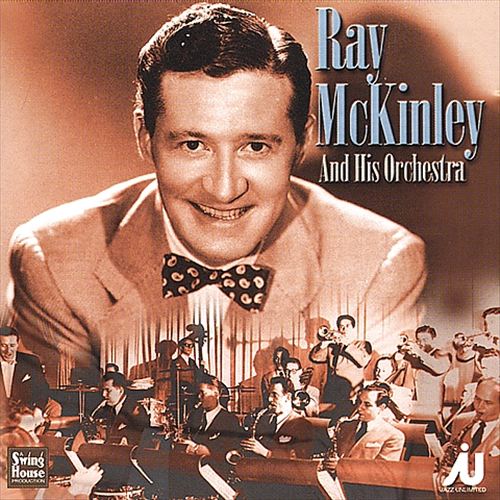
 Ray McKinley was born in Fort Worth, Texas. He entertained
himself at an early age by "drumming" on whatever was available, and
he received his first drum set at age nine from a family friend. His performing
career had begun even earlier, at age six, with a snare drum solo for several
thousand at the Elks Circus in the North Fort Worth Coliseum. At twelve he
started playing professionally with local bands and orchestras.
Ray McKinley was born in Fort Worth, Texas. He entertained
himself at an early age by "drumming" on whatever was available, and
he received his first drum set at age nine from a family friend. His performing
career had begun even earlier, at age six, with a snare drum solo for several
thousand at the Elks Circus in the North Fort Worth Coliseum. At twelve he
started playing professionally with local bands and orchestras.


 When the feuding Dorsey Brothers broke up in 1935 McKinley
joined Jimmy Dorsey, in his new orchestra, where he remained until 1939.
Although the Jimmy Dorsey band did not achieve the fame that brother Tommy’s
band did, it waxed some fine swinging sides driven by McKinley on skins. Parade
of the Milk Bottle Caps and John Silver were two of the most well known
instrumental recordings of the group and both were enhanced greatly by
McKinley's impeccable timekeeping and occasional fiery outbursts.
When the feuding Dorsey Brothers broke up in 1935 McKinley
joined Jimmy Dorsey, in his new orchestra, where he remained until 1939.
Although the Jimmy Dorsey band did not achieve the fame that brother Tommy’s
band did, it waxed some fine swinging sides driven by McKinley on skins. Parade
of the Milk Bottle Caps and John Silver were two of the most well known
instrumental recordings of the group and both were enhanced greatly by
McKinley's impeccable timekeeping and occasional fiery outbursts.


