
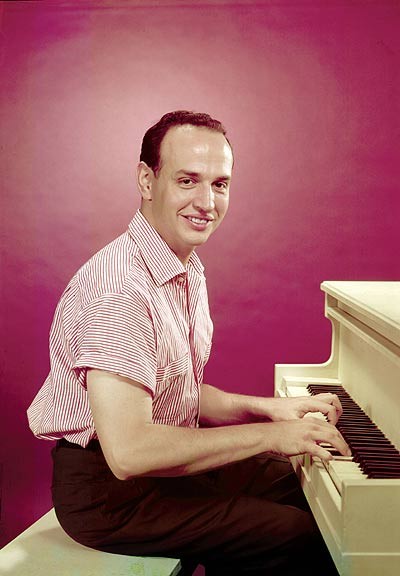
Roger Williams (born Louis Jacob Weertz, October 1, 1924 –
October 8, 2011) was an American popular music pianist. A celebrated musician,
considered by many as the greatest pianist of popular music of the 20th
Century, he achieved a string of Top-40 hits on the Pop Charts and garnered
more-than 20 gold and platinum albums, while performing in front of nine
presidents  during his career.
 during his career.
Weertz was born to a Lutheran minister, the Rev. Frederick
J. Weertz (1891–1980) and a music teacher, Dorothea Bang Weertz (1895–1985), in
Omaha, Nebraska. The family moved to Des Moines, Iowa, before his first
birthday. He first played the piano at age three. In high school he became
interested in boxing, mainly at his father's insistence, and only returned to music
after breaking his nose several times and sustaining several other injuries.
Weertz majored in piano at Drake University in Des Moines,
but claimed he was expelled for playing "Smoke Gets in Your Eyes" in
 the practice room. Weertz entered the United States Navy and served in World
War II. While still in the Navy, he earned a bachelor's degree from Idaho State
College (now Idaho State University) in 1950. Afterwards, Weertz re-enrolled at
Drake, where he earned his master's degree. He then moved to New York City to
attend Juilliard, where he studied jazz piano under Lennie Tristano and Teddy
Wilson.
the practice room. Weertz entered the United States Navy and served in World
War II. While still in the Navy, he earned a bachelor's degree from Idaho State
College (now Idaho State University) in 1950. Afterwards, Weertz re-enrolled at
Drake, where he earned his master's degree. He then moved to New York City to
attend Juilliard, where he studied jazz piano under Lennie Tristano and Teddy
Wilson.
 the practice room. Weertz entered the United States Navy and served in World
War II. While still in the Navy, he earned a bachelor's degree from Idaho State
College (now Idaho State University) in 1950. Afterwards, Weertz re-enrolled at
Drake, where he earned his master's degree. He then moved to New York City to
attend Juilliard, where he studied jazz piano under Lennie Tristano and Teddy
Wilson.
the practice room. Weertz entered the United States Navy and served in World
War II. While still in the Navy, he earned a bachelor's degree from Idaho State
College (now Idaho State University) in 1950. Afterwards, Weertz re-enrolled at
Drake, where he earned his master's degree. He then moved to New York City to
attend Juilliard, where he studied jazz piano under Lennie Tristano and Teddy
Wilson.
Weertz won a talent contest on Dennis James' television
program, Chance of a Lifetime. David Kapp, founder of Kapp Records, heard him,
and was so impressed that he signed the pianist, giving him the professional
name "Roger Williams" after the founder of Rhode Island.

In 1955 Williams recorded "Autumn Leaves", the
only piano instrumental to reach #1 on Billboard's popular music chart. It sold
over two million copies, and was awarded a gold disc. This began a streak of 22
hit singles that ran through 1969; he had two other Top Ten hits, "Near
You" in 1958 and "Born Free" in 1966. Williams  was equally
successful on the album charts, racking up a total of 38 hit records between
1956 and 1972, including the Top Ten albums Songs of the Fabulous Fifties
(1957), Till (1958), Maria (1962), and Born Free (1966).
was equally
successful on the album charts, racking up a total of 38 hit records between
1956 and 1972, including the Top Ten albums Songs of the Fabulous Fifties
(1957), Till (1958), Maria (1962), and Born Free (1966).
 was equally
successful on the album charts, racking up a total of 38 hit records between
1956 and 1972, including the Top Ten albums Songs of the Fabulous Fifties
(1957), Till (1958), Maria (1962), and Born Free (1966).
was equally
successful on the album charts, racking up a total of 38 hit records between
1956 and 1972, including the Top Ten albums Songs of the Fabulous Fifties
(1957), Till (1958), Maria (1962), and Born Free (1966).
Billboard magazine ranks him as the top selling piano
recording artist in history with 18 gold and platinum albums to his credit.
Williams was known as the "Pianist to the Presidents", having played
for nine US Presidential administrations, beginning with Harry S. Truman. His
last White House performance was in November 2008 for a luncheon hosted  by
First Lady Laura Bush. Throughout his career, Williams electrified audiences in
such prestigious venues as Carnegie Hall, the Hollywood Bowl and the Las Vegas
strip.
by
First Lady Laura Bush. Throughout his career, Williams electrified audiences in
such prestigious venues as Carnegie Hall, the Hollywood Bowl and the Las Vegas
strip.
 by
First Lady Laura Bush. Throughout his career, Williams electrified audiences in
such prestigious venues as Carnegie Hall, the Hollywood Bowl and the Las Vegas
strip.
by
First Lady Laura Bush. Throughout his career, Williams electrified audiences in
such prestigious venues as Carnegie Hall, the Hollywood Bowl and the Las Vegas
strip.
On his 75th birthday, Williams performed his first 12-hour
piano marathon. He performed the marathon at Steinway Hall in New York City and
the Nixon, Carter and Reagan Presidential Libraries. His Steinway & Sons
"Gold Steinway" grand piano was on tour for public display and
entertainment during 2007–2008. In 2010, Roger Williams was inducted into the
Hit Parade Hall of Fame.
Williams developed his particular attitude to his public
from a boyhood experience in Des Moines, Iowa. After a piano concert by Ignacy
Jan Paderewski, he waited for 45 minutes outside in cold  weather to meet
Paderewski. When the pianist finally appeared, it was to rush to a waiting
automobile. Williams who had waited was upset.
weather to meet
Paderewski. When the pianist finally appeared, it was to rush to a waiting
automobile. Williams who had waited was upset.
 weather to meet
Paderewski. When the pianist finally appeared, it was to rush to a waiting
automobile. Williams who had waited was upset.
weather to meet
Paderewski. When the pianist finally appeared, it was to rush to a waiting
automobile. Williams who had waited was upset.
"I didn't even get near enough to touch him or get an
autograph. It was then and there I resolved that if ever I became famous I
would never disappoint anyone who wanted to talk to me."
In March 2011 Williams posted on his website that he had
pancreatic cancer and that his doctors had told him they could not remove the
tumor until chemotherapy shrunk it to an operable size. Williams said that he
did not plan on canceling any upcoming concerts. He wrote: "What does it all
mean? It means I'm in just one more fight — the fight for my life... And this
much I know, this old Navy boxing champion is going for broke. Just watch
me!"
 He died on October 8, 2011, Los Angeles, CA., one week after his 87th
birthday. Williams was married twice. His first marriage produced three
children. Both marriages ended in divorce.(Info compiled mainly from Wikipesia)
He died on October 8, 2011, Los Angeles, CA., one week after his 87th
birthday. Williams was married twice. His first marriage produced three
children. Both marriages ended in divorce.(Info compiled mainly from Wikipesia)


