
Albert Luandrew (September 5, 1906* – March 17, 1995),
known as Sunnyland Slim, was an American blues pianist who was born in the
Mississippi Delta and moved to Chicago, helping to make that city a center of
postwar blues. The Chicago broadcaster and writer Studs Terkel said Sunnyland
Slim was "a living piece of our folk history, gallantly and eloquently
carrying on in the old tradition.
 Exhibiting truly amazing longevity that was commensurate
with his powerful, imposing physical build, Sunnyland Slim's status as a
beloved Chicago piano patriarch endured long after most of his peers had
perished. For more than 50 years, the towering Slim had rumbled the ivories
around the Windy City, playing with virtually every local luminary imaginable
and backing the great majority in the studio at one time or another. His piano
style is characterised by heavy basses or vamping chords with the left hand and
tremolos with the right. His voice was loud, and he sang in a declamatory
style.
Exhibiting truly amazing longevity that was commensurate
with his powerful, imposing physical build, Sunnyland Slim's status as a
beloved Chicago piano patriarch endured long after most of his peers had
perished. For more than 50 years, the towering Slim had rumbled the ivories
around the Windy City, playing with virtually every local luminary imaginable
and backing the great majority in the studio at one time or another. His piano
style is characterised by heavy basses or vamping chords with the left hand and
tremolos with the right. His voice was loud, and he sang in a declamatory
style.
He was born Albert Luandrew in Mississippi and received
his early training on a pump organ. After entertaining at juke joints and movie
houses in the Delta, Luandrew made Memphis his home base during 1927, playing
along Beale Street and hanging out with
 the likes of Little Brother Montgomery
and Ma Rainey. He adopted his colourful stage name from the title of one of his
best-known songs, the mournful "Sunnyland Train." (The downbeat piece
immortalized the speed and deadly power of a St. Louis-to-Memphis locomotive
that mowed down numerous people unfortunate enough to cross its tracks at the
wrong instant.)
the likes of Little Brother Montgomery
and Ma Rainey. He adopted his colourful stage name from the title of one of his
best-known songs, the mournful "Sunnyland Train." (The downbeat piece
immortalized the speed and deadly power of a St. Louis-to-Memphis locomotive
that mowed down numerous people unfortunate enough to cross its tracks at the
wrong instant.)

Slim moved to Chicago in 1939 and set up shop as an
in-demand piano man, playing for a spell with John Lee "Sonny Boy"
Williamson before waxing eight sides for RCA Victor in 1947 under the somewhat
misleading handle of "Doctor Clayton's Buddy." If it hadn't been for
the helpful Slim, Muddy Waters may
not have found his way onto Chess; it was at the pianist's 1947
 session for Aristocrat that the Chess brothers made Waters'
acquaintance. Slim's Shout Aristocrat (which issued his harrowing
"Johnson Machine Gun") was but one of a myriad of labels that Slim
recorded for between 1948 and 1956: Hytone, Opera, Chance, Tempo-Tone, Mercury,
Apollo, JOB, Regal, Vee-Jay (unissued), Blue Lake, Club 51, and Cobra all cut
dates on Slim, whose vocals thundered with the same resonant authority as his
88s. In addition, his distinctive playing enlivened hundreds of sessions by
other artists during the same time frame.
session for Aristocrat that the Chess brothers made Waters'
acquaintance. Slim's Shout Aristocrat (which issued his harrowing
"Johnson Machine Gun") was but one of a myriad of labels that Slim
recorded for between 1948 and 1956: Hytone, Opera, Chance, Tempo-Tone, Mercury,
Apollo, JOB, Regal, Vee-Jay (unissued), Blue Lake, Club 51, and Cobra all cut
dates on Slim, whose vocals thundered with the same resonant authority as his
88s. In addition, his distinctive playing enlivened hundreds of sessions by
other artists during the same time frame.
not have found his way onto Chess; it was at the pianist's 1947


In 1960, Slim travelled to Englewood Cliffs, New Jersey,
to cut his debut LP for Prestige's Bluesville subsidiary with King Curtis
supplying diamond-hard tenor sax breaks on many cuts. The album, Slim's Shout,
ranks as one of his finest, with definitive renditions of the pianist's
"The Devil Is a Busy Man," "Shake It," "Brownskin Woman,"
and "It's You Baby."

Chicago Jump Like a deep-rooted tree, Sunnyland Slim
persevered despite the passing decades. For a time, he helmed his own label,
Airway Records. As late as 1985, he made a fine set for the Red Beans logo,
Chicago Jump, backed by the same crack combo that
shared the stage with him
every Sunday evening at a popular North side club called B.L.U.E.S. for some 12
years.
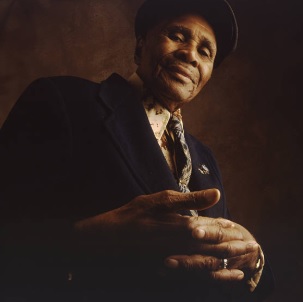 There were times when the pianist fell seriously ill, but
he always defied the odds and returned to action, warbling his trademark Woody
Woodpecker chortle and kicking off one more exultant slow blues as he had done
for the previous half century. He was a recipient of a 1988 National Heritage
Fellowship awarded by the National Endowment for the Arts, which is the United
States government's highest honour in the folk and traditional arts.
There were times when the pianist fell seriously ill, but
he always defied the odds and returned to action, warbling his trademark Woody
Woodpecker chortle and kicking off one more exultant slow blues as he had done
for the previous half century. He was a recipient of a 1988 National Heritage
Fellowship awarded by the National Endowment for the Arts, which is the United
States government's highest honour in the folk and traditional arts.
Finally, after a calamitous fall on the ice coming home
from a gig led to numerous complications, Sunnyland Slim died of kidney failure
in March 1995. He's sorely missed.
(Edited from Wikipedia & All Music) (* other sources
give 1905 & 1907 as birth year)
Here’s a clip from 1969.: Sunnyland Slim - piano; Willie
Dixon - bass; Johnny Shines - gtr; Clifton James - drums

