
Adelaide Louise Hall (20 October 1901 – 7 November 1993) was an American-born UK-based jazz singer and entertainer. Hall's long career spanned more than 70 years from 1921 until her death and she was a major figure in the Harlem Renaissance. Hall entered the Guinness Book of World Records in 2003 as the world's most enduring recording artist having released material over eight consecutive decades.
 Adelaide Louise Hall was born in Brooklyn, New York. Her
family moved across the East River to Harlem, and it was here, among the rich
and fertile renaissance of black culture in the 1920s, that Adelaide nurtured
her dreams of becoming a star. Her first stage role was in 1921 in the chorus
line of the all-black Broadway musical "Shuffle Along", which gave
her a taste of the limelight. The show ran for 504 performances and then went
on tour.
Adelaide Louise Hall was born in Brooklyn, New York. Her
family moved across the East River to Harlem, and it was here, among the rich
and fertile renaissance of black culture in the 1920s, that Adelaide nurtured
her dreams of becoming a star. Her first stage role was in 1921 in the chorus
line of the all-black Broadway musical "Shuffle Along", which gave
her a taste of the limelight. The show ran for 504 performances and then went
on tour.
Her next stint on stage came in 1923, when she was
featured in the all-black Broadway musical "Runnin' Wild." Of her
performance, Variety wrote, " . . . picked from the chorus is Adelaide
Hall, who can be termed a real find. She jazzes a number as Paul Whiteman would
have it done, and her singing of 'Old Fashinoed Love' is a knockout." The
show ran for 213 performances and then went on
 tour. In 1925 she toured Europe
as lead in "The Chocolate Kiddies Revue". She introduced Europe to
the Charleston dance and performed it to Duke Ellington's "Jig Walk"
(the fact is that she was a sensation in Europe before the better known
Josephine Baker--who always gets credited for introducing Europe to the
Charleston--did.
tour. In 1925 she toured Europe
as lead in "The Chocolate Kiddies Revue". She introduced Europe to
the Charleston dance and performed it to Duke Ellington's "Jig Walk"
(the fact is that she was a sensation in Europe before the better known
Josephine Baker--who always gets credited for introducing Europe to the
Charleston--did.
In 1927 she recorded "Creole Love Call" on a
record, backed by the Duke Ellington Orchestra. The record caused a furore
after its release because of its blatantly sexual overtones, but it went on to
sell millions of copies and is still selling. It is widely regarded as

among the most famous and important jazz recordings ever made. It introduced "scat singing" to the general public, and catapulted Adelaide and Ellington to international stardom.

among the most famous and important jazz recordings ever made. It introduced "scat singing" to the general public, and catapulted Adelaide and Ellington to international stardom.
In 1928 she starred (with Bill "Bojangles"
Robinson) in Blackbirds of 1928. It was this revue that made her name, both in
the U.S. and in Europe when the show was taken to Paris. Her performances in it
included the songs "I Can't Give You Anything But Love, Baby",
"Diga Diga Doo", and "I Must Have That Man", which continued
to be audience favourites throughout her career.

She married a British sailor, Bert Hicks, and he started
a nightclub in Paris, France (La Grosse Pomme) for her. After many years
performing in the U.S. and Europe, Hall went to the United Kingdom in 1938 in
order to take a starring role in a musical version of Edgar Wallace's The Sun
Never Sets at the Theatre Royal, Drury Lane. She was so successful, and became
so popular with British audiences, that she stayed, becoming one of the most
popular singers and entertainers of the time. She lived in London from 1938
until her death.
 Hall's career was an almost uninterrupted success. She
made over seventy records for Decca, had her own radio series (the first black
artist to have a long-term contract with the BBC), and appeared on the stage,
in films, and in nightclubs (of which she owned her own, in London and Paris).
In the 1940s, and especially during World War II, she was hugely popular with
both civilian and ENSA audiences, and became one of the highest paid
entertainers in the country (despite the destruction in an air raid of the
London nightclub owned by her and her husband, the Florida Club).
Hall's career was an almost uninterrupted success. She
made over seventy records for Decca, had her own radio series (the first black
artist to have a long-term contract with the BBC), and appeared on the stage,
in films, and in nightclubs (of which she owned her own, in London and Paris).
In the 1940s, and especially during World War II, she was hugely popular with
both civilian and ENSA audiences, and became one of the highest paid
entertainers in the country (despite the destruction in an air raid of the
London nightclub owned by her and her husband, the Florida Club).

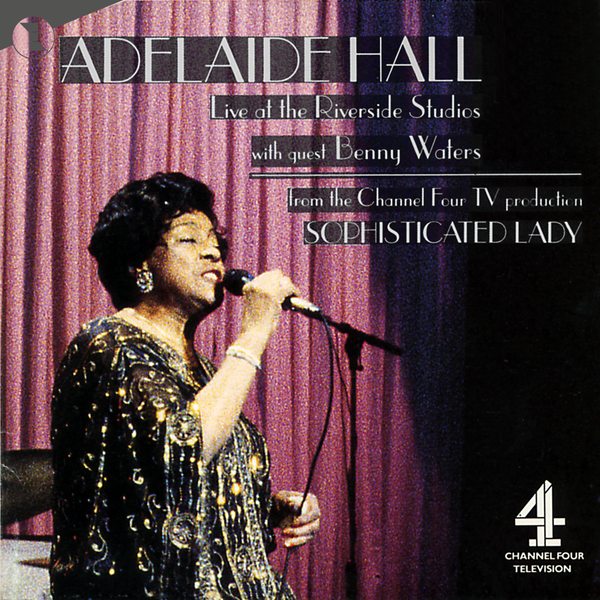 During an extremely long career (since 1991 she has held
the world record as the most enduring recording artist), Hall has performed
with major artists such as Ethel Waters, Josephine Baker, Louis Armstrong, Lena
Horne, Cab Calloway, and Jools Holland, and has recorded as a jazz singer with
Duke Ellington (with whom she made her most famous recording, "Creole Love
Call" in 1927), Fats Waller, and Art Tatum. She appeared in the London run
of Kiss Me, Kate, starred with Lena Horne in Jamaica on Broadway in 1957, and
made two jazz recording with Humphrey Lyttelton in 1969–1970. This was followed
by theatre tours and concert appearances.
During an extremely long career (since 1991 she has held
the world record as the most enduring recording artist), Hall has performed
with major artists such as Ethel Waters, Josephine Baker, Louis Armstrong, Lena
Horne, Cab Calloway, and Jools Holland, and has recorded as a jazz singer with
Duke Ellington (with whom she made her most famous recording, "Creole Love
Call" in 1927), Fats Waller, and Art Tatum. She appeared in the London run
of Kiss Me, Kate, starred with Lena Horne in Jamaica on Broadway in 1957, and
made two jazz recording with Humphrey Lyttelton in 1969–1970. This was followed
by theatre tours and concert appearances.
Without knowing it, just about everybody singing jazz
today is influenced by Adelaide, for she helped create the whole genre,
although perhaps her only direct successor would be someone like Lena Horne
(and they did perform together) or today maybe somebody like Diana Ross.
Adelaide Hall was of the gracious side of jazz, but she was an original. You
can’t say she sounds like anyone else. Even her phrasing swings in a different
way to many later singers, but it swings nevertheless.(info mainly Wikipedia)
(Compiled and edited mainly from Wikipedia & IMDb)

