
Joseph Christopher "Joe" Liggins, Jr. (born
Theodro Elliott; July 9, 1916 – July 26, 1987) was an American R&B, jazz
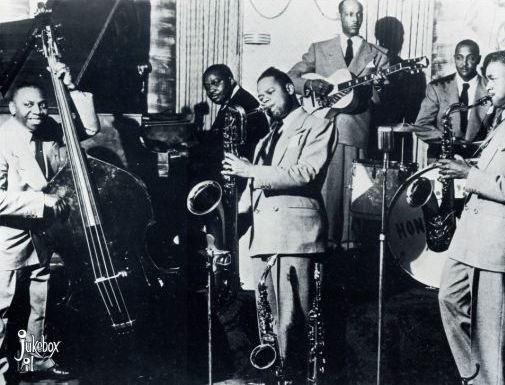
and blues pianist and vocalist who led Joe Liggins and his Honeydrippers in the
1940s and 1950s. His band appeared often on the Billboard magazine charts. The
band's biggest hit was "The Honeydripper", released in 1945. Joe
Liggins was the older brother of R&B  performer Jimmy Liggins.
 performer Jimmy Liggins.
The son of Harriett and Elijah Elliott, he was born in Guthrie,
Oklahoma, and took his stepfather's surname, Liggins, as a child. He apparently
dropped the name Theodro and adopted the names Joseph Christopher during the
1930s. The family moved to San Diego in 1932. He studied music and arranging at
the local State College. He began playing piano, trumpet and drums with various
local bands in 1933.
By 1939 he was ready to move up to Los Angeles and try
his luck.  One of his earliest bands there included future saxophone legend
Illinois Jacquet. While working with Sammy Franklin's California Rhythm
Rascals, Liggins wrote a tune called "The Honeydripper", which would
become his signature song. Reluctance on Franklin's part to record
"Honeydripper" caused Joe to form his own band, the Honeydrippers, in
1944.
One of his earliest bands there included future saxophone legend
Illinois Jacquet. While working with Sammy Franklin's California Rhythm
Rascals, Liggins wrote a tune called "The Honeydripper", which would
become his signature song. Reluctance on Franklin's part to record
"Honeydripper" caused Joe to form his own band, the Honeydrippers, in
1944.
 One of his earliest bands there included future saxophone legend
Illinois Jacquet. While working with Sammy Franklin's California Rhythm
Rascals, Liggins wrote a tune called "The Honeydripper", which would
become his signature song. Reluctance on Franklin's part to record
"Honeydripper" caused Joe to form his own band, the Honeydrippers, in
1944.
One of his earliest bands there included future saxophone legend
Illinois Jacquet. While working with Sammy Franklin's California Rhythm
Rascals, Liggins wrote a tune called "The Honeydripper", which would
become his signature song. Reluctance on Franklin's part to record
"Honeydripper" caused Joe to form his own band, the Honeydrippers, in
1944.
Joe Liggins' Honeydrippers was formed in the basement of
the Los Angeles home of the saxophonist Little Willie Jackson, who co-founded
the group and who, at the time of his death in 2001, was the last original
surviving member of the Honeydrippers.

The band were packing them in with "The Honeydripper"
at the Samba Club in early 1945, when Leon Rene (owner of Exclusive Records)
came to check out what all the fuss was about. He arrived early in the evening,
but Liggins told him that if he wanted to hear "The Honeydripper", he
would have to wait until 11:45, like every night. It was a long song, 15
minutes, and saved for the climax of the show, which had to end at midnight, as
there was still a wartime curfew. Leon did wait and was treated to an evening's
worth of Joe Liggins songs, which made him even more determined to record the
band. "The Honeydripper" was cut down to six minutes, and divided
over two sides of Joe's first release on Exclusive.
night. It was a long song, 15
minutes, and saved for the climax of the show, which had to end at midnight, as
there was still a wartime curfew. Leon did wait and was treated to an evening's
worth of Joe Liggins songs, which made him even more determined to record the
band. "The Honeydripper" was cut down to six minutes, and divided
over two sides of Joe's first release on Exclusive.
 night. It was a long song, 15
minutes, and saved for the climax of the show, which had to end at midnight, as
there was still a wartime curfew. Leon did wait and was treated to an evening's
worth of Joe Liggins songs, which made him even more determined to record the
band. "The Honeydripper" was cut down to six minutes, and divided
over two sides of Joe's first release on Exclusive.
night. It was a long song, 15
minutes, and saved for the climax of the show, which had to end at midnight, as
there was still a wartime curfew. Leon did wait and was treated to an evening's
worth of Joe Liggins songs, which made him even more determined to record the
band. "The Honeydripper" was cut down to six minutes, and divided
over two sides of Joe's first release on Exclusive.
It was a giant hit, reportedly selling 2 million copies,
and topping  the R&B charts for 18 weeks (still a record, jointly with Louis
Jordan's "Choo Choo Ch'Boogie" from 1946). It also crossed over to
the pop charts (# 13), as did the # 2 hit from 1946, "Got A Right To
Cry" (# 12 pop). Other Liggins hits on Exclusive included "Left A
Good Deal In Mobile" (# 2), "Tanya" (# 3), "Blow Mr.
Jackson" (# 3), "Dripper's Blues" (# 9) and "Roll 'Em"
(# 9), all between 1945 and 1948.
the R&B charts for 18 weeks (still a record, jointly with Louis
Jordan's "Choo Choo Ch'Boogie" from 1946). It also crossed over to
the pop charts (# 13), as did the # 2 hit from 1946, "Got A Right To
Cry" (# 12 pop). Other Liggins hits on Exclusive included "Left A
Good Deal In Mobile" (# 2), "Tanya" (# 3), "Blow Mr.
Jackson" (# 3), "Dripper's Blues" (# 9) and "Roll 'Em"
(# 9), all between 1945 and 1948.
 the R&B charts for 18 weeks (still a record, jointly with Louis
Jordan's "Choo Choo Ch'Boogie" from 1946). It also crossed over to
the pop charts (# 13), as did the # 2 hit from 1946, "Got A Right To
Cry" (# 12 pop). Other Liggins hits on Exclusive included "Left A
Good Deal In Mobile" (# 2), "Tanya" (# 3), "Blow Mr.
Jackson" (# 3), "Dripper's Blues" (# 9) and "Roll 'Em"
(# 9), all between 1945 and 1948.
the R&B charts for 18 weeks (still a record, jointly with Louis
Jordan's "Choo Choo Ch'Boogie" from 1946). It also crossed over to
the pop charts (# 13), as did the # 2 hit from 1946, "Got A Right To
Cry" (# 12 pop). Other Liggins hits on Exclusive included "Left A
Good Deal In Mobile" (# 2), "Tanya" (# 3), "Blow Mr.
Jackson" (# 3), "Dripper's Blues" (# 9) and "Roll 'Em"
(# 9), all between 1945 and 1948. masters of Joe's hits for
reissue on Specialty. When he couldn't come to terms with the creditor's
committtee, Rupe signed Liggins to Specialty (Joe's younger brother Jimmy was
already contracted to the label) and had him rerecord several of his Exclusive
tracks. Some say the Specialty remakes of "The Honeydripper" and
"I've Got A Right To Cry" are superior to the original versions and
the condensed 1950 arrangement of "Honeydripper" is now the better
known version.
masters of Joe's hits for
reissue on Specialty. When he couldn't come to terms with the creditor's
committtee, Rupe signed Liggins to Specialty (Joe's younger brother Jimmy was
already contracted to the label) and had him rerecord several of his Exclusive
tracks. Some say the Specialty remakes of "The Honeydripper" and
"I've Got A Right To Cry" are superior to the original versions and
the condensed 1950 arrangement of "Honeydripper" is now the better
known version.
In 1950, Joe had two big hits, "Rag Mop" (# 4
R&B) and "Pink Champagne" (# 1 for 13 weeks, the biggest R&B
record of 1950). Over the next three years, Joe continued to come up with good
songs, good records and solid if unspectacular sellers. But he was unable to
adapt to changing times. By 1954 his records sounded tame compared to the
popular R&B hits of the day and Rupe dropped him.

Subsequent recordings for Mercury, Aladdin, Vita and Dot went nowhere amidst the rock 'n' roll turmoil. Liggins returned to Mercury in 1962, where he cut an album of his old hits along with some new songs aimed at the twist market, alas to no avail. That was his last major label affiliation. Some scattered sides on obscure labels fill out the Joe Liggins discography. He kept his own Honeydrippers working right up until his death, at age 71, on July 31, 1987. The honey never stopped dripping.

Subsequent recordings for Mercury, Aladdin, Vita and Dot went nowhere amidst the rock 'n' roll turmoil. Liggins returned to Mercury in 1962, where he cut an album of his old hits along with some new songs aimed at the twist market, alas to no avail. That was his last major label affiliation. Some scattered sides on obscure labels fill out the Joe Liggins discography. He kept his own Honeydrippers working right up until his death, at age 71, on July 31, 1987. The honey never stopped dripping.
(Info edited mainly from rockabilly.nl)
Here's Joe Liggins & The Honeydrippers performing The Honeydripper Los Angeles 1983.

