Sunday, 27 January 2019

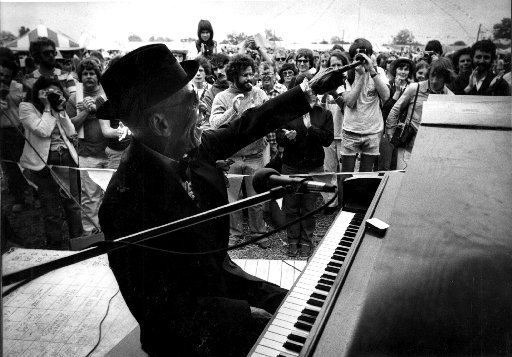
Bobby "Blue" Bland born 27 January 1930


Robert Calvin Bland (né Robert Calvin Brooks; January 27, 1930 – June 23, 2013), known professionally as Bobby "Blue" Bland, was an American blues singer. Bland developed a sound that mixed gospel with the blues and R&B. He was sometimes referred to as the "Lion of the Blues" and as the "Sinatra of the Blues".

Bland was born Robert Calvin Brooks in the small town of Barretville, Tennessee. His father, I.J. Brooks, abandoned the family not long after Robert's birth. Robert later acquired the name "Bland" from his stepfather, Leroy Bridgeforth, who was also called Leroy Bland. With his mother, Bland moved to Memphis in 1947, where he started singing with local gospel groups, including the Miniatures.

In his late teens he hung out in the city with King, the pianist Rosco Gordon and the singer Johnny Ace, an informal musical gang known as the Beale Streeters. Bland released his first single for Duke in 1955. In 1956 he began touring on the chitlin' circuit with Junior Parker in a revue called Blues Consolidated, initially doubling as Parker's valet and driver. He began recording for Duke with the bandleader Bill Harvey and the arranger Joe Scott, asserting his characteristic vocal style and, with Harvey and Scott, beginning to craft the melodic big-band blues singles for which he became famous, often accompanied by the guitarist Wayne Bennett. Unlike many blues musicians, Bland played no instrument.


Melodic big-band blues singles, including "Farther Up the Road" (1957) and "Little Boy Blue" (1958) reached the US R&B Top 10, but Bobby's craft was most clearly heard on a series of early 1960s releases including "Cry Cry Cry", "I Pity The Fool" and the sparkling "Turn On Your Love Light", which became a much-covered standard. Despite credits to the contrary, many such classic works were written by Joe Scott, the artist's bandleader and arranger.

Some of Bland's best work, done under Scott's direction in 1960-63, appeared on the albums Two Steps from the Blues, Here's the Man... and Call on Me, such as the ferocious homily Yield Not to Temptation, the joyous Turn on Your Love Light and a virtuoso reading of the blues standard (Call It) Stormy Monday, featuring a guitar line by Wayne Bennett that has become a blues guitarists' set piece. Occasionally, saccharine songs and lush orchestrations would move Bland rather more than two steps from the blues, but his admirers endured his straying and waited for him to find his way back with poised renderings of strong material such as Blind Man and Black Night.

Bland's records mostly sold on the R&B market and he had 23 Top Ten hits on the Billboard R&B charts and in the 1996 Top R&B book by Joel Whitburn, Bland was rated the #13 all-time best selling artist.

Financial pressures forced the singer to cut his touring band and in 1968 the group broke up. He suffered from depression and became increasingly dependent on alcohol. He stopped drinking in 1971; his record company Duke was sold by owner Don Robey to the larger ABC Records group. This resulted in several successful and critically acclaimed contemporary blues/soul albums including the later "follow-up" in 1977 Reflections in Blue, were all recorded in Los Angeles and featured many of the city's top sessionmen at the time.

Subsequent attempts at adding a disco/Barry White flavour were mostly unsuccessful. In 1985, Bland was signed by Malaco Records, specialists in traditional Southern black music for whom he made a series of albums while continuing to tour and appear at concerts with fellow blues singer B. B. King. The two had collaborated for two albums in the 1970s. Despite occasional age-related ill-health, Bland continues to record new albums for Malaco, perform occasional tours alone, with guitarist/producer Angelo Earl and also with B.B. King, plus appearances at blues and soul festivals worldwide.

Bland continued performing until shortly before his death. He died on June 23, 2013, at his home in Germantown, Tennessee, a suburb of Memphis, after what family members described as "an ongoing illness". He was 83.

Bland was inducted into the Blues Hall of Fame in 1981, the Rock and Roll Hall of Fame in 1992, and the Memphis Music Hall of Fame in 2012. He received the Grammy Lifetime Achievement Award in 1997.The Rock and Roll Hall of Fame described him as "second in stature only to B.B. King as a product of Memphis's Beale Street blues scene"

(Edited from Wikipedia & The Guardian)

Saturday, 26 January 2019

Stephane Grappelli born 26 January 1908


Stéphane Grappelli (26 January 1908 – 1 December 1997) was a French jazz violinist who founded the Quintette du Hot Club de France with guitarist Django Reinhardt. It was one of the first (and arguably the most famous) of all-string jazz bands.

Grappelli was born in Paris, France to Italian parents: his father, marquess Ernesto Grappelli was born in Alatri (Lazio). His mother died when he was four and his father left to fight in World War I. As a result he was sent to an orphanage. Grappelli started his musical career busking on the streets of Paris and Montmartre with a violin. He began playing the violin at age 12, and attended the Conservatoire de Paris studying music theory, between 1924 and 1928.

He continued to busk on the side until he gained fame in Paris as a violin virtuoso. He also worked as a silent film pianist while at the conservatory and played the saxophone and accordion. He called his piano "My Other Love" and released an album of solo piano of the same name. His early fame came playing with the Quintette du Hot Club de France with Django Reinhardt, which disbanded in 1939 due to World War II. In 1940, a little known jazz pianist by the name of George Shearing made his debut as a sideman in Grappelli's band.


After the war he appeared on hundreds of recordings including sessions with Duke Ellington, jazz pianists Oscar Peterson, Michel Petrucciani and Claude Bolling, jazz violinist Jean-Luc Ponty, jazz violinist Stuff Smith, Indian classical violinist L. Subramaniam, 
vibraphonist Gary Burton, pop singer Paul Simon, mandolin player David Grisman, classical violinist Yehudi Menuhin, orchestral conductor André Previn, guitar player Bucky Pizzarelli, guitar player Joe Pass, cello player Yo Yo Ma and many others.

He also collaborated extensively with the British guitarist and graphic designer Diz Disley, recording 13 record albums with him and his trio, and with now renowned British guitarist Martin Taylor. In the 1980s he gave several concerts with the young British cellist Julian Lloyd Webber.

Grappelli made a cameo appearance in the 1978 film King of the Gypsies, along with noted mandolinist David Grisman. Three years later they performed together in concert, which was recorded live and released to critical acclaim. Grappelli's music is played very quietly, almost inaudibly, on Pink Floyd's album Wish You Were Here. The violinist was not credited, according to Roger Waters, in order to avoid "a bit of an insult". A remastered version with Grappelli's contribution fully audible can be found on the 2011 editions of Wish You Were Here.

In January 1994, he celebrated his 86th birthday in concert with Stanley Black at London's Barbican Hall. He made records with several backing groups, played duets with Gary Burton, Earl Hines, Martial Solal, Jean-Luc Pony and many other leading jazzmen. He also ventured into other areas of music and, in addition to the duets with Menuhin, he has recorded with the western swing fiddler, Vassar Clements.

At ease with a repertoire based upon his early career successes, Grappelli's flowing style steadily matured over the years and the occasional uncertainties of his early work with Reinhardt are long forgotten. 

Perhaps at odd moments in his later years he seemed to be coasting, yet some of his recorded performances are very good while several of those from the mid- and late 70s are amongst the most distinguished in the history of jazz violin.

Of particular merit are Parisian Thoroughfare, recorded with the rhythm section of Roland Hanna, George Mraz and Mel Lewis, and a set recorded at the Queen Elizabeth Hall in London in 1973 when he was backed by Disley and Len Skeat. Grappelli's late flowering helped to prompt appreciation of the old tradition of jazz violin playing.

In the 1980s he gave several concerts with British cellist Julian Lloyd Webber. Although sometimes confined to a wheelchair, he continued concert touring into the mid-1990s.

Among his many honours, Grappelli received a Grammy Lifetime Achievement Award, as well as the Ordre National de la Legion d'honneur, France's highest civilian honour. He was also inducted into the Downbeat Jazz Hall of Fame.

Stephan Grappelli died  in Paris on December 1, 1997 after undergoing a hernia operation. He is buried in the city's Père Lachaise Cemetery.


 (Compiled and edited from Wikipedia & Verve Music Group)

Here’s a clip of Stephane Grappelli at the  Warsaw Jazz Festival in 1991 with McCoy Tyner, piano; Jean-Philippe Viret, bass; Mark Fosset, guitar.

Friday, 25 January 2019

Ziggy Talent born 25 January 1912


Ziggy Talent (January 25, 1912 - June 25, 1997) ** was a saxophonist and novelty vocalist who performed with Vaughn Monroe's big band from 1940 to 1953. On stage he'd often go on with just the band's rhythm section while Monroe and the rest of the orchestra would take a break.

Zigmund Talent was born in Boston, Mass. As a child he sang in choirs and in school glee clubs. His voice he claims, has always been strange, always "high, without touching the beauty of a soprano--sort of a cross between milk and sour cream, like buttermilk."

Though you'd never suspect it, zany Ziggy was a bashful child. Once, at a Sunday family gathering, the kind that are part of New England tradition, the elder Talents called upon their young prodigy to sing. Ziggy obliged, he says, but "from behind the door in the next room, where nobody could see. I was only ten, so I guess I can be excused."

Zany Ziggy explains "The Telephone No Ring"
 to an impatient Vaughn as he monopolizes
the only available telephone backstage.
It was at this time that Ziggy got his first saxophone. His brother, Leo, a musician, was playing in a three-piece outfit at a Boston hotel. Leo brought Ziggy along to see the show. "I brought my kazoo with me," reminisces Ziggy, "and while they were doing a number I kazooed along with them. One of the patrons heard me, was curious, and asked Leo about me. Leo told him I was just his kid brother and that I was practicing to be a saxophonist."

Ziggy had no idea at the moment that he would become a saxophonist. But next day, Leo, who had by then become convinced that it might be a good idea, went out and rented an instrument and hired a teacher for his kid brother. "So," cracks Ziggy, "I got a big kazoo with keys, for the small one."

He put his odd, high-pitched and reedy singing voice to good use on several goofy songs over the years, both with Monroe and on his own, including 'Sam, You Made The Pants Too Long', 'The Maharajah of Magador', 'Josephine, Please No Lean On The Bell', and 'Please Say Goodnight To The Guy, Irene'.


"You wouldn't call it singing. You wouldn't call it a voice. It's a freak. It's God's gift to no man." That's how Ziggy answers you when you ask him about his voice. And he's not kidding. Talent knows well enough that he's no Sinatra, Como, or for that matter, Monroe.  Ziggy may not be a crooner, but his following is almost as fanatic as theirs.

Ziggy recorded on Bluebird then RCA Victor with Vaughn Monroe up to 1950 and by himself 1949 – 1950. He then moved to Decca from 1950 – 1955.  In 1962 Ziggy released  an "updated" version of The Maharajah of Magador on ABC Paramount records, but it never quite reached the "Top 100".
And that dear friends is where Ziggy’s trail goes cold. I cannot find any more information regarding Ziggy’s life until June 25, 1997 when he died in Nassau, New York, USA.

**Many sources give January as Ziggy’s birthday, but IMDb give June. They also they spell his name as Ziggie. and his place of birth as Manchester, New Hampshire, USA, (I am unable to confirm which information is correct, so have gone with majority until other confirmed info available)

(Edited from various sources mainly vaughnmonroesociety.org)

Ziggy Talent, accompanied by Vaughn Monroe & His Orchestra, performs the novelty number "I Can't Dance (I Got Ants in My Pants)" from the MGM film "Meet the People" (1944).

Thursday, 24 January 2019

Tuts Washington born 24 January 1921


Isidore "Tuts" Washington (January 24, 1907 – August 5, 1984) was an American blues pianist from New Orleans, Louisiana who was a primary influence on later Crescent City players spanning from Professor Longhair and Allen Toussaint to Fats Domino.

He began teaching himself piano at the age of ten; inspired by the 
itinerant New Orleans musician Joseph Louis "Red" Cayou, Washington amassed a vast repertoire of songs by memorizing performances by area brass bands, then quickly returning home to develop his own renditions.

Recognized as something of a prodigy, Washington -- also known as "Papa Yellow" -- was already the superior of most local barrelhouse pianists by his teen years, and he regularly sat in with prominent Dixieland and society bands; his style brought together an eclectic mix of ragtime, jazz, and blues textures, and despite a general reliance on instrumentals, he was also known to pull the occasionally bawdy vocal number out of his bag of tricks.

After World War II, Washington joined Smiley Lewis in a trio with drummer Herman Seals. Prior to the 1952 breakup, they cut some of the landmark New Orleans R&B sides of the period for Imperial, among them "Tee-Nah-Nah," "The Bells Are Ringing," and "Dirty People."

However, for the most part, Washington considered recording of little consequence, content instead in his standing as the consensus choice as the French Quarter's champion pianist; as a result, he regularly rejected offers to cut solo sides, and in 1950 set out to conquer new territories, relocating to St. Louis to join the Tab Smith Orchestra.


                     Here's "Tee-Nah-Nah" from above album.


He was back in New Orleans by the end of the decade, performing in restaurants in the French Quarter in clubs such as Tipitina's and at the New Orleans Jazz & Heritage Festival. He signed on with the Clyde Kerr Orchestra and added a new pop-oriented dimension to his playing for the sake of tourists. 

He also frequently played on the Mississippi River on the Delta Queen whilst continuing to perform at various musical landmarks in New Orleans such as the Court of Two Sisters Restaurant in the French Quarter, and the piano bar at the Caribbean Room of the Pontchartrain Hotel.

Tuts Washington was a piano playing institution in New Orleans and he is frequently cited as one of the major influences on Fats Domino, Professor Longhair, James Booker, Dr. John, and Allen Toussaint, all of whom respected Washington and acknowledged his contribution to their styles.

He avoided recording for most of his career, but he released the solo piano album New Orleans Piano Professor for Rounder in 1983. A live recording by Washington, Live at Tipitina's '78, was released by Night Train International Records in 1998.


Washington died on August 5, 1984, after having a heart attack while performing at the World's Fair in New Orleans.


(Compiled and edited from Wikipedia, AllMusic, the Blues Trail.com)

Wednesday, 23 January 2019

Eugene Church born 23 January 1938


Eugene Church (January 22, 1938 – April 3, 1993) was an American R&B singer.

Eugene R. Church was born in St. Louis, but was raised in Los Angeles, where his father was pastor at a church at 5th Avenue and West Adams. Around 1955, Eugene became friends with Jesse Belvin, who already had released several records on different 
Church & Belvin
labels. Jesse showed him the finer points of vocal harmony and songwriting. The duo first recorded together in 1956, under the name The Cliques ("Girl In My Dreams", Modern 987).

After a solo single for Specialty in 1957 ("Open Up Your Heart"), Church sang background vocals on such Belvin recordings as "Beware" and "Deacon Dan Tucker". The latter song was the inspiration for Eugene's biggest hit, "Pretty Girls Everywhere", which made the Top 40 (# 36) in 1959. Church claims that the late Tommy "Buster" Williams, another member of Jesse Belvin's inner circle, inspired the song when they were out driving around in Church's car. 

Church with The Turks AKA The Fellows
"There were these pretty women walking up and down the sidewalk, and Buster said, 'Man, look at this, pretty girls everywhere!' I knew right then we had a song title." "Pretty Girls Everywhere" (also a # 6 R&B hit) was his first record for Leon Rene's Class label. Originally intended for Bobby Day, who was not interested, it was credited to "Eugene Church and the Fellows", though the background singers also included the female group The Dreamers.


The house band for Class Records was the Googie Rene Combo, which included the illustrious trio of Plas Johnson (tenor sax), Rene Hall (guitar) and Earl Palmer (drums). Eugene's follow-up Class single, "Miami"/"I Ain't Going For That" also did well (# 14 R&B, # 67 pop) and saw a UK release on London HL 8940, after London 
had inexplicably withheld "Pretty Girls Everywhere" from the UK public. After two more singles for Class and one for Rendezvous (a label also co-owned by Leon Rene), Church moved to the King label in 1961.

The first King single, "Mind Your Own Business" (still with involvement from Messrs Hall, Johnson and Palmer) peaked at # 19 on the R&B charts, but it was to be Eugene's last chart entry. Four further King singles followed in quick succession, produced by Johnny Otis, but sales were very limited.

By 1963, Church (who had relocated to Texas) was ready to join the ministry. Over the next four years he sang nothing but gospel music. In 1967 he recorded one last single ("Dollar Bill") for the World Pacific label, before embarking on a study to become a beautician. Eugene opened his own beauty parlour, from which he made much more money than he had ever seen as a recording artist. 

Church (left) in 1992 with Richard Berry
Still, the attraction of the entertainment business had never disappeared completely, and in the early 1990s, Church returned to Los Angeles, went back to secular music and toured the oldies circuit, which also brought him to Britain. But before he could make a real comeback, Eugene Church died of cancer on April 16, 1993, aged 55. As an innocent victim of the insidious Aids virus, he never lived to see a compilation of his work on either vinyl or CD.

(Compiled and edited mainly from the liner notes of  The Very Best Of Eugene Church by Stuart Colman.)

Monday, 21 January 2019

Bibi Johns born 21 January 1929


Bibi Johns (born Gun Birgit Jonsson, January 21, 1929 in Arboga, Sweden) is a Swedish singer, film actress and artist.

Bibi Johns, the daughter of a haulage contractor, who grew up in the small Swedish town of Arboga, started her musical career at the age of 13, when she won her first singing contest at a Children's Day event.

After finishing school, she applied for an art school to become an advertising artist. In Stockholm she came into contact with the musical show group Vårat gäng , where she debuted in 1946  and then came to tour with for a year and a half. She took singing lessons and toured the homeland as a vocalist with the Swedish jazz bands of Carl-Henrik Norin and later, Thore Swanerud.

Johns travelled to the U.S. in 1951 and secured a recording contract with RCA Victor through Gordon Jenkins where she got her artist name of Bibi Johns. 

She toured the U.S. and was a winner on the television talent show Chance of a Lifetime, then used the prize money to finance her return trip to Sweden. There she met a producer from the German Electrola label who convinced her to cut some German-language recordings for the German market, where "Bella Bimba" and "Gipsy Band" became big hits. She continued to record in Germany and appeared in German movie musicals throughout the '50s


Bibi Johns was the first in the line of Swedish schlagersangerers who made success in Germany, and it is mainly her time in Germany during the 1950s and 60s that gave her fame.

In the early 1960s, she came home to Sweden to tour the public parks and play a revue at Liseberg. At home she now got record successes with songs such as Leka with the fire, the wedding and Bibbi's Bossa Nova.

In the 1970s, Bibi Johns was mostly on television. She moderated her own TV shows like "Do you know Miss Johns", "Too young to be blonde" and "The old wave". During 1970 to 71 she was co-presenter and singer in the 13-part English entertainment series "Rolf Harris Show" at the BBC, London. At home in Sweden, she was the presenter of the Melodifestivalen 1983.

Bibi Johns has also made a career as an artist. In 1975 she started at an art school in Munich and has since had exhibitions in Munich, Cologne, Baden-Baden, Bad Homburg, Hanover and Stuttgart.

Johns was married twice. Once in the 1950s for a short time with an American. Her second husband was the director Michael Pfleghar from 1960 to 1962. Pfleghar was later married to the Danish singer Wencke Myhre. After that, Bibi Johns spent some years with pianist Peter Jaques, with whom she performed together 
in the musical "The Key Carousel". From 1974 to about 1990 the composer Rob Pronk was her life companion and from 1997 to 2010 she lived with the 40 year younger pianist Alex Racic .

Shortly before her 85th birthday Bibi Johns had released another album, a collection of Swedish folk songs.Although she does not sing anymore, music is still the most important thing in her life, said the election Bavarian, who lives in Pullach near Munich, opposite the German Press Agency. Despite being 90 years old, Bibi Jones still drives a car and loves to talk to friends via computer, even in her native Sweden.


(Edited mainly from Wikipedia (translation) & My Hit World @ /www.mdr.de) 

Here's a medley from a 1973 TV show. Songs included are Bella Bimba, Zwei Herzen im Mai and Es ist nur die Liebe.

Sunday, 20 January 2019

Slim Whitman born 20 January 1924


Ottis Dewey Whitman Jr (January 20, 1923 – June 19, 2013), professionally known by stage name Slim Whitman, was an American country music, western music and folk music artist singer-songwriter and instrumentalist known for his yodeling abilities and his smooth, high, three-octave-range falsetto in a style christened as "countrypolitan". He stated that he had sold in excess of 120 million records.

Although once known as "America's Favorite Folk Singer", he was consistently more popular throughout Europe, and in particular the United Kingdom, than in his native America, especially with his covers of pop standards, film songs, love songs, folk tunes, and melodic gospel hymns.
As a child, Slim Whitman (born Ottis Dewey Whitman Jr.) became infatuated with music and learned to yodel listening to Montana Slim and Jimmie Rodgers records. At age 17, he married 15-year-old Geraldine Crist, a preacher's daughter. The newlyweds moved to a 40-acre farm south of Jacksonville, Florida, where Whitman worked as a meat packer. While working in the plant, he suffered an accident and lost two fingers on his left hand. After the accident, he began working in a Tampa shipyard.

During World War II, Whitman served in the U.S. Navy, where he learned to play guitar. Following the war, he returned to the shipyard and also joined a local minor-league baseball team, the Plant City Berries. Whitman remained with the team through 1948, but then began building a singing career at several Tampa radio stations, eventually creating a backup band, the Variety Rhythm Boys.

Slim Whitman got his first big break after Colonel Tom Parker -- who was managing Eddy Arnold at the time -- heard him singing on radio station WFLA. Parker landed a contract with RCA for Whitman by the end of 1948. After reluctantly complying with the label's request to change his first name to "Slim," he released his 
first single, "I'm Casting My Lasso Towards the Sky" -- eventually to become his theme song. He made his national debut on the Mutual Network's Smokey Mountain Hayride in the summer of 1949, and the following year joined The Louisiana Hayride. Despite his national exposure, Whitman's career wasn't making much of an impact, and he was forced to take a job as a part-time mailman.


In the early '50s, he released a cover of Bob Nolan's "Love Song of the Waterfall," which became his breakthrough hit, peaking at number ten on the country charts; the follow-up single, "Indian Love Call," made him a star, peaking at number two on the country 
charts and crossing over into the pop Top Ten. Both sides of his next single -- "Keep It a Secret"/"My Heart Is Broken in Three" -- were also major hits and he continued to have a string of Top Ten hits into the mid-'50s.

In 1955, his title song for the film Rose-Marie became a smash on both sides of the Atlantic; following its success, Whitman joined the Grand Ole Opry, and then went to Britain in 1956 as the first country singer to play the London Palladium. Throughout the late '50s and early '60s, he had a string of British hits, including "Tumbling Tumbleweeds," "Unchain My Heart," and "I'll Take You Home Again Kathleen."

Although he was experiencing great success in the U.K., Whitman's career was in neutral in the U.S. After 1954's "Singing Hills," he had only two Top 40 hits in the course of a decade. In 1965, he bounced back into the country Top Ten with "More Than Yesterday." For the next few years, he had a series of minor country hits, including "Rainbows Are Back in Style" (1968), "Happy Street" (1968), and "Tomorrow Never Comes" (1970). Throughout the early '70s, he continued to have minor hits, but in 1974, he retired from active recording.


In 1979, Whitman filmed a television commercial to support Suffolk Marketing's release of a collection of his greatest hits. On the strength of the commercials, All My Best sold four million records and became the best-selling television-marketed album in history. After its success, the label released Just for You in 1980, 
and The Best in 1982. Between 1980 and 1984, Whitman had a small run of minor hits, highlighted by 1980's number 15 hit "When." In the late '80s, he returned to television-marketed albums, releasing Slim Whitman: Best Loved Favorites in 1989 and 20 Precious Memories in 1991.

During the '90s, Whitman recorded infrequently but continued to tour successfully, particularly in Europe and Australia. His final release, Twilight on the Trail, appeared in 2010, and he died three years later of heart failure at the age of 90.

(Compiled mainly from a bio by Sandra Brennan @ AllMusic)