Tuesday, 9 January 2018

Dick Jurgens born 9 January 1910


Dick Henry Jurgens (January 9, 1910 – October 5, 1995) was an American swing music bandleader and composer who enjoyed great popularity in the late 1930s and early 1940s.

The son of Dietrich Heinrich Jurgens and the former Clara Matilda Erath, Jurgens showed an early interest in music, studying with Henry E. Marvin, Robert Fenton, and Harry Wills. He was dismissed from his high school orchestra for playing popular music and jazz, but that only encouraged him to organize his own dance orchestra, which he first did in 1928 while still in high school. (He always worked closely with his brother, Will Jurgens, who eventually became his personal manager.) 

In 1933, he graduated from Sacramento Junior College (he also attended the University of California at Berkeley) and immediately turned to bandleading full-time, earning his first important engagement at the St. Francis Hotel in San Francisco. He was signed to newly formed Decca Records and had his first recording session on October 22, 1934. Singer Eddy Howard, who would be an important part of Jurgens' band during his 1934-40 tenure with it, first recorded with him on the 1935 Decca single "The Martinique."
 
From the mid-'30s to the early '40s Jurgens held residencies at the Casino Ballroom on Catalina Island, the Elitch Gardens in Denver, the Aragon Ballroom and the Trianon Ballroom in Chicago, and other popular swing venues. He recorded for Vocalion Records in 1938 and for Okeh Records starting in 1940. His first side to reach Your Hit Parade was "It's a Hundred to One You're in Love with Me" in 1939; the following year, "In an Old Dutch Garden" proved to be a big hit. Jurgens often found that Glenn Miller's versions of his hits performed better on the charts than his own, such as the song "Careless". 


Following Howard's departure from the group in 1940, Harry Cool became its lead singer. Jurgens scored more hits later that year, with "A Million Dreams Ago" and the instrumental "Elmer's Tune", the latter of which Miller would take a vocal version to number one. Later hits included "The Bells of San Raquel" and "Happy in Love" (released on Columbia Records). His biggest hit was 1942's "One Dozen Roses", with Buddy Moreno on vocals; the song hit #1 in the summer of that year and was also recorded or performed by Harry James, Glen Gray, Glenn Miller, and Dinah Shore.
 
Arguably, Jurgens was at the peak of his career in mid-1942. Just then, the recording ban by the American Federation of Musicians prevented him from making further recordings, and at the same time, he disbanded and joined the U.S. Marine Corps to participate in World War II. He remained with the service through the end of the war in 1945, serving as musical director for Marine shows.

 
He reorganized his band in 1946 and went back to work, albeit in a musical climate that was less conducive to his kind of musical approach. Nevertheless, he continued recording for Columbia through the early 1950s, later switching to Mercury. From July to September 1948, he had a half-hour weekly radio berth on CBS, the Summer Spotlight Revue. He married Miriam Davidson on December 6, 1948.
 
Dick Jurgens wrote or co-wrote the following songs: "Elmer's Tune", "Careless", "I Won't Be Home Anymore When You Call", "One Dozen Roses", "It's a Hundred To One (I'm in Love)", "I Guess I'll Be On My Way", "If I Knew Then (What I Know Now)", and "Day Dreams Come True At Night".

As the popularity of swing diminished, he continued leading his band until 1956, when he gave it up and started an electronics business in Colorado Springs, CO with his brother, though he continued to perform occasionally at the local Broadmoor Country Club. In 1965, he relocated to California and began to make occasional appearances. By the late '60s he had reformed his band, and he played with it part-time until 1976, even making some new recordings in the early '70s. Then he left the music business again, returning home to Sacramento, where he got into real estate. 

Singer Don Ring bought the rights to the band’s name and library in 1986, and the New Dick Jurgens Orchestra has a permanent residency at Ring’s Park Ponderosa Ballroom in McFarland, Wisconsin.
 
Jurgens died in 1995 of cancer at age 85. (Info edited from Wikipedia & All Music)

Monday, 8 January 2018

Jon Lucien born 8 January 1942


Jon Lucien (January 8, 1942 – August 18, 2007) was a pioneering jazz-soul singer. Dubbed "the man with the golden throat" by Herbie Hancock, Jon Lucien was the premier crooner of the fusion era -- blessed with a deep, velvety voice ideally matched to romantic ballads, his sophisticated amalgam of soul, light jazz, and Caribbean rhythms never enjoyed commercial success commensurate with the esteem afforded him by critics and peers alike.
Born Lucien Harrigan on Tortola in the British Virgin Islands on January 8, 1942, he grew up on the neighbouring island of St. Thomas. An ardent fan of Nat King Cole, as a teen he played bass in Rico and the Rhythmaires, a group led by his father, Eric.

In the mid-'60s he relocated to upstate New York, recording commercial jingles and performing at parties, weddings, and bar mitzvahs. At one such gig he captured the attention of RCA exec Ernie Alshulter, and the label soon extended a contract offer.

Renaming himself Jon Lucien, the singer was also a gifted songwriter, but RCA limited his contributions to his 1970 debut, I Am Now. to just one original, instead insisting he record a series of jazz and pop standards: "The record company was attempting to package me as a sort of 'black Sinatra,'" Lucien recalled decades later. "Once the white women started to swoon at my performances, their attitudes quickly changed." 


Three years in the making, the follow-up, Rashida, consisted solely of Lucien originals. Both the title cut and the bossa nova-inspired single "Lady Love" found some favour with U.S. radio, and the record also earned rapturous critical notice, even earning arranger Dave Grusin a Grammy nomination.  Response from musicians and critics was strong, yet RCA found it difficult to market Lucien, and, after his Mind Game album in 1974 met with similar commercial failure, he shifted to CBS for Song for My Lady in 1975 and Premonition the following year. Disco was now the ruling form of black American popular music and CBS had no more luck than RCA in marketing him.
Lucien was guest vocalist on several jazz albums, including on jazz-rock bassist Alphonso Johnson's Yesterday's Dreams in 1976 and Weather Report's Mr Gone in 1978, but felt despondent at the music industry's failure to advance his career. Cocaine addiction and his daughter's drowning led him to return to the Virgin Islands in the 1980s.

Only in 1982 did he resume his solo career with the Precision label release Romantico. "My frustration stemmed from being asked to be a hit-maker...do disco, country...whatever it takes to sell millions," he later said. "I struggled for the executives to understand my music."

Lucien also suffered personal tragedy in 1980 when his young daughter Zeudi Jacira drowned. He spent much of the decade to follow battling drug addiction, and during the mid-'80s returned to the Virgin Islands, ultimately settling in Puerto Rico.

In the US in 1990, he found his old albums being played on jazz stations. An even greater surprise was discovering British "acid jazz" DJs championing him. He began to release new albums and performed again, his supple baritone in fine shape. In 1996, he suffered a further tragedy when his 17-year-old daughter was killed in a plane crash. This event informed his Endless is Love album in 1997.

His new-found popularity with British audiences meant Lucien started to play dates here, yet he could only ever be away from kidney dialysis for a few days at a time. Lucien issued four more albums on his own Sugar Music label and continued to perform, touring right up until July 2007 with the US Superstars of Jazz Fusion. Health problems plagued him, however, and he died of respiratory failure in Orlando, FL, on August 18, 2007.

(Info compiled & edited from Jason Ankeny @ All Music & Garth Cartwright @ The Guardian)


Sunday, 7 January 2018

Paul Revere born 7 January 1937


Paul Revere (January 7, 1938 - October 4, 2014) was an American musician and organ player. In 1958, he and other musicians founded the group Paul Revere & the Raiders. They recorded many hits. He worked with the group until his death in 2014. Revere was born in Harvard, Nebraska.
Born Paul Revere Dick, his family moved from Harvard, Nebraska to Caldwell, Idaho when he was a small child. As a teen-ager Paul showed an aptitude for business as well as music. Various sources have him owning multiple hamburger restaurants and a barber shop after graduating from Caldwell High School in 1956. At the same time he was he was building a musical career with a band called The Downbeats that played in and around Boise.
After some local success the Downbeats moved to Portland, Ore., in 1960 and with encouragement of their new manager, radio disc jockey Hart, renamed themselves Paul Revere and the Raiders. In 1963 at a Spokane studio recorded one of the all time great party records “Louie-Louie”. While the version recorded by the Kingsmen went on to much greater success, the Raiders version helped them land a contract with Columbia records.
Being an American group during the British Invasion era, become the group's signature sight gag. The group performed a choreographed show in elaborate outfits complete with tri-cornered hats, brightly collared frock coats, white hose and knee-high black leather boots. The Revolutionary War inspired costumes were a tongue-in-cheek retort to the takeover of the music scene by one British act after another.
Although he was a conscientious objector during the Vietnam War, Revere later made it a point to honour veterans at his concerts and supported various charities aimed at helping veterans get a fair shake that he felt many of them didn't get in the post-Vietnam era. He also used his time off the road to put his business acumen to work in several major real estate developments in the Boise area.
The on-stage antics of Revere and his band helped obscure the fact that they were a very talented group with a wide-range of material. In 1964, they signed a contract with Columbia Records as the label's first rock act. Their songbook includes the aforementioned “Louie-Louie”, the hard-rocking anti-drug anthem “Kicks” and the social commentary of “Indian Reservation.” Originally planned as a single release for Raider's lead singer Mark Lindsay, Revere helped turn the song that illustrated the bitterness and despair of Native Americans into a million-seller by jumping on his motorcycle and criss-crossing the country to promote it to anyone who would give it a listen.
 
                                  
Producer Terry Melcher honed the band's hard-edged, guitar-driven sound with Lindsay, the front man, providing the vocals. The blond Revere was content to remain in the background playing organ. "Just Like Me," a 1965 hit written by Revere and Lindsay, made the Rock and Roll Hall of Fame's list of Songs That Shaped Rock and Roll.
Impressed by their high-energy stage shows and comparatively wholesome image in the midst of the Flower Power movement, legendary TV producer Dick Clark signed them up as the house band for several series including “” “Where the Action Is” and “Happening '69” as well as "The Ed Sullivan Show," "The Tonight Show" and as themselves on the "Batman" TV show in 1966.
The band had 20 consecutive hits and reached its peak with John D. Loudermilk's "Indian Reservation" at No. 1 in 1971, but a revolving door of band members and changing musical tastes led to its decline. During the mid-70's the Raiders gradually faded into irrelevancy when it came to the music scene and Revere announced his retirement in 1976 after several years playing state fairs and lounges as a nostalgia act. The retirement was short-lived and Paul Revere and the Raiders toured through the 80's before settling in Branson, Missouri, along with fellow classic rockers, the Righteous Brothers at Dick Clark's American Bandstand Theatre. The Idaho Statesman reports that gig lasted until the mid 2000s.

 
Even after the closing of the Bandstand Theatre, Revere kept up a busy touring schedule with his Raiders until cancer treatments forced him to give up the road and settle back in Garden City, Idaho where he spent his final days. According to a tribute on Paul Revere's website penned by one-time manager Roger Hart, Revere died peacefully at his Garden City home.
(Info compiled and edited mainly from an article by Mike Hennessy| @ AXS.com)

The controversial TV show The Smothers Brothers Comedy Hour provided a perfect setting for Paul Revere & the Raiders in early 1967. Both the Raiders and the Smothers Brothers, (Tom & Dick) were at their zenith. Looking completely sleek, lean and mean in their cool streamlined white tights and hip-length white velvet jackets, tailored to the max, the Raider's showmanship and musical tightness on this version of their hit "Ups and Downs," is unsurpassed by any rock band of their day. Little wonder they were the most visible band of the 60's. Over 750 television airings. "This is America's number #1 show band" according to legendary keyboardist, Paul Shaffer, of the Late Night Letterman show. Band members included: Paul Revere,(keyboard) Mark Lindsay, (vocals) Jim "Harpo" Valley, (Guitar) Mike "Smitty" Smith (Drums) and Phil "Fang" Volk, (Bass Guitar & vocals)


Saturday, 6 January 2018

Earl Scruggs born 6 January 1924


Earl Eugene Scruggs (January 6, 1924 – March 28, 2012) was an American musician noted for popularizing a three-finger banjo picking style, now called "Scruggs style", that is a defining characteristic of bluegrass music. His three-finger style of playing was radically different from the ways the five-string banjo had been historically played. He popularized the instrument in several genres of music and elevated the banjo from its role as a background rhythm instrument, or a comedian's prop, into featured solo status.
The youngest of five, Scruggs was born in rural Cleveland County, North Carolina, and  lived on a farm which he helped tend after his father died. As a teenager, he attended high school in Boiling Springs, North Carolina. With his school, farm work and other chores, his past time became the five-string banjo and he spent every spare moment playing it. He was fascinated with the instrument. He played his father's banjo and one his older brother owned until he was around eleven or twelve years old.


In 1939,Earl began playing with the Morris Brothers (Zeke on mandolin and Wiley and George on guitars) featuring what was known then as “country” music or “hillbilly” music. Don Reno had just left the band as banjoist to soon join Arthur Smith and his Crackerjacks. Earl played with these men for a few months, then quit so that he could take care of his widowed mother at his home in Shelby. He worked for the Lily Mills textile mill near his home until the draft restriction of World War II was lifted. And his mother encouraged him to pursue music as a career.
Scruggs joined Bill Monroe's Blue Grass Boys in late 1945 and devised a picking method in which the thumb and two fingers of the right hand led a breathtaking dance, its leaps and rolls transforming the sound of the rural stringband into an intricately engineered high-performance music. Critics would call him the Segovia of the five-string banjo, the Paganini of bluegrass.


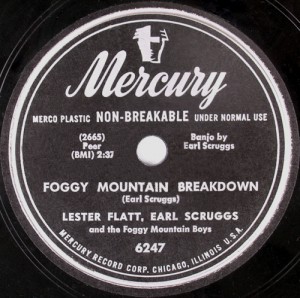
In 1948, Flatt and Scruggs set out on their own, jointly leading the Foggy Mountain Boys  The group made sparkling recordings such as Flint Hill Special, named after Scruggs's home town; Randy Lynn Rag, for his eldest son; Foggy Mountain Breakdown and The Ballad of Jed Clampett, the theme tune of the popular TV show The Beverly Hillbillies and a No 1 on the country chart in 1962.
The instruction book Earl Scruggs and the Five-String Banjo was published in 1968; it went on to sell more than a million copies. But Scruggs became, as he said later, "bored and unhappy doing the same things for over 20 years", and in 1969 he broke with Flatt and formed the Earl Scruggs Revue with his sons Gary and Randy, and later Steve. Their embrace of amplified instruments, drums and repertoire outside the bluegrass canon lost Scruggs some of his original audience, but he found another on the college campuses of the 1970s, and he participated in the Nitty Gritty Dirt Band's 1972 triple LP Will the Circle Be Unbroken, which opened the ears of many rock fans to connections with earlier forms.
Technically gifted (he was also a very fine guitarist) and musically open-minded, Scruggs stepped easily across the borders of genre, and when, in 1975, he celebrated 25 years at Columbia Records with an anniversary album, he was joined by Leonard Cohen, Billy Joel and dozens of other musicians from backgrounds unlike his own.
From the 1980s onwards he played less often, but the awards for his innovation rolled in: election to the Country Music Hall of Fame in 1985, a National Heritage fellowship in 1989, the National medal of arts in 1992. On the album Earl Scruggs and Friends (2001) he remade Foggy Mountain Breakdown, sharing the banjo part with the comedian Steve Martin, and the tune won its second Grammy. In 2008 Scruggs received a Grammy lifetime achievement award.

 
Scruggs' wife and manager Louise Scruggs died on February 2, 2006 at the age of 78 at Nashville, TN's Baptist Hospital following a lengthy illness. Near the end of Earl’s life, home was the place he enjoyed playing most; Scruggs hosted jam sessions at his Nashville house.  At age 88, Earl Scruggs died from natural causes on the morning of March 28, 2012, in a Nashville hospital. He was buried at Spring Hill Cemetery in a private service.
(Info edited mainly from an article by Tony Russell @ The Guardian & Wikipedia)

Friday, 5 January 2018

Anona Winn born 5 January 1904


 Anona Winn MBE (born Anona Edna Wilkins, 5 January 1904 – 2 February 1994) was an Australian-born actress, broadcaster and singer, who spent most of her career in the UK. She will be remembered by the generation who were alive in 'the golden age of radio' (before television was part of everyday life) when millions listened to her intelligent performances in Twenty Questions and Petticoat Line.
She was born in Sydney in 1904 (she was always reluctant to disclose her age), the daughter of David Winn-Wilkins and Lilian (nee Woodgate), and educated at Redland College for Girls in Sydney. She rejected her original plan to become a lawyer and studied for an operatic and concert career at the Sydney Conservatorium of Music and the Albert Street Conservatorium, Melbourne, becoming a pupil of Dame Nellie Melba.
After journalistic work, and singing in The Merry Widow, she came to England in 1927 and appeared in The Blue Mazurka (music by Franz Lehar). That year she opened at the London Hippodrome in a musical comedy, Hit the Deck. When Ivy Tresmand, a leading lady of the time, became ill, she took over the main part. Norman Hackforth (later to become a colleague as the 'mystery voice' on Twenty Questions) met her at this period when she sang his songs. He described her as 'a pretty young Australian soprano'.
The BBC was broadcasting from Savoy Hill and Winn rapidly made her name as a radio artiste, mainly in revues with Harry S. Pepper and Doris Arnold. In 1930 she appeared at the Victoria Palace in her own variety act and in December, at the same theatre, in Chelsea Follies. One year later her name was in lights at the London Palladium and she had made over 300 broadcasts, including a popular series called Songs from the Shows, which started in April 1930.
Anona Winn had already written and composed her own songs; now she worked for films, composing the music for Little Damozel in 1932 and appearing in The Constant Nymph a year later. Radio was becoming increasingly popular and television was only an experimental service until 1936. In the basement of Broadcasting House in the tiny studio known as 'BB', the first television revue was produced in 1933 with Anona Winn backed by a chorus line of the Paramount Victoria Girls. This was on the 30-line (as opposed to today's 625-line) Baird system, using grotesque make-up with blue-black eyes and lips.


In the Thirties Winn also recorded for Rex, HMV, Decca and Columbia such songs as her own 'What More Can I Ask', a popular hit of 1934. Her stage performances included Dandini in the pantomime Cinderella and a record 20 weeks in Peter Pan in 1939. Throughout the Forties she continued her radio work in shows like Variety Bandbox, toured the music halls and variety theatres still existing at that time (including the South Pier at Blackpool in 1944).
In 1947 she added yet another facet to her career as an entertainer in Twenty Questions. This was planned for a six-week run with Stewart Macpherson as chairman and a panel comprising of various celebrities. The show was an enormous success and ran until 1976. Winn astonished listeners with her astute questioning and remained through many changes of panel.
By August 1962 Twenty Questions had made over 500 broadcasts, now with Kenneth Horne as chairman. It was run till 28 July 1976 when the last broadcast had Anona Winn, Isobel Barnett, Penelope Keith and James Burke on the panel with Richard Briers as the mystery voice, Cliff Michelmore as chairman and Bobby Jaye producer.
Although television had attracted many radio personalities and created new ones, Anona Winn preferred radio and (with Ian Messiter) devised a new show called Petticoat Line, first broadcast on 6 January 1965. An original and amusing idea at the time, an all-woman panel discussed listeners' letters dealing the problems and comments on women's views on men. The show ran until 1970. She was awarded MBE (Member of the Order of the British Empire) in the 1954 Queen's Honours List for her services to broadcasting.
 

By the end of the Fifties Winn had business interests outside entertainment and after the run of Petticoat Line she disappeared from the reference books. Ill-health took its toll and even those who had worked with her for years lost touch. She died in Bournemouth aged 90. (Info mainly edited from The Independent)
 

Wednesday, 3 January 2018

Herbie Nichols born 3 January 1919


Herbert Horatio Nichols (3 January 1919 – 12 April 1963) was an American jazz pianist and composer who wrote the jazz standard "Lady Sings the Blues". Obscure during his lifetime, he is now highly regarded by many musicians and critics.
One of jazz's most tragically overlooked geniuses, Herbie Nichols was a highly original piano stylist and a composer of tremendous imagination and eclecticism. He wasn't known widely enough to exert much influence in either department, but his music eventually attracted a rabid cult following, though not quite the wide exposure it deserved.
Nichols was born January 3, 1919, in San Juan Hill, Manhattan in New York City to parents from St. Kitts and Trinidad and grew up in Harlem. He began playing piano at age nine, later studying at C.C.N.Y. His first known work as a musician was with the Royal Barons in 1937, but he did not find performing at Minton's Playhouse a few years later a very happy experience. The competition didn't suit him. However, he did become friends with pianist Thelonious Monk even if his own critical neglect would be more enduring.
After serving in World War II, Nichols played with a number of different groups and was in on the ground floor of the bebop scene.
However, to pay the bills he later focused on Dixieland ensembles; his own music -- a blend of Dixieland, swing, West Indian folk, Monk-like angularity, European classical harmonies via Satie and Bartók, and unorthodox structures -- was simply too unclassifiable and complex to make much sense to jazz audiences of the time. Mary Lou Williams was the first to record a Nichols composition -- "Stennell," retitled "Opus Z," in 1951; yet aside from the song he wrote for Billie Holiday, "Lady Sings the Blues," none of Nichols' work got enough attention to really catch on.
 
 
              Here’s “Lady Sings The Blues” from above album.
                               

Nichols never played standards, or wrote his tunes over their chords, often breaking away from the 32-bar AABA format of Broadway and Tin Pan Alley songwriting, to which even Monk’s compositions clung for comprehensibility’s sake. The drum parts are intricately woven into the music, and Nichols’ solos elliptically paraphrase his melodies rather than blowing through the changes. There is intelligence, passion, and confident iconoclasm in every phrase, but precious little showmanship — either in the music or the man.
He signed with Blue Note and recorded three brilliant piano trio albums from 1955-1956, adding another one for Bethlehem in late 1957. Nichols languished in obscurity after those sessions, though; sadly, just when he was beginning to find a following among several of the new things adventurous, up-and-coming stars, he was stricken with leukaemia and died on April 12, 1963.
Nichols habitually registered scores for new compositions with the Library of Congress, and many have been published or recorded by Roswell Rudd, Frank Kimbrough’s Herbie Nichols Project, and others in the decades since, finally realizing his asymmetrical melodies and expansive formal conceits with the horn sections he had always — and only — heard in his head.
(Info compiled and edited from articles by Steve Huey @ All Music, Franklin Bruno @ hilobrwow.com and Wikipedia)

Monday, 1 January 2018

Teddy Foster born 1 January 1908


Teddy Foster (1908 - 1984) was a much loved British trumpeter and band leader in the 40's.
 
Almost every sideman you meet seems to have played at one time or another in Teddy Foster's band. Teddy Foster himself played trumpet and sang in his husky voice with Billy Cotton, having fronted his first band, The Collegians, in 1929 at Tony's Ballroom in Birmingham when his signature tune was "Collegiate." 
After touring with Billy Cotton he led a small unit "The Kings Of Swing" using "St.Louis Blues" as his opening theme. Teddy Foster formed a 17 piece band in 1945 which enjoyed much success at the Opera House, Covent Garden before moving down the road to the Strand Lyceum.


 In 1945 he was resident at the Casino in Birmingham  and was broadcasting weekly in "Saturday Night  At The Palais." In fact he became one of the most popular touring Palais bands of the 40's and 50's. During the early 50’s Teddy doubled as manager and resident bandleader at the Brighton Aquarium. 


His band was probably the first British band to have an eight piece brass section with five sax, and Foster always sought out the best musicians and arrangements: some were by Roland Shaw who also did some arranging for Ken Mackintosh. 

He gave up band leading in 1960 to form a theatrical agency and
subsequently discovered Julie Rogers, whom he married. Julie Roger’s professional singing career began when she joined the Teddy Foster Band as featured vocalist and she sang for two seasons at the Butlin’s holiday camp at Filey. Also after leaving military service, where he was a singer with the Royal Signals Band, Vince Hill became a singer with Teddy Foster's Band, based in London. 
When the band broke up, Teddy and Julie formed a double act and toured the American bases throughout Europe during the following 18 months. Their style was similar to the Louis Prima and Keely Smith duo that was popular in the States at the time. This, together with Julie’s dance band experience, gave her the foundation for her future solo success. 

Foster was well known in show business circles and through his connections he took Julie to meet acclaimed record producer Johnny Franz. Julie sang ‘Come Rain Or Come Shine’ and Franz immediately signed her to the Mercury label in early 1964 with a five-year contract. Foster gave up his own musical career to 
Teddy presenting prizes at Filey holliday camp.
become Julie’s personal manager as well as all kinds of popular entertainment acts.

Teddy Foster married Julie Rogers in 1968, and they remained a couple until Foster's death on January 5th  1984.
 
(Info compiled and edited from various sources inc Talking Swing: The British Big Bands By Sheila Tracy).