Monday, 23 November 2020

R.L. Burnside born 23 November 1926


R. L. Burnside (November 23, 1926 – September 1, 2005) was an American blues singer, songwriter and guitarist. He played music for much of his life but received little recognition before the early 1990s. In the latter half of that decade, Burnside recorded and toured with Jon Spencer, garnering crossover appeal and introducing his music to a new fan base in the punk and garage rock scenes. 

Robert Lee Burnside was born into a family of Mississippi sharecroppers, received little education and joined his parents picking cotton on plantations at a young age. Moving to Chicago in the late 1940s, where he saw his fellow Mississippi bluesman Muddy Waters play, he was part of the great migration of black Americans from the delta region to northern industrial cities. Two years later, he returned to Mississippi after his father, two brothers and an uncle had been murdered in separate incidents in Chicago. Back in the south, Burnside shot a man who had wanted to run him off his land. He was convicted of murder and sent to Parchman, the notorious Mississippi prison. After serving six months, Burnside was released through the influence of a white plantation foreman. 

He began learning blues guitar, observing his neighbour Mississippi Fred McDowell, who had helped shape the modal rhythm-based techniques of the north Mississippi blues. Burnside continued doing farm work by day and playing at weekends. Then, in 1967, he was recorded by folklorist George Mitchell. This led to the release of the album Mississippi Delta Blues, and Burnside started getting booked for festivals. 

Yet he remained a marginal figure, rarely playing outside his home state. Then, in 1991, his fortunes began to change when he was signed to the fledgling Fat Possum label by Matthew Johnson, then a student at Ole Miss University. Johnson had befriended the journalist and blues scholar Robert Palmer, and Palmer, intent on recording Burnside, encouraged Johnson to start a label. 

Fat Possum took the approach of marketing Burnside to an audience who generally favoured punk rock. If the approach seemed eccentric - Burnside's 1991 Fat Possum debut Bad Luck City initially sold only 700 copies - Johnson's vision was to prove itself: Burnside's raw blues, bleak wit and nihilistic character soon found a large, youth audience. 

In 1992 Palmer was approached by British pop musician Dave Stewart who wanted to produce a documentary about a music scene seemingly unchanged from the 1920s. The resulting film, Deep Blues (named after Palmer's highly regarded book of the same name), helped broaden Burnside's appeal. 


This and Johnson's astute marketing found him playing rock venues across the US, Europe and Japan. Burnside's notoriety reached new levels when the Jon Spencer Blues Explosion joined him to record his 1996 album, A Ass Pocket Of Whiskey, which sold more than 70,000 copies. A surreal form of celebrity began to envelop Burnside: initially championed by Iggy Pop and Bono, he became the most chic black man in white, North American society. Richard Gere hired him to play at his parties, Uma Thurman attended his concerts, Jay McInerney wrote a profile of him for the New Yorker, while Annie Liebowitz took photographs for Vanity Fair. 

Burnside remained indifferent and continued to live in a ramshackle, cockroach-infested house surrounded by the debris of old vehicles. In 1997 Burnside's Mr Wizzard album found him performing uninspired material and gained poor reviews. Conscious of the devaluation of their most popular artist, Fat Possum released Come On In, a 1998 album of remixes of Burnside material. The album sold strongly even if Burnside appeared indifferent to the results. 

He retired from touring at the end of 1999, citing poor health and underwent heart surgery. After a heart attack in 2001, his doctor advised him to stop drinking; Burnside did, but he reported that change left him unable to play.

Another heart attack in November 2002 resulted in a surgery in 2003, and short-circuited any future career plans he had. Yet Burnside continued as guest singer on occasions, such as at Bonnaroo Music Festival, 2004, his last public appearance. He died at St. Francis Hospital in Memphis, Tennessee on September 1, 2005, at the age of 78. 

In 2004 Fat Possum issued A Bothered Mind, which sold well and attracted positive reviews. His songs continued to appear on film and television soundtracks (including The Sopranos) and a documentary film, You See Me Laughin', about Burnside and Fat Possum, was screened at film festivals. For the last decade of his life, Burnside was championed by the international media, earned six figure sums and outsold every other black blues icon except BB King and the late John Lee Hooker. 

Burnside won one W. C. Handy Award in 2000 (Traditional Blues Male Artist of the Year), two in 2002 and one in 2003). He had 11 unsuccessful nominations in 8 years for the awards, starting in 1982, as well as one for a Grammy. Several of the Mississippi Blues Trail markers, which have been erected since 2006, mention him. In 2014 he was inducted to the Blues Hall of Fame in Memphis. 

(Edited from article by Harth Cartwright @ The Guardian & Wikipedia)

Here's a clip of R.L. Burnside at home in Independence, Mississippi, shot by Alan Lomax, Worth Long, and John Bishop in August, 1978.

Sunday, 22 November 2020

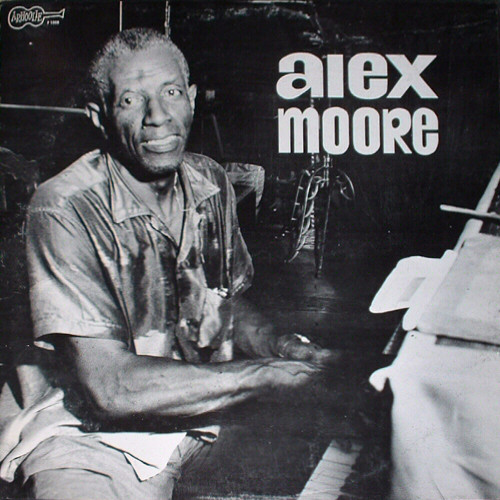
Whistlin' Alex Moore born 22 November 1899

Whistlin' Alex Moore (November 22, 1899 – January 20, 1989) was an American blues pianist, singer and whistler. 

Moore was born Alexander Herman Moore in Dallas, Texas. At the age of three, his family moved to El Paso, Texas but returned to Dallas three years later for his father's job, who was a professional candy maker. Although his family did not own a piano Moore learned the instrument by watching others, including a female cousin, and practicing on instruments he found around town. 

He also learned to play harmonica as a boy, and was a tap dancer and whistler. He took a more serious interest in playing piano in his mid-teens, although he never learned how to read music. In 1915 he performed on Dallas radio station WWR, and continued to play for tips at various social gathering places, including chock-houses (homes or stores where home-brewed alcohol was served) and juke joints in Dallas. 

After his father's death, he dropped out of school to support his mother and two siblings. He had become proficient on the piano before entering the United States Army in 1916. His overall sound during the 1920s combined elements of the blues, ragtime, barrelhouse boogie, and stride. Also in the 1920s he acquired his nickname, based on a whistle he made while playing the piano. 


In 1929, he made his debut recordings for Columbia Records. The records he made did not sell in great quantities, and Moore did not record again until 1937, when a few of his songs were issued by Decca Records. 

However, throughout the 1940s and 1950s, he performed in clubs in Dallas and occasionally other parts of Texas. It was 1951 before Moore recorded again, with RPM Records/Kent after which he was almost forgotten but was rediscovered after Arhoolie Records signed him to a recording contract in 1960, and the subsequent recordings brought him nationwide recognition. 

Although he made recordings he had little interest in the commercial aspect, thus continuing his day job.. Throughout the course of his adult life, his non-musical jobs included hauling gravel, driving mule teams, washing dishes, working as a hotel porter, and as a custodian at office buildings. He retired from the last of those jobs in 1965. 

During the 1960s, Moore played at clubs and festivals in the United States and a few festivals in Europe. He toured with the American Folk Blues Festival in 1969, performing on the same bill as Earl Hooker and Magic Sam. The same year he recorded a session in Stuttgart, Germany, which led to the release of the album Alex Moore in Europe. He did not record again in either the 1970s or 1980s, but he continued to give live performances until his death. He remembered and sang again the blues he had recorded in the 1920s and 1930s, such as "West Texas Woman" and "Blue Bloomer Blues", with their touching and poetic lyrics. 

In 1987, Moore was granted a National Heritage Fellowship by the National Endowment for the Arts, becoming the first African-American Texan to receive such an honour. The year before his death, he recorded the album Wiggle Tail, his final session for Rounder Records. On November 22, 1988, the state of Texas designated his birthday Alex Moore Day. Although Moore played the piano for audiences around the world, he never considered himself a professional musician. 

Moore died of a heart attack on January 20, 1989 in Dallas, aged 89. He never married; he was survived by a son and daughter. He was interred at the Lincoln Memorial Cemetery in Dallas.

Music journalist Tony Russell wrote that "Moore was so odd a performer that some newcomers to the blues have been uncertain whether to take him seriously. By the time he became moderately well-known on the international blues scene of the 1960s and 1970s; his always singular style had burgeoned into florid eccentricity, and he would reminisce tirelessly in a foggy half-shout about youthful high times in his hometown, over skipping blues and boogie-woogie piano patterns with occasional bursts of shrill whistling. 

(Edited from Wikipedia) 

Saturday, 21 November 2020

Claire Austin born 21 November 1913


Claire Austin (November 21, 1918 - June 19, 1994) was an American blues and jazz singer and pianist. 

Claire was born Augusta Johnson in Yakima, Washington to Swedish / American parents in 1918 and moved to Tacoma in 1926, then Seattle in 1931. Her interest in music began early. She studied piano and dancing, and in high school became interested in drama. During her senior years, she sang alto in the school choir and first soprano in her church choir. She wanted to go to the University of Washington, but her father said no. So, with the end of school in June 1936, she thought on singing as a career, and haunted an agent's office until he booked her into The Oasis, a large nightclub on the edge of town. Her parents, who neither drank nor smoked, and had never seen the inside of a night club, were horrified. But Claire persuaded them she could always quit if she didn't like the place. 

The Oasis job lasted six weeks. The house band, led by pianist Gene Smith, was composed of young musicians who were interested in jazz, and with them Claire developed her natural feeling for improvisation. She sang at other clubs in the area for a while, returned to The Oasis for a 21-week stay, then continued singing in various clubs in Washington, Oregon and Northern California. During the early years of World War 2, she met Chuck Austin, who was playing drums in a club in Redding, California. They were married in Reno, and Chuck went into the army soon after. 

For the next few years, Claire worked at clubs in Oakland, Cincinnati, Chicago and Louisville, close by various army camps at which Chuck was stationed. There were difficult times for Claire, trying to be near her husband, caring for her two children, and working to support the family. Finaly, she returned to Seattle, where her folks lived, for the birth of her third child, and to wait for Chuck's release from the army. 

The post-war years of readjustments were not easy either. They moved to Sacramento, and Claire studied accounting, eventually getting a job with the State of California. With work, making a home, and caring for her three children, there was no time for a singing career. It was during this period, in 1947, she first heard a Bessie Smith record and first became interested in the blues as a form for her own singing. In 1947, for Mother's day, Chuck gave her an album of Bessie's records, which she took to playing as she did her housework. 


So matters rested until one day in 1951 when she received a phone call from a friend who told her Turk Murphy's Jazz Band was at The Clayton Club in Sacramento and Turk was looking for a singer. Claire remembers, "I had never heard any music like that before. I sang some blues and later "Cakewalkin' babies". 

Claire with Turk Murphy

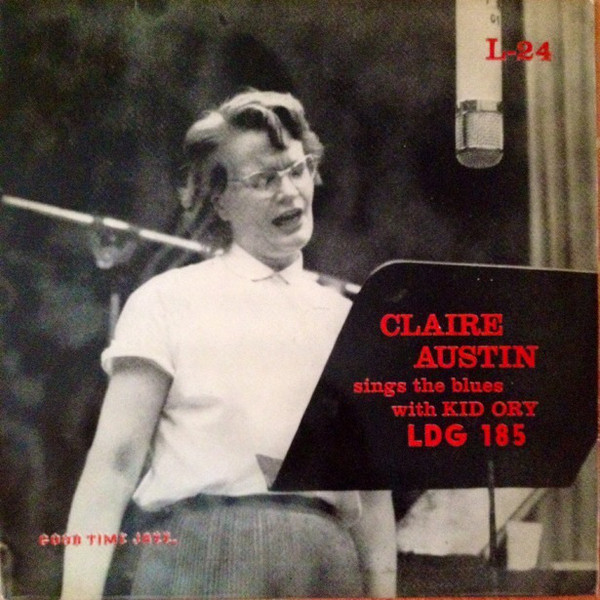
The bartender asked Chuck to sit in, whom he did, and we had an extremely enjoyable evening". She left Turk in 1952, to devote herself to her family, Claire did not appear professionally again  until 1954 for the recording session of the album "Claire Austin sings the blues with Kid Ory". Her next album was “When your lover has gone", after which Claire went back home !

She played in nightclubs throughout the northwest recording again for the GHB label in 1966. She remained active through the 1970s and in 1975  she came back in the studio in Atlanta where she recorded "Memories of you" for George H. Buck who runs the "Audiophile" label in New Orleans. 

She died in Willits, California on 17 June 1994 (aged 75) 

(Edited from bonjourqui.blog & Wikipedia). 

Friday, 20 November 2020

Esquerita born 20 November 1935


Eskew Reeder, Jr. (November 20, 1935 – October 23, 1986), usually known by the stage name Esquerita, and occasionally as S.Q. Reeder or The Magnificent Malochi, was an American R&B singer, songwriter and pianist, known for his frenetic performances. With a 6" pompadour, brocaded shirts, rhinestone shades, and a rhythmic, belligerent style of piano playing, he has been credited with influencing rock and roll pioneer Little Richard. 

A native of Greenville, South Carolina, he was the son of Elizabeth and Eskew Reeder, and attended Sterling High School in Greenville from 1947 to 1950. Though most reliable sources give his birth name as Eskew Reeder, Jr.,some give the name Stephen Quincy Reeder. Although most sources give the year of his birth as 1935, other reliable sources, and his social security records, state 1938. 

He was basically a self-taught pianist, and was accomplished enough to be playing in church by the age of 9 or 10. He spent his early years playing piano in E.W. Watson's Tabernacle Baptist Church. In his late teens, he dropped out of high school to join a gospel group based out of New York called the Heavenly Echoes, with whom he appeared on their Baton Records single "Didn't It Rain" in 1953. 

Returning to Greenville after the breakup of the Heavenly Echoes, Esquerita established himself as the house rock and roller at the Owl Club on Washington Street under the moniker "Professor Eskew Reeder". It was there that he was 'discovered' by Gene Vincent's rhythm guitarist Paul Peek. Reeder's first solo studio recordings came about when Paul Peek got him to record some demos at a Greenville radio station (WESC) around 1958. 

Paul Peek's influence and contacts with Capitol Records helped gain Reeder a record contract. Cub Koda described the results as "some of the most untamed and unabashed sides ever issued by a major label." At this point, Eskew Reeder, Jr. adopted the stage name Esquerita.

A backing band was put together, including Tony White on bass, Vincent Mosley on guitar, Ricardo Young on drums, and a backing-vocal group from Atlanta called the Gardenias. As Esquerita, he often wore heavy makeup, sunglasses, and two wigs, piling his pompadour high on his head. As a gesture of gratitude to Paul Peek for helping to get his career on track, Esquerita wrote "The Rock Around", which became Peek's first solo single for the NRC label. Esquerita played piano behind Peek on both sides of the 45. 


The ensuing years found Reeder cutting several singles with various backing musicians in studios in Nashville, Dallas, New Orleans and Detroit. Capitol Records released the LP Esquerita in 1959, his only album in the traditional sense (that is, not a compilation of earlier singles, or re-issues).

Some of the musicians he recorded with during this era included Jimi Hendrix, Dr. John, Allen Toussaint, and The Jordanaires (Elvis Presley's backup singers). His best known songs from this time include: "Hey Miss Lucy", "Get Back Baby", "Getting’ Plenty of Lovin’", "Rockin’ the Joint", and "Oh Baby". In 1963, he recorded a session for Berry Gordy's Motown Records but those recordings were never released. 

In 1968, Reeder changed his name to The Magnificent Malochi and signed with Brunswick Records. He played keyboards on "Takin' Care Of Business" by John Hammond in 1970. Shortly after this, he began to fade from the music scene, but Linda Hopkins released a song written by Reeder called "Seven Days and Seven Nights" in 1973. Around this time, Esquerita formed a new group, consisting of Charles Neville (the saxophone player of The Neville Brothers) who then resided in Brooklyn, New York, and drummer Jerry Katz of Queens, New York. They and a few other musicians played a steady gig at Tommy Smalls Night Club on 50th Street and 8th Avenue in New York City. Several months later the group disbanded. 

According to an interview with Billy Miller and Miriam Linna in the ReSearch book Incredibly Strange Music, Reeder occasionally performed at African-American gay clubs under the name Fabulash during the 1970s. He was eventually tracked down by a writer for Kicks Magazine in 1983 or 1984, who found him performing in second-rate New York City clubs. According to an article ("Who Was Esquerita?") by music historian Johnny Carter in an international oldies magazine, music maven Bill Lowery (who originated National Recording Corporation and was involved in the Peek sessions for NRC) was approached by Esquerita on the street in New York in 1985 after a conference at Broadcast Music, Inc.. Lowery confirmed that Esquerita was down on his luck and was working as a parking lot attendant but was still as flamboyant as ever. 

A few months before his death, he was seen washing car windshields for tips at an intersection in Brooklyn. Esquerita's father, Eskew Reeder Sr., said that his son had died in Harlem Hospital, New York, from complications brought on by AIDS  on 23 Octber 1986. He was buried in a paupers grave on Hart Island, New York. Esquerita's father (who was born on March 25, 1907) died in February 1989, a little over two years after his son's death. Eskew Sr.'s last known residence was Simpsonville, South Carolina. 

(Edited from Wikipedia and various album liner notes)

Thursday, 19 November 2020

Sam Trippe born 19 November 1923


Sam Trippe (born Nov. 19 1923, Endicott, NY, USA. d. Nov. 19 1959, Los Angeles, CA, USA), was a New York big band leader for a very brief time in the late 50's. 

Samuel Tripiccio grew up near Rochester, N.Y. He married Dorothy Mae Haus in 1945 and lived in the village of Endicott, N.Y. 

Sam & Family

According to a 1946 ad in the Rochester Democrat and Chronicle, Trippe played jam sessions with drummer Jimmy Antonelli at the Casablanca on Endicott's Main Street. Later that year Trippe and his wife along with Trippe's parents decided to move to Los Angeles. It's unclear why they relocated or what Trippe did while out three. Some speculate that he was probably offered a well-paying band job for live television shows in L.A. 

In 1958, Trippe formed a big band, which appeared on L.A.'s channel 2 during a U.S. Marine Corps musician’s variety show. The show, Dress Blues, was hosted by Lt. Bob Osterberg, who introduced singer Pam Garner backed by Trippe's orchestra. In May 1959, Trippe appeared on TV's channel 5 fronting a 17-piece band on a show called Larry Finley's Strictly Informal. 


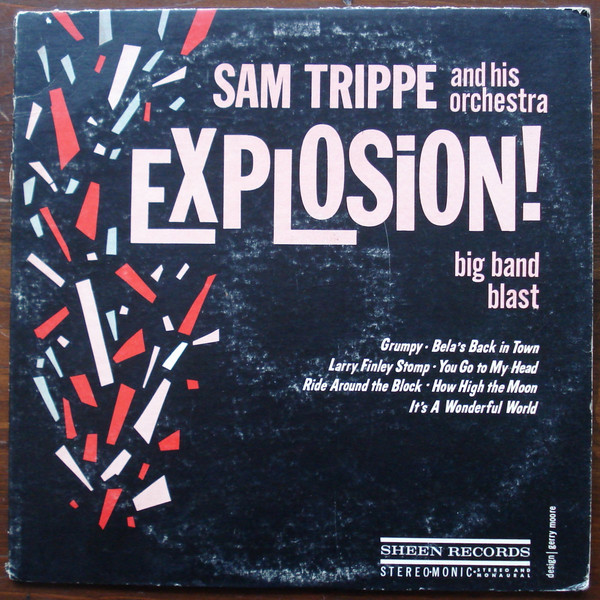
On June 3, 1959, Trippe recorded his first album with the band for the Sheen label, which was based in Monrovia, Ca. The album was Explosion! It was to be the start for a new promising band, formed by the young trumpeter Sam Trippe and his musician friends. "Sam Trippe and his Jazz Orchestra" had among its members Bill Smiley and Ray Caton.  In this time of general disinterest in big bands Trippe found the help of two unselfish fans, who put all their money into the production of this album. Sadly, he would never hear the recording when it was released late that year. 

One week after the recordings Sam Trippe, his wife Dorothy and his three children met with an accident on the Freeway. His youngest daughter Angele was the only one to survive. Suddenly all the hopes and expectations put into the band were ruined, the album was not released (until the following year), both producers lost their money and the orchestra broke up. The Trippes were heading home to the La Puente section of the city when their car was struck by Vincent Eria, who was heading toward downtown L.A. A second car driven by Richard Conger, 38, smashed into the rear of Trippe's car after it was stopped cold by Eria's vehicle. 

On November 6, the Binghamton Press in New York picked up an Associated Press article reporting that four children were in the car. Three were the Trippes' children and the fourth was a friend of theirs. At the time, AP reported that Rosalia, 12, suffered light injuries, Frank, 14, was in fair condition with cuts, bruise and shock, while Angele 10, was in fair condition with a fractured right leg and internal injuries. 

Frank Trippe's friend, Donald, 14, of La Puente, was listed in critical condition with a depressed skull fracture. Upon release from the hospital, Rosalia went to the La Puente home of her paternal grandfather, Frank. One can assume the other two Trippe children did the same when they were released. It's unclear whether Frank's friend, Donald, survived. The Los Angeles Times reported that after the accident, Eria was booked on suspicion of manslaughter. 

Trippes friends and colleagues paid Sam their last tribute in a big "In Memorium Dance" at the Hollywood Palladium. The proceeds of the dance went as a stipend to Trippe's daughter and were used to pay the hospital bills. 

Sam had many friends, his music and friendship were always valid and are best summed up in the words "Many lived longer, but few lived more". He literally gave his life for his music- he was on his way home from the last editing session for the album when he died. And he was so certain he had the "greatest band in the world". 

(Info edited from jazzwax and album sleeve notes by Hans J. Mauerer)

Wednesday, 18 November 2020

Claude Williamson born 18 November 1926

Claude Berkeley Williamson (November 18, 1926 – July 16, 2016) was an American jazz pianist known for his daring, centipede-like speed on the keyboard along with sinewy improvisational lines. 

Claude was born in Brattleboro, Vermont and was exposed early to jazz through his father, a drummer who led a territory band in the New England states. Despite his father's background in jazz and dance bands, Claude's studies focused on classical music from the start. He began piano lessons at age seven. By the age of 14 he played piano in the territory band led by his father. It toured the southern part of the state between 1940 and 1944. In 1945 after which Claude began full-time musical studies at the New England Conservatory of Music. 

In contrast to these highbrow surroundings, Williamson knew from the start that he wanted to make his career as a jazz musician. Sam Saxe, Williamson's teacher, was a somewhat unorthodox conservatory teacher for the 1940’s. In addition to emphasizing the mastery of keyboard fundamentals, Saxe gave Claude transcriptions of Art Tatum piano figures to be practiced in all twelve keys. 

In late 1946, Saxe moved to Southern California, and in February 1947, Williamson followed, not only to continue his studies but also to take advantage of the growing musical opportunities Saxe promised on the West Coast. To earn money over the six-month period before receiving his Los Angeles musician's union card, Williamson played gigs where he met other key musicians who would become instrumental in his career in the 1950s

Immediately after joining the union, Williamson became pianist for the Charlie Barnet band. Barnet's ensemble was evolving into a more bop-oriented band, much like the Woody Herman Herd of the same era. Like other young musicians then joining the band Williamson was increasingly drawn to the modern jazz idiom. During the two years he remained with Barnet, his piano style evolved from its swing era roots in Teddy Wilson and Jess Stacy to a more contemporary approach rooted in the innovations of Bud Powell. His best-known work with Barnet was his piano feature on "Claude Reigns" (a punning reference to both Williamson's keyboard prowess and Hollywood actor Claude Raines). 


 After leaving Barnet in December 1949, Williamson served as musical director for June Christy. Between 1950 and '51, Williamson was June Christy's accompanist, appearing on her recording of A Mile Down the Highway in 1950 and on the Snader Telescriptions that same year with the Ernie Felice Quartet. From 1951 to 1953, Williamson served in the Army in the Pacific. When he returned, he took over Russ Freeman's chair as the house pianist at Howard Rumsey's Lighthouse in Hermosa Beach. While employed at the Lighthouse, Williamson played with virtually all of the major musicians who would come to dominate the West Coast jazz scene. 

In 1955, Williamson left to join the Bud Shank Quartet, which toured overseas. In addition to his work at the Lighthouse, Williamson was an in-demand jazz studio player, recording with Dave Pell, Chet Baker, Pete Rugolo, the Lighthouse All-Stars and many other headliners. Throughout the '50s, Williamson recorded steadily, at times reaching four studio sessions a month. In the late 1950s and early '60s, he was featured on several leadership albums. 

His recording activity slowed in the 1960s and early '70s as his television work in Los Angeles picked up. He worked on a range of TV variety shows as a conductor, composer and arranger, notably on the Andy Williams Show and the Sonny and Cher, and Donny and Marie shows. In 1978, Williamson went back to the jazz world and released many albums, mainly for Japanese labels, often accompanied by Sam Jones and Roy Haynes. His studio recording pace slowed even further in the 1980s and '90s, with his last known album, 52nd St. Revisited, being recorded in February 1996. 

The craze for L.A. cool jazz came and went and came and went again. In his later years, Williamson suffered illnesses and frailty, yet during 2013 he agreed to appear at a jazz reunion. He was so weak he barely made it to the venue. Then, on stage, at the age of 87, he played. “It was amazing,” his son recalled. “I’m so glad I was there.”

The performance recalled his old style, which was “seamless,” his son said. “It flowed.” After a bad fall in February 2015, Claude broke a hip and never fully recovered. He had hospice care for about a year before he died on July 16, 2016 at the age of 89. 

Overall, Williamson, along with Hampton Hawes, infused West Coast jazz with a pure bebop feel. But Williamson also could stretch out on songs with a breathtaking, graceful technique that was all his own. As a sideman, musicians such as Bud Shank favoured Williamson's driving piano while singers such as Christy favoured Williamson's classy swinging feel and hip chord voicings. Williamson was perhaps the last link to Hollywood's jazz scene at the dawn of the LP.   (Edited from Jazzwax, Jazz Research & LA Times) 

Here's June Christy in 1950 singing Taking a Chance on Love, with the Ernie Felice Quartet and Claude Williamson on piano.

Tuesday, 17 November 2020

Samantha Jones born 17 November 1943


Samantha Jones (real name Jean Owen) (born November 17, 1943) is an English singer and entertainer from Liverpool, whose career in show business spanned the mid-1960s through the early 1980s. Her recordings experienced a revival in the 1990s-2000s among devotees of English girl-group pop. She won the Sopot International Song Festival in 1971. 
Jean Owen; Frances Lea; Maureen Kennedy

After taking part in a singing contest in 1961, Jean Owen was offered a job with the Ivor Kirchen Band. However, she also applied for a part in the Vernons Girls, a group set up, at least in part, to promote the football pools by circumventing laws banning the advertising of gambling. Despite joining several years after the other members, when a decision was taken to trim the group from 16 to just three singers, Jean, as she was still known, was asked to stay on. The Vernons Girls enjoyed a couple of top 40 hits, including "Lover Please", "Only You Can Do It," (also released by Françoise Hardy) and recorded one of the first Beatles tribute songs, "We Love The Beatles". They also opened for The Beatles several times and appeared with them in a 1964 TV special, Around The Beatles. 

In 1964, with the help of producer Charles Blackwell, Owen embarked on a solo career and signed with the international record label United Artists, who gave her the stage name Samantha Jones. Her first TV performance as a solo performer was a duet with Long John Baldry on 20 November 1964, with whom she had also duetted in Around the Beatles while a member of the Vernons Girls. She released several unsuccessful 45s (amongst them "Surrounded by a Ray of Sunshine," later a staple on the Northern soul circuit). Two of Jones' songs were covered by Françoise Hardy and released on the LP known as L'Amitié. 


In 1965 she took part in the Venice ''Mostra Internazionale di Musica Leggera'' with song ''Un uomo forte non si arrende''. In 1967, two of Samantha Jones's performances were included in the soundtrack of the film The Vengeance of Fu Manchu. Her first album Call It Samantha was released in US only in 1968. 

Jones switched to UK label Penny Farthing in 1969 and recorded her second album A Girl Named Sam with the producer Mark Wirtz. The performance of one of the tracks, the chugging "Today (Without You)" brought Samantha Jones the Grand Prix of the Radio-Télé Luxembourg in October 1969 and charted in Belgium and the Netherlands. A year later, Jones won the music festival held in Knokke-Heist with a version of "My Way", which subsequently reached No. 4 on the Dutch charts. In 1988, the track was included in the compilation album World Stars – 28 Greatest Artists of the World.

On 15 July 1970, Samantha Jones made a guest appearance on The Morecambe & Wise Show, performing "You've Got Your Troubles". She also issued a duet with Kris Ife, Feelin’ better, under the name Krimson Kake. Later that year, she released her third LP The Other Jones. Samantha Jones appeared on the edition of 5 June 1971 of Disco aired in West Germany on the ZDF network. 

Her success in continental Europe continued with winning the 1st prize in the Sopot International Song Festival held in 26–29 August 1971 in Poland. In 1973, she recorded the song "Man Is a Hunter" for the film Commuter Husbands. After that, she switched labels again, this time to EMI, and released two albums with the veteran producer Walter J. Ridley. 

By then, Jones had become a known cabaret act and performed on cruise ships including the Queen Elizabeth 2. All the while, Samantha Jones sang on numerous BBC radio shows. In 1982, the Dutch label Dureco released the album Goin' Places. She stopped singing in 1986 and became a producer placing numerous musical production shows on cruise lines until she sold her interest in the mid-1990s. 

In 1986 she became close to showbiz accountant Jose Goumal (who had been her professional adviser since 1970), they moved in together and married in 1998. Today, Jean Owen lives with her husband in London and Henley-on-Thames. 

Even though her records were released worldwide, well written and beautifully produced, they never achieved the hit status they deserved.  (Edited mainly from Wikipedia)