Saturday, 15 October 2016

Mickey Baker born 15 October 1925


MacHouston Baker (October 15, 1925 – November 27, 2012), known as Mickey Baker and Mickey "Guitar" Baker, was an American guitarist. He is widely held to be a critical force in the

bridging of rhythm and blues and rock and roll, along with Bo Diddley, Ike Turner, and Chuck Berry.
Baker was born in Louisville, Kentucky. His mother was black, and his father, whom he had never met, was believed to be white. In 1936, at the age of 11, Baker was put into an orphanage. He ran away frequently, and had to be retrieved by the staff from St. Louis, New York City, Chicago, and Pittsburgh. Eventually the orphanage quit looking for him, and at the age of 16 he stayed in New York City. He found work as a labourer and then a dishwasher. But after hanging out in the pool halls of 26th Street, he gave up work to become a full-time pool shark.
At 19, Baker decided to make a change in his life. He went back to dishwashing, and was determined to become a jazz musician. The trumpet was his first choice for an instrument, but with only $14 saved up, he could not find a pawnshop with anything but guitars for that price.
He enrolled at The New York School of Music, but found the learning pace too slow. He dropped out and resolved to teach himself, but gave up shortly afterwards. Six months later he met a street guitarist who inspired him to start playing again. He continued taking private lessons from different teachers over the next few years. His musical style was influenced by saxophonist Charlie Parker.
By 1949, Baker had his own combo, and a few paying jobs. He decided to move west, but found that audiences there were not receptive to progressive jazz music. Baker was stranded without work in California when he saw a show by blues guitarist Pee Wee Crayton. Baker said of the encounter: He found a few jobs in Richmond, California, and made enough money to return to New York.
After returning east, Baker began recording for Savoy, King and Atlantic Records. He did sessions with Doc Pomus, The Drifters, Ray Charles, Ivory Joe Hunter, Ruth Brown, Big Joe Turner, Louis Jordan, Coleman Hawkins, and numerous other artists. During this time, Baker (along with either Paramour Crampton or Connie Kay on drums, Sam "The Man" Taylor on tenor, and Lloyd Trotman on bass) played on numerous hit records on the Atlantic, Savoy, and King labels.
Inspired by the success of Les Paul & Mary Ford, he formed the pop duo Mickey & Sylvia (with Sylvia Robinson, one of his guitar students) in the mid-1950s. Together, they had a hit single with "Love Is Strange" in 1956. The duo split up in the late 1950s, but sporadically worked together on additional tracks until the mid-1960s.
 
             Here's "Old Devil Moon" rec. 1959 from above EP
 

  It was around this time that he moved to France, where he worked with Ronnie Bird and Chantal Goya and made a few solo records. He would remain in France for the rest of his life. Up until the end of his life, Baker was rarely without work. Baker appeared at the 1975 version of the Roskilde Festival.
Because Baker revealed very few details about his private life, reasons for his move to France were never made completely clear. Some media sources claimed that Baker had grown tired of the business aspects of the commercial music industry in the United States, while others stated that the bi-racial Baker was angered by the growing rate of hate crimes in the southern United States during the burgeoning civil rights movement.
In 1999 Baker received a Pioneer Award from the Rhythm and Blues Foundation. In 2003 he was listed at #53 on Rolling Stone's "100 Greatest Guitarists of All Time". His self-tuition method book series, the Complete Course in Jazz Guitar is a mainstay for introducing students of guitar to the world of jazz. They have remained in print for over 50 years.
Baker was married six times. Among his wives were Barbara Castellano from the mid-1950s to the mid-70s, and Marie France-Drei, a singer with whom he stayed from the early 1980s until his death.
Baker died on November 27, 2012 near Toulouse, France, aged 87. His wife, Marie, said he died of heart and kidney failure. (Info edited from Wikipedia)

Friday, 14 October 2016

Bill Justis born 14 October 1926


William Everett "Bill" Justis, Jr. (October 14, 1926 – July 15, 1982) was an American pioneer rock and roll musician, composer, and musical arranger, best known for his 1957 Grammy Hall of Fame song, "Raunchy." As a songwriter, he was also often credited as Bill Everette.
Justis was born in Birmingham, Alabama but grew up in Memphis, Tennessee. His mother was a concert pianist, who encouraged him into music, which he studied  at Christian Brothers College (high school department) and Tulane University in New Orleans, Louisiana. After graduation, Justis started playing trumpet in jazz and dance bands in Memphis, and took up the saxophone around 1955.
He was eventually taken on by Sam Phillips at Sun Records where he recorded music for himself as well as arranged the music for Sun artists. At 30, Justis was a good decade older than most of Sun's artists and had little interest in rock & roll until he learned just how lucrative the music had become. With guitarist Sid Manker, Justis composed a wild, primitive instrumental they dubbed "Backwoods"; Phillips renamed the tune "Raunchy," releasing it as a single in November 1957. Although Justis' honking tenor sax assumed centre stage, what made "Raunchy" so unique was Manker's guitar; he forged the song's distinctive riff not from the traditional middle strings but from the bass strings, creating a cavernous, resonant sound further buffered by studio echo.
 
                                   
Released in November 1957, his song "Raunchy" was the first rock and roll instrumental hit, and its popularity was such that it reached #2 on the American Billboard chart by 3 different artists (Ernie Freeman for Imperial, and Billy Vaughn on Dot). It reached #11 in the UK Singles Chart. It sold over one million copies, and was awarded a gold disc.
Justis would nevertheless score only more chart hit, "College Man," which only went as high as number 42. He continued recording the occasional single (including "Flea Circus," penned by Steve Cropper), but by and large focused the remainder of his career on studio work, arranging sessions for Jerry Lee Lewis, Johnny Cash, and Roy Orbison. Justis also discovered Charlie Rich at Memphis night spot The Sharecropper Club and brought him to Sun in 1960, arranging Rich's first major hit, "Lonely Weekends."
However, squabbles with Phillips prompted Justis to leave Sun soon after, and he formed his own label, the short-lived Play Me Records. In 1961 after moving to Nashville and briefly reuniting with Rich at RCA. By 1963 he was with Monument Records, another significant southern label, where he produced hits by vocal group the Dixiebelles. Kenny Rogers was among those for whom he later wrote arrangements. He then landed with Mercury which remained his home for the remainder of his career.
In the years to follow, Justis would arrange records for everyone from Patsy Cline to Dean Martin to Tom Jones, also recording a series of instrumental LPs for Mercury's Smash subsidiary. He played saxophone on the soundtrack for the 1964 Elvis Presley film, Kissin' Cousins and that same year took over as manager of the singing group, Ronny & the Daytonas.
Justis had a number one hit in Australia in 1963 with "Tamoure". The song did not chart on the Billboard Hot 100. In the early 1960s he produced a successful series of instrumental albums on the Smash label (Alley Cat/Green Onions and Telstar/The Lonely Bull). Justis was credited by Ray Stevens in the TNN special, The Life and Times of Ray Stevens, for giving him the phrase "gitarzan", which became a million selling hit for Stevens in 1969.
Justis also wrote the scores for several films including Dear Dead Delilah (1972), Smokey and the Bandit (1977), Hooper (1978), The Villain (1979), and Island Claws (1980).
Justis died of cancer in Nashville in 1982, at the age of 55. The huge crowd that attended his funeral attested to the respect in which he was held. He was interred in the Memorial Park Cemetery in Memphis. (Info mainly edited from Wikipedia & All Music)

Wednesday, 12 October 2016

Nappy Brown born 12 October 1929


Napoleon Brown Goodson Culp (October 12, 1929 – September 20, 2008) better known by his stage name Nappy Brown, was an American R&B singer. His hits include the 1955 Billboard chart #2, "Don't Be Angry" and "Night Time Is the Right Time". His style is instantly recognizable; Brown used a wide vibrato, melisma, and distinctive extra syllables.
Brown was the son of Kathryn Culp and Sammie Lee Brown. After his mother died he was brought up by Fred and Maggie Culp. They attended Gethsemane AME Zion Church and he attended school in Charlotte, North Carolina.
He began his career singing gospel music before switching to R&B. In 1954 he won a recording contract with Savoy Records, which yielded a series of hits, including "Don't Be Angry" (#2 R&B, #25 pop, 1955), "Pitter Patter" (#10 R&B, 1955). Brown was among the biggest stars in R&B, frequently touring with the revues of Alan Freed.


His songs, along with those of his peers and contemporaries (such as Little Richard, Chuck Berry, and Fats Domino), were among the first wave of African-American pop music to become noticed and popular with white audiences.


“Nappy” Brown, Junior Parker, Elvis, Bobby “Blue” Bland
Elvis Presley reportedly used to see Brown perform whenever he appeared in Memphis. In addition to Brown's influence on blues music, and 1950s R&B and pop, Brown's powerful and protean voice, combined with his distinctive emotive style, is widely viewed as a key link in the development of soul music.
The pop-tinged “It Don’t Hurt No More” restored Nappy to the R&B charts in 1958, and he repeated the feat with the powerful “I Cried Like A Baby” the next year. But rock and roll had softened significantly, soul was still in its infancy, and most of Brown’s spectacular Savoy offerings failed to find a substantial audience. Nappy remained with the company through 1962 before largely disappearing from public view apart from an obscure ‘69 album for the equally unknown Elephant label.
In the early 1980s, a renewed interest in R&B led to some of Brown's early songs being released on European albums. At the urging of Bob Margolin, former guitarist for Muddy Waters's band and a fan of Brown, Brown returned to the music industry, beginning with a successful tour of Scandinavia in 1983. In 1984, 14 years since his last recording, Brown signed with Landslide Records and released the album Tore Up with The Heartfixers. Other recordings followed.
Brown's Savoy Records hit, Piddly Patter was featured in the John Waters film, Cry-Baby, starring Johnny Depp.
Nappy Brown's final album, Long Time Coming, recorded in May 2007, on Blind Pig Records, was released on September 25, 2007. Reviews were overwhelmingly positive; the album and Brown were each nominated for a Blues Music Award (the genre's highest honour). The album, produced by Scott Cable, featured the guitarists Sean Costello, Bob Margolin, Junior Watson, and other special guests performing Brown's hits and several new songs. In the fall of 2007, Nappy Brown was Living Blues Magazine's September cover artist, and followed that honour with a European tour. Brown was a musical guest on Garrison Keillor's Prairie Home Companion on October 20, 2007.
At the ceremony for the Blues Music Awards in May 2008, Brown gave one last electrifying performance, capping an incredible comeback year. On June 1, 2008 following a performance at the Crawfish Festival in Augusta, New Jersey, Brown fell ill due to series of ailments and was hospitalized. In his last conversation with his wife Ann, Nappy said that this last year was the best of his life and was brought to tears by reading all of the cards and letters from fans.  He died in his sleep on September 20, 2008 at Mercy Hospital in Charlotte, North Carolina at the age of 78.

 
Brown was inducted into the Blues Hall of Fame on August 24, 2002. (Info mainly Wikipedia) Here's Nappy Brown with The Bloodshot Eyes - "Who"
(Pori Jazz Festival / Novo Stage, Pori, Finland, July 15, 1999)

Monday, 10 October 2016

Leo Mathisen born 10 October 1906


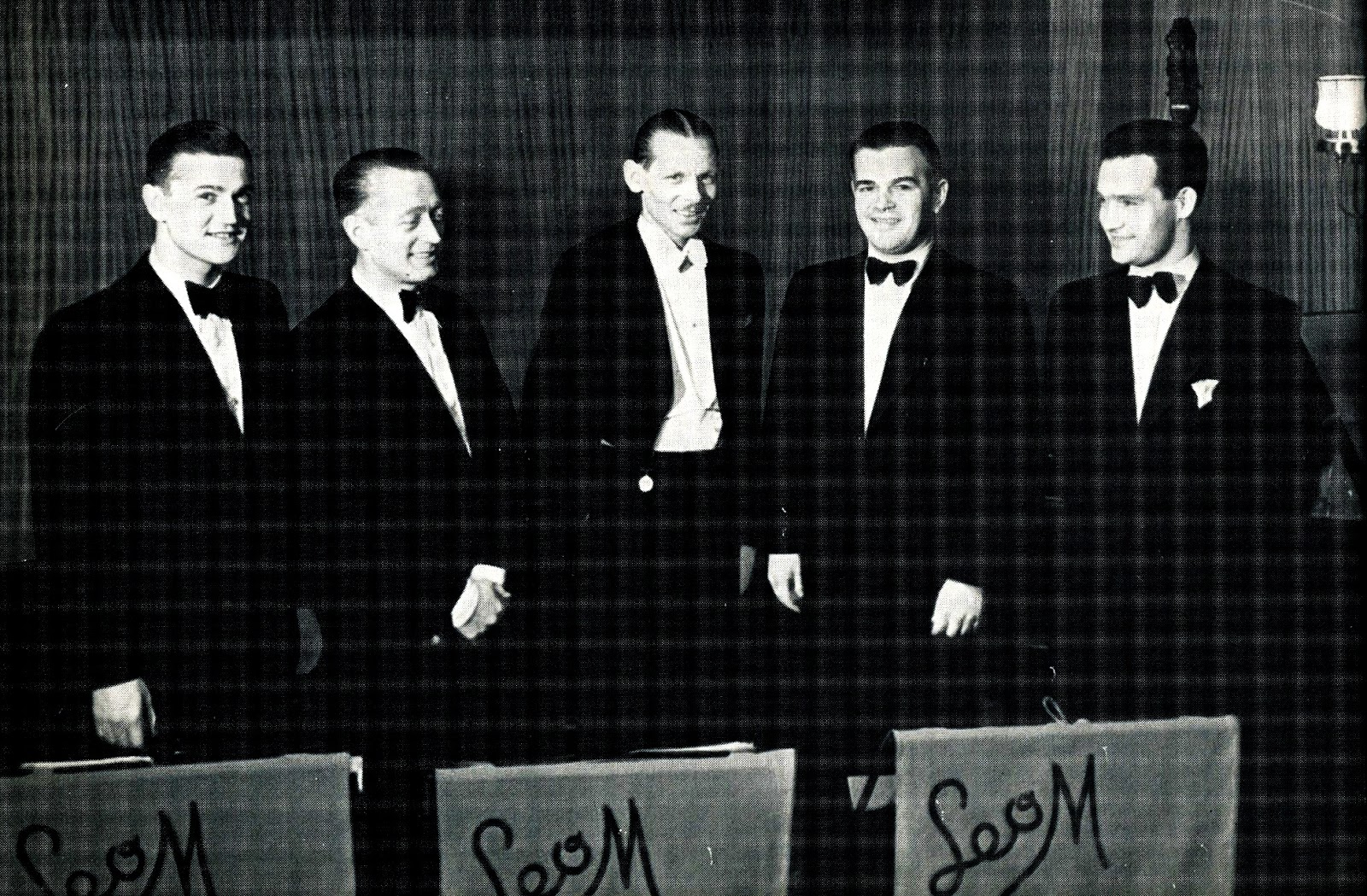
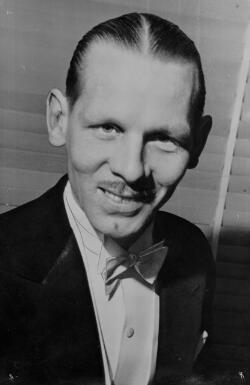
Leo "The Lion" Mathisen (10 October 1906 – 16 December 1969) was a Danish jazz pianist, composer, arranger, singer and bandleader. He was a leading figure of the thriving Danish scene during the years around World War II—a period which has been labelled the Golden Age of Danish Jazz—and he is considered to be one of most significant and original jazz musicians of his day. 

His nickname is a reference to his first name as well as MGM's mascot Leo the Lion. He is also remembered for his characteristic appearance with his flat, centrally parted hair, his thin moustache and, most notably, his fondness of large cigars.

Leo Mathisen was born in Copenhagen in 1906. He worked in a record shop, listened to records and tried to copy the virtuous piano play that he heard. After completing a merchant education, he started working professionally as a pianist in restaurant Arena and with Kai Ewans' band in Restaurant Adlen. The same year he also recorded his first album, The More We Are Together, in collaboration with Victor Cornelius. From 1927 to 1928 he was also part of a trio with Otto Lington and Anker Skjoldborg. 

From 1928 through 1931 he performed with Adrian Rollini's orchestra and with Max Lefkos' band in Germany and Sweden. In 1936 Mathisen formed his own band and until 1952 he led various acclaimed orchestras which performed in restaurants in Copenhagen and toured in Scandinavia after the end of World War II also in Germany. They also served as backup bands for various popular singers. 

Mathisen recorded numerous albums with his band, often with his own compositions. His main source of inspiration was Fats Waller, both in his piano play and in his singing, and particularly his recordings from 1941 to 1943 are considered to be among the swing music's finest. His most famous songs are Take it Easy and To be or not to be. With larger orchestras he recorded tracks like Long Shadows which is a typical example of his original arrangements.


Mathisen also recorded popular hits of his time such as Lionel Hampton's Hey! Ba-Ba-Re-Bop, Five Minutes More, Near You and Makin' Whoopee. With Erik Parkerm he also created Danish lyrics to songs such as De 24 Røvere that Fats Waller recorded in 1941 and Jack McVea’s The Key's In The Mailbox. 


Among the members of his band were Erik Parker, Henry Hagemann and John Steffensen while the trumpeter Jørgen Ry joined the ensemble in the years after the war. During the war, a time which has been labelled as the Golden Age of Danish Jazz, he reached huge popularity, particularly at the München establishment where he performed regularly for several years during the Occupation of Denmark. When he was forbidden to perform in English, he resorted to Scat singing with a destinctive Copenhagen-English sound.
 

From 1951 he performed as a solo pianist around Denmark but in spring 1953 he retired from music altogether due to health problems. He died in 1969 and is interred on the Mariebjerg Cemetery in Gentofte in the northern outskirts of Copenhagen. (Info edited from Wikipedia)

Sunday, 9 October 2016

Gerry Brereton born 9 October 1921


Gerry Brereton, (9 September 1921 – 2005) was a ballad-singing baritone English singer and Commando who was blinded during a raid on Sicily in 1943. Also played football for Derby County before his accident.

During the war, Gerry served with No. 3 Commando and in 1943 his unit took part in Operation Husky, the Allied invasion of Sicily. In July 1943, after successfully capturing the town of Cassibile, 3 Commando embarked on HMS Prince Albert with the aim of landing in the Bay of Agnone and then seizing the Ponte dei Malati bridge. The bridge connected Syracuse to Catania and as it was essential for a rapid advance, it had to be taken intact. 

There was a shortage of landing craft and so the commandos had to disembark in two waves. The first wave landed around seven miles from the bridge and came under immediate enemy fire. A few hours later, the second wave landed and suffered the same fate. Despite this, the commandos managed to get off the beach and push inland. The first group was in position at the Malati bridge at 3 am on the 14th of July where the single platoon of Italians garrisoned there was quickly overcome. The commandos settled in to defend their position until reinforcements arrived. 

Over the course of the next few hours they came under intensive mortar and shell fire and the number of casualties grew: 30 were killed, 66 wounded and 59 reported missing or captured. Among the wounded was Gerry Brereton who lost his sight in an explosion.

Before the war, Gerry had a promising career as a footballer with Derby County but now totally blind, he needed to find a new way to earn a living. 

In 1946, the ‘St. Dunstan’s Review’ reported that Gerry had secured a job as a telephone operator at an iron foundry but less than a year later, there came the first of several announcements to say he could be heard in a radio broadcast. In 1949 he received a fantastic reception from the audience when he took part in Hughie Green’s ‘Opportunity Knocks’ and by 1950 he was described by one of his local BBC assistant senior producers as, “the North’s leading vocalist.” His success growing, Gerry decided to move with his family from his home in Derby to see if he could hit the big time in London. 


He was a guest singer in a concert at the Royal Festival Hall and then spots in several radio and TV broadcasts culminated in his invitation to appear at the Royal Variety Performance. He walked on stage unaided, having memorised the route during rehearsals, and sang ‘Here in My Heart’. The audience took him to their hearts and he was the only artiste to be called back to take a second bow. 

The next day, the newspapers were full of praise for him. A recording contract followed and it wasn’t long before Gerry released his first record on Parlophone, ‘Wyoming Lullaby’
 
 (Info from Glarnies, Green Berets & Goons) 

This is where the trail goes cold, although I did find a comment by Gerry’s son in law who wrote that he used to drive Gerry and his pianist Tim, around to some of their gigs”. 

Also another comment by his Grand-daughter,  “ He was a great singer in the 50's and used to perform with Eddie Calvert among others. He toured the country and sang at the London Palladium in 1952. My grandad sang Hold me, thrill me, kiss me in 1953 which can be found on the 1953 Time to Remember CD along with singing many others including The Bells of St Mary, You above all, Let the rest of the World go by and Trees . He was a great man but very private and his family were very important to him, hence he retired from the music business! However he still continued to entertain all his family and friends.” 

“Sadly most of his own collection of memorabilia was lost during a flood he had at home many, many years ago. He was also a great golfer (even though he was blind!), playing with the likes of Bob Hope for charity. The Telegraph was able to supply me with a fantastic photo of them. He certainly had a very active (if not quiet life), along with being a great comedian, the loss of his sight never stopped him doing anything. He was a member of St. Dunstan's, who do a lot of work for ex-service men & women who loose their sight. The only reason I ever knew as to why he never carried on with his showbiz career, was that he wanted to spend more time with his family. “(source “Whirlygigtv.yuku.com)

Friday, 7 October 2016

June Allyson born 7 October 1917


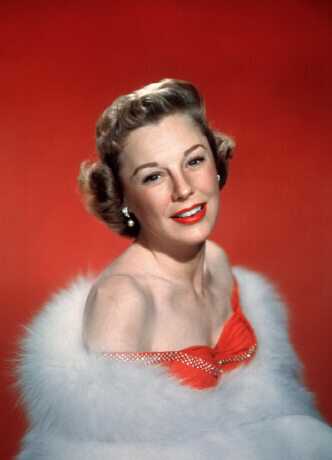
June Allyson (October 7, 1917 – July 8, 2006) was an American stage, film, and television actress, dancer, and singer.
 
Born Eleanor Geisman on Oct. 7, 1917, Ella was 6 when her alcoholic father left. Her mother worked as a telephone operator and restaurant cashier. At 8, the girl was bicycling when a dead tree branch fell on her. Several bones were broken and doctors said she would never walk again. Months of physical therapy helped her to defy that prognosis. 
 
 "After the accident and the extensive therapy, we were desperate," Allyson wrote in her autobiography. "Sometimes mother would not eat dinner, and I'd ask her why. She would say she wasn't hungry, but later I realized there was only enough food for one."

 After graduating from a wheelchair to crutches to braces, Ella was inspired by Ginger Rogers' dancing with Fred Astaire. Fully recovered, she tried out for a chorus job in a Broadway show, ''Sing out the News.'' The choreographer gave her a job and a new name: Allyson, a family name, and June, for the month.  

 As June Allyson she danced on stage in "Very Warm for May" and "Higher and Higher." For "Panama Hattie," she understudied Betty Hutton and subbed for her when Miss Hutton got the measles. Her performance led to a role in "Best Foot Forward" in 1941.  MGM signed her to a contract, and she appeared in small roles. Then in "Two Girls and a Sailor" (1944), her winsome beauty and bright personality connected with U.S. servicemen. She starred in "Music for Millions," "The Sailor Takes a Wife," "Two Sisters from Boston" and "Good News."


 Allyson appeared opposite Johnson in several films, and she was Stewart's wife in "The Stratton Story," "The Glenn Miller Story" and "Strategic Air Command."  Only once did she play an unsympathetic role, as a wife who torments husband Jose Ferrer in "The Shrike." It was a failure.  In 1949, she starred with Elizabeth Taylor, Janet Leigh and Margaret O'Brien in "Little Women."  

 In 1945, Allyson married Powell, the crooner who turned serious actor and then producer-director and television tycoon. The marriage seemed like one of Hollywood's happiest, but it wasn't.  She began earning big money after leaving MGM, "but it had little meaning to me because I never saw the money, and I didn't even ask Richard how much it was. ... It went into a common pot with Richard's money." The couple separated in 1961, but reconciled and remained together until his death in 1963. They had two children, Pamela, who lives in Santa Monica, and Richard Keith Powell, who lives in Los Angeles.  

 A few months after Powell's death, Allyson married his barber, Glenn Maxwell. They separated 10 months later, and she sued for divorce, charging he hit her and abused her in front of the children and passed bad checks for gambling debts.  During this time, Allyson struggled with alcoholism, which she overcame in the mid-1970s. In 1976, Allyson married David Ashrow, a dentist turned actor. The couple occasionally performed together in regional theater, and in the late 1970s and early 1980s, toured the United States with the stage play My Daughter, Your Son. They also appeared on celebrity cruise ship tours on the Royal Viking Sky, in a program that highlighted Allyson's movie career. 

After her film career ended in the late '50s, Allyson starred on television as hostess and occasional star of "The Dupont Show with June Allyson." The anthology series lasted two seasons. In later years the actress appeared on TV shows such as "Love Boat" and "Murder, She Wrote." 

 For the last 20 years, Allyson represented the Kimberly-Clark Corp. in commercials for Depends and championed the importance of research in urological and gynaecological diseases in seniors.  

Following hip-replacement surgery in 2003, Allyson's health began to deteriorate. She died July 8, 2006, aged 88 at her home in Ojai, California. Her death was a result of pulmonary respiratory failure and acute bronchitis. (Info mainly edited from legacy.com)

Wednesday, 5 October 2016

Carlo Mastrangelo born 5 October 1938


Carlo Mastrangelo, (October 5, 1938-April 4, 2016) was a singer, songwriter and drummer and former original member of Dion and the Belmonts and The Belmonts. 

 Mastrangelo grew up in the Bronx, playing drums and singing on street corners and in subways with his classmates from Roosevelt High School Angelo D'Aleo and Fred Milano. They eventually named themselves The Belmonts and recorded their first single in 1957, Teenage Clementine / Santa Margherita for the local Mohawk Records. 


Another Mohawk Records artist, Dion DiMucci, had also released a single with the group The Timberlines; however, he never met his backing group, just adding vocals to the tracks The Chosen Few and Out in Colorado. 
 
For their next recording, Dion joined the Belmonts and released one further single on Mohawk (We Went Away / Tag Along) before moving to Laurie Records where their first release, I Wonder Why, went to number 22 on the Hot 100 in mid-1958. They had two more minor hits, No One Know (1958 / #19) and Don't Pity Me (1958 / #40) before finally breaking out nationally with A Teenager in Love. Written by Doc Pomus and Mort Schuman, the record went to number 5 on the Hot 100 and 28 in the U.K. 

 Dion and the Belmonts, with Mastrangelo singing bass, made numerous appearances on American Bandstand and Dick Clark's Saturday Night Beachnut Show throughout this time and were part of the Winter Dance Party tour that also included the late Buddy Holly, Richie Valens and the Big Bopper. Holly actually played drums for the Belmont's set during the show the night before he died.

 Dion and the Belmonts released four more singles on Laurie, all of which made the top 50, including their highest charting single Where or When (1959 / #3) but Dion was interested in moving to a more rock sound while the rest of the group wanted to remain with group harmony, so they parted ways in early 1960. 

 Mastrangelo moved to the lead spot as the Belmonts continued as a trio. Over the next three years, they scored six Hot 100 songs, all on their own Sabina label, including Tell Me Why (1961 / #18) and Come On Little Angel (1962 / #28) but, disagreements over the finances of their level led to a split with Mastrangelo going solo. 


Recording under the name Carlo with Laurie Records, none of his four singles charted although they did get regional airplay. After little success, he joined back up with Dion as songwriting partner, backup vocalist and drummer for Dion and the Wanderers. 
In late-1966, Dion and the three original Belmonts reunited for the album Dion & the Belmonts Together Again. While they had no hits in the U.S., two of the singles, My Girl The Month of May and Movin' Man, made it to the British top twenty. Dion and Mastrangelo left after the reunion with Carlo joining the group The Endless Pulse, releasing music once again on Laurie Records. 

 Mastrangelo, Dion and the Belmonts reunited again in 1972 for one of Richard Nader's shows which resulted in a live album, and again the next year at the Nassau Coliseum but Carlo remained involved with the group now named Pulse performing jazz-rock music. He later formed and sang for the group The Midnite Sun. 
 
 Mastrangelo lived in Boynton Beach, Florida, minutes away from Dion DiMucci. The two former lead singers of The Belmonts continued to collaborate on many of DiMucci's recordings and live performances from the 1980s until Mastrangelo's death from cancer in April 2016 at the age of 78. 
 
(Info mainly from vintagevinylnews.com)