Wednesday, 7 June 2023

Teddy Redell born 7 June 1937

Teddy Redell (7 June 1937- 3 September 2014) was an American rockabilly, rock 'n' roll and country musician.

Teddy Riedel's unique style of piano playing has been a fixture of American music for half a century. Born Theodore DeLano Riedel in North Central Arkansas, his early years were spent on the family farm near Quitman, Arkansas. Teddy learned to play piano from his grade school teacher Annie Witt, who focused his lessons around boogie woogie and ragtime popular during the 1920s and 30s. Moon Mullican became his idol and his principal influence. By his teens, Teddy had developed his own style and was writing his own songs.

Teddy's break came at the age of 15 when he was asked to perform on KWCB radio in Searcy, Arkansas, on a program profiling young musicians from area schools. The station was soon flooded with requests for replays of his performance, Steel Guitar Rag. Lloyd Sutherland asked Teddy to join his band for their weekly radio program and Teddy began playing live shows with Sutherland and his band around central Arkansas. In the winter of 1955, popular recording star Wayne Raney brought Teddy to Missouri to appear on his television program on KRCG in Jefferson City.

On March 21, 1955, Redell went into Cincinnati's King studio with Raney and played piano on four tracks, including "Bootleg Boogie" and "Gone With the Wind This Morning". He toured with Raney's band until late 1956. In the summer of 1957 he auditioned for Sam Phillips, but as we all know, Phillips released only a fraction of what he recorded and these Sun recordings are not only unissued, but also untraceable. Redell did session work as a pianist for the small Dub and Stylo labels in Little Rock and, starting 1958, also for the fledgling Vaden label in Trumann, AK, owned by Arlen Vaden

Vaden asked Teddy to play backup for a recording session in 1959. When the lead singer came down with laryngitis, Teddy was given the studio time. Knocking on the Backside and its flipside, Before It Began, was released on Vaden Records under the stage name "Teddy Redell." It quickly became a popular selection in the juke boxes of eastern Arkansas. Teddy's second release, Corrina Corrina / Gold Dust, was recorded at King Studios in Cincinnati, and released on the Vaden label in 1960. His third release, I Want to Hold You / Pipeliner soon followed. 


But it was his fourth release that would become his most famous. Judy was recorded in 1960 and released as the B side of Can't You See on the Vaden and Atco labels. The following year, Judy was released by Elvis Presley and stayed for several weeks on Billboard's Hot 100. The Presley version ensured that Teddy would receive a handsome writer's royalty cheque every six months for the rest of his life.

Teddy was drafted into the U.S. armed services in 1960. He completed basic training at Fort Leonard Wood, Missouri, and served the remainder of his two years at Fort Bliss, Texas. During his army years, Teddy continued to play local bars around El Paso. Teddy returned to Arkansas in 1962 and began touring under his own name. In October 1962, Teddy joined with the Pacers to record his fifth release, Poor Ole Me / Between Midnite and Dawn, on Razorback Records.

In 1963, Teddy grew tired of the road and settled in Benton, Arkansas, to learn piano tuning from a professional piano technician. During the 1960s, he continued his songwriting career with an exclusive agreement for Sonny James. In 1964, Teddy married his wife Rose, and they eventually settled in Rose Bud, Arkansas, where he established his own piano service business and ran a farm. Teddy returned to the music scene in the 1970s, performing regularly at local private clubs around Searcy. In 1979, Teddy was approached by record producer Cees Klop of the Netherlands. The first compilation of Teddy's Vaden recordings appeared on LP on White Label, along with a new LP of Teddy's popular club standards from the 1970s, such as Roll In My Sweet Baby's Arms.

Teddy's first European tour in 1988 took him to show dates in the Netherlands and Sweden, followed by a live album release on Collector Records. His second tour in 1991 took him again to the Netherlands and new venues in Germany. A CD compilation of this greatest works appeared that same year. Teddy toured the Netherlands and Sweden again in 1997. His fourth and most recent European tour was to the famous Hemsby Music Festival in England in 2002.

Teddy stooped touring in 2005 and continued to tune pianos until 2011, but still performed for special events around Arkansas. He died on September 3, 2014, at the Greystone Nursing Home in Cabot (Lonoke County) aged 77, and is buried at Crossroads Cemetery in Hopewell (Cleburne County).

(Edited from This Is My Story, Last.fm &  Encyclopedia of Arkansas)


Tuesday, 6 June 2023

Richard "Popcorn" Wylie born 6 June 1939

Richard Wayne Wylie (June 6, 1939 – September 7, 2008), often known as Popcorn Wylie, was an American pianist, bandleader, songwriter, occasional singer, and record producer who was influential in the early years of Motown Records and was later known for his work on many records in the Northern soul genre. 

Wylie was born in Detroit, Michigan, into a musical family, and learned piano. He gained the nickname "Popcorn" through his habit of popping quickly out of the football team's huddle at Northwestern High School. While at school, he formed a group, Popcorn and the Mohawks, which also included later Motown musicians and producers James Jamerson, Clifford Mack, Eddie Willis, Mike Terry, Lamont Dozier, and Norman Whitfield. The band performed at local venues, where Wylie would front the band wearing a homemade Mohawk headdress. 

In 1960, he released a solo single, "Pretty Girl", on the local Northern label. He also performed at a Detroit club, Twenty Grand, where he met fellow musician Robert Bateman who was working as an engineer at Berry Gordy's fledgling Motown label. Wylie then began recording for Motown, releasing three unsuccessful singles as Popcorn and the Mohawks: "Custer's Last Man" / "Shimmy Gully", followed by a cover of Barrett Strong's "Money (That's What I Want)", and then "Real Good Lovin'". 

He also recorded with Janie Bradford as a duo, Janard, and began working as a backing musician. He played piano on The Miracles' 1961 hit "Shop Around" and The Marvelettes' "Please Mr. Postman", and additionally worked with The Contours, Marvin Gaye, Marv Johnson, The Supremes, Martha & the Vandellas and Mary Wells. He was Motown's first head of A&R, and served as the band leader for the first Motortown Revue tour in 1962.  That same year he left Motown after a disagreement with Gordy, who failed to mention him in his later autobiography. Wylie signed with Epic Records, releasing four singles between 1962 and 1964 on which he was reputedly backed by Sun Ra and members of his Arkestra. 


He later freelanced as a songwriter, producer, and session player for various local labels, including SonBert, Ric-Tic, Correc-tone, Continental and Golden World. He also formed his own labels, Pameline (an amalgamation of his daughters' names) and SoulHawk, in 1966. During this period he worked extensively with singers Edwin Starr and J.J. Barnes, and co-wrote Jamo Thomas' minor hit "I Spy (For the FBI)". Several of the records with which he was involved, including "The Cool Off" by the Detroit Executives, first issued in 1967, and "Nothing No Sweeter Than Love" by Carl Carlton, later became favourites of the Northern soul scene in the UK. He also co-wrote The Platters' 1967 hit, "With This Ring". 

He began recording again, under the name Popcorn Wylie, in 1968, releasing "Rosemary, What Happened?" - another Northern soul favourite - on the Karen label, and "Move Over Babe (Here Comes Henry)" on Carla. In 1971, he briefly returned to Motown, and released his most successful solo single, "Funky Rubber Band", on their subsidiary Soul label. An instrumental, it reached # 40 on the Billboard R&B chart and # 109 on the US pop chart. He recorded an album, Extrasensory Perception, for ABC Records in 1974, working with arrangers McKinley Jackson and Gene Page. Two singles were released from the album in 1975, "Lost Time" and "Georgia's After Hours". 

For some years, Wylie was unaware of the popularity of his earlier records on the UK Northern soul scene, and he reportedly allowed his children to play frisbee with highly collectable singles he had produced and released. In the mid-1980s, he finally travelled to the UK to promote his work, helping to put together compilation albums and working with producer Ian Levine. He recorded "Love is My Middle Name" and "See This Man in Love" for Levine's Motorcity label, and co-wrote songs for fellow Motown veterans The Contours and The Elgins, among others. A selection of his recordings on the Pameline label was issued on a compilation, Popcorn's Detroit Soul Party, in 2002, and he also took part in a 2003 documentary, The Strange World of Northern Soul. 

Though his name would mean nothing to the average music lover, most of Richard “Popcorn” Wylie’s work as an artist, writer and producer is held in huge esteem by those who really know soul. Though his achievements are numerous, the man himself claimed that his best work was ‘With This Ring’ – a big hit, of course, for the Platters. He was so damn proud of it simply because he wrote it for his wife. 

He died at home in Detroit in 2008, aged 69, after suffering from congestive heart problems for some time. 

(Edited from Wikipedia & Soul Jazz Funk 


Monday, 5 June 2023

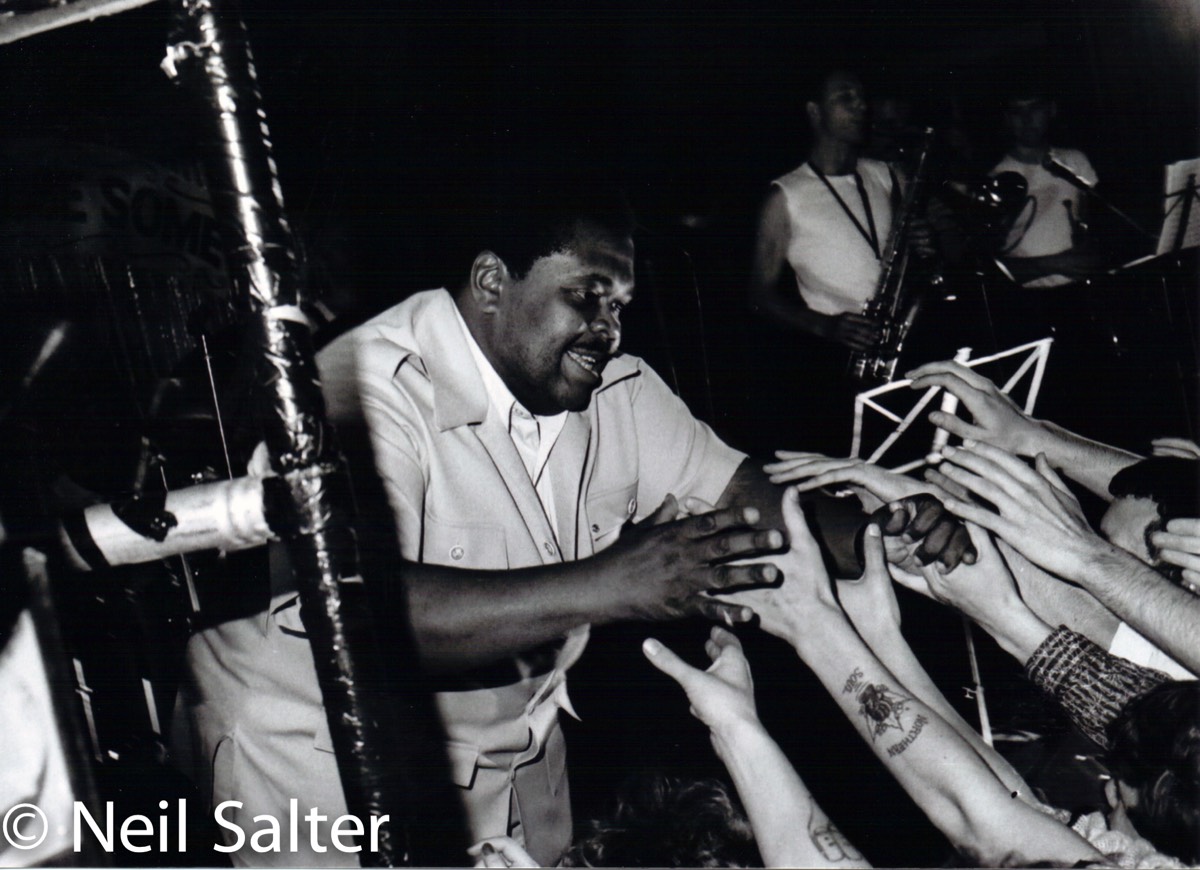
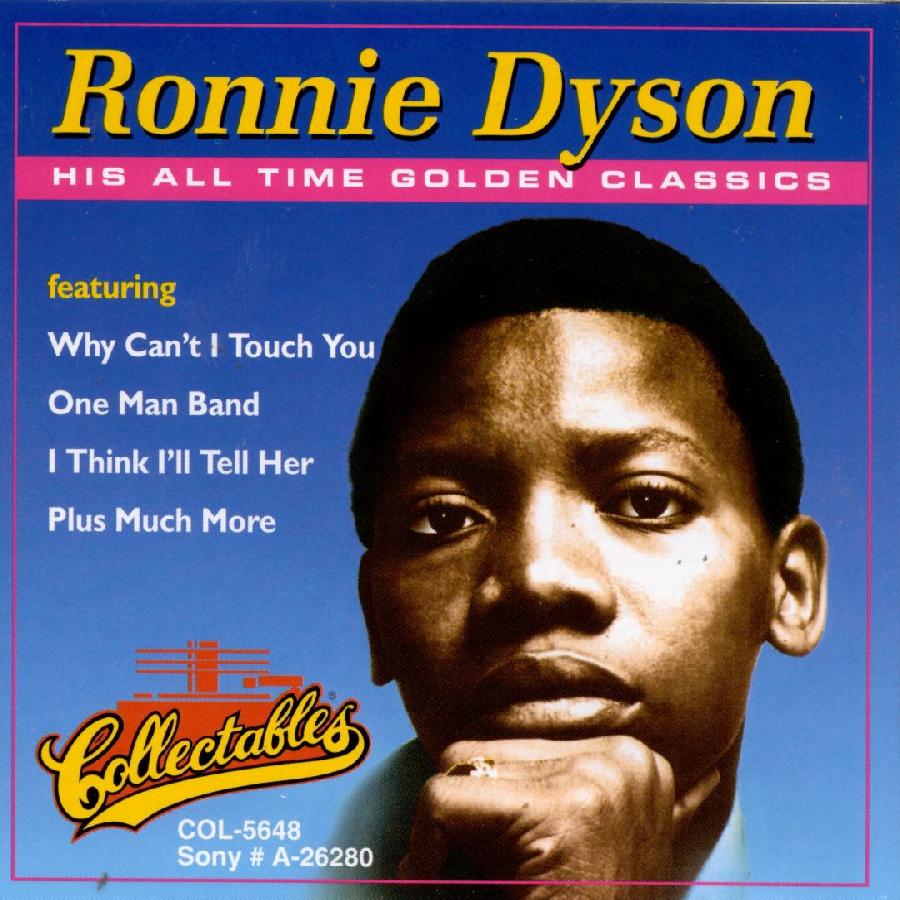
Ronnie Dyson born 5 June 1950

Ronald Dyson (June 5, 1950 – November 10, 1990) was an American soul and R&B singer and actor. 

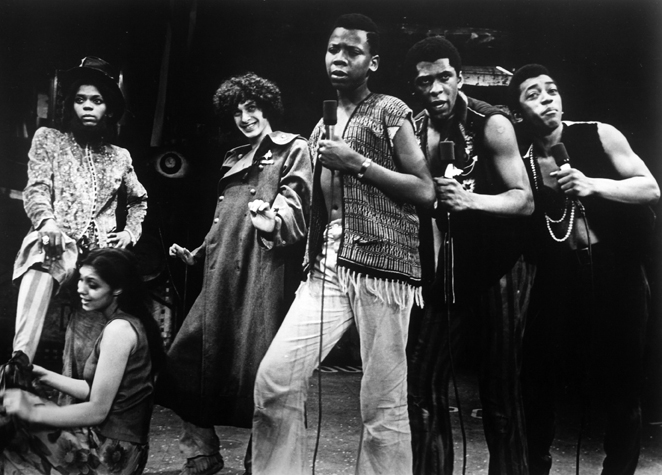
Born in Washington, D.C., Dyson grew up in Brooklyn, New York, where he sang in church choirs. At 18 years of age, he won a lead role in the Broadway production of Hair, debuting in New York in 1968. Dyson became an iconic voice of the 1960s with the lead vocal in the show's anthem of the hippie era, "Aquarius". It is Dyson's voice leading off the song and opening the show with the famous lyric "When the Moon is in the seventh house, and Jupiter aligns with Mars..." He made a cameo appearance in the 1979 motion picture version of Hair, singing "3-5-0-0" with another Hair alumnus, Melba Moore. 

Dyson had the misfortune, perhaps, to emerge in the late 1960s recording in the same era as signature Soul Men such as Marvin Gaye, Al Green, Curtis Mayfield, Isaac Hayes, and Donny Hathaway. Unlike many of his peers, Dyson’s musical sensibilities were more geared to the theater and the cabaret as than the Chitlin’ Circuit of the day. Dyson was above all, a song stylist who was most comfortable singing tunes in the vein of aforementioned Fifth Dimension, Nancy Wilson, Dionne Warwick, and Johnny Mathis. 

At the dawning of the 1970s and with Stax and Motown defining the sounds of Blackness for mainstream audiences, pitching the youthful Dyson to mainstream audiences with show tunes and 1960s pop standards was going to be a difficult sell. As such, Dyson spent the better part of the first decade of his career trying to find his voice. Nevertheless, it was a show tune, “(If You Let Me Make Love To You) Why Can’t I Touch You?,” from the musical Salvation! that gave Dyson his first taste of pop stardom in 1970, peaking at #9 on both the Pop and Soul charts. The follow-up, "I Don't Wanna Cry", was a US R&B hit, climbing to number nine. 


In 1971, his cover, "When You Get Right Down to It", was a more dramatic version of a song that had been a hit the previous year for the Delfonics; it reached number 34 on the UK Singles Chart in December. His record company, Columbia Records, sent him to Philadelphia in 1973 to be produced by Thom Bell, one of the premier producers of the day, for several tracks. 

Bell's highly orchestrated style suited Dyson with hits including "One Man Band (Plays All Alone)", which reached number 28 on the Hot 100 and number 15 on the R&B chart, and "Just Don't Want to Be Lonely", peaking at number 60 on the Hot 100 and number 29 on R&B. They appeared on an album which was also made up of re-mixes of some earlier recordings, including "When You Get Right Down to It". 

Dyson remained with Columbia working with top-line producers for another three albums, The More You Do It (1976), Love in All Flavors (1977) and If the Shoe Fits (1979). The title track of the first of the three resulted in one of the singer's biggest-selling records, reaching number six on the R&B chart. It was produced by Charles "Chuck" Jackson (half brother of Jesse Jackson and no relation to the more famous singer of the same name, who recorded for the same company in the 1960s) and Marvin Yancy, who had been responsible for successfully launching the career of Natalie Cole with a series of hits. (Jackson and Yancy had also produced hits for a Chicago soul group, The Independents, with whom Jackson was also lead singer.).

Dyson then moved to an Atlantic Records subsidiary label, the Cotillion Records label, in 1981 for two albums and several singles which were only moderately successful. His acting and singing career had begun to stall in the late 1970s due to ill health, and it was in 1983 that Dyson appeared on the R&B chart for the last time on Cotillion with "All Over Your Face". In 1986. After a brief appearance on the soundtrack on Spike Lee’s first theatrical release She’s Gotta Have It (1986). 

Dyson disappeared from the public eye, but in 1990 he released his final solo recording “See The Clown.”. After years of chain-smoking and other excesses and after attending hospital on two separate occasions for a suspected heart condition, he died from heart failure at the age of 40 on November 10, 1990, in Brooklyn, New York. 

A posthumous release on Society Hill Records appeared in 1991, when a duet with Vicki Austin, "Are We So Far Apart (We Can't Talk Anymore)", dented the US R&B chart, reaching number 79 during a five-week run. 

(Edited from Wikipedia, Mark Anthony Neal bio & Soul Walking) 


Sunday, 4 June 2023

Texas Ruby born 4 June 1908


Ruby Agnes Owens (June 4, 1908 – March 29, 1963), professionally better known as Texas Ruby, was an American pioneering country music female vocalist and musician of the late 1930s through to the early 1960s. Her brother was famous as Tex Owens, the writer of Cattle Call.

She didn’t headline in Vegas or score any huge hit records during her too-short career, but she remains one of the most memorable country music stars of all time. Ably accompanied by husband Curly Fox’s fiddle, her deep singing voice and distinctive performing style helped make her special, but her personality was the crowning touch. She was sassy and tempestuous, a hard living and highly spirited force of nature. 

Ruby was born on a ranch in Wise County, Texas, near Decatur, United States. When she was three years old she started to sing, often together with her two brothers. Her career began when a radio station owner in Kansas City radio station heard her sing in Fort Worth, Texas. In early 1937, she made her debut recording for Decca Records. Later that year, she met fellow musician Curly Fox in Fort Worth. They were married in 1939. The couple was invited to be members of The Opry in the late 1930s. 

Ruby was dubbed "radio's original cowgirl". The husky voice star was something of a cross between Sophie Tucker (whom she was often compared to) and Dale Evans and with her husband, fiddler Curly Fox was an enormously popular radio and personal appearances star in the 1940s although she failed to have any hit records. Her best-known song, "Don't Let That Man Get You Down" predated Loretta Lynn's stand-up-to-your-man hits by twenty years.


This sassy persona was adopted on most of Ruby's recordings, "Ain't You Sorry That You Lied" and "You've Been Cheating on Me", songs perhaps too trailblazing to have been record hits in that very conservative era of country music. Most of Texas Ruby's recordings were done for the King Records and Columbia Records labels. Her first sessions were in Dallas for Decca Records in February, 1937. 

Texas Ruby made her first breakthrough in the music industry working with country bandleader Zeke Clements but by the mid forties she and husband Fox had developed their own stage act and were much in demand, including a stint as regulars on the Grand Ole Opry from 1944 to 1948. The Foxes left the Opry and in late 1948 moved to Texas, where most of their concert dates were. The move seemed to push national stardom further away from the duo, who in the early 1960s moved first to Los Angeles (appearing on the Town Hall Party country music television series) and then back to Nashville in attempts to return to the limelight. 

Fox, widely considered one of country music's greatest fiddlers, worked the Opry more frequently as background instrumentalist than as a star. As he was appearing on the Opry on March 29, 1963, Ruby fell asleep smoking in their mobile home and was killed in the resulting fire, shortly after making a comeback album with Fox. "Shanty Street" was issued on a Starday label sampler posthumously. 

It was the most grim month in Opry history as Ruby was the fifth Grand Ole Opry star to die that month, following Patsy Cline, Hawkshaw Hawkins, Cowboy Copas, and Jack Anglin. Fox was reinstated as an official Grand Ole Opry member shortly afterward but he retired by 1970. 

(Edited from Wikipeda, geezermusicclub & last.fm)

Saturday, 3 June 2023

Margie Rayburn born 3 June 1924

Margie Rayburn (June 3, 1924 – June 14, 2000), was an American traditional pop singer. 

Rayburn was born Marjorie Helen Orwig in the San Joaquin Valley in the central California town of Madera. Following graduation from the Hollywood High School, she started her musical career during the Second World War. While still in her late teens she began singing with big bands and in that capacity entertained American soldiers. entertaining the troops as a big band singer. After the war she sang wilh Ray Anthony’s Orchestra, and then toured with Gene Autry, worked the San Francisco nightclubs and had a few singles released in 1954-55 on Alma, S & G and Capitol. 

Around 1954 she joined the Sunnysiders, a vocal and instrumental group, formed by two former members of Spike Jones's City Slickers, banjo player Freddy Morgan and Jad Paul. Margie's husband, Norman Malkin collaborated with Morgan on material for the group and is sometimes listed as a member of the Sunnysiders. This group had a hit in 1955 with "Hey, Mr. Banjo", which was also issued in the UK. Norman's name is often misspelled as Milkin. 

Margie left the Sunnysiders in 1956 for a solo career on Liberty Records. Her fifth single for the label, "I'm Available", was her only hit, but a big one, reaching # 9 on the Billboard Hot 100 in December 1957. The tune was written and first recorded by Dave Burgess in his pre-Champs days. Rayburn was already 33 at the time, but sounded like a 17-year old girl on the sensuous "I'm Available". 


Liberty Records was hopeful that Rayburn would have a follow-up hit single. Between 1958 and 1960 Rayburn recorded six more singles with the label as well as her 1959 album, Margie. The album featured accomplished covers of pop standards like “Come Rain Or Come Shine”, “Almost Like Being In Love” and “Blues In the Night”. 

Among the session musicians to appear, often uncredited, on a number of Margie Rayburn’s singles with Liberty was Eddie Cochran. He was having his own hit records including his Top Ten hit in 1958, “Summertime Blues.” Cochran appeared with guitar, including solos, on “Smoochin’”, “I Would” and “Wait”. The latter was written by Johnny Burnette of “You’re Sixteen” fame. 

Numbers of her songs used a lot of echo and multi-tracked vocals effects to give her voice the suggestive quality Rayburn achieved on “I’m Available.” Don Ralke and his Orchestra often were in the studio with Rayburn to record her singles. Rayburn left Liberty in 1960 and signed on with Challenge Records. She teamed up again with the songwriter who wrote “I’m Available”, Dave Burgess of The Champs. He penned a new song called “Try Me” and suggested she make a recording. It was released in December 1960. 

The song caught on in Vancouver and peaked at #12, despite receiving next to no airplay south of the border. It didn’t chart on the Billboard Hot 100 and it’s best chart performance was in San Antonio, Texas, peaking at #46 on KTSA which had a Top 100 chart called the San Antonio Survey. In Los Angeles Rayburn’s husband, Norman Malkin, went on to become a producer for Dot Records in the late 50s. He helped Margie make the transition from Challenge Records to Dot Records. With Dot she recorded two songs aimed at the teen audience: “Hello, Mr. Heartache” and “Bobby Is My Hobby”. Both singles flopped. 

By 1965 Rayburn moved on to Capitol Records and recorded “Maker of Raindrops and Roses”, written by Australian country singer Arthur Blanch. Like her other tunes since her brief limelight with “I’m Available”, there was no interest. By this time the pop charts were full of tunes by The Beatles, The Rolling Stones, The Dave Clark Five, The Animals, Petula Clark and The Kinks. 

Unable to find another hit, Rayburn last recorded in 1966 then retired from the music industry. She settled down in Los Angeles with her husband and fell  into obscurity. She died of a heart attack on June 14, 2000 in Oceanside, California, at the age of 76. 

(Edited from This Is My story, Ray McGinnis article & Wikipedia)


Friday, 2 June 2023

Lee Andrews born 2 June 1936

Lee Andrews (June 2, 1936 - March 16, 2016) was the lead singer of the American doo-wop quintet The Hearts which were recognized as one of the finest doo-wop groups of the '50s. 

Arthur Lee Andrews Thompson was born in Goldsboro, North Carolina (June 2, 1936) to a musical family. His father, Beechie Thompson, had been with the Dixie Hummingbirds gospel group. Around 1940 Lee’s family moved to the Woodland Avenue and 49th Street section of Southwest Philadelphia, where Lee grew up. He attended Bartram High School, where, in 1952, he helped to form a vocal group called the Dreamers. This group was comprised of: Lee (lead), Royalston "Roy" Calhoun (first tenor), Thomas "Butch" Curry (second tenor), Jimmy McCalister (baritone), John Young (bass), and Kenny Lowe (piano). 

Their influences were the usual: the Orioles, the 5 Keys, the 5 Royales, and the Ravens. Lee's special influences were Nat "King" Cole and Bing Crosby; he loved Pop music, and it shows in the recordings, which are not as heavily R&B as those of their contemporaries. They originally sang spirituals, guided by Butch's aunt. But little by little they expanded their repertoire to include Rhythm & Blues. 

In 1954, one of the big wheels in Philadelphia was DJ Kae Williams (nicknamed "The Jet Pilot") who encouraged local groups to come up and audition for him, and that's just what the Dreamers did, singing "Maybe You'll Be There" and "Bells Of St. Mary." You could tell that Williams was impressed; he instantly became their manager. A couple of months later, they recorded a few demos, but since there already was a local group called the Dreamers, a name change was needed. Jimmy McCalister saw a heart on a secretary's desk, and "The Hearts" were born. At the same time, Arthur Thompson used his two middle names to become "Lee Andrews." 

The demos were released by Rainbow Records but shakeups started occurring. With nothing happening for the group, Jimmy McCalister joined the Navy, in 1955, to be replaced by baritone Ted Weems. Kenny Lowe left, and Gerald Thompson became the new pianist. Finally, Kae Williams gave up on Rainbow. The Hearts had all graduated from High School by this time, and both Lee and Roy ended up working in the processing plant of Philadelphia's Gotham Records. Although still under contract to Kae Williams, they did no recording at all in 1955. 

One day the Hearts found out that their contract with Kae was invalid, since they had all been minors when they'd signed it. That was the day that Lee and Roy started pestering their employer, Gotham owner Ivin Ballen, to listen to the group. He put them off repeatedly, until, in late 1955 he finally agreed to an audition. He must have liked them, since he signed them to Gotham on January 3, 1956. 


A Gotham employee, Bill Scott, became their manager. Recording them at Gotham's Federal Street studio, in May he released "Bluebird Of Happiness" backed with "Show Me The Merengue". After releasing a few more unsuccessful singles they tried the Main Line label. Finally, after three years with no hits, the luck of Lee Andrews and the Hearts was about to change. In June 1957, Main Line issued "Long Lonely Nights"/"The Clock" (both re-recordings of tunes originally done on Gotham). "Long Lonely Nights" was an instant local hit. In fact, it was doing so well that Atlantic Records wee initially interested, but Chess was more amenable, and in July it was released on the Chess label. By the time "Long Lonely Nights" had peaked, it had gone to #45 on the Pop charts and #11 on R&B. 

After recording more singles the group switched to United Artists. And that was that. Ted Weems left for the service, and Lee Andrews just left. He had a single release on Casino in 1959 (backed by a chorus): "I Wonder"/"Baby Come Back" (a reprise of the first Rainbow recording). Sometime in 1962, Lee reunited with the Hearts, to turn out their final release together. Issued on Gowen records, it was the aptly-named "Together Again" backed with "My Lonely Room" (a re-make of "Lonely Room"). Unfortunately, it too failed to chart. February 1963 found Lee recording for Parkway. 

In 1964, Lee decided to get another Hearts group together. Richard Booker and Richard Mason were joined by Robert Howard and Victoria McCalister. Their first release that year was on Crimson records. Another solo spot for Lee in 1965, this time for the V.I.P. label. After this, Lee opened a dress shop in Philadelphia. He kept it going until around 1970, but it didn't affect his singing career too much. Lee and the Hearts then did "You're Taking A Long Time Coming Back"/"Quiet As It's Kept" for RCA-Victor, released in August 1966 and had more releases on Crimson in 1967 and 1968. 

The last appearance of Lee Andrews on record was with Congress Alley, which consisted of Richard Booker, Karen Briscoe, and Lee's wife, Jackie. They had two singles and an album on Avco Embassy in 1973. 

Lee Andrews passed away on March 16, 2016. (Edited from Marv Goldberg’s R&B Notebooks)


Thursday, 1 June 2023

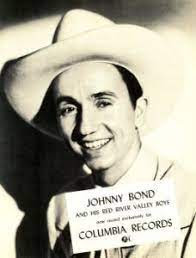
Johnny Bond born 1 June 1915

Cyrus Whitfield Bond (June 1, 1915 – June 12, 1978), known professionally as Johnny Bond, was an American country music singer-songwriter, guitarist and composer and publisher, who co-founded a music publishing firm, he was active in the music industry from 1940 until the late 1970s. 

Cyrus Whitfield Bond was born in Enville, Oklahoma, to a poor farming family. His first instrument was the trumpet and learned basics of music as a member of his high school's brass band. He also learned to play the guitar and the ukulele, and by the time he was a teenager he was entertaining at local dances. His main inspiration was the playing of Jimmie Rodgers and Milton Brown and the Light Crust Doughboys. After graduating from high school in 1933, he headed for Oklahoma City to try for a career on radio, first broadcasting under the name Cyrus Whitfield, and later as Johnny Whitfield, before he settled on Johnny Bond. 

During 1937 in Oklahoma City he hooked up with Jimmy Wakely and Scotty Harrell (later replaced by Dick Reinhart), with whom he formed a group, originally known as the Singing Cowboy Trio and later the Bell Boys, in acknowledgment of their radio sponsorship from Bell Clothing. Their repertoire in those days was influenced heavily by the work of Gene Autry and the Sons of the Pioneers, and featured many cowboy songs. They did their broadcasting on radio station WKY, and cut transcription discs at KVOO in Tulsa. By then, Bond was already writing songs of his own, and in 1938 he wrote his first classic, "Cimarron." Gene Autry saw their work when he was on tour late in the 1930s and indicated his interest in using them on his Melody Ranch radio show, should they ever make it out to California. 

By 1939, they were brought out to Hollywood for an appearance, under the name of the Jimmy Wakely Trio, in The Saga of Death Valley, starring Roy Rogers and produced by Republic Pictures. This taste of movie work registered with Wakely and Bond -- there was more film work being offered by Republic, and Autry's offer was difficult to ignore. In May of 1940, Wakely, Bond, Reinhart, and their families headed west in Wakely's Dodge. They immediately became regulars on Melody Ranch, and Bond continued to play on the show for 16 years, until it was canceled in 1956. 

The Encyclopedia of Country Music says that the Bond-Wakely-Harrell trio "pulled a clever musical scam" by recording for two companies under different names: the Jimmy Wakely Trio (for Decca Records) and Johnny Bond & the Cimarron Boys (for Columbia Records). Bond also acted in more than 40 films, beginning with Saga of Death Valley (1939) and including Wilson and Duel in the Sun. Beginning in 1953, Bond and Tex Ritter were hosts of the syndicated country music television series Town Hall Party, which lasted seven years. 


Bond's first solo recordings came with Columbia Records in 1937. He is best known for his 1947 hit "Divorce Me C.O.D.", one of his seven top ten hits on the Billboard country charts. In 1965 at age 50 he scored the biggest hit of his career with the comic "Ten Little Bottles", which spent four weeks at No. 2. Bond's other hits include "So Round, So Firm, So Fully Packed" (1947), "Oklahoma Waltz" (1948), "Love Song in 32 Bars" (1950), and "Sick Sober and Sorry" (1951). Despite his acceptance of changing tastes and trends in music, however, Columbia Records declined to renew Bond's contract when it was up in 1957, at it seemed as though his career on records might be at an end. 

He spent a brief time on Gene Autry's Republic Records label, for which he recorded "Hot Rod Lincoln," a crossover record that did well and later became a rock & roll standard. Then, in 1960, Bond was signed to the Starday label, beginning an 11-year relationship with the company. In 1964, he recorded a new version of "Ten Little Bottles," a song that he'd previously done twice, as far back as 1954 -- this proved to be the biggest hit of Bond's career, rising into the Top Three and making it to number one on some charts. Unfortunately, none of Bond's follow-up records, including the comical "Morning After," sold nearly as well. 

His contract with Starday ended in 1969, and Bond immediately signed to Capitol where he recorded a Delmore Brothers tribute album with his longtime friend Merle Travis. It didn't sell, however, and by the end of the year both Bond and Travis were gone from Capitol. He resigned to Starday and remained there only for another two years before leaving permanently in 1971. He continued making records for the Lamb & Lion label, and then moved over to his old friend Jimmy Wakely's Shasta label in 1974, where he did one session, 

 As a songwriter, he was responsible for several compositions that became country standards, including "Cimarron," "I Wonder Where You Are Tonight," "Conversation With a Gun," "Tomorrow Never Comes," and "I'll Step Aside," which became hits for everyone from Billy Vaughn & His Orchestra to Johnny Rodriguez.  He and Tex Ritter formed Vidor Publications, a music publishing firm. He retired from performing in the 1970s to devote more time to publishing music. Bond died of a stroke in Burbank, California, on June 12, 1978 at the age of 63. 

(Edited from Wikipedia & Allmusic)