Sunday, 7 February 2021

Juliette Gréco born 7 February 1927

Juliette Gréco ( 7 February 1927 – 23 September 2020) was a French singer and actress and an icon of post-Second World War French bohemianism. 

Juliette Gréco was born in Montpellier, France, the youngest of two daughters to Gérard Gréco, a Corsican policeman, and Juliette Gréco, née Lafeychine. The pair separated, and Gréco and her sister Charlotte were brought up in part by their maternal grand-parents in Bordeaux. Gréco was twelve when the war began in Europe, and both her mother and her sister survived Nazi prison camps following their involvement in the French Resistance. Gréco, too, was imprisoned for several months, and it was likely during this time she developed an oppositionist stance that never left her. 

With the help of a family friend, the actress Hélène Duc, she took drama lessons while working as a sort of combination hostess and bouncer at Le Tabou, a jazz club in the heart of St.-Germain-des-Prés, the Left Bank neighborhood that had become the city’s center of bohemian life. During this time her habit of wearing men’s clothes, including rolled-up pants, was necessitated by poverty and made possible by the hand-me-downs of male friends who lived in the same pension. The style caught on. Though she had yet to garner attention as an actress, her distinctive look got the attention of leading French photographers, who took and published pictures of her. 

Gréco began singing in cabaret in 1949, after she was offered a job helping organise the first show at the newly reopened Le Bœuf Sur le Toit cabaret club. That was the beginning. The first song she recorded, “Je Suis Comme Je Suis,” was released in 1951. Her first album, “ Chante Ses Derniers Succès,” appeared the next year. But her star-defining triumph was her 1954 concert at Olympia Hall in Paris, after a tour of the United States and South America. During the performance she introduced “Je Hais les Dimanches” (“I Hate Sundays”), a new number by a young songwriter, Charles Aznavour. 


She had made her film debut even before her singing career began, as a nun in “Les Frères Bouquinquant,” a 1948 drama. She went on to appear in almost 30 films, mostly in the 1950s and ’60s. They included Jean Cocteau’s “Orphée” (1950), as Aglaonice, an astronomer-witch; “The Sun Also Rises” (1957), an American adaptation of Hemingway’s novel, with Tyrone Power and Ava Gardner; “The Roots of Heaven” (1958), a drama set in Africa, in which she starred opposite Errol Flynn; and “Crack in the Mirror” (1960), with Orson Welles. She also made a lasting impression in a 1965 French mini-series, “Belphegor, Phantom of the Louvre.” When it was made into a feature film in 2001, she was cast in a small role as a tribute to her influence. 

1n 1953, Ms. Gréco married the actor Philippe Lemaire; they divorced in 1956. Their daughter, Laurence-Marie Lemaire, died in 2016. She was married to the French actor Michel Piccoli from 1966 until their divorce in 1977. She was with the pianist and composer Gérard Jouannest, her third husband, from 1988 until his death in 2018. 

Her longest and best-known romantic relationship may have been with Miles Davis, the celebrated jazz trumpeter, whom she met when he was appearing in Paris in 1949. Sartre reportedly once asked him why he and Ms. Gréco were not married. According to Ms. Gréco, Mr. Davis replied, “I love her too much to make her unhappy.”In 2014, Ms. Gréco told The Guardian, “We saw each other regularly until his death” in 1991. 

After 1970, Gréco became an emblem of what seemed a lost era. She was the last of the great chanteuses, and she toured the world with a constantly changing repertory of songs. They had usually been written for her, and when she sang them her control and concentration was that not only of a great singing actor, but of a survivor. In the 90s she became president of the association to preserve Saint-Germain-des-Prés, the area which, she quipped, had “turned me into a marketable commodity”. 

Gréco’s final acting role was in Jedermanns Fest (2002), though she also appeared in a documentary, Dans les Pas de Marie Curie (2011). She wrote two autobiographies; Jujube (2002) and Je suis faite comme ca (2012). In France, she was made a Commander of the Legion of Honour in 2012; she received the National Order of Merit in 2015, and was made a Commander of the Order of Arts and Letters a year later. 


After a pause of 20 years, she resumed releasing albums, which included Je Me Souviens de Tout (2009). A final album, Gréco Chante Brel, appeared in 2013, and two years later she announced a farewell tour, calling it Merci. Her last-ever live performance took place in 2017 in Paris.  She died of a stroke, on 23 September 2020 at her Ramatuelle house in the south of France, near Saint Tropez. She was 93 years old. 

(Edited from The New York Times & The Guardian)


Saturday, 6 February 2021

Sax Kari born 6 February 1920


Sax Kari (February 6, 1920 – October 1, 2009), born Isaac Columbus Toombs Jr., sometimes known as Isaac Saxton Kari Toombs or simply Saxton Kari, was an American multi-instrumentalist, bandleader, songwriter, record producer, A&R man and promoter, who had a wide variety of roles during a career in African American entertainment and R&B music lasting from the 1920s to the 1990s. He was a prolific songwriter with 339 credits on BMI. He also used pseudonyms, including Ira Green, The Alley Cats, Texas Red, Dirty Red Morgan, and Candy Yams. 

He was born in Chicago, the son of Tennessee-born Isaac Columbus Toombs and his wife Irene. As a child, he ran away from home and from the age of nine performed in vaudeville as a comic entertainer with Butterbeans and Susie, who gave him the nickname "Candy Yams" for his relatively light freckled complexion. He learned to play piano, guitar, and reed instruments, and by 1940 was living in Gary, Indiana, with his mother. He worked in bands as a guitarist, and in 1942 took Charlie Christian's place in the orchestra at the Lyon's Den club in Oklahoma City. He began working with and for club owner and entrepreneur Denver D. Ferguson in Indianapolis in the early 1940s, promoting concerts and helping Ferguson set up the network later known as the "Chitlin' Circuit". 

He formed his own eighteen-piece touring band, and settled in Detroit around 1945. He made his first recordings with his orchestra for Imperial Records in 1947, followed by recordings with vocalist Roosevelt "Whiskey" Sheffield for Apollo in 1949. In 1953, he released his most successful record, "Daughter (That's Your Red Wagon)", an answer song to Ruth Brown's "(Mama) He Treats Your Daughter Mean", which reached #8 on the Billboard R&B chart. The record was credited to "Swinging Sax Kari" and featured singer Gloria Irving. 


He also worked with Houston promoter Don Robey during the 1950s. In the mid-1950s, he produced early recordings in Detroit by Della Reese, as well as recording novelty records such as "Chocolate Fizz" and "Goldie the Green-Eyed Octopus" under his own name, on a variety of mostly small independent labels. He also wrote and produced for other musicians on labels including Checker and Vee Jay. In 1959, he produced the single "You're So Fine" by The Falcons, a group that included Mack Rice, Eddie Floyd and Robert Ward. The song reached #2 on the R&B chart and #17 on the pop chart. 

Rufus Thomas & Sax Kari

In the early 1960s, he moved to New Orleans, where he set up a recording studio and worked with Allen Toussaint as an A&R man and producer for his Sansu record label. He managed Esquerita, and produced records by Chris Kenner, Polka Dot Slim, and others. By the late 1960s he had moved to Mobile, Alabama, where he set up a record store and his own record label, Channel 1. He also worked as a songwriter for Henry Stone's TK label in Miami, Florida, writing for George McCrae, as well for Wilson Pickett and others. He composed the soundtrack for the 1978 blaxploitation movie The Six Thousand Dollar Nigger, also known as Super Soul Brother, starring Wildman Steve. 

He wrote for Rock Candy Records, a hip-hop label in New York, in the early 1980s, and also toured with a band, Four Sticks of Dynamite and a Fuse – the fuse being a female dancer. The band won a residency at a club in Seffner, Florida, and Kari settled there. He also started performing as a solo act in resorts in the Tampa area, often billed under his old nickname as "Candy Yams". In 1997, he released a CD, Love Juice, credited to Candy Yams and the Bluesville Express. 

He retired to Brandon, Florida, where he was interviewed by Preston Lauterbach and provided much of the background information for Lauterbach's book, The Chitlin' Circuit and the Road to Rock 'n' Roll. Sax Kari died in Florid after a short battle with pancreatic cancer on October 1, 2009. He was 89. 

A compilation of his New Orleans recordings, Fumigate Funky Broadway, was issued on CD in 2002

(Edited from Wikipedia)

Friday, 5 February 2021

Bob Dunn born 5 February 1908


 Robert Lee "Bob" Dunn (February 5, 1908 – May 27, 1971)  was an American pioneer  Western swing steel guitarist. 

Bob Dunn was born in Fort Gibson, Oklahoma, the oldest of four children. The son of a fiddler, Bob followed in his father’s musical footsteps, taking up slide guitar and playing Hawaiian music, as was enjoying a surge of popularity at the time, drawing influence from leading players such as Sol Ho’opi’i.  Inspired by the music of those like Jack Teagarden, Dunn soon shifted toward jazz, and added an electric pickup to his guitar, playing in an idiosyncratic brassy style peculiar to him.  In the late 1920s, he played in groups such as the Panhandle Cowboys and Indians, before winding up in Fort Worth in 1934.  

Bob Dunn's style was virtually unique among the steel guitarists of his time. He was an admirer of the trombonist Jack Teagarden and took a similar approach to his soloing, using a horn-like phrasing far away from the Hawaiian style of the day. He always tried to treat the steel guitar as a jazz instrument, or what he termed a "modern instrument". 

Whilst at Fort Worth he met Milton Brown, who invited him to a studio jam. Dunn made a great impression on Brown and immediately became a member of Milton Brown and His Musical Brownies. Dunn, with his homemade pickup and became the first to use an electric guitar to record a country-rooted song, entitled "Taking Off." Dunn fell in love with western swing music. His amplified steel guitar was featured on several recordings. He played and recorded more than ninety tunes with the Brownies before Brown's death in 1936. 


He left the band following the death of Milton Brown in 1936 and played with many different groups, including Moon Mullican, Roy Newman and His Boys (1937), Cliff Bruner's Texas Wanderers, Bill Mounce and the Sons of the South, and Buddy Jones and the Sheldon Brothers (1939). 

He made some recordings on Decca under the name Bob Dunn's Vagabonds (actually Cliff Bruner's Texas Wanderers).  When the Vagabonds broke up, Dunn played in a variety of different western swing bands, including Bill Boyd’s Cowboy Ramblers, Dickie McBride’s Village Boys, Bill Mounce’s Sons of the South, and the Sons of Dixie. 

Bob Dunn' with Benny Leader's Band 1948

After serving in the United States Navy during World War II, he played in a number of bands in the late 1940s. In 1950 he retired from performing and opened his own music store in Houston, where he also taught music. He operated the store for more than twenty years, until his death from lung cancer on May 27, 1971. Dunn influenced generations of steel guitar players. In 1992 he was inducted into the Steel Guitar Hall of Fame and the Texas Western Swing Hall of Fame. In late 2010 the Origin Jazz Library label released a comprehensive 2-CD set of remastered recordings of Dunn's work, titled Bob Dunn: Master of the Electric Steel Guitar 1935-1950. 


As a result of Dunn's early performances, the electric steel guitar remains an indelible element of country music, and his work reverberates among countless contemporary artists in the genre. 

(Edited mainly from The Handbook Of Texas &, Brad’s Page Of Steel)

Thursday, 4 February 2021

Tony Fruscella born 4 February 1927


Tony Fruscella (February 4, 1927 – August 14, 1969) was a mellow, lyrical, cool American jazz trumpeter in the vein of Chet Baker who unfortunately lived a similarly addictive lifestyle that led to a tragically premature death. 

Fruscella was born in Greenwich Village in 1927, into a family that belonged to the Italian-American working class of that area. His childhood years are largely undocumented, but he was brought up in an orphanage from an early age and seems to have had little exposure to music other than as it related to the church. However, he left the orphanage when he was about fourteen or fifteen, started studying the trumpet, and came into contact with both classical music and jazz. 

He appears to have been quick to develop his skills and was soon playing in public. When he was eighteen he went into the army and gained more experience by playing in an army band. It was around this time that Fruscella also encountered the new modern sounds of the day, and the post-war years saw him mixing with the many young, white New York jazzmen who were devoted to bebop and cool jazz. They had an almost-fanatical belief in the music and had little time for anything else. 

One of the musicians who participated in these sessions was an alto-player by the name of Chick Maures, and in 1948 he and Fruscella recorded for a small label called Century, though the records never appeared commercially until thirty years later. Of course, by 1946 bebop was well-established, and the music shows the influence of the famous Charlie Parker quintet of those days. Fruscella's trumpet playing, though superficially akin to that of Miles Davis, had its own subtlety and warmth. Fruscella married teenage singer Morgana King in 1947. They had a daughter Graysan (1950–2008) 

Fruscella and the others no doubt continued to play when and where they could, and a few even got to work professionally. But paying jobs, especially those involving jazz, were often hard to come by. Bob Reisner, a writer around Greenwich Village in the early1950s, recalled that Fruscella never seemed to have a permanent address. "Short marriages, short stays in hospitals and jails, and he invented the crash pad. He walked the streets, an orphan of the world, but with incredible dignity. He never accepted anything for free. He would cook and clean and play music if you put him up." 

The chaotic nature of Fruscella's life wasn't improved by his use of alcohol and drugs. He wasn't alone in this. Chick Maures, his companion on the 1948 record date, died from a drugs overdose in 1954, and Don Joseph, a trumpeter who was not unlike Fruscella in his playing and was close to him as a person, had a career that was marred by drug addiction. Both were wayward to the point of self-destruction.There were a few moments of near-glory in Fruscella's career however. In February, 1952, he joined forces with altoist Herb Geller, tenorman Phil Urso, pianist Bill Triglia, and a couple of others, to produce some music which ought to have been heard at the time and drawn some attention to Fruscella. Instead, it simply disappeared into the vaults, and Fruscella and his companions carried on struggling to play their music and earn a living. 

A little steady work did come along now and then, and in 1953 Fruscella was hired to play with Stan Getz's group. Some poorly-recorded excerpts from a broadcast from Birdland do exist, and on "Dear Old Stockholm" Fruscella demonstrates all that was best in his playing as he shapes a solo that is relaxed, warm, melodically coherent, and in which the use of spaces between the notes is as important as the notes themselves. Some listeners might think there is a resemblance to Chet Baker in Fruscella's sound. 


He did play with Gerry Mulligan's group briefly in 1954, but it is only slight, and Fruscella very much had his own way of constructing a solo. 1955 was probably the peak year in Fruscella' s short career, and he was featured on a couple of recordings by Stan Getz and was also invited to make an LP under his own name for the Atlantic label, a well-established company. 

What happened to Tony Fruscella after 1955? Very little, it seems, if the reference books are anything to go by. He probably still played at jam sessions and perhaps even did some club work in obscure places, but the "dogged will to fail" that Bob Reisner saw in him, and his drug and alcohol problems, must have held him back. Also in 1956 his marriage to Morgana King ended in divorce. 

The 1960s were lean years for a lot of jazzmen, as pop music took over in clubs, dance halls, and on the radio. His kind of music, quiet, reflective, and requiring sympathy and understanding from the listener was hardly likely to appeal to many people. It never had, it's only fair to say, but things got even worse. Apart from a few hospital stays caused by his well-known personal problems nothing at all is known of his activities in the sixties. Tony Fruscella died on April 14th 1969, whilst at a friend’s apartment. The cause of death was cirrhosis and heart failure.”

(Edited mainly from Jazz Profiles)

Wednesday, 3 February 2021

Johnny Bristol born 3 February 1939


John William Bristol (February 3, 1939 – March 21, 2004) was an American musician, most famous as a songwriter and record producer for the Motown label in the late 1960s and early 1970s. 

Johnny Bristol was born in Morganton, North Carolina. He attended and graduated from high school in his hometown, performing in a group called the Jackets that appeared at school functions. At the time, he had no plans to make music a career. After graduating, Bristol moved north and joined the U.S. Air Force. He was stationed at Fort Custer in Battle Creek, Michigan, married his first wife, Maude and continued to dabble in music with a group of fellow servicemen in a group called the High Fives. 

Soon Bristol and another member, Jackey Beavers, experienced conflict with the other musicians and left the group. As a duo they performed around Battle Creek, sometimes sharing the stage with another local act, Junior Walker and the All Stars. They also met Akim Fakir, brother of Abdul "Duke" Fakir of the group the Four Tops, and that got them an introduction to Gwen Gordy, the sister of Motown label founder Berry Gordy Jr. Gwen Gordy signed the pair to her new Anna label in 1959 where they recorded two singles. 

Johnny & Jackey moved to Tri-Phi, another of the small labels that came together to form Motown; it was headed by key Motown songwriter and producer Harvey Fuqua. Many of their singles were modeled on the styles of other rhythm-and-blues singers of the day, but one release from November of 1961, "Someday We'll Be Together" (Tri-Phi), had a rich, romantic sound all its own. Bristol wrote the song with Beavers and Fuqua. The duo had moderate success around the Midwest but never broke out nationally. In 1963, when Tri-Phi was absorbed by rapidly growing Motown, Bristol put his own career on hold to sign on with Motown as an assistant to Fuqua in the label's artist development department. 

Bristol became part of the Motown "family" in more ways than one: he also married Berry Gordy's niece Iris. As the close-knit creative team at the label grew, he got the chance to contribute to Motown recordings directly, as a producer, writer, and arranger. Notably, Bristol was the producer and co-writer of the final singles for both Diana Ross & the Supremes and Smokey Robinson & the Miracles, before each group lost its namesake lead singer. While the Miracles' "We've Come Too Far to End It Now" (1972) was an original, the Supremes' "Someday We'll Be Together" (1969) was a remake of a Johnny & Jackey single from 1961. Bristol is the male voice on the Supremes' version of "Someday We'll Be Together", singing response to Diana Ross' lead vocal. 

But he became disenchanted with Motown after the company's move to Los Angeles in 1972, although he too moved to the West Coast. In the early and middle 1970s Bristol worked as a producer for various artists, including Jerry Butler and Tavares. He was signed as an in-house producer by the Columbia label and helped to turn Boz Scaggs into a middle-of-the-road soul-style star with the album Slow Dancer (1974). Still hoping for a hit of his own, however, he signed with the MGM label. 


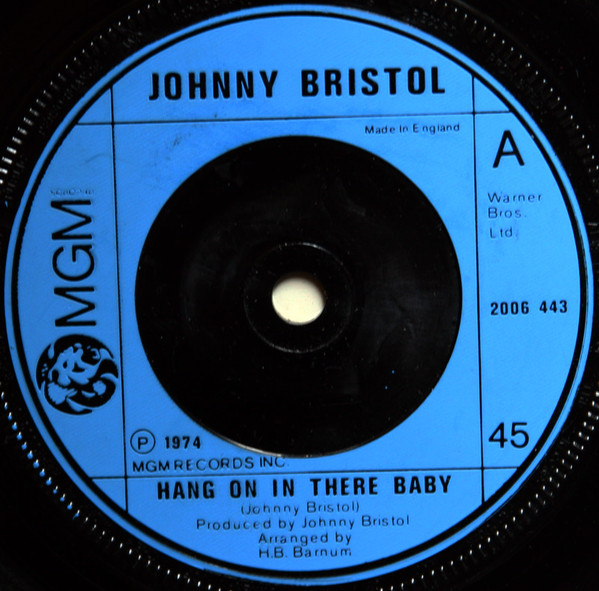
At MGM, Bristol recorded two successful albums and charted with several singles, notably "Hang On in There Baby". He also recorded the original version of "Love Me for a Reason", later a major hit for The Osmonds. He was nominated for a Grammy Award in 1975 for Best New Artist, ultimately losing out to Marvin Hamlisch. By the time the disco style began to dominate pop charts in the 1970s, Bristol was in his late thirties, and although his albums Feeling the Magic (1975) and Bristol's Creme (1976) continued to feature his songwriting and production, they had limited success. 

Bristol moved to Polydor for the latter release and recorded Strangers for the label in 1978. Bristol's main market was in Europe by the early 1980s. His duet with Amii Stewart on a medley of "My Guy - My Girl" reached #39 in the UK Singles Chart in 1980. An affiliation in 1989 with the UK record label Motorcity Records was brief, but did result in one of Bristol's most popular releases, "Man Up in the Sky", and a cover of the Bristol-penned "What Does it Take to Win Your Love" 

He recorded for several small labels in the 1980s and 1990s, releasing an album called Life and Love in Japan in 1996. In 2002 he sang "Someday We'll Be Together" on a Public Broadcasting Service television special with Mary Wilson of the Supremes. Bristol lived near Howell, Michigan, northwest of Detroit, in his later years, and he was working on a gospel album at the time of his death. 

Bristol suffered an apparent seizure at his home and was pronounced dead at the hospital on Sunday the 21st of March 2004 at the St. Joseph Mercy Livingston Hospital in Howell, Michigan. He was 65. 

(Edited from Encyclopedia.com & Wikipedia)

Tuesday, 2 February 2021

Sonny Stitt born 2 February 1924

Sonny Stitt  (February 2, 1924 – July 22, 1982), was an American jazz saxophonist of the bebop idiom. He was also one of the most prolific saxophonists, recording over 100 records in his lifetime. He was nicknamed the “Lone Wolf” by jazz critic Dan Morgenstern, due to his relentless touring and his devotion to jazz. 

Edward Boatner Jr. was born in Boston on 2 February 1924.  It was a musical and religious household but a few years later his parents divorced and after his mother married Robert Stitt, Edward became known as Sonny Stitt. He studied the piano and clarinet and had saxophone lessons from Big Nick Nicholas who later sat in Tiny Bradshaw’s sax section with him. Wardell Gray was another of his tutors. His early instrumental influences at that time were Rudy Williams and Benny Goodman. The Stitts were living in Saginaw, Michigan and both Nicholas and Gray often stayed in the Stitt home when they worked locally because Saginaw’s only hotel did not accommodate African-Americans. 

In 1943, Stitt met Charlie Parker. As he often recalled, the two men had similar styles. Parker is alleged to have remarked, "Well, I'll be damned, you sound just like me", to which Stitt responded, "Well, I can't help the way I sound. It's the only way I know how to play." His earliest recordings were from 1945, with Stan Getz and Dizzy Gillespie. He had also experienced playing in some swing bands, though he mainly played in bop bands. Stitt featured in Tiny Bradshaw's big band in the early forties. 

Stitt played alto saxophone in Billy Eckstine's big band alongside future bop pioneers Dexter Gordon and Gene Ammons from 1945 until 1949, when he started to play tenor saxophone more frequently. Later on, he notably played with Gene Ammons and Bud Powell. During 1948 Stitt spent time in a Lexington prison on account of selling narcotics. 

Stitt, when playing tenor saxophone, seemed to break free from some of the criticism that he was apeing jazz genius Charlie Parker's style. When alto saxophonist Gene Quill was criticised for playing too similar to Parker once by a jazz writer he retorted, “You try imitating Charlie Parker!” Indeed, Stitt began to develop a far more distinctive sound on tenor. He played with other bop musicians Bud Powell and Eddie “Lockjaw” Davis, a fellow tenor with a distinctly tough tone in comparison to Stitt, in the 1950s and recorded several albums for the burgeoning Prestige Records label as well as for Argo, Verve and Roost. Stitt's playing is said to be at its zenith on these now rare records. Stitt experimented with Afro-Cuban jazz in the late 1950s, and the results can be heard on his recordings for Roost and Verve, on which he teamed up with Thad Jones and Chick Corea for Latin versions of such standards as “Autumn Leaves.” 

Stitt joined Miles Davis briefly in 1960, and his sole performance with the 1960 quintet is on the record Live at Stockholm, which featured Wynton Kelly, Jimmy Cobb and Paul Chambers. However, Miles fired him due to the excessive drinking habit he had developed, and replaced him with fellow tenor saxophonist Hank Mobley. Stitt, later in the 1960s paid homage to one of his main influences, Charlie Parker, on the seminal cut “Stitt Plays Bird”, which features Jim Hall on guitar. 


He recorded a number of memorable records with his friend and fellow saxophonist Gene Ammons. The records recorded by these two saxophonists are regarded by many as some of both Ammons and Stitt's best work, thus the Ammons/Stitt partnership went down in posterity of the best duelling partnerships in jazz, alongside Zoot Sims & Al Cohn, and Johnny Griffin with Eddie “Lockjaw” Davis. Stitt would venture into soul jazz, and he recorded with fellow tenor great Booker Ervin in 1964 on the enjoyable Soul People album. Stitt would also record with Duke Ellington alumnus Paul Gonsalves during the 1960's. 

In the 1970s, Stitt slowed his recording output, though not by much and in 1972, he produced another classic, Tune Up, which was and still is regarded by many jazz critics, such as Scott Yanow, as his definitive record. Indeed, his fiery and ebullient soloing was quite reminiscent of his earlier playing. Stitt was one of the first jazz musicians to experiment with an electric saxophone (the instrument was called a Varitone) in the late '60s. Because the device distorted Stitt's glorious, uncluttered, pure yet embodied sound, critics and Stitt followers were relieved when he eventually discarded the gratuitous gadget. 

Stitt, to his credit, never slowed down, joining the Giants of Jazz (which included Art Blakey, Dizzy Gillespie and Thelonious Monk) on some albums for the Mercury Records label, and recording sessions for Cobblestone and other labels. His last recordings were made in Japan. 

In 1981, Stitt had performed with George Duvivier and Jimmy Cobb, six weeks before his death when he suffered a heart attack and died on July 22, 1982 in Washington D.C. 

(Edited from All about Jazz, Jazz Profiles  & Wikipedia) 

Monday, 1 February 2021

Bob Shane born 1 February 1934


Robert Castle Schoen (February 1, 1934 – January 26, 2020), known professionally as Bob Shane, was an American singer and guitarist who was a founding member of The Kingston Trio. In that capacity, Shane became a seminal figure in the revival of folk and other acoustic music as a popular art form in the United States in the late 1950s through the mid-1960s. 

Shane was born in Hilo, Hawaii. Interested in music since childhood, he taught himself how to play the ukulele and guitar. He met a fellow guitarist, Dave Guard, and the two performed together beginning in the early ’50s. While attending college in California, in 1956, Shane met Nick Reynolds, who joined Shane and Guard in a singing group (which expanded to several members) that went under various names. They were unsuccessful, so Shane returned to Hawaii and performed as a solo act, then returned to California, where he found Reynolds and Guard performing in a group they’d named the Kingston Quartet. He began to use the phonetic spelling Shane in 1957. 

Bob Shane, Dave Guard & Nick Reynolds 

While performing in a San Francisco nightclub, the group was seen by publicist Frank Werber, who suggested that Guard and Reynolds team up with Shane as a trio. The three musicians/singers debuted formally as the Kingston Trio at the Purple Onion in San Francisco in the spring of 1957 and were a quick hit. They soon moved over to the more prominent Hungry i nightclub where their close harmonies, impressive guitar work and witty banter guaranteed sell-out crowds every night. 


Signed to Capitol Records and paired with producer Voyle Gilmore, the group’s appeal easily transferred to the recording medium and they became a national phenomenon. In addition to their best-selling albums, they scored a #1 single the first time out with 1958’s “Tom Dooley,” and went on to place a total of 23 singles on that Billboard chart. 

For several years the Kingston Trio was described as "the most envied, the most imitated, and the most successful singing group, folk or otherwise, in all show business" and "the undisputed kings of the folk singing rage by every yardstick". The Trio's massive record sales in its early days made acoustic folk music commercially viable, paving the way for singer-songwriter, folk rock, and Americana artists who followed in their wake. 

In 1961, Guard became the first original member to leave the group, replaced by John Stewart. That line-up remained together for six years, disbanding in 1967. Shane had not been in favour of the break-up of the Kingston Trio, both because he felt that the Trio could adapt to changing musical tastes and because he had by then become a thoroughly accomplished entertainer and a canny marketer. 

Deciding to stay in the entertainment business, Shane experimented both with solo work (he recorded several singles, including a version of the song "Honey" that later became a million-seller for Bobby Goldsboro) and with different configurations with other folk-oriented performers. 

In 1969, he asked permission of Reynolds and Werber, still his partners, to lease the group's name. They assented with the provisos that Shane assemble a group of comparable musical quality to the two original configurations and that "New" be appended to the name. Shane organized two troupes under the name of "The New Kingston Trio". The first consisted of guitarist Pat Horine and banjoist Jim Connor in addition to Shane and lasted from 1969 to 1973, the second including guitarist Roger Gambill and banjoist Bill Zorn from 1973 until 1976. Though both of these groups made a limited number of recordings and television appearances, neither generated very much interest from fans or the public at large. 

Shane purchased the rights to the Kingston Trio name outright from Reynolds and Werber, and all subsequent iterations of Shane's troupe since late 1976 have been known simply as the Kingston Trio. The personnel in the group changed several times, though Shane and Grove remained constants. Shane guided the group to a success that, if never the equivalent of the group's first decade, was nonetheless steady and consistent. Shane's Kingston Trio relied heavily on a "greatest hits formula" augmented by a number of other songs acquired through the years that fans had accepted as part of the group's repertoire. 

In March 2004, a month after his 70th birthday, Shane suffered a debilitating heart attack that forced him into retirement from touring and performing after 47 years with the act. Though Shane had initially planned to return to the group after convalescing, the attack was severe enough to warrant Shane's permanent withdrawal from performing with the group. He was replaced by former New Kingston Trio member Bill Zorn. 


In 2010, Shane received a Lifetime Achievement Grammy award alongside Julie Andrews and Dolly Parton. Even after his retirement, he still found ways to perform. “Occasionally someone will call me and ask me to go onstage, and I pack a couple of oxygen tanks and go,” he said in a 2011 interview. He died on January 26, 2020 at a hospice facility in Phoenix, Arizona at the age of 85

(Edited from Wikipedia & Best Classic Bands)