Friday, 21 February 2025

John Klein born 21 February 1921


John Klein (February 21, 1921 – April 30, 1981) was an American composer, author, conductor, pianist, organist and carilloneur. 

Born John McLaughlin Klein in Rahns, Pennsylvania, he studied at the Philadelphia Academy of Music in Philadelphia. He also studied at the High School of Music in Berlin with Paul Hindemith and at the Mozarteum in Salzburg, at Ursinus College in Collegeville (Pennsylvania), but also privately with Nadia Boulanger, Igor Stravinsky and Marcel Dupré in Paris. 

Between 1937 and 1942 he was the chief organist for the Broadstreet Presbyterian Church in Columbus, Ohio, and from 1944 to 1957 he was a pianist and composer for recordings, films, radio and television. He composed the US Treasury radio shows, including the 'American Notebook' series, which won the US Treasury District Service Citation and the Silver Medal, and the US Army radio show 'Sound Off!' (for which he composed the title theme). 

At the 1958 Brussels World's Fair, the Salzburg Music Festival and at the International Carillon Festival recitals in Cobh, Ireland he played the Schulmerich Carillon Americana Bells. He joined the Composers Guild of America, the American Guild of Organists and, in 1953, ASCAP. He became director of music for Schulmerich Carillons, Incorporated, and associate music director and instructor for the Columbus Boychoir School in Ohio. 


Klein appeared at the New York, Seattle and Brussells World Fairs, Montreal Expo 67, the Salisbury, Austria Music Festival and the International Music Festival at Cobh, Ireland. As a guest recitalist on the “Presidential” carillons, Klein has played the bells in Dwight D. Eisenhower Memorial Chapel, Harry S. Truman Library and Herbert Hoover Memorial Library. As a teacher and second director, he was affiliated with the Columbus Boychoir School in Ohio. As well as his many attributes, Klein also ran an antique shop in his home town of Rahns. 

As a multi-talented composer, arranger, his use of popular to classical music attracted a wide audience. During his musical career which included 45 carillon records and 450 published compositions. Klein was first to combine the carillon with orchestra and chorus. He has been musical composer/arranger for stage, screen, radio and television shows and has written chamber music, choral music and commercial jingles. Among his compositions were a Violin Concerto, The Yellowstone Suite and Cranberry Corners, USA as well as a number of songs and marches. 

As author, his two-volume book, “The First Four Centuries of Music” has been translated into foreign languages and his “Art of Playing the Modern Carillon” includes instructions, original compositions, transcripts and arrangements. Klein was honored by the American Society of Composers, Authors and Publishers, of which he was a member. He was also a member of the American Guild of Organists.  He died April 30, 1981, in Collegeville, Pennsylvania. 

(Edited from Discogs, Encyclopedia.com & IMDb)

Thursday, 20 February 2025

J.Geils born 20 February 1946

John Warren Geils Jr. (pronounced Gailz) (February 20, 1946 – April 11, 2017), known professionally as J. Geils or Jay Geils, was an American guitarist. He was known as the leader of the J. Geils Band. 

John Warren Geils Jr. was born in New York City, and grew up in Morris Plains, New Jersey. He was of German ancestry. In 1959, his family moved to Old Farm Lane in Bedminster, New Jersey. He attended Bernards High School in nearby Bernardsville. Before he graduated in 1964 he was a member of the math club, the physics club, student council, car club, band club and the marching band. He also was a big fan of motorcycles. His father was an engineer at Bell Labs and a jazz fan. 

From an early age, he heard his father's albums by Benny Goodman, Duke Ellington, and Count Basie, and was escorted by his father to a Louis Armstrong concert. He learned to play Miles Davis music on the trumpet and drums, and he listened to blues singers Howlin' Wolf and Muddy Waters on the radio. In 1964, he began attending Northeastern University and was a trumpeter in the marching band. When he was drawn to folk musicians in Boston, he left Northeastern for Worcester Polytechnic Institute, where he studied mechanical engineering. 

Geils began playing jazz trumpet but eventually switched to blues guitar. He formed an acoustic blues trio, 'Snoopy and the Sopwith Camels', with bassist Danny Klein and harmonica player Richard "Magic Dick" Salwitz, while studying mechanical engineering at Worcester Polytechnic Institute in the mid-1960s. In late 1965 their line-up consisted of vocalist/saxophone player Peter Kraemer, guitarists Terry MacNeil and William "Truckaway" Sievers, bassist Martin Beard (born 1947, London), and drummer Norman Mayell. They soon moved to Boston, where they added new drummer Stephen Jo Bladd and lead vocalist Peter Wolf, who was a late-night DJ on WBCN. 


Geils later formed the 'J. Geils Blues Band' with Klein, Salwitz, Bladd, and Wolf, with Seth Justman becoming the final member before the band released its debut album as the J. Geils Band in 1970, the first of 11 albums until 1985. Although they were influenced by soul music and rhythm and blues, their musical style was difficult to categorize. Their success was allegedly limited by being "too white for the black kids and too black for the whites". The band's sound moved toward pop and rock by the time the breakthrough album Love Stinks (EMI, 1980) came out. Their next album, Freeze Frame, produced the song "Centerfold", which sat at number one for six weeks, and the title track, which was a Billboard Top 10 hit. 

J.Geils Band

Tension and conflict arose among band members, and Wolf left to pursue a solo career. The band broke up in 1985. Geils took a break from music to concentrate on auto racing and restoration. In 2012 he filed a lawsuit against the other band members when they allegedly planned to tour without him while using the band's trademarked name. This prompted him to quit the group permanently. In 1992 he formed the band Bluestime and  recorded two blues albums with Magic Dick, then played in a jazz trio with guitarists Duke Robillard and Gerry Beaudoin. He released his first solo album, Jay Geils Plays Jazz!, in 2005. 

In addition to passing on an interest in jazz, Geils's father took him to auto races in Pennsylvania in the 1950s. Geils became fascinated with Italian sports cars. He drove in five races a year during the early 1980s, at the peak of the J. Geils Band's popularity. He opened KTR Motorsports, an automobile restoration shop in Ayer, Massachusetts to service and repair vintage sports cars such as Ferrari and Maserati. He sold the shop in 1996, though he continued to use the shop and participate in the company.

The J Geils Band reunited for a tour in 1999 and made sporadic subsequent appearances, including opening for Aerosmith at Fenway Park, Boston, in 2010. Geils was named to the Wall of Honor at his alma mater, Bernards High School, in Bernardsville, New Jersey. In September 2016, he was arrested and charged with drunk driving after allegedly rear-ending a car in Concord, Massachusetts. 

On April 11, 2017, Groton Police conducted a well-being check on Geils and found him unresponsive at his home in Groton, Massachsetts. He was pronounced dead from natural causes at age 71.  (Edited from Wikipedia)


Wednesday, 19 February 2025

Eddie Hardin born 19 February 1949

Eddie Hardin (19 February 1949 – 22 July 2015) was an English rock pianist and singer-songwriter, best known for his associations with the Spencer Davis Group, Axis Point, and Hardin & York. 

Peter York & Eddie Hardin

Born in South London, Hardin's musical career began when he was a young piano student. By the time he was 13 he’d learnt enough to join his first group in South London, playing a Vox Continental organ. As his playing progressed he discovered the Hammonds and soon mastered the M102. His first big break came in 1967 when, aged just 18, he joined the legendary Spencer Davis Group. Dubbed 'the singing keyboard wunderkind',  he soon made his presence felt in this mega star-outfit and appeared on the UK hit singles "Time Seller" and "Mr. Second Class" . By mid-1968, and with the band's star on the descent, Hardin left with the group's drummer Pete York, due to 'differences over musical policy' to form the duo, Hardin & York. 

Spencer Davis Group

Signing to Bell Records, the pair released the album, "Tomorrow Today" and undertook numerous tours of mainland Europe, and in particular Germany, where they regularly filled medium-sized venues and also supported the likes of The Nice and Deep Purple. Two further Hardin & York LPs followed: "Smallest Big Band In The World" (1970) and "For The World" (1971 ) before the pair decided to go their separate ways and pursue solo ventures. His best known work is perhaps his lead vocal on the theme from the Thames Television children's magazine series Magpie, recorded by the then line-up of the Spencer Davis Group under the pseudonym The Murgatroyd Band in 1971. 


Hardin's solo career kicked off with November 1971's "Driving" & "Where I'm Going To SleepTonight" Decca single which was swiftly followed by the 1972 LP "Home Is Where You Find It" and another single, "Why Does Everybody Put Me Down"/"Spend Your Money Honey" . He then put his solo attempts on hold when he took part in the 1973 reformation of the Spencer Davis Group where he was again reunited with Pete York. The reunion lasted for just two LP's "Gluggo" and "Living In R Back Street", before the band again split up. Hardin along with York and bassist Charlie McCracken then formed Hardin-York-McCracken and released one critically acclaimed self-titled LP, in 1974, for Vertigo Records. 

Hardin continued as a solo artist, occasionally reuniting with York, much of his work from 1974 onwards was produced by Roger Glover who had recently left Deep Purple. Hardin featured on Glover's solo project The Butterfly Ball and the Grasshopper's Feast that year, singing lead on the track "Sir Maximus Mouse" and playing on and co-writing others, most notably the hit song "Love Is All". After this he released the singles "S'Easy"/"Strange Times" and "Summer Days"/"Seems I'm Always Going To Love You" and the album "You Cant Teach An Old Dog New Tricks" . 

Axis Point

Between 1979 and 1981, he led Axispoint, who also featured bassist Charlie McCracken, drummer Rob Townsend and guitarist John 'Charlie' Whitney, and who released two LP's "Axispoint" and "Boast Of The Town". Also in 1981 he released a single "Resurecttion Shuffle" under the name of A30 Eddie. Following the demise of Axispoint, Hardin stayed with RCA for 1982's "Circumstantial Evidence" LP  and then teamed up with Zak Starkey to work on a musical version of "Wind In The Willows" which also featured Donovan and John Entwistle. 

In the 1980’s he released a couple of 'New Age' style albums for Coda Records, "Dawn Til Dusk" (1986) and "Survival" (1980), overseen the re-issuing of Hardin & York's old recordings and took part in occasional reformations of the Spencer Davis Group in the 2000’s. That wasn't the end of the Hardin and York story, though.  The friends would periodically reunite, recording new albums in 1981 and 1995, and would tour together and remain involved on various projects with their friends in Deep Purple.  They remained close until Hardin's death following a heart attack on 22 July 2015, while relaxing in a swimming pool. He was 66 years old.

(Edited from Mark Brennan article , Wikipedia, Second Disc)


Tuesday, 18 February 2025

Warren Storm born 18 February 1937

Warren Storm (February 18, 1937 – September 7, 2021) was an American drummer and vocalist, known as a pioneer of the musical genre swamp pop; a combination of rhythm and blues, country and western, and Cajun music and black Creole music. 

Warren Schexnider was born in Vermilion Parish, some 20 miles south of Lafayette in Louisiana, and moved to nearby Abbeville to attend first grade. He got his musical inspiration from his father, who played drums, accordion and fiddle. Warren made his musical debut in 1952 when he sat in for his father (as a drummer) on a dance job and he continued playing country and Cajun music throughout his years at Abbeville High School. 

Around this time he befriended fellow Abbeville musician Bobby Charles, and the two would travel to New Orleans to hear black rhythm and blues artists in the local nightclubs, particularly Fats Domino and drummers Earl Palmer and Charles "Hungry" Williams. These visits to New Orleans greatly influenced Storm's musical tastes and his own drumming style. Storm cites New Orleans rhythm and blues musician Charles "Hungry" Williams as a major drumming influence. 

In 1956 he formed his first group, the Wee-Wows and changed his name to Warren Storm. A club owner introduced him to businessman/producer/ songwriter Jay Miller, who owned a recording studio and ran several tiny independent labels out of Crowley, Louisiana. Miller also produced for other labels, in particular Ernie Young's Excello label (from Nashville) and its pop subsidiary, Nasco. After a successful audition for Miller, Warren was placed on Nasco and had his first session for the label in May 1958. 


Miller convinced Nasco records of Nashville to release a 45 RPM record of Storm's version of the old country composition "Prisoner's Song"; the flip side was "Mama Mama Mama (Look What Your Little Boy's Done)." The release broke into the Billboard Hot 100 and both songs became lifelong standards for Storm. Storm also served as a session drummer for Miller in the late 1950s and 1960s and appeared on dozens of swamp blues sessions for Excello by artists such as Lazy Lester, Lightnin' Slim, Katie Webster, and Lonesome Sundown. 

Over the following years Storm recorded swamp pop music for numerous labels, including Rocko, Zynn, American Pla-Boy, Top Rank, and Dot. In the early 1960s he teamed up with fellow swamp pop musicians Rod Bernard and Skip Stewart to form The Shondells, performing with the group and cutting tracks on the La Louisianne label until The Shondells disbanded around 1970. 

Meanwhile, Storm released songs on several more labels, including ATCO, Sincere, and Teardrop, and, later, Premier, Showtime, Starflite, and Jin, among others. It was during this period that Storm recorded two more regional favorites, "Lord I Need Somebody Bad Tonight" and "My House of Memories". 

During the 1980s and '90s, Storm appeared as a regular house musician at several south Louisiana dance clubs, and in 1989 recorded the Cajun Born LP for La Louisianne with fellow south Louisiana musicians Rufus Thibodeaux, Johnnie Allan, and Clint West. "Storm has built a career and reputation as a vocalist and musician of great skill, talent and artistry, influencing and inspiring generations of performers to create and perpetuate music unique to southwest Louisiana," reported a city proclamation declaring June 15, 1998, as Warren Storm day. 

Around 2000, Storm experienced a resurgence in popularity when he joined the Lil' Band of Gold, an all-star south Louisiana band that included, among others, guitarist C. C. Adcock, accordionist Steve Riley of the Mamou Playboys; fiddler David Greely; Richard Comeaux of River Road; and pianist David Egan of Filé. 

On September 5, 2010, during his performance at the "Boogie for the Bayou" fundraiser event at Paragon Casino in Marksville, Louisiana, Storm was inducted into The Louisiana Music Hall of Fame.

Storm died from Covid on September 7, 2021, at the age of 84. 

(Edited from Wikipedia, This Is My Story & Daily Advertiser)

Monday, 17 February 2025

Charlie Spivak born 17 February 1907

Charlie Spivak (February 17, 1907 – March 1, 1982) was an American trumpeter and bandleader, best known for his big band in the 1940s. 

Charlie Spivak was born in Kiev, Ukraine. He immigrated to the United States with his parents in 1910 and grew up in New Haven, Connecticut where he learned to play trumpet when he was ten years old, and played in his high school band, going on to work with local groups before joining Johnny Cavallaro‘s orchestra. 

He played with Paul Specht‘s band for most of 1924 to 1930, then spent time with Ben Pollack (1931–1934), the Dorsey brothers (1934–1935), and Ray Noble (1935– 1936). He played on “Solo Hop” in 1935 by Glenn Miller and His Orchestra. He spent 1936 and 1937 mostly working as a studio musician with Gus Arnheim, Glenn Miller, Raymond Scott‘s radio orchestra, and others, followed by periods with Bob Crosby (1938), Tommy Dorsey(1938–1939), and Jack Teagarden (1939). 

Glenn Miller & Charlie Spivak

Finally, with the encouragement and financial backing of Glenn Miller, he formed his own band in November 1939. Though it failed within a year, he tried again shortly afterwards. The new orchestra made its debut during the spring of 1940, with Frank Howard as vocalist. In November, they signed with Columbia Records. Spivak’s band was one of the most successful in the 1940s, and survived until 1959. Among his better recordings were his theme "Let's Go Home," "Autumn Nocturne" and "Star Dreams." 


Despite his past work with some of the top jazz groups of the day, Spivak’s orchestra played it straight, focusing on ballads and popular numbers and relying heavily on vocalists. In the band’s early days, Spivak, known as “Cheery, Chubby Charlie,” played his trumpet with a mute, trying to project a softer tone. He later switched to playing open trumpet, for which he received great critical acclaim. He was one of the better trumpet players of the era, though he was undoubtedly overshadowed by Harry James. He never completely gave up his mute, however, until later in his career.

Spivak’s orchestra became one of the most popular in the nation during the early 1940s, placing third in Down Beat magazine’s poll for best sweet band in 1942, second in 1943, first in 1944, and second in 1945. A number of the band’s musicians were to make names for themselves, including drummer Dave Tough, bassist Jimmy Middleton, trumpeters Les Elgart and Paul Fredricks, saxophonist Don Raffell, trombonist Nelson Riddle, and singers Garry Stevens, June Hutton, Tommy Mercer, Jimmy Saunders, and Irene Daye (who had sung with Gene Krupa, and whom Spivak married in 1950). Riddle was also responsible for many of the band’s arrangements, together with Sonny Burke. The late Manny Albam also arranged for the Spivak band. 

Spivak continued leading his band until the late 1950s. When the orchestra broke up, he went to live in Florida, where he continued to lead a band until illness led to his temporary retirement in 1963. On his recovery, he continued to lead large and small bands, first in Las Vegas and then Miami. In 1967, he organized a small outfit that played regularly at the Ye Olde Fireplace restaurant in Greenville, South Carolina, with Irene Daye as vocalist. Spivak was co-owner with Mr. Charlie Grubbs.  Daye battled cancer during the last years of her life, finally losing that battle in 1971. 

In 1974 Spivak married Wilma "Dubby" Hayes, who was a local singer he met at the restaurant where he remained playing up until his death from bone cancer on March 1, 1982, shortly after his 75th birthday. In his last few years, he led a new seventeen-piece orchestra. 

Spivak’s eldest son, the late Joel A. Spivak, was a television and radio broadcaster primarily in the Philadelphia, Pa, Los Angeles, Cal, and Washington, D. C. areas. Spivak’s youngest son, Steven Glenn Spivak, is a public relations manager in northern California. 

(Edited from Wikipedia, Bandchirps & Furman University)


Sunday, 16 February 2025

Peggy King born 16 February 1930

Peggy King (born February 16, 1930) is an American jazz singer. She was a member of big bands led by Charlie Spivak, Ralph Flanagan, and Ray Anthony. 

Born in Greensburg, Phiadelphia, King began singing at an early age. After her family moved to Ravenna, Ohio, she attended high school and business college, meanwhile singing at clubs around the Cleveland area. She made the move to radio and a hotel band as well. She then joined the big-time when she began touring with the orchestras of Charlie Spivak, Ray Anthony, and Ralph Flanagan. 

Sparked by the national popularity of Flanagan's band, King moved to Hollywood, where she took singing and dancing lessons. Her television debut came on Mel Tormé's show, but her big break came under inauspicious circumstances. In 1952, MGM signed her to a contract, which led to a singing cameo in Vincente Minnelli's The Bad and the Beautiful (recorded with Skip Martin for MGM Records) and a series of commercial jingles for Hunt's tomato sauce. These last brought her to the attention of Mitch Miller at Columbia Records. Miller signed her to a long-term contract, under which she made two best-selling albums - Wish Upon on a Star and Girl Meets Boy and a string of hit singles, including "Make Yourself Comfortable" in 1954. She sang the Oscar-nominated song "Count Your Blessings" on the 1955 Academy Awards telecast, and both Billboard and Down Beat magazine named her Best New Singer of 1955–56. 


"Pretty Perky Peggy King", as she was called, appeared on The George Gobel Show from 1954 through 1957 and guest-starred on many other TV shows, including Bob Hope's 1956 Chevy Show, American Bandstand, Maverick, Dragnet (series), The Steve Allen Show, The Kraft Music Hall with Milton Berle, What's My Line?, The Tonight Show Starring Johnny Carson, The Perry Como Show, The Garry Moore Show, and The Jack Benny Program. 

King sang in the 1955 comedy Abbott and Costello Meet the Mummy and was featured as chief co-star on the poster. She portrayed the stewardess Janet Turner in the suspense thriller Zero Hour! (1957), later the basis for the satirical comedy Airplane!. She starred opposite Tab Hunter in the television musical Hans Brinker, or The Silver Skates (1958) and in a musical version of Jack and the Beanstalk co-starring Joel Grey, Celeste Holm, and Cyril Ritchard. Her albums include Lazy Afternoon (1959), Oh What a Memory We Made Tonight, and Peggy King Sings Jerome Kern. 

On February 8, 1960, King became one of the first stars to be honored on the Hollywood Walk of Fame. Her star is located on the north side of the 6500 block of Hollywood Boulevard. Though her studio recording schedule grew less busy, King made numerous appearances on television during the late '50s and early '60s. Later making her home in Philadelphia, King performed with the acclaimed Philadelphia Orchestra, and co-wrote (and performed) the NFL's "The Men Who Played the Game." 

Peggy has been married three times. She first married trumpeter-trombonist Knobby Lee (born Norbert William Francis Lidrbauch) on February 2, 1953, in Los Angeles County. She met Lee while singing with Ralph Flanagan. Lee had been a trumpeter with the band. Knobby and Peggy divorced October 19, 1956, in Los Angeles County. After ending a two-year engagement to Andre Previn in 1958, she married Bill Kirkpatrick in 1959. At the time, Kirkpatrick was a publicist with Bill Doll. Then, in the early 1960s, she married Samuel Rudofker (1921–1994) of Philadelphia, with whom she has two children and one granddaughter. Tabloids and biographies suggest that she had once had a love interest with Sammy Davis Jr. 

In 2008 Sepia Records reissued the original cast album of Hans Brinker, or The Silver Skates, adding sixteen of King's Columbia recordings and four of Hunter's. In 2016, Fresh Sound released her first new album in 36 years. (see comments) 

The Broadcast Pioneers of Philadelphia inducted King into their Hall of Fame in 2010. The success of the movie led to her resuming her singing career in 2013 with the All-Star Jazz Trio, and she received strong notices at 54 Below in New York and the Metropolitan Room. King continues to perform in nightclubs, theatres and at charitable and private events on a regular basis, with Music Director/Pianist Andrew Kahn and accompanied by The All-Star Jazz Trio. 

(Edited from Wikipedia & AllMusic)


Saturday, 15 February 2025

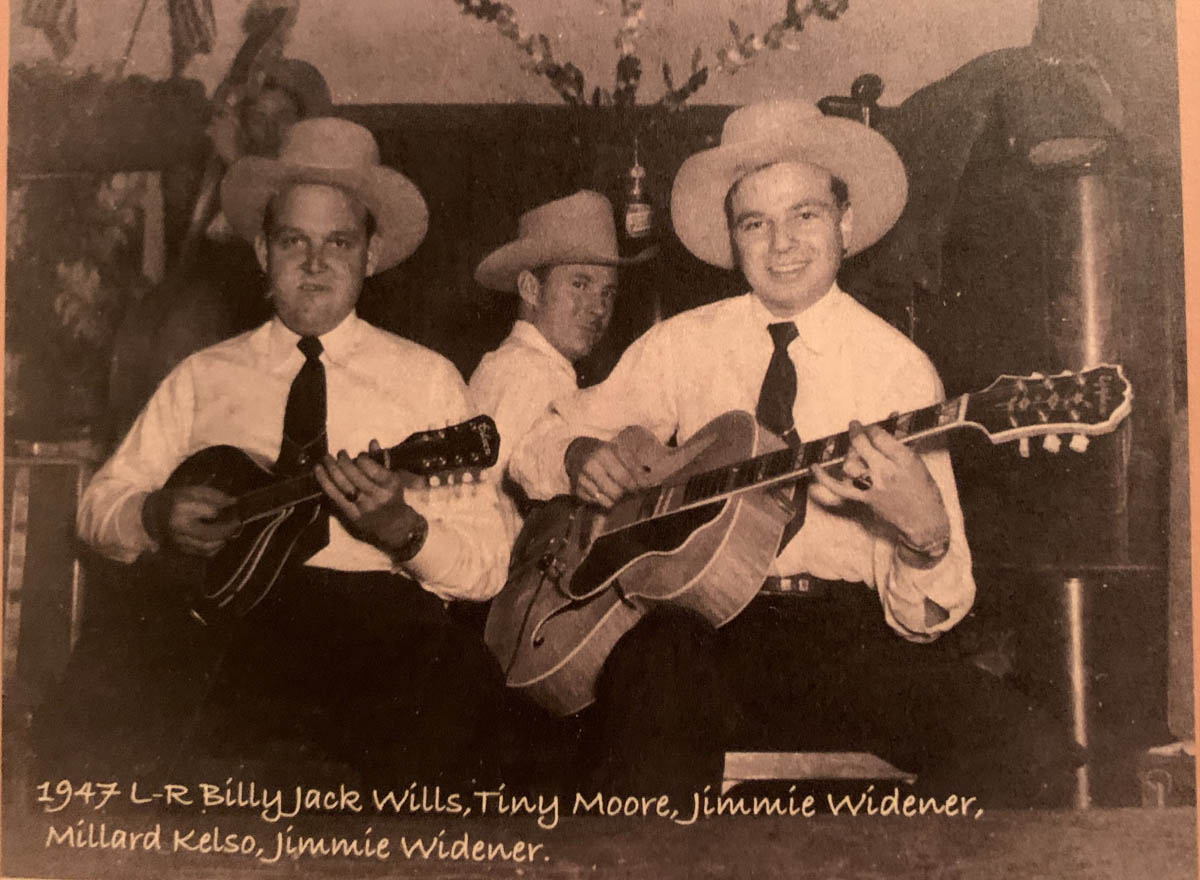
Jimmie Widener born 15 February 1924

Jimmie Widener (February 15, 1924 - 8th September 2001) was a Western Swing musician, singer and songwriter. 

“Oklahoma” Jimmie Widener was born James Leon Widener just northwest of Tulsa, either in Cleveland or 10 miles north across the Arkansas River in Hominy, Osage County. His father Carl was a fiddler and Jimmie took up tenor banjo and was playing around town and on radio by the time he was 6. When the new Tulsa sensations Bob Wills & his Texas Playboys came to Hominy when Jimmie was 10 0r 11, Widener’s father took him to Bob and told him Jimmie was a banjo player, so Bob allowed little Jimmie to play Johnnie Lee’s banjo.” After the gig, Wills told him, “You go ahead and finish your education and when you finish high school, you come wherever I am, and when you do you have a job.”

The Wideners were living 90 miles south in Seminole, Oklahoma by 1940. Although Jimmie was apparently in Illinois in July 1941 when he applied for his social security card, he was back in Seminole when he registered for the draft in June 1942. Soon after that, the Wideners headed to California. Bob Wills was in town filming the last of eight Russell Hayden westerns made for Columbia that year, using a cut down version of the Texas Playboys made up mostly of members of Johnnie Lee Wills’ band. 

Widener decided to take Bob up on the promise made at Hominy seven or eight years earlier. Wills was true to his word and Jimmie played with him over the next few weeks before Wills disbanded his orchestra soon after returning to Tulsa in December and entered the Army. Widener was himself inducted into the Army in late April 1943. He spent the next two and half years in the service, discharged in October 1945 in California. Even before he was fully mustered out, he was sitting in with Spade Cooley’s band. 

Widener was soon rooming with rising star Merle Travis, already an in-demand session man and soon to sign to Capitol Records. Travis had helped inaugurate Syd Nathan’s King label two years before and Nathan enlisted Travis as a West Coast talent scout and A & R man for the label. Among those Nathan signed at Travis’ urging was Jimmie Widener. His sessions for King in March and May and September, 1946 at Universal Recorders in Hollywood had an all-star studio line-up. Although many of the 1946 tracks would not be issued for several years, these would be Widener’s last recordings under his own name until 1952-3. 


Widener worked for a time with T. Texas Tyler, then re-joined Wills when Eldon Shamblin took a leave of absence following the death of his son in early 1947. Following Shamblin’s return, Jimmie went back to Tyler’s band for until rejoining Spade Cooley in 1948. He worked briefly for Wills in late ’48, then joined the Texas Playboys once again when Wills relocated to Oklahoma City for a while in late summer 1949, playing tenor banjo, singing solos and in trios. 

Widener opted to remain in California when Wills returned to Oklahoma after the April recording session. He joined Tex Williams’ Western Caravan, and sang on one of Smokey Rogers Coral releases (“Trouble Then Satisfaction”). He remained with Williams when Rogers took most of the Caravan to San Diego a few months later. He cut some covers of current hits for the Ace-Hi label in 1952, and then cut a fantastic lone session for Imperial in March 1953, featuring Speedy West, Jimmy Bryant, and others. His top-notch cover of the jazzy blues “Red Top” comes from this session. 

During the early 1950's he MC'ed the Tex Williams television show, live from Knotts Berry Farm. He also recorded western gospel sides for the Biblical label in the mid-50s.He later cut a series of transcriptions with a group called the Country Gentlemen, a western act that boasted Sons of The Pioneers legend Hugh Farr on fiddle.  He retired in the 1970's to care for his ailing wife, but later returned to Oklahoma and was active in a number of Texas Playboys-related events through the 1980s-90s, until his health no longer permitted. He died in Seminole in 2001, aged 77. 

Widener’s unique voice was so sincere, fresh and swingin' at the same time. It is hard to understand why his career ended nowhere, especially after the recording sessions at the KING studio and what sessions! The cream of the cream of the Hillbilly Jazz was there! What happened and why the KING recording label, only put out these 1946 recordings in the early 1950's defies explanation. Part of the problem in dealing with Jimmie Widener’s legacy is that there was more than one performer using the name. There was reportedly a Jimmy Widener in the Pacific Northwest and there was unquestionably another musician active in the Southern California western swing scene at the same time named Jimmie Philliip Widener who was often known as “Alabama” Jimmy Widener, to differentiate him from the artist featured here. 

(Edited mainly from articles @ doghouseandbonerecords)