Saturday, 23 September 2023

Ann Dee born 1920

Ann Dee (born 1920*- 22 March 2005) was a singer, music teacher and owner of a 1950s-era San Francisco nightclub that helped start the careers of singers Johnny Mathis and Fran Jeffries and comedian Lenny Bruce. 

She was born Angela Maria De Spirito and raised in Wilkes Barre, Pennsylvania, and filled her high school years with piano and singing lessons. Dee studied at the Curtis Institute of Music in Philadelphia. When the United States entered World War II, her parents, eager to help with the war effort, moved the family to Baltimore, where her father worked as a shipyard welder and her mother was a riveter in an airplane factory. Dee worked at Bethlehem Steel and sang part time in Baltimore cabarets. 

After the war, the De Spirito family moved to Los Angeles. Ann had already changed her name from Angela Maria De Spirito, "everybody did that in those times, all the entertainers," her brother said, and started working clubs and cabarets in the Los Angeles area. Eventually, she worked up and down the West Coast, singing as far away as Alaska, and found herself in San Francisco in the early 1950s. 

With her second husband, John Barrett (who died in 1964), she opened Ann's 440 Club in North Beach, "a nightspot that ranks with the hungry i, Purple Onion, Bimbo's 365 and Fack's as a real landmark. By the mid-1950s, Ms. Dee had developed problems with her vocal cords and sang only on special occasions. Her real metier was in developing talent and working with young performers, he said. To that end, she showcased such newcomers as Jeffries and Bruce. In 1955, she hired a 19-year-old named Johnny Mathis after hearing him sing in a bar just two weeks into his professional career. Columbia Records’ George Avakian was persuaded to visit the 440 Club to hear Mathis and signed him to a recording contract. 

                          Here's "Free Again" from above LP


Then, in 1962, she was padlocked by the government for nonpayment of taxes, and had to sell the club. So Ms. Dee started looking for a job and eventually moved back to Los Angeles where, her voice then recovered, she returned to performing. "She was a very good singer," the director of "Diamond Stud," said Greg Corarito, “and had good lungs."Her brother said, "She was short, just about at 5-foot, but what a voice. She sure could belt it out." In 1967 she recorded an album for Capitol Records titled “Free Again.” 

Ann with Michael Greer 1971

Ann’s grand manner kept her employed in a number of Los Angeles clubs. She was a regular at Ye Little Club in Beverly Hills and had bit parts in a couple of movies. She played "the singer" in the 1967 George Roy Hill picture "Thoroughly Modern Millie," and appeared in a 1970 soft-core porn movie, "Diamond Stud," based on the life of railroad millionaire and bon vivant Diamond Jim Brady. She recorded her second album “With Love” in 1972. 

A Times writer, reviewing her performance at the Wilshire Ebell Theater in 1973, praised her as “a sophisticated singer with a big, belting voice, fine vocal technique and great interpretive skill.” He called her delivery of “Free Again” a “masterpiece of irony” and her singing of “Send in the Clowns” an example of “pure class.” 

She had spent her last years living in Palm Springs, where she ran an antiques and collectibles store during the 1980s, and then in Joshua Tree, California, where she died March 22, 2005 of lung, kidney and heart failure March 22 at the Hi-Desert Medical Center. She was 85. 

(Edited from L.A. Times, SFGate & San Francisco Chronicle) (*Rate Your Records give birth year as 1921)

Friday, 22 September 2023

June Webb born 22 September 1934

June Webb (born September 22, 1934) is American former country music singer-songwriter notable for the song "Looking Glass". She rose to fame in the early 1950s, and had a 11-year career in the country music industry. 

Webb particularly experimented in the honky-tonk side of country music, but varied to gospel. She played the violin and the guitar, and was a talented instrumentalist. She was an inspiration for Loretta Lynn, who later used Webb's main line of her song in her song "Before I'm Over You." 

June Webb was born on September 22, 1934 in L'Anse, a village in the northern County of Baraga in Michigan. She had one sister, Shirley, and one brother, Ford. Her family were working-class, and musically inclined. The family moved to the Brownsville suburb of Miami, Florida in early 1937. She took private dancing and singing lessons, and her father taught her how to play various instruments. Webb attended Earlington Heights Elementary School. 

June & Shirley with Williams

Growing up in the music industry, she begin performing from the age of 6 with her sister Shirley as the "Harmony Sweethearts". They did very well, becoming popular in hotels and various small venues throughout Miami. The sisters used to sing Carter Family songs, and Patsy Montana's million seller smash hit. 

In early 1950, her family decided to go all in show business but as a family band. The family group toured the country, and performed with several Grand Ole Opry acts like Hank Williams. The families were scheduled to perform with Hank the night he died (January 1, 1953). The family moved to Nashville in 1951, due to their big success. Webb was the lead singer, despite being the youngest of three children. 

Webb's soprano voice became noticeable, and she went solo performing on her own in stints at the Grand Ole Opry. In 1954, she signed with RCA Records on a $200 a week contract, but this ended in 1956 after having no success. She signed with the Roy Acuff show as the group's female singer in 1957. One magazine article called her "The Prettiest Smokey Mountain Boy", and Billboard magazine gave her its "Most Promising Female Artist" award as voted on by country & western disc jockeys. 


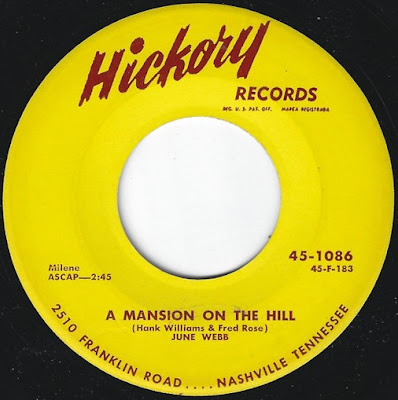
Webb auditioned for Hickory Records in 1959 after Roy Acuff urged them to sign her, and she found herself signing with them a month later. However, before the first recording session she fell off a horse and suffered a broken/fractured leg. This delayed the recording session for three months, as she had a two-month hospital stay and one month of recuperation at home. 

She recorded for Hickory from 1959 until 1964, with three successful songs and five singles released. Her appearances with Acuff's show took her all over the world, including Europe and the Caribbean. She led a very private life. She became a member of the Grand Ole Opry in April 1961, performing regularly on their radio show. 

Webb performed her biggest hit, "Looking Glass", at the Opry on July 30, 1964, when she announced that she was leaving the Roy Acuff show. To the disappointment of the public, she left in September 1964, and was on the verge of retirement, according to a Nashville newspaper. She left Hickory Records in November 1964, but despite plenty of papers saying Webb had retired, she continued to perform within the US for another three months. 

She officially retired in February 1965, though occasionally performed in smaller venues through the mid-1960s. She continued to live a private life in South Nashville. She explored many other avenues; such, as other occupations, artwork and painting and raising a family.  

It wasn’t until August 15, 1992 that June walked out onto the Grand Ole Opry stage for the first time in three decades. She chatted with Roy Acuff on stage and then she sang two songs; I’m So Lonesome I Could Cry and Making Believe. After that she went back into being private person for another 18 years. 

Then in 2010 she issued a compilation CD with a new recording “June Webb then… with a hint of now,” after from which she had unexpected and unplanned country music activities and awards followed by another CD of new recordings in 2015 Reminiscing With June Webb. 

June has now retired from her 'active touring and recording career. 

(Edited from Wikipedia & June Webb Music)

Thursday, 21 September 2023

Papa Jack Laine born 21 September 1873

George Vital "Papa Jack" Laine (September 21, 1873 – June 1, 1966) was an American musician and a pioneering band leader in New Orleans in the years from the Spanish–American War to World War I. He was often credited for training many musicians who would later become successful in jazz music. 

"Papa Jack" Laine, was born in New Orleans. The son of Francois Laine and Bernadine Wink, Laine spent all of his life in or near the city’s 8th Ward (Lower Faubourg Marigny). Laine’s love for music began early. His first drum, a toy, came from bandleader Patrick S. Gilmore's son. By age eleven, Laine had progressed from a toy drum to a field drum purchased by his father at a salvage sale.  As a youth, Laine played in parades with other neighborhood boys using rag-tag homemade instruments. He later moved on to fife and drum type bands, playing tin flutes and penny whistles. Though primarily remembered as a bass drummer, he also played snare drum, full trap set, alto horn and string bass. 

Jack & Blanche

By the age of 16, Laine was an accomplished bandleader of both string bands and brass bands. He also led a large drum and bugle corps during the Spanish-American War. One of Laine's early specialties was playing music for funerals, and by agreement with other New Orleans bandleaders played only in Algiers and Gretna. In 1895, Laine married Blanche Nunez, the daughter of Cuban immigrants. Jack and Blanche had two children, Alfred (b.1895), and Alma (b.1901). 

Near the turn of the century, Laine organized his famous Reliance Brass Band which he lead for nearly 20 years. The market demand for music in the early 1900s eventually called for three separate units of this group, plus four others, the Tuxedo Band, Laine's Band, the Formal Band, and another, with no name at all. As the crave for vernacular dance music grew, Laine also included dance bands, adding pianists, guitarists and string bassists with brass band players. Laine’s love of music and his role in it’s perpetuation is reflected in his creation of a children’s band. Laine often turned his house into a dormitory to ensure performers were available early for picnics, excursions, and out-of-town parades. 

Although segregation laws of the day prohibited blacks and whites from performing together, Laine’s band included lighter-skinned blacks and creoles that he could hire without running afoul of the rule. The age of his musicians spanned the full gamut of years. Some had a great deal of formal musical training while others, none. His bands were made up of readers and fakers (those who could read music and those who could not), a winning combination in playing both standards and the evolving new music. In 1904, he combined New Orleans musicians with St. Louis locals at the St. Louis Exposition in Missouri, playing with the group briefly before returning to New Orleans. 

As a bandleader, Laine hired many musicians, 150 of whom are now identifiable. A third of them became mainstays of early jazz. One of Laine's last jobs before retiring was at Camp Beauregard in Alexandria, LA., organizing and operating bands which included many of his band members who had been drafted during World War I. In 1919 Laine retired from the music business, but played occasionally with his son Alfred "Pantsy" Laine's band. He returned to his old occupation as a blacksmith, working predominantly for the Dennis Sheen Transfer Company in Fauborg Marigny. 


"Papa Jack" started to take on the role of an early New Orleans music legend in November 1939, when the Sunday Times-Picayune ran a story entitled "Hot Music's Granddad Beats Anvil Instead of Drum." When the National Jazz Foundation was organized in New Orleans in 1945, interest in Laine expanded and continued to grow. In January 1959, a recording was made of Laine playing bass drum with cornetist Johnny Wiggs's band. Laine surprised everyone by still being able to play and producing an extremely vibrant, driving bass drum sound that definitely kicked the band along. 

Laine's interviews between 1951 and 1964 give an account of his life and the development of jazz over time. On September 28, 1963, a week after his 90th birthday, the New Orleans Jazz Club honored Laine with a Certificate of Merit at a special function at the Royal Orleans Hotel. In late 1963, the National Educational Television network (NET) did a special entitled "Jack Laine- Patriarch of Jazz."

By the time of his death on June 1, 1966, Laine had regained some of the glory of the days when he was at his peak. Jack Laine was extremely important in the long, extended development of New Orleans jazz. As a legendary figure, he pre-dated Buddy Bolden, and his career continued long after Bolden became incapacitated. As a bandleader and musician, his influence affected the course of jazz and touched many up-and-coming superstars, even after he himself had retired.

(Edited from National Park Service- New Orleans Jazz) 


Wednesday, 20 September 2023

John Dankworth born 20 September1927

Sir John Phillip William Dankworth, CBE (20 September 1927 – 6 February 2010), also known as Johnny Dankworth, was an English jazz composer, saxophonist, clarinetist and writer of film scores. With his wife, jazz singer Dame Cleo Laine, he was a music educator and also her music director. 

Born in Woodford, Essex, he grew up, within a family of musicians, in Walthamstow in its suburb of Highams Park and attended Sir George Monoux Grammar School in Walthamstow. He had violin and piano lessons before settling eventually on the clarinet at the age of 16, after hearing a record of the Benny Goodman Quartet. Soon afterwards, inspired by Johnny Hodges, he learned to play the alto saxophone. 

After studying at London’s Royal Academy of Music and then national service in the army, he began a career on the British jazz scene. In 1949 he attended the Paris Jazz Festival and played with Charlie Parker. Parker's comments about Dankworth led to the engagement of the young British jazzman for a short tour of Sweden with the soprano-saxophonist Sidney Bechet. Dankworth was voted Musician of the Year in 1949. 

In 1950, Dankworth formed a small group, the Dankworth Seven, as a vehicle for his writing activities as well as a showcase for several young jazz players. After three successful years, the group was wound up, although it re-formed for several reunions over the years. Dankworth formed his big band in 1953. 

The band was soon earning plaudits from the critics and was invited to the 1959 Newport Jazz Festival. The band performed at the Birdland jazz club in New York and shortly afterwards shared the stage with the Duke Ellington Orchestra for a number of concerts. Dankworth’s band also performed at a jazz event at New York’s Lewisohn stadium where Louis Armstrong joined them for a set. By now, Cleo Laine's singing was a regular feature of Dankworth's recordings and public appearances and they married in 1958. 


Beginning that year, Dankworth started a second career as a popular composer of film and television scores (often credited as "Johnny Dankworth"). Among his best-known credits are the original themes for two famous British TV programmes, The Avengers (used from 1961 to 1964) and Tomorrow's World, plus the scores for the 1966 films Modesty Blaise and Morgan: A Suitable Case for Treatment.  In 1961, Dankworth’s recording of Galt MacDermot’s African Waltz reached the British charts and remained there for several months. 

Johnny with Cleo Laine

Dankworth’s friendship with trumpeter Clark Terry led to Terry being a featured soloist on Dankworth’s 1964 album The Zodiac Variations, together with Bob Brookmeyer, Zoot Sims, Phil Woods, Lucky Thompson and other guests. Other Dankworth recordings during this period featured many other respected jazz names. During this active period of recording, the Dankworth band nevertheless found time for frequent live appearances and radio shows, including tours in Britain and Europe with Nat King Cole, Sarah Vaughan and Gerry Mulligan, and concerts and radio performances with Lionel Hampton and Ella Fitzgerald. 

Dankworth’s friendship with Duke Ellington continued until the latter’s death in 1974. He recorded an album of symphonic arrangements of many Ellington tunes. Dankworth recorded various symphonic albums with Dizzy Gillespie and the Rochester Philharmonic Orchestra and others.  From 1984 to 1986, Dankworth was professor of music at Gresham College, London, giving free public lectures.  He set up his own record label, Qnotes, in 2003, to reissue some of his old recordings as well as new ones. They include a number with Julian Lloyd Webber, Dudley Moore and members of his family. 

John Dankworth was made a Knight Bachelor in the 2006 New Year's Honours List. Sir John remained an active composer into later life, and he wrote a jazz violin concerto for soloist Christian Garrick to play. This work had its world premier in Nottingham on 1 March 2008 in partnership with the Nottingham Youth Orchestra. 

In October 2009 at the end of a US tour with his wife, Sir John was taken ill. The couple cancelled a number of UK concert dates for the following month. Dankworth did return to the concert stage for just one solo at the London Jazz Festival at the Royal Festival Hall, London, in December 2009. He played his sax from a wheelchair. He also played at John & Cleo's Christmas Show on the 17 December at The Stables in Wavendon. Dankworth died on 6 February 2010, aged 82.

(Edited from All about Jazz & Wikipedia)

Tuesday, 19 September 2023

Peter Van Wood born 19 September 1927


 Peter Van Wood (19 September 1927 – 10 March 2010), was a Dutch-Italian guitarist, singer, songwriter, actor, and astrologer. 

Peter Van Wood was born as Pieter van Houten in The Hague. He began playing guitar when he was fourteen years old, and studied at the Royal Conservatory of The Hague. At the same time he started listening to great jazz guitar players and began playing in small groups in and around the Netherlands. 

He was among the first to use the electric guitar with special effects such as echo and reverb. In 1946 he performed at the London Palladium and in 1947 and 1948 he toured all over the world, including concerts at the Olympia theatre in Paris and at Carnegie Hall in New York City. About this time he acquired his signature guitar, a custom Gretsch White Falcon; this was allegedly a personal gift or "endorsement" from Fred Gretsch, and was humorously dubbed by an Italian TV host "the Texan milkman's guitar". 

In 1949 he moved to Italy. After a series of concerts and shows in Naples, he was contacted by pianist and singer Renato Carosone, who was asked to put together a group for a club's opening night, and the Trio Carosone, with Gegè Di Giacomo on drums, was formed. The trio recorded several albums for the Pathé record label, and then became a quartet with Hungarian Romani musician Elek Bacsik on bass, guitar, and violin. In 1954 Van Wood left the Trio Carosone in order to devote himself to his solo career. He relocated to Milan and formed a quartet, which signed for Fonit and released many successful records. 


Van Wood's most famous song is "Butta la chiave", which prominently features an apparent "dialogue" between the lyrics he sings and the responses of his "singing" guitar, mimicking the negative responses of a wife who is refusing to let her husband back into their house. 

It is unclear whether he made use of a rudimentary wah-wah pedal, a "singin' guitar" device like Alvino Rey, or simply a vibrato-bar to achieve that effect, which astonished Italian audiences with its novelty. His other well-known songs include "Via Montenapoleone", a song about one of the most renowned streets of Milan, "Tre numeri al lotto", "Mia cara Carolina" and "Capriccio". 

In the 1960s he decided to dedicate himself to astrology and started to contribute horoscopes to Italian newspapers and magazines while continuing to make recordings. He opened the Amsterdam 19 night club in Galleria Passarella in Milan where he often performed as a singer and guitarist. 

In 1974 he recorded Guitar Magic an instrumental album for Vedette Phase-6 record label. In 1982 Van Wood recorded the theme song of the Italian television show La Domenica Sportiva. He came again to prominence on Italian television when he took part in the football show Quelli che... il Calcio presented by Fabio Fazio. After this he often appeared as a guest on RAI television shows, discussing astrology. Has recorded 8 albums for Pathé and has participated in four movies. 

In October 2007 he sued Coldplay for one million euros, claiming that the song "Clocks" plagiarized his song "Caviar and Champagne". 

Peter Van Wood died on 10 March 2010 at the Agostino Gemelli University Policlinic in Rome after a long illness. (Edited from Wikipedia) 

Monday, 18 September 2023

Sharon Tandy born 18 September 1943

Sharon Tandy (18 September 1943 – 21 March 2015) was a South African singer who achieved some success in the United Kingdom in the 1960s as part of the blue-eyed soul and psychedelic movements. In 1966, she recorded some songs at Stax studios, a rarity for a white singer. She also had several chart hits in South Africa in the 1970s.

She was born Sharon Finkelstein in Johannesburg in 1943, gifted with a full-throated voice that soon got her noticed locally. By 1964 Sharon had several recordings and movie appearances under her belt, but it was a chance encounter with South African-born Frank Fenter, back home as manager of ex-pat beat group the Couriers, that led to major changes. Sharon went back to the UK with Fenter as both her manager and her partner, and after some months of struggle, he got her signed to Pye and Mercury, where the singer made a handful of state-of-the-art pop singles in 1965 and 1966, including the delectable ‘Perhaps Not Forever.’ 


Sharon appeared on several contemporary television programmes, such as Beat Club. She has been described by Richie Unterberger as "blue-eyed soul singer rather in the mold of Dusty Springfield, both in terms of her voice and her versatility, blending various shades of soul, British pop, and even some tinges of mod-psychedelia." Her voice has also been compared to those of Julie Driscoll and Christine Perfect. 

With Fenter ensconced as UK label manager of Atlantic, he engineered a major coup in getting Sharon aligned with Stax and she was dispatched to record with Isaac Hayes and Booker T & The MGs in Memphis in November 1966, the first non-American artist to do so. Though she taped several tunes there, only the pumping ‘Toe Hold’ saw release in early 1967, around the time Sharon got to open for the Stax/Volt tour in the UK. 

Her next record is the one Sharon Tandy is best known for. The intended A-side was a cover of ‘Stay With Me Baby,’ but heavy continental airplay saw the flip ‘Hold On’ get the nod. On this molten disc, Sharon’s breathy vocal was accompanied by the powerhouse sounds of the Fleur De Lys, Fenter’s house band and a legendary act in their own right. They would back Sharon on several other freakbeat gems, including ‘Daughter Of The Sun,’ and in time she and guitarist Bryn Haworth became a couple. 

Though she released a steady flow of singles through to the end of the decade, Sharon never really capitalized on the small amount of noise that ‘Hold On’ had made, despite some memorable discs such as ‘You’ve Gotta Believe It’ and ‘Gotta Get Enough Time.’ The young woman also encountered a run of bad luck that led to fractured relationships and ill-health, and by 1971 she was back in South Africa. Sharon forged a new career for herself in the 1970s and 1980s, singing on several local hits with Billy Forrest and Graham Clarke, and she also started a family. 1989, she appeared in the South African boxing film Brutal Glory as a singer. 

But back in the UK and beyond, thanks to that run of notable singles, Sharon graduated from an intriguing mystery for collectors to boasting a cult following as a veritable mod-goddess, fuelled by an occasional glimpse of her sultry Vidal Sassoon-ed promo shots, or the heavy rotation of ‘Hold On’ at any retro club you might encounter. 

After her return to the UK, nostalgic interest in 2004 resulted in her playing a gig at London's 100 Club; a reviewer commented "the band struck up with a couple of driving soul numbers and were then joined by the diminutive Tandy to a rapturous reception. The smile on Sharon's face could have lit up a small town and did not once dim throughout the show... Sharon simply radiated enjoyment, absolutely loving the opportunity to be singing again." 

Sharon Tandy died in London on 21 March 2015, after a long illness. 

(Edited from Ace Records & Wikipedia) 

Sunday, 17 September 2023

Jerry Colonna born 17 September 1904

Gerardo Luigi "Jerry" Colonna (September 17, 1904, Boston, Massachusetts - November 21, 1986, Woodland Hills, California) was an Italian-American comedian, singer and songwriter, remembered best as the zaniest of Bob Hope's sidekicks on Hope's popular radio shows and films of the 1940s and 1950s. 

With his pop-eyed facial expressions and walrus-sized handlebar mustache, Colonna was known for singing loudly "in a comic caterwaul," according to Raised on Radio author Gerald Nachman, and for his catch phrase, "Who's Yehudi?", uttered after many an old joke, although it usually had nothing to do with the joke. The line was believed to be named for violin virtuoso Yehudi Menuhin, and the search for Yehudi became a running gag on the Hope show. 

Colonna started his career as a trombonist in orchestras and dance bands in and around his native Boston; he can be heard with Joe Herlihy's orchestra on discs recorded for Edison Records in the late 1920s. During the 1930s, Colonna played with the CBS house orchestra, the Columbia Symphony Orchestra, and developed a reputation for prankishness. His off-stage antics were so infamous that CBS nearly fired him on more than one occasion. Fred Allen, then on CBS, gave Colonna periodic guest slots, and a decade later he joined the John Scott Trotter band on Bing Crosby's Kraft Music Hall. 

Colonna married Florence Purcell, whom he reportedly met on a blind date in 1930; the couple adopted a son, Robert, in 1941. The marriage lasted 56 years.  In an opera parody, Colonna hollered an aria "in a deadpan screech that became his trademark on Bob Hope's show," Nachman noted. Colonna was one of three memorable 1940s Kraft Music Hall discoveries. The others were pianist-comedian Victor Borge and Trotter's drummer, music "depreciationist" Spike Jones. 


Colonna had the ability to stretch a syllable to extreme lengths. In addition to songs (such as "Aaaaaaaaaaaaaaaaaaall, or nothing at aaaaaaaaaaaaaaaaaaall..."), he worked this bit into The Road to Rio along with another of his catch phrases. The action periodically cuts to a cavalry riding to the rescue of Bing and Bob. At one point he exhorts his riders, Chaaaaaaaaaaaaaaaaaarge!" At the end of the film, when all is resolved and he is still "charging," he pulls up and tells the audience, "Well, what do you know... we never quite made it. Exciting, though... wasn't it?!" 

Colonna's persona also spawned nonsensical catch phrases that he would usually utter upon entrance. "Who's Yehudi?" and "Greetings Gates, Let's Operate!" were his two most famous, always eliciting laughter even without context, justification, or logic. Occasionally those on the Hope show would use such a line sans Colonna as an ad-lib - always a sure fire laugh. The "Who's Yehudi (sometimes spelled Yahoodi)" craze spawned a song that became a best selling 78 covered by several bands of the era. Colonna was part of several of Hope's early USO tours during the 1940s. Jack Benny's singing sidekick Dennis Day, a talented impressionist as well as a singer, did an effective imitation of Colonna's manic style and expressions. 

 Colonna joined ASCAP in 1956; his songwriting credits include "At Dusk", "I Came to Say Goodbye", "Sleighbells in the Sky" and "Take Your Time." He released an LP of Dixieland-style music, He Sings and Swings (Mercury-Wing MGW 12153), in the late 1950s.  Colonna featured in three of the popular Hope-Crosby Road films: The Road to Singapore (1940) as Achilles Bombassa and The Road to Rio (1947) as a Cavalry captain and a cameo role in The Road to Hong Kong (1962). He can also be seen in the 1945 Fred Allen vehicle, It's in the Bag!, as psychiatrist Dr. Greenglass, and he made a brief appearance with Hope in the "Wife, Husband and Wolf" sketch in Star-Spangled Rhythm. 

Colonna left the Hope show as a regular in 1950, but he continued appearing with Hope on holiday television specials and live shows into the 70's. He hosted his own television comedy series, The Jerry Colonna Show which lasted a single season. After his guest shot on The Monkees, Colonna suffered a stroke. Its paralytic effect forced his retirement from show business, and a 1979 heart attack forced him to spend the last seven years of his life in the Motion Picture and Television Hospital. With much of his body paralyzed, one of his few visitors remained Bob Hope, who always made a point of providing Colonna with money. Unable to perform, Colonna put his creative energy towards writing a novel titled The Loves of Tullio.  Florence stayed by his side to the end, when he died of kidney failure on November 21, 1986. She died eight years later at the same hospital. 

 (Edited from Wikipedia & blog.wmfu)