Wednesday, 24 May 2023

Charles Earland born 24 May 1941

Charles Earland (May 24, 1941 – December 11, 1999) was an American jazz organist. 

Charles Earland came into his own at the tail-end of the great 1960s wave of soul-jazz organists, gaining a large following and much airplay with a series of albums for the Prestige label. While heavily indebted to Jimmy Smith and Jimmy McGriff, Earland came armed with his own swinging, technically agile, light-textured sound on the keyboard and one of the best walking-bass pedal techniques in the business. Though not an innovative player in his field, Earland burned with the best of them when he was on. His hard, simmering grooves earned him the nickname "The Mighty Burner". 

Earland actually started his musical experiences surreptitiously on his father's alto sax as a kid, and when he was in high school, he played baritone in a band that also featured fellow Philadelphians Pat Martino on guitar, Lew Tabackin on tenor, and yes, Frankie Avalon on trumpet. After playing in the Temple University band, he toured as a tenor player with McGriff for three years, became infatuated with McGriff's organ playing, and started learning the Hammond B-3 at intermission breaks. 

When McGriff let him go, Earland switched to the organ permanently, forming a trio with Martino and drummer Bobby Durham. He made his first recordings for the obscure Choice label  in 1966, then joined Lou Donaldson for two years (1968-1969) and two albums before being signed as a solo artist to Prestige. Earland's first album for Prestige, Black Talk!, became a best-selling classic of the soul-jazz genre; a surprisingly effective cover of the Spiral Starecase's pop/rock hit "More Today Than Yesterday" from that LP received saturation airplay on jazz radio in 1969. He recorded eight more albums for Prestige, one of which featured a young unknown Philadelphian named Grover Washington, Jr., then switched to Muse before landing contracts with Mercury and Columbia. 


By this time, the organ trio genre had gone into eclipse and there followed a succession of successful jazz / soul / funk albums including 'Odyssey' in 1976, featuring 'Intergalactic Love Song', 'The Great Pyramid', featuring 'Driftin' and perhaps his best remembered album from this period 'Perceptions', featuring the Randy Muller (Brass Construction) produced 'Let The Music Play'. The record was in the U.S. charts for five weeks and reached number 46 in the UK Singles Chart. With Earland's playing on synthesizer, the track also had his wife Sheryl Kendrick as an uncredited singer. 

He moved into the Eighties with 'Coming To You Live' featuring 'The Woman In You' and the title track. Charles' 1981 album release, 'Pleasant Afternoon' featured the song 'Murilley', which became highly popular on the Acid Jazz scene at the time. There were further CBS outings with 'Street Themes' and 'Earland's Jam'. In 1983 he released an odd twelve inch single entitled 'It's A Doggie Boogie, Baby', popular on the UK dancefloors. 

Kendrick's death from sickle-cell anemia in 1985 left Earland desolate, and he stopped playing for awhile, but a gig at the Chickrick House on Chicago's South Side in the late '80s brought him out of his grief and back to the Hammond B-3. Two excellent albums in the old soul-jazz groove for Milestone followed, and the '90s found him returning to the Muse label. 

Earland traveled extensively from 1988 until his death in 1999, performing throughout the U.S. and abroad. One of the highlights of his latter years was playing at the Berlin Jazz Festival in 1994. Among the musicians that performed with him at the Berlin Jazz Festival was the Alabama-born Chicago resident, Zimbabu Hamilton on the drums. 

 Earland died of heart failure on December 11, 1999, the morning after playing a gig in Kansas City; he was 58. 

(Edited from AllMusic & Wikipedia)

Tuesday, 23 May 2023

Artie Shaw born 23 May 1910

Artie Shaw (May 23, 1910 – December 30, 2004) was an American clarinetist, composer, and bandleader and also an author. 

Arthur Arshawsky was born and raised in Connecticut, Shaw took up the saxophone at an early age and began playing professionally when he was only 14. He left home at 15 for a job in Kentucky. The position never materialized and he was forced to play with traveling orchestras in order to get home. At age 16 he switched to the clarinet and went to Cleveland, where he spent three years playing in local groups, including that of Austin Wylie. 

In 1929 Shaw joined Irving Aaronson's Commanders. While traveling the country with the band he discovered the works of contemporary avant-garde classical composers whose influence would later surface in his own music. When the Commanders arrived for a gig in New York, Shaw decided to remain. There he freelanced with many of the top artists of the day, including Vincent Lopez, Red Nichols, and Teddy Wilson. He also briefly spent time with Fred Rich's orchestra and toured with Roger Wolfe Kahn. 

In 1934 Shaw became disillusioned with the music industry and quit for the first of what would be many times. He bought a farm in Pennsylvania and tried his hand at being a writer. He soon returned to New York and took up studio work again. He was one of the most successful studio musicians in the city when in 1935 he was asked to lead a small group during intermissions at a swing concert held by the Imperial Theater. He put together an unusual outfit consisting of a string quartet, a rhythm section minus piano, and his clarinet. 

Shaw's unique combination was wildly received by the audience. He was offered financial backing to form his own orchestra, and in 1936 he debut his first dance band, which featured a Dixieland approach and a string quartet. The new group made some impressive recordings but couldn't compete with the brassier swing orchestras of the day, so Shaw disbanded it the following year and formed a more conventional big band. 

Shaw with Helen Forrest

His new outfit was a huge success, featuring such musicians as Georgie Auld, Buddy Rich, Tony Pastor, and Jerry Gray. Vocalists included Billie Holiday, Kitty Kallen, Peg LaCentra, and Helen Forrest. In September of 1938 Shaw collapsed on stage due to exhaustion. He was also absent from the band in the summer of 1939 due to illness. Upon his return to good health he announced he was quitting the business again but was talked out of it by Gray and Pastor. He didn't stay long however. He left in November and moved to Mexico. 


Shaw returned to the U.S. two months later and formed a 32-piece studio orchestra which recorded several songs, including his famous version of ''Frenesi.'' Later in the year, he formed a new band of his own that included the now famous Gramercy Five. Ray Conniff arranged for the new group and Anita Boyer sang. Shaw again grew restless and disbanded his new outfit in early 1941. He formed another group in the fall of that year. Vocalists included Bonnie Lake, Paula Kelly and Fredda Gibson (later to become Georgia Gibbs). He also disbanded this group soon after starting it, in January of 1942. 

In April Shaw joined the Navy. After going through boot camp and serving two months on a minesweeper he was put in charge of a service band. He shaped up the group and took it on a tour of Pacific combat zones, often playing in dangerous and primitive conditions. The strain of such an endeavor soon got to him, however, and he was medically discharged in November 1943. 

By fall of 1944 Shaw's health had recovered and he formed a new civilian band, which included Conniff, Barney Kessel, Roy Eldridge, and Dodo Marmarosa. Imogene Lynn provided vocals. By 1947 he had quit that group and taken up the study of classical clarinet, for which he performed and recorded an album. In 1949 Shaw formed a bop orchestra. He again quit the music industry in 1951 and retired to a farm, where he wrote his autobiography. 

In 1954 he returned briefly to music with a new Gramercy Five, but by the end of the year Artie Shaw had packed up his clarinet for the last time. He spent the rest of his life doing various concerns: writing and working briefly as a film distributor and a gun expert. 

He moved to Spain in 1955, to Connecticut in 1960, and to Southern California in 1973. In the 1980s he formed a new orchestra for special performances, though he did not play in it himself. The 1985 film documentary Time Is All You've Got traced his career in some detail. Shaw suffered from ill health the last few years of his life. He passed away on December 30, 2004. Shaw had been diabetic since the 1980s. 

(Edited from Parabriscas.com)


Monday, 22 May 2023

Mack Self born 22 May 1930


Wiley Laverne "Mack" Self (22 May 1930 – 14 June 2011) was an American rockabilly singer, songwriter and musician and was a member of the Rockabilly Hall of Fame. 

Mack Self is one those unsung heroes at Sun Records whose rockabilly was closer to the country end of the spectrum than the rock 'n' roll one. Though he had a mere two singles released by Sam Phillips, one on Sun and one on Phillips International, Sam persevered with him over a period of some four years (1955-59). 

Self was born in Calico Bottoms, Phillips County, Arkansas, one of four children, and started playing guitar as a child, often performing with his friend C.W. Gatlin. In 1955, after playing on radio station Kxjk in Forrest City, Arkansas, disc jockey Hal Webber encouraged him to make a recording of his song "Easy to Love". The demo recording then found its way to Sam Phillips of Sun Records, who invited him to audition. Self's first recordings were not released, but Phillips encouraged him to write more songs. He returned to the recording studio in March 1957 to work with producer Jack Clement, and re-recorded "Easy to Love" along with several new songs on which he was backed by guitarist Therlow Brown and bass player Jimmy Evans. 

"Easy to Love" was then released in 1957 as Sun 273, but by that time its style was regarded as somewhat old-fashioned and it was not a hit. Sam Phillips was now spending most of his promotional budget on Jerry Lee Lewis. However, Self returned to the recording studio in 1959, and released a second single, "Mad At You" / "Willie Brown". He continued to perform despite his lack of recording success. He also continued to write songs, setting up his own publishing company. 


For all his back-country charm, Mack Self remains beloved by rockabilly fans and collectors. This is pretty easy to understand. Years of Sun archaeology has unearthed undeniable rockabilly gems by Mack like Vibrate and Lovin' Memories. Although they were never released during the 1950s, these tracks provide strong credentials for Mack's Hall of Fame status. At a personal level, Mack Self is a man who, as Johnny Cash sang, "was there when it happened." Self's sessions included players like Roland Janes, Stan Kesler, Jimmy Van Eaton, Johnny Bernero, W. S. Holland, Billy Riley and Martin Willis. 

The man in the control room hitting the record button was either Jack Clement or Sam Phillips. The bottom line is that Mack's name appears on nearly a dozen tape boxes full of songs recorded at what he calls "that little ole rinky dink studio" in Memphis. He's the real deal. In fact, it's good to remind ourselves that Sam Phillips auditioned both Mack Self and Harold Jenkins (a/k/a Conway Twitty) – an Arkansas running buddy of Mack's – at just about the same time. Phillips passed on Twitty and decided to work with Mack. 

In 1962 and 1964, Mack recorded six songs for the Zone label in Memphis, with producer Chips Moman. These were all country, as were the recordings he made in the early 1970s for Twin Records. Self quit the nightclub circuit in 1963, devoting his time to raising his six children and to running his heating, air and sheet metal business in Helena, Arkansas. He returned to undertake occasional performances after 1992, with his Silver Dollar Band, and was inducted into the Rockabilly Hall of Fame in 1993. 

Mack Self died on June 14, 2011 in West Helena, Arkansas. 

(Edited from Wikipedia, & Bear Family Records)

Saturday, 20 May 2023

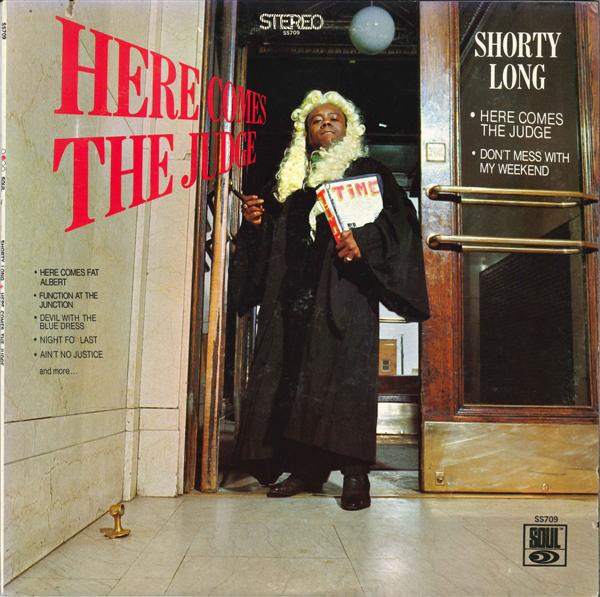
Shorty Long born 20 May 1940


Frederick Earl "Shorty" Long (May 20, 1940 – June 29, 1969) was an American soul singer, songwriter, musician, and record producer. Standing a little over five feet in height, he was one of the funkiest singers to record at Motown Records. 

Long was born in Birmingham, AL. While growing up he learned about music from people like Alvin "Shine" Robinson and W.C. Handy. The multi-talented singer could play piano, organ, drums, guitar, trumpet, harmonica, and was probably an excellent hand clapper. In Birmingham he worked as a DJ, toured with the Ink Spots, and gigged at club called Old Stables. In 1959, Long moved to Detroit, caught the ear of Harvey Fuqua, and cut two singles for Fuqua's Tri-Phi label. "I'll Be Here," backed with "Bad Willie," came out in 1962 and went unnoticed; the follow-up, "Too Smart," released later in the year, stiffed as well. Fuqua, tired of fighting with distributors and doing all the things it takes to run a label, decided to sell his operation to Berry Gordy, and Shorty Long became a Motown artist. 

His first release, "Devil With the Blue Dress On," was a slow bluesy grinder with a stinging solo guitar that accented the break. Long and William Stevenson wrote "Devil" and it had all the ingredients of a hit but, for some reason, didn't chart. His next release, "It's a Crying Shame," did nothing. Then came what should have been a million seller -- Long's funky name-dropping soulful "Function at the Junction"; written by Shorty Long and Eddie Holland, the song had it all, funky beat, soulful singing, good lyrics, danceability, everything, yet it only climbed to the number 97 position on the pop chart in 1966. His classic remake of the Big Bopper's "Chantilly Lace" received some spins but failed to impact, despite a cool spoken intro by Long and a rollicking honky tonk piano. Ironically, his next release, "Night Fo' Last," went to number 75 on Billboard's Top 100, 22 slots better than "Function," and the song isn't half as good, a good effort that got lost in the mix. 


Shorty Long had to wait until 1968 before he had his first bona fide hit in the music business. "Here Comes the Judge" was a popular catch phrase, partly because of Flip Wilson, but it was funnyman Pig Meat Markum who really coined the phrase years earlier. "Here Comes the Judge," a funky record that had some nifty lyrics and a percolating, bubbling beat, and zoomed all the way to number eight on the charts. An excellent LP was released, which included his hits, should-have-been hits, and some new stuff like "Don't Mess With My Weekends" and "Here Comes Fat Albert." Oddly, "It's a Crying Shame" and "Chantilly Lace" weren't included, nor were the Tri-Phi singles. 

Motown released a second LP, The Prime of Shorty Long, and like the first it showcased the many talents of the diminutive singer. Before his death, Motown allowed Shorty to produce himself; the only other Motown singer allowed to do this was Smokey Robinson. The late Earl Van Dyke, Motown's session pianist, says Shorty used to come in and say, "Today we ain't playing nuthin' but funk, if you don't feel funky, take a drink of this," and then he'll reach in his coat and pull out a bottle of liquor. 

Whatever plans Motown might have had for Shorty Long came to a halt on 29 June 1969. An obsessive and accomplished fisherman, he liked nothing more than to get out on his small boat and while away his free time in pursuit of the catch of the day. He and his friend Oscar Williams were fishing on the Detroit River, close to the point where Northern America becomes Canada, when their boat ran into the slipstream of a freighter and capsized. Too far away from land for either man to swim to safety, they both drowned. 

Stevie Wonder played the harmonica at Shorty’s burial in Birmingham and placed it on his casket afterwards. Writer Roger Green's epitaph stated: "So there endeth the career of a man who sang what he wanted to sing – everything from the blues to romantic ballads, from wild and crazy numbers to a utopian vision of Heaven on Earth. Short in stature but big in talent, he entertained and amazed us, and finally he inspired us." 

Motown released Long's final album, The Prime of Shorty Long, in November 1969, five months after his death. He was inducted into the Alabama Jazz Hall of Fame in 1980. 

(Edited from AllMusic, CD liner notes &Wikipedia)

Friday, 19 May 2023

Sonny Fortune born 19 May 1939

Cornelius "Sonny" Fortune (May 19, 1939 – October 25, 2018) was an American jazz saxophonist. Fortune played soprano, alto, tenor, and baritone saxophones, clarinet, and flute. 

Born in Philadelphia, Pennsylvania, Fortune attended the Wurlitzer and Granoff music schools and performed with local R&B bands in his teens. Influenced early on by such players as Charlie Parker, Sonny Rollins, and John Coltrane, Fortune was 18 before he decided to pursue a career in music exclusively. He played with the singer Carolyn Harris up to 1967 when he moved to New York City and quickly found work with several name artists, including drummer Elvin Jones and percussionist Mongo Santamaria, with whom he would play for two years. 

Around 1970 Fortune performed with Leon Thomas. He was also asked join McCoy Tyner's group and ended up performing with the legendary pianist from 1971 to 1973. During this time, Fortune also recorded with drummer Buddy Rich and even turned down an invitation to join Miles Davis' fusion ensemble, choosing to stick with Tyner. However, in 1974 Fortune finally accepted and replaced saxophonist David Liebman in Davis' group. Although he was only with Davis for a year, it was a fruitful time and Fortune appeared on several albums including Big Fun, Get Up with It, Agharta, and Pangaea. The last two recorded live in Japan. 

                Here’s “This Side of Infinity” from above album.


Fortune joined Nat Adderley after his brief tenure with Davis, then formed his own group in June 1975 and during the remainder of the decade released several albums including 1975's Awakening, 1977's Serengeti Minstrel with trumpeter Woody Shaw, and 1977's Waves of Dreams. Also during the '70s, he worked with cornetist Nat Adderley as well as the Elvin Jones Jazz Machine. 

Although his own discography was sparse throughout the '80s, Fortune continued to perform, favouring a more commercially oriented style in his recordings than in his performances.. He joined  the Coltrane Legacy Band in 1987 along with Tyner, Jones, and bassist Reggie Workman. 

In the '90s Fortune's solo work kicked into high gear and he released several acclaimed records for Blue Note, including 1994's Four in One, 1995's A Better Understanding, and 1996's From Now On. He has also performed with Roy Brooks, Buddy Rich, George Benson, Rabih Abou Khalil, Roy Ayers, Oliver Nelson, Gary Bartz, Rashied Ali, and Pharoah Sanders, as well as appearing on the live album The Atlantic Family Live at Montreux (1977). 

During the following years Fortune continued to perform around the world and released a steady stream of albums, including his 2000 tribute album In the Spirit of John Coltrane, 2003's Continuum, 2007's standards album You and the Night and the Music, and 2009's live album Last Night at Sweet Rhythm. It is at the Smoke, a club where he has often performed in recent years, that from July 13 to 15, 2018 Sonny Fortune delivered his last concert during several evenings which received a warm welcome precisely because of his unfailing commitment to jazz, which he had served so brilliantly throughout an exceptional artistic career. 

He died in Manhattan on October 25, 2018 due to complications of a stroke. He was 79 years old. 

(Edited from AllMusic, New Grove Dictionary of Jazz, Jazz Hot & Wikipedia.) 

Thursday, 18 May 2023

Lou Bennett born 18 May 1926


Lou Bennett (May 18, 1926 – February 10, 1997) was an American jazz organist. 

Lou Bennett was born Jean-Louis Benoît in Philadelphia. His father, who came from Martinique/French West Indies abandoned him at birth. Lou learned how to play piano from his mother, but he was actually raised by his grandparents. His grandfather was a Baptist pastor, his grandmother taught him to accompany the hymns of the church on piano or harmonium. Lou´s first exposure to the organ came in his grandfather's church in Maryland where he learned to play gospel music. He continued to play piano through his teens and while living in Baltimore, learned the shoe repair trade and played as an amateur pianist in Baltimore. 

During his military service in Georgia and Alabama (1943-1946) he played tuba in the army brass band; it is undoubtedly that by playing this instrument, he took a fancy to low, opulent tones, further developing his appreciation for bass work, which lead him to play Hammond organ. After military service he returned to shoe repairing in Baltimore but at the same time formed a jazz trio, fashioned after Nat King Cole's popular group (shoemaker during the day, musician at night, sometimes sleeping in his car for a few hours, while waiting for the store to be opened by its owner). 

This trendy move was interrupted, however, when Lou heard what Bill Davis was doing with the Hammond organ - it was during this time that Lou became interested in electronics, and after hearing Davis he bought an organ. 1949 was to become an influential year for numerous pianists, some of which would surface in the organ revolution that followed Bill Davis' era. These younger lions included Jimmy Smith, Johnny "Hammond" Smith and Lou Bennett. It was now time for this shoe repairman to use his own shoes on the foot pedals of his newly acquired Hammond organ and hone his bass work striving for virtuosity and in 1951 he turned professional. 

Lou gained notification in Baltimore and, because of his success, he decided to go to New York in 1955, where he met artists agents, who made him tour all over the US, except for the West coast. He had a list of appearances which included the more important clubs of New York (notably Minton´s and Small´s Paradise) and hot spots throughout the East coast and Midwest, touring until 1959. He was also distinguishing himself with his increasingly proficient footwork. 


In 1959, Lou's good friend, Babs Gonzales, introduced him to a man named Daniel Filipacchi, chief editor of Europe 1 (one of France's big radio stations), they met in New York. Filipacchi invited him to come to France, to make the organ known to the French Jazz lovers, and booked Lou in the 'Blue Note' club in Paris the following year. So Lou Bennett unloaded his Hammond B3 in Le Havre in 1960. He took Paris by storm, becoming an overnight star on the jazz scene there. In a 1961 poll, he was voted number  organist over Jimmy Smith and Wild Bill Davis, and his overall popularity in France was superior to that of Count Basie, Miles Davis, and other American jazz stars. 

Bennett never succeeded in confirming his success, because of his quasi-obsession with the electronic parts of his organ. He was continually striving to find the perfect sound, and to find as many sounds as he could in order to better express himself. A part of his obsession concerned the bass played with his feet on the pedalboard. 

Having an astonishing bass-playing technique, he continually searched for ways to better its sound as if to suggest an additional member of the rhythm section. The common practice was for organists to play the bass with their left hand and to move their left foot along with the rhythm of the tune. Lou returned to America only once, for the 1964 Newport Jazz Festival. He also recorded in the 1960s with Philip Catherine, Shirley Bunnie Foy and Franco Manzecchi. In the 1980s he played in his own quintet with Gerard Badini, among others. Throughout his career Lou led his own groups: trios, a quintet during the 1980´s, and a quartet by the end of the decade. 

Many of Bennett’s opportunities were ruined because of faulty wiring and breakdowns of his “Bennett Machine” that he had created. Bennett had little interest in financial gain or publicity. He would accept low-paying contracts for as little as a meal and traveling expenses. Often he would repair his organ on stage, interrupting his concert to do so. Having performed all over Europe, he met with a great deal of success in Spain, and built a house there with room for his electronic experiments. His music took priority over his marriage, although he and his wife remained together up until the time of his death. 

His last album 'Now Hear My Meaning' (Mas I Mas) was recorded in 1992. With an international recognition for more than 30 years of career, Lou Bennett is considered as a true 'teacher' and one of the big organists of the Jazz world by the specialized critic, musicians and fans. Lou passed away February 10, 1997 at a hospital in Le Chesnay, outside of Paris.He was 70 years old.

(Edited from Rutgers & Andre Conduant’s website)

Wednesday, 17 May 2023

Jesse Winchester born 17 May 1944

James Ridout "Jesse" Winchester Jr. (May 17, 1944 – April 11, 2014) was an American-Canadian musician and songwriter. 

Winchester was born at Barksdale Army Air Field, near Bossier City, Louisiana, United States, and raised in northern Mississippi through age 12, when his family relocated to Memphis, Tennessee. Winchester was one of three children.

He graduated from Christian Brothers High School in Memphis in 1962 as a merit finalist, a National Honor Society member and the salutatorian of his class. He graduated from Williams College, in Williamstown, Massachusetts, in 1966. Upon receiving his draft notice the following year, Winchester moved to Montreal, Quebec, Canada, to avoid being drafted into the US military while the US was involved in a war with Vietnam. “I just didn’t believe in the war,” he told Graham Rockingham of the Hamilton Spectator in 2011. 

Winchester began playing guitar in bands while still in high school. He played in Germany during college study abroad and after graduation. Upon arriving in Quebec in 1967, he joined a local band, Les Astronautes. He also began writing songs, which he performed as a solo artist at the Montreal Folk Workshop and at coffeehouses throughout eastern Canada, adding impetus to a revival in folk music that was taking place across Canada. Under the auspices of the Band's Robbie Robertson, another Canadian, Winchester began his recording career in 1970 with a self-titled album released on the Ampex label. 

Winchester released several albums during the 1970s. Because of his status as a draft-evader, entailing that he was subject to arrest had he entered the country, he was unable to tour in the United States, and he became recognized primarily as a songwriter. His best-known songs include "Yankee Lady", "The Brand New Tennessee Waltz", "Mississippi, You're on My Mind", "A Showman's Life", "Biloxi", "That's a Touch I Like", and "Every Word You Say". These and others have been recorded by numerous artists. His 1970 recording of his song "Black Dog" preceded the release of Led Zeppelin's different song of the same name by a year. 


In 1974, Winchester often performed at the Hotel Le Chatelet in Morin Heights, Quebec, run by several expatriate Tennesseans who had come to Canada in 1972. David "Butch" McDade and Jeff "Stick" Davis moved to Quebec to become part of Jesse Winchester and the Rhythm Aces. Winchester was the first to record the songs "Third Rate Romance" and "The End Is Not in Sight", both written by Russell Smith. Smith traveled to Montreal to assist in the recording of the album Learn to Love It at Studio Six. Smith, Davis and McDade later were original members of the Amazing Rhythm Aces. 

Upon his election in 1976, President Jimmy Carter declared he would grant amnesty to draft evaders, except those who had deserted or had become citizens of another country. Winchester had by then become a Canadian citizen, but Barry Bozeman, his manager at the time, convinced Carter on Winchester's behalf to broaden the amnesty. Winchester's first appearance in the U.S. was a sold-out performance in Burlington, Vermont, on April 21, 1977. On June 10 he appeared alongside Little Feat, Emmylou Harris and Bonnie Raitt on Burt Sugarman's The Midnight Special. 

Winchester was nominated for the Best Country Male Vocalist award at the Juno Awards of 1990. In 2002, he moved back to the United States, settling in Memphis with his girlfriend, Cindy. That year, his song "Step by Step", from the album Let the Rough Side Drag, was used as background music for the montage that ended the first season of the television program The Wire. He received a Lifetime Achievement Award from the American Society of Composers, Authors and Publishers in 2007. Winchester continued to record and perform throughout the United States and Canada, releasing his tenth studio album, Love Filling Station, in 2009. 

In 2011, Winchester was diagnosed with cancer of the esophagus and underwent treatment for the next couple of months. He was later given a clean bill of health from his doctor and resumed touring. Quiet About It, a tribute record to Winchester, was released in 2012, featuring James Taylor, Lyle Lovett, Lucinda Williams, Rosanne Cash and Jimmy Buffett, who spearheaded the project, among others. 

In April 2014, it was revealed that Winchester was gravely ill and receiving hospice care at his home, in Charlottesville, Virginia. He died there on the morning of April 11, 2014, aged 69, from bladder cancer. His final CD, A Reasonable Amount of Trouble, was released in September 2014, with liner notes by his friend Jimmy Buffett. It was nominated for two Grammy awards. Rolling Stone called it "a gentle collection of playful songs about love, memory and gratitude that amounts to one of the most moving, triumphant albums of Winchester's 45 year career." 

(Edited from Wikipedia)