Monday, 25 January 2021

Antonio Carlos Jobim born 25 January 1927

Antônio Carlos Brasileiro de Almeida Jobim (January 25, 1927 – December 8, 1994), also known as Tom Jobim ), was a Brazilian composer, pianist, songwriter, arranger and singer. Widely considered as one of the great exponents of Brazilian music, Jobim internationalized bossa nova and, with the help of important American artists, merged it with jazz in the 1960s to create a new sound with remarkable popular success. As such he is sometimes known as the "father of bossa nova". 

“Tom” Jobim—as he was popularly known—first began playing piano when he was 14 years old, on an instrument given to his sister by their stepfather. He quickly showed an aptitude for music, and his stepfather sent him to a series of highly accomplished classically trained musicians for lessons. During the course of his studies, Jobim was particularly inspired by the music of Brazilian composer Heitor Villa-Lobos (1887–1959), whose Western classical works regularly employed Brazilian melodic and rhythmic materials. When it came time to choose a career, Jobim initially showed no interest in pursuing music professionally, opting instead to become an architect. He soon became disenchanted with the choice, however, and left the field to devote himself fully to music. 

By the time he turned 20, the lure of music was too powerful, and so he started playing piano in nightclubs and working in recording studios. He made his first record in 1954 backing singer Bill Farr as the leader of "Tom and His Band" (Tom was Jobim's lifelong nickname), and he first found fame in 1956 when he teamed up with poet Vinícius de Moraes to provide part of the score for a play called Orfeo do Carnaval (later made into the famous film Black Orpheus). In 1958, the then-unknown Brazilian singer João Gilberto recorded some of Jobim's songs, which had the effect of launching the phenomenon known as bossa nova. 

Jobim maintained a second home in the United States, where bossa nova’s fusion of understated samba pulse (quiet percussion and unamplified guitars playing subtly complex rhythms) and gentle, breathy singing with the melodious and sophisticated harmonic progressions of cool jazz found a long-lasting niche in popular music. His breakthrough outside Brazil occurred in 1962 when Stan Getz and Charlie Byrd scored a surprise hit with his tune "Desafinado" -- and later that year, he and several other Brazilian musicians were invited to participate in a Carnegie Hall showcase. Fueled by Jobim's songs, the bossa nova became an international fad, and jazz musicians jumped on the bandwagon, recording album after album of bossa novas until the trend ran out of commercial steam in the late '60s. 


Jobim himself preferred the recording studios to touring, making several lovely albums of his music as a pianist, guitarist, and singer for Verve, Warner Bros., Discovery, A&M, CTI, and MCA in the '60s and '70s, and Verve again in the last decade of his life. Jobim collaborated on many albums, such as Getz/Gilberto (1963) and Frank Sinatra & Antonio Carlos Jobim (1967). He also recorded solo albums, most notably Jobim (1972) and A Certain Mr. Jobim (1965), and composed classical works and film scores. 

When Brazilian music was in its American eclipse after the '60s, a victim of overexposure and the burgeoning rock revolution, Jobim retreated more into the background, concentrating much energy upon film and TV scores in Brazil.  But by 1985, as the idea of world music and a second Brazilian wave gathered steam, Jobim started touring again with a group containing his second wife Ana Lontra, his son Paulo, daughter Elizabeth, and various musician friends. At the time of his final concerts in Brazil in September 1993 and at Carnegie Hall in April 1994 (both available on Verve), Jobim at last was receiving the universal recognition he deserved. 

In early 1994, after finishing his album Antonio Brasileiro, Jobim complained to his doctor, Roberto Hugo Costa Lima, of urinary problems. He underwent an operation at Mount Sinai Hospital in New York City on December 2, 1994. On December 8, while recovering from surgery, he had a cardiac arrest caused by a pulmonary embolism, and two hours later another cardiac arrest, from which he died. His last album, Antonio Brasileiro, was released posthumously three days after his death. 

A vast amount of tribute albums and concerts followed his demise. Jobim's reputation as one of the great songwriters of the century is now secure, nowhere more so than on the jazz scene, where every other set seems to contain at least one bossa nova. Of the more than 400 songs Jobim produced in the course of his musical career, “Samba de uma nota só” (“One-Note Samba”), “Desafinado” (“Slightly Out of Tune”), “Meditação” (“Meditation”), “Corcovado” (“Quiet Nights of Quiet Stars”), “Garota de Ipanema” (“The Girl from Ipanema”), “Wave,” and “Dindi” have been particularly popular. 

Edited from AllMusic, Britannica & Wikipedia)

Sunday, 24 January 2021

Bob Bain born 26 January 1924


Bob Bain (26 January 1924 – 21 June 2018) was perhaps the most-heard, yet unmentioned guitarist in history. With his trusty Telecaster, he created the soundtrack to American pop culture in the latter half of the 20th century, playing on sessions with legendary artists ranging from Frank Sinatra to Quincy Jones.  Bain’s work has influenced almost every guitarist who came along after him, whether they realize it or not. 

Robert Furniss Bain was born in Chicago, Illinois. His musical life began playing bass with the high school orchestra and guitar on the side. After graduating, he hit the road playing bass with a trio featuring guitarist Joe Wolverton. Bain settled into the Los Angeles club scene and continued playing bass behind guitar mentors, most important of all the great Les Paul. In 1942, he joined Freddy Slack's band where he met Barney Kessel, who sat in one night. This contact led to Bain joining a group called the Phil Moore Four and One More, one of the first West Coast groups to play the new bebop style and one of the first interracial bands on the L.A. scene. This group also led to the first contact with Sinatra, when the singer decided to cut his own disc in the bop style, "Bop Goes My Heart."

During the second World War, Bain wound up in a U.S.O. group in Europe with actor George Raft and singers Louise Albritton and June Clyde. He returned home in 1945 and joined the big band of Tommy Dorsey, featuring Buddy Rich on drums. He is credited with guitar on one of Dorsey's biggest hits, "Opus No. 1".Sick of the constant spatting between this egotistical drummer Dorsey, Bain moved after two years to the more relaxed Bob Crosby Big Band. Meanwhile, the guitarist's own band, the San Fernando Playboys, was making recordings in the studio of Les Paul (i.e., his living room).

Bain later played and recorded with Harry James and his big band and Andre Previn's trio. Previn was working at MGM and was one of the first film composers to write parts for the electric guitar, which he brought Bain in to play. The guitar intro section to Nat King Cole's "Mona Lisa" was Bain's idea. Bain was ahead of the pack when it came to sight-reading, a talent many guitarists got by without in the '40s. This led to his first-call status in the world of jingles, radio broadcasts, and film and television scores.

Bain was an unusually early adopter of the electric guitar, playing an early Gibson Les Paul model before switching to a modified 1953 Fender Telecaster. Like most jazz guitarists, he also favoured semi-acoustic models such as the Gibson L-5 and ES-150. A long time collaborator with composer Henry Mancini, he is also credited with the instantly recognisable guitar introduction to the theme from the popular 1950's television private detective series "Peter Gunn". The soundtrack album from the series features several other memorable contributions of Bain's. Bain also contributed guitar on another of Mancini's significant soundtrack albums, the musical score to the movies "Breakfast at Tiffany's" , “The Magnificent Seven “and “Dr. Zhivago”, where he played the balalaika in the score for certain scenes where “Lara’s Theme” is heard. 


Bain recorded three albums and a few singles for capitol Records between 1958 and 1960. Session work included countless TV soundtracks including Breakfast At Tiffany’s, Dr. Zhivago, The Magnificent Seven, The Pink Panther, Ozzie and Harriet, Mission Impossible, Bonanza, Batman, The Adams Family and The Munsters. Sometimes he recorded on other string instruments, such as mandolin and banjo. 

Examples of his banjo picking can be heard on the soundtracks to Thoroughly Modern Millie and Around the World in 80 Days, two of the hundreds of film scores he played on. By the '70s, a new crowd of studio guitarists began to dominate. Bain continued to record, write, arrange, produce, and also regularly played in Doc Severinsen’s band on The Tonight Show from 1972 to ’92—the last 20 years that Johnny Carson hosted. 

Bain continued to perform until the 2010s, mainly at monthly jazz gigs at his favourite Southern California restaurants. Most recently he performed with the legendary George Van Eps and in 2015 with John Pisano. 

In the field of jazz he was involved in 210 recording sessions between 1943 and 2008. Bain died of heart failure at his beachfront home in Oxnard on June 21, 2018. He was 94. 

(Edited mainly from AllMusic & Wikipedia)

Saturday, 23 January 2021

Chita Rivera born 23 January 1933


Chita Rivera (born January 23, 1933 as Dolores Conchita Figueroa del Rivero), is an American actress, singer and dancer best known for originating roles in Broadway musicals including Anita in West Side Story, Velma Kelly in Chicago, and the title role in Kiss of the Spider Woman. She is a ten-time Tony Award nominee and a three-time Tony Award recipient, including one for Lifetime Achievement. She is the first Hispanic woman and the first Latino American to receive a Kennedy Centre Honour and is a recipient the Presidential Medal of Freedom. 

Rivera was born to Puerto Rican parents and grew up in the Bronx. She started dancing when she was seven, and from the age of 11, trained for a career in classical ballet. After studying at the New York City Ballet via a scholarship from choreographer George Balanchine, in 1952 she turned from classical dance and joined the chorus of “Call Me Madam” on Broadway. Further chorus work in “Guys and Dolls” and “Can-Can” was followed by appearances in “Shoestring Revue,” “Seventh Heaven,” and “Mr. Wonderful” (1956). She rocketed to stardom in 1957 as Anita in “West Side Story,” and stopped the show nightly by singing and dancing herself into a frenzy to the whooping rhythms of “America.” 

She caused even more of a sensation when “West Side Story” opened in London on December 12, 1958; it is still regarded by many as the most exciting first night of the post-war years. Two years later she was back on Broadway as Dick Van Dyke’s secretary Rose, in the first successful rock ‘n’ roll musical, “Bye Bye Birdie,” and she re-created her role in London in the following year. A musical adaptation of “The Prisoner of Zenda” (1963), in which she starred with Alfred Drake, folded before it reached New York, but a year later, Rivera was acclaimed for her role as a gypsy princess in “Bajour” on Broadway. 

                  Here’s “In Other Words" from above album


In the late ’60s, she toured in various productions including “Sweet Charity,” and also appeared in the 1969 film version with Shirley MacLaine. After more national tours in the early ’70s in musicals such as “Jacques Brel Is Alive and Well and Living in Paris” and “Kiss Me, Kate,” in addition to several straight roles, she co-starred with Gwen Verdon in the “sinfully seductive” “Chicago” (1975). 

John Kander and Fred Ebb wrote the score, and they also devised and developed Chita Rivera’s cabaret act, which included a number called “Losing,” a reference to the number of Tony Award nominations she had received. She gained one more nomination for her performance in “Bring Back Birdie” (1981), which closed after only four nights, and “Merlin” (1983) was also unsuccessful. Rivera was finally awarded the coveted Tony Award — and a Drama Desk Award — when she co-starred with Liza Minnelli in “The Rink” (1984), another of Kander and Ebb’s projects. 

Shortly afterward, she was involved in a serious car accident that “mangled my leg from the knee down.” After having 12 bolts inserted in the bones, she was back on Broadway, along with Leslie Uggams, Dorothy Loudon, and others, in “Jerry’s Girls,” a tribute to the composer Jerry Herman. During the rest of the ’80s, she performed in cabaret and continued to tour in America and other countries including the UK. In 1988, she joined the Radio City Music Hall Rockettes in a national tour of “Can-Can” that lasted for over a year. In 1991, she was inducted into New York’s Theater Hall of Fame, along with Kander and Ebb. She was subsequently widely applauded — and won London Evening Standard and Tony awards — for her outstanding dual performance as the movie star Aurora and the Spider Woman in Kander and Ebb’s musical “Kiss of the Spider Woman.” After 749 performances in Toronto, London, and New York, in November 1994 she set out on the show’s two-year road tour of North America. 

Her outstanding contribution to the musical theater was recognized in the early ’90s by the Drama Desk’s Annual Achievement Award, and the first annual Bandai Musical Award for Excellence in Broadway Theater. While in Washington, DC during 1996 with “Kiss of the Spider Woman,” she was presented with an honorary Gold Record by the Recording Industry Association of America for her contribution to American sound recording. In the late ’90s, Rivera co-starred with Carol Channing on stage in “Broadway Legends” (“Together at Last!”) and toured her own revue, “Chita & All That Jazz,” through the U.S. regions. 

In June 1998, she also appeared in a unique reunion of “Sweet Charity” at Avery Fisher Hall at New York’s Lincoln Center, and in the following year starred as Roxie Hart in the Las Vegas production of “Chicago.” In February 2001, Rivera was honoured by the Drama League in New York. Rivera returned to Broadway in The Visit, the final musical written by John Kander, Fred Ebb and Terrence McNally. The musical opened at the Lyceum Theatre on March 26, 2015 and closed on June 14, 2015. Rivera received praise for her performance, and was nominated for a Tony Award, Best Performance by a Leading Actress in a Musical. With her upcoming shows being postponed due to the pandemic, Ms Rivera keeps herself busy by doing virtual shows and interviews. Over the past few months, she has made a few online appearances to fundraise. 

(Edited mainly from PBS.org)

Friday, 22 January 2021

Nolan Strong born 22 January 1934


Nolan Strong ( January 22, 1934 - February 21, 1977) was an American rhythm & blues singer and songwriter. 

Nolan Strong was born in Scottsboro, Alabama and moved to Detroit at a young age. He started singing soon after arriving in Detroit and whilst at the Central High School he formed his first Diablos group in 1950, which originally consisted of Strong (lead tenor), Juan Guitierrez (tenor), Willie Hunter (baritone), Quentin Eubanks (bass), and Bob "Chico" Edwards (guitar). 

The group’s name is said to have come from a book, El Niño Diablo (The Devil Child), that Strong was reading for a high-school book report. In 1954, the Diablos went into Detroit's Fortune Record Studios to cut some demo sides, with the hopes of furthering their career. Their hopes were realized even more quickly than they expected. Those demos impressed Jack and Devora Brown, owners of Fortune, who immediately signed the group to record for their label. Their first recording for Fortune was the Devora Brown-penned "Adios My Desert Love", a cha-cha influenced tune. 

But it was their second Fortune record that established the group as R&B legends. Written by the group members, "The Wind" had a haunting sound, with the group chanting "blow wind" in harmony behind Strong's delicate tenor lead, and smooth and sexy talking bridge. Following the release of "The Wind", Guitierrez and Eubanks left the group, to be replaced by Nolan's brother Jimmy on tenor and George Scott on bass. Over the next two years this configuration of Diablos would turn out several records, including "Route 16", "Do You Remember What You Did", "Daddy Rockin' Strong", "The Way You Dog Me Around", "You Are", and "A Teardrop From Heaven. 


By late 1956, more changes occurred. Scott decided to leave the group about this time to join Hank Ballard & the Midnighters - and again the Diablos were in need of a bass. Enter Jay Johnson, who was introduced to Strong through fellow Fortune artist Andre Williams. Also in late 1956, about the time Jay Johnson joined the group, Strong departed for a two-year stint in the army. While Nolan was in the service, the Diablos  magic seemed to be missing. 

When Nolan came back from the service Fortune was focusing more of their attention on Strong, and not the Diablos group. In 1954, records showed "The Diablos Featuring Nolan Strong". Then billing changed to "Nolan Strong & the Diablos", and by 1962, when "Mind Over Matter" was climbing the charts, the label just read "Nolan Strong", although the Diablos were on the record, as prominent as ever, but their lack of recognition along with financial inequities inevitably lead to the group's demise. 

Just as Strong had been influenced by Clyde McPhatter, he in turn would be influential to Smokey Robinson. And Robinson was not the only one at Motown to have an appreciation for Nolan Strong & the Diablos. Berry Gordy had wanted to bring the Diablos into his fast-growing Motown complex. The deal was never finalized. 

As the Diablos were dissolving, the Velvet Angels were forming. The group would include Diablos alumni Johnson and Hunter along with Calhoun (baritone) and Cy Iverson (tenor). In 1963, Strong came to New Jersey and spent some time with the group, rehearsing and appearing with them at the Tender Trap. Some of these rehearsal sessions at their hotel (the Madison Hotel in Jersey City, NJ) were recorded on a basic home tape recorder, but for various reasons this group disbanded in 1964. 

Nolan Strong's recording career tapered off after 1965. According to his friends, the singer drank heavily during the late 1960s. Strong remained contracted to Fortune Records, but little is known about the reasons for his lack of recordings or his life during his final years. There is a rumour that he worked as a janitor at a Ford plant the last years of his life and that his voice was shot. Other opinions regarding Nolan's career decline blame the unprofitable contract that Fortune Records had him locked into as the reason for his lack of recordings in the late 60s and the 70s. 

Nolan Strong passed away from what is believed to be heart failure on February 21, 1977, at the age of 43. He was buried in an unmarked grave in Detroit. Some thirty years later, a dedicated fan named Wayne Pritchard mounted a successful campaign, which included a memorial concert, to purchase a grave marker for the singer at the Westlawn Cemetery in Wayne, Michigan. 

The Diablos were inducted into the United In Group Harmony Hall of Fame in 2003. In March 2008 the group was inducted into the Doo-Wop Hall of Fame of America. 

(Edited from Wikipedia & Michigan Rock and Roll Legends.com) 

Thursday, 21 January 2021

Mac Davis born 21 January 1942


Scott Mac Davis (January 21, 1942 – September 29, 2020) was an American country music singer, songwriter, and actor. 

Born in Lubbock, Texas, he was the son of Edith (nee Lankford) and Thomas “TJ” Davis. His father, a builder, owned an apartment complex called the College Courts, where Davis lived with his parents and sister, Linda. He described his father as “very religious, very strict and very stubborn”. A keen football player, he often found himself involved in fist fights. He graduated from Lubbock high school aged 16, and left the city to move in with his mother in Atlanta, she having divorced and remarried. 

Inspired by the example of Lubbock’s most famous son, Buddy Holly, whom he recalled seeing driving through Lubbock in a brand new black and pink Pontiac convertible, Davis angled to break into the music business and, after dabbling with a local Atlanta band, the Zots, he joined the Vee-Jay record company in 1961 before being hired as a regional manager for Liberty Records in 1965. 

In 1966 he became a plugger for Liberty’s music publishing division in Hollywood, trying to sell other writers’ songs while also slipping in demo recordings of his own material. He was subsequently hired as a staff writer by Nancy Sinatra’s fledgling publishing company B-n-B Music and was able to place his material with artists including Bobby Goldsboro, Kenny Rogers & the First Edition, OC Smith and Sinatra herself. He also performed frequently in her stage shows. 

In 1968, Elvis Presley recorded Davis' "A Little Less Conversation," and soon the King was requesting more of his work. After notching a Top 40 hit with Davis' "Memories," Presley reached the Top Five in 1969 with the songwriter's "In the Ghetto," a single from the landmark From Elvis in Memphis LP. Davis also arranged the music for Presley's first television special before signing his own recording contract in 1970. In that year, he released his first chart single, "Whoever Finds This, I Love You," from his debut album, Song Painter. 

Presley took In the Ghetto to No 3 on the US chart in 1969, with Don’t Cry Daddy reaching No 6 later the same year. Both songs reflected Davis’s personal experiences. Don’t Cry Daddy recalled the breakup of his parents’ marriage, while In the Ghetto was based on memories of his Lubbock childhood, when he used to play with a young black boy and gained an early inkling of the social ills of poverty and racism. In the Ghetto triggered a major comeback for Presley after several fallow years, and has since been recorded by more than 170 artists, including Dolly Parton, Solomon Burke, Sammy Davis Jr and Nick Cave & the Bad Seeds. 


In 1970 Davis wrote I Believe in Music while at a party at Lulu and Maurice Gibb’s home in London. He also wrote the song "Watching Scotty Grow", which Bobby Goldsboro made a #11 hit single in early 1971.  In 1972, Davis scored a number one pop hit with "Baby, Don't Get Hooked on Me," which also reached the country Top 20. Davis was named Entertainer of the Year by the Academy of Country Music. 

His crossover success continued throughout the decade, with singles like 1974's "Stop and Smell the Roses," 1975's "Burnin' Thing," and the following year's "Forever Lovers" scoring with listeners in both camps. Between 1974 and 1976, Davis hosted a musical variety show for NBC television, followed by a string of specials; in 1979, he also starred in the film North Dallas Forty with Nick Nolte. 

Davis' success continued in the early '80s; "It's Hard to Be Humble," the title track of his 1980 album, was the first of four consecutive Top Ten country hits that culminated with his biggest country single up to that point, "Hooked on Music," the next year. In 1980, he also starred in a TV movie, Cheaper to Keep Her. A co-starring role opposite Jackie Gleason and Karl Malden in 1983's disastrous The Sting II effectively ended Davis' career in Hollywood, and by 1985, he had recorded his last Top Ten hit, "I Never Made Love ('Til I Made Love with You)." 

After a period of alcoholism and rehab, he made a breakthrough on Broadway when he took over the title role in the musical The Will Rogers Follies in 1992, an event he described as “the biggest turnaround in my life”. In 1994 he released his final album of original material, Will Write Songs for Food. He was inducted into the Songwriters Hall of Fame in 2006 and was still able to inspire younger artists well into his eighth decade. 

More recently, after years of inactivity on the charts, Mr. Davis enjoyed a revival as a songwriter, collaborating with Bruono Mars with whom he wrote the 2012 pop hit “Young Girls” which was certified platinum by the Recording Industry Association of America. 

Mac Davis died in a Nashville hospital on September 29, 2020, falling ill after heart surgery; he was 78 years old. He was buried in Lubbock, Texas. (Edited from The Guardian & AllMusic) 

Wednesday, 20 January 2021

Piney Brown born 20 January 1922


Columbus S. Perry (January 20, 1922 – February 5, 2009), better known as Piney Brown, was an American R&B and blues singer and songwriter, who has been described as a "fine, big-voiced shouter". He released a string of singles between 1948 and 1988 and issued two albums late in his career. His songs have been recorded by Little Milton and James Brown. Less famous than Big Joe Turner or Wynonie Harris, Piney Brown was a gifted blue shouter who recorded a long string of singles and CDs, spanning a career of five decades. 

Perry was born in Birmingham, Alabama  and raised by his mother who was a housekeeper in Kansas City, Missouri. As a young boy he started to sing in a Gospel group The Young Blue Jays while attending a lot of Vaudeville and Tent Shows. There he met the famous Vaudeville artist Shepherd Sam who taught him how to dance, sing, tell tales, acrobatics. 

At the end of the 1930's, Colombus tried his luck in Kansas City with no success but he had there the opportunity to watch and meet many of the blues and jazz acts of the time. It was here that he took the stage name Piney Brown from a club owner. He then went to Baltimore around 1940, singing and dancing in several night clubs of this big harbour. He even replaced at the Royal Theatre and backed by the Lucky Millinder Orchestra, an ill Wynonie Harris from who he knew all the songs.

In 1946, he formed a singing and dancing duo with Estelle Young. Estelle took the stage name of Caldonia (cashing on Louis Jordan's hit) and Colombus Perry became Piney Brown, the title of a smash hit by Big Joe Turner about a famous Kansas City bartender! The duo enjoyed some success and Piney Brown started to tour across the USA with several shows, sharing the bill with Billy Eckstine, Gatemouth Brown, Percy Mayfield, Lester Young and even a very suspicious (at first) Big Joe Turner. 

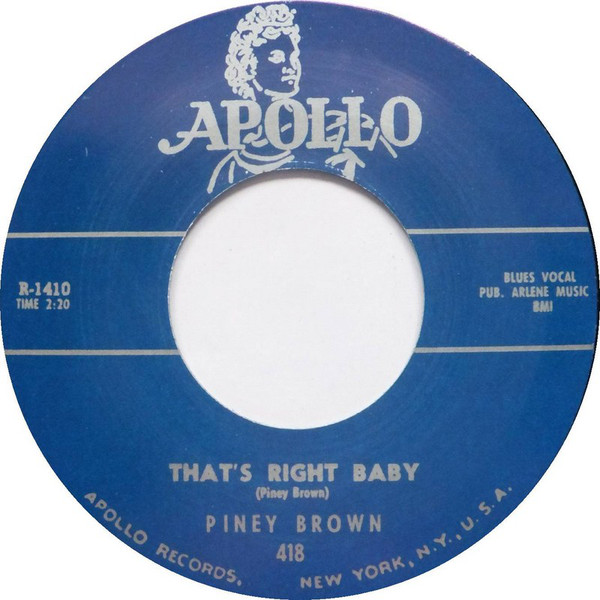
Thanks to Sonny Thompson, Piney made his recording debut in 1947 for Miracle. Of the four songs that were recorded, only one was released, which was “That's Right, Little Girl", issued by Esquire Records in the UK several years later. Perry was invited to make a session the next year at New York for the prestigious Apollo label of Bess Berman, cutting several sides in 1948, including the single "Morning Blues" backed with "Gloomy Monday Blues". “My Baby's Gone” enjoyed some success and Piney appeared at many famous clubs and venues like the Apollo Theatre, the Cotton Club, while embarking of several tours of US Military bases. 


In 1953 Brown recorded "Ooh You Bring Out the Wolf in Me" backed with "Don't Pass My By" for Jubilee Records and "Walk-a-Block-and-Fall" backed with "Whispering Blue" for King Records. None of his records made the national charts, but they sold well locally, and Brown was a top-performing attraction who regularly toured the country. He performed with the young guitarist Albert Collins in the early 1950s. 

In the music polls in the Pittsburgh Courier, Brown was regularly nominated as the "top blues artist". He performed as a duo with Billy Brooks, and they played for a time at the Club DeLisa in Chicago, as a result of which both of them recording for Duke Records. In 1959, Brown recorded "Sugar in My Tea (Cream in My Coffee)" backed with "My Love" for Mad Records, a label founded by Tommy "Madman" Jones two years earlier. 

After an unsuccessful attempt to own a night club in Kansas City, Piney had to come back to Birmingham to help his aging mother, although he continued to tour more locally. Then he recorded for the Heart label and helped launch Jerry McCain career. In 1964, Piney finally settled down permanently in Dayton (Ohio) where he married, singing at local clubs (The Village) or US Air Force bases while still recording for the small Dayton label, Deep Groove in a style more and more leaning towards Soul and Funk (Everything but you). During the late 1960's Piney also recorded several sessions for John Richbourg's 77 label in Nashville, backed by a young Country band. 

When Delmark reissued his Jubilee tracks, Piney contacted the Chicago label for his royalties. Delmark spread the news among blues buffs around the world and after a lengthy article and interview on the British Juke Blues magazine,  Piney embarked himself on several tours of Europe. In 2000, after 48 years apart musically, Brown and Wiley reunited to perform at the Blues Estafette, in Utrecht, Netherlands. Brown's debut album, My Task, was issued in 2004. His last album, One of These Days, was issued by Bonedog Records, of McKeesport, Pennsylvania, in 2006. Brown supported its release by playing some local gigs. 

Another album was programmed for Delmark but Piney Brown died on February 5, 2009, at the age of 87, in Dayton, Ohio, his home since 1963. 

(Edited from Brian Baumgartner @ Juke Blues #48 & Wikipedia) 

Here’s a collage of Piney Brown performing his classics with the Bonedog Allstars... McKeesport, PA., 2006.

Tuesday, 19 January 2021

Shirley Ellis born 19 January 1929


Shirley Ellis (January 19, 1929 – October 5, 2005) was an American soul music singer and songwriter of West Indian heritage. 

Shirley Marie O'Garra was born to William H. and Petra (Smith) O'Garra. Her father was a native of Montserrat, and her mother was born in the Bahamas. Shirley had three full siblings, Joyce, Bertram and William Jr., and four half siblings, Reginald, Suzanne, Joycelyn and Berbian. 

June 16, 1954, was a proud day for twenty-five year old singer-songwriter Shirley Ellis, when she registered her first songwriting copyrights with Library Of Congress. This she hoped would be the start of a successful songwriting career that would transform her fortunes and help her escape from the abject poverty of life in the Bronx. 

Although Shirley Ellis had embarked upon a career as a songwriter, she hadn’t given up hope of making a career as a singer, and every weekend left her home in the Bronx, and sang with the jazz and calypso band The Metronomes. Sometimes, Shirley Ellis entered talent contests, and in 1954 followed in the footsteps of Billie Holliday and Ella Fitzgerald when she won the Amateur Night at the Harlem Apollo singing Hoagy Carmichael's Skylark.  This gave Shirley Ellis’ career a huge boost. 

By late-1955, Shirley Ellis had already written songs for some of high-profile groups and artists, including The Sh-Booms, The Chords, Heartbreakers and Scott and Oakes. Just a year after registering her first song, Shirley Ellis’ star was already in the ascendancy, and she had just met and married her husband. This was Alphonso Elliston, who was the lead singer of The Chords, who enjoyed a hit with Sh-Boom in April 1954. It was through her husband’s cousin that Shirley was introduced to songwriter Lincoln Chase who became her manager and songwriting partner. They penned Shirley’s first single in 1961, “A Beautiful Love” but it failed to trouble the national charts. In 1962, she released a single on Mercury, under the name of Shirlee May, entitled ‘Lonely Birthday’ b/w ‘Little Sally Walker’. 

But by 1963 Shirley signed a deal with musical publisher Al Gallico, who secured her a recording contract with Kapp Records’ imprint Congress where they shortened her surname Ellison to Ellis. She was paired with producer Hutch Davie and entered the studio on the ‘13th’ of September 1963 to record a novelty song penned by Lincoln Chase, The Real Nitty Gritty. By the time the single was released, The Real Nitty Gritty had been shortened to The Nitty Gritty. When the song was released in October 1963, Shirley Ellis’ sophomore single started climbing the charts and buoyed by an appearance on American Bandstand eventually reached number eight on the US Billboard 100 and four on the US R&B charts. 


Other hits followed "The Name Game" (1964, US no. 3) and "The Clapping Song" (1965, US no. 8 and UK no. 6). "The Clapping Song" was another novelty song, which was arranged and produced by Charles Calello. When it was released, it reached number eight in the US Billboard 100 and six in the US R&B charts, and sold over a million copies. This resulted in Shirley Ellis receiving her first ever gold disc. 

By then, Shirley Ellis was a familiar face on American television and regularly appeared on American Bandstand, Hullabaloo, The Mike Stone Show and Shindig.  Despite her chart success other releases were disappointing. Although commercial success eluding Shirley Ellis she was signed by Columbia Records, on the advice of Calello, who was the company’s A&R Department producer. Columbia Records would become Shirley Ellis’ new home for the next two years. 

It wasn’t until 1967 that Shirley’s “Soul Time” reached sixty-seven in the US Billboard 100 and thirty-one in the US R&B charts. Given the quality of Soul Time, the single deserved to fare better. For the follow-up to Soul Time, Shirley Ellis recorded Sugar Let’s Shing-A-Ling. 

However, commercial success again eluded Shirley Ellis’ latest single which also lent its name to her third album so she left Columbia Records and although she was reported to have pacted with the Bell label, no records were forthcoming. She retired from the music industry in 1968 and never seemed to have looked back, only occasionally belting out a tune at block parties. 

Cover versions of her hits have been recorded by Madeline Bell, The Belle Stars, Laura Branigan, Aaron Carter, Gary Glitter, Ricardo Ray, Pia Zadora, and Gladys Knight and the Pips (a version of "The Nitty Gritty", produced by Norman Whitfield). 

She died on October 5, 2005 in New York City at the age of 76. 

(Edited from various sources mainly Dereks Music Blog)