Tuesday, 25 December 2018

Tony Martin born 25 December 1913


Alvin Morris (December 25, 1913 – July 27, 2012), known professionally as Tony Martin, was an American actor and popular singer.

Tony Martin was born Alvin Morris Jr on Christmas Day 1913 in San Francisco, and educated at Oakland High School and St Mary’s College. From childhood he sang for family and friends, and as a teenager proficient on clarinet and saxophone he formed a quartet backing small-time acts in vaudeville halls.

Having failed his Law finals at college — prompting a lifelong jibe about him never having passed a bar since — Martin began touring nightclubs playing saxophone and singing. He worked for the bandleaders Anson Weeks and Tom Gerun and played alongside a young Woody Herman. Aiming to emulate Bing Crosby as a leading all-rounder, Martin wound down his instrumental work in favour of his voice. The singer Frances Langford then recommended that he try Hollywood on the strength of his good looks and fine physique.

Screen tests landed Martin a minor role in Follow the Fleet (1935), and shortly thereafter he was spotted in a nightclub by Darryl F Zanuck, who cast him in several films for Twentieth Century Fox, including Shirley Temple’s Poor Little Rich Girl and Sing, Baby, Sing (both 1936). In the latter he sang When Did You Leave Heaven? and starred alongside the Ritz Brothers and Alice Faye. Between 1936 and 1938 Martin made a dozen films for Fox, four of them with the sultry-voiced Alice Faye, whom he married in 1937.

Meanwhile his vocal powers as a theatre and club artist continued to grow. On radio he became Gracie Allen’s boyfriend in The Burns and Allen Show and he recorded eight times with the Ray Noble Orchestra for the Brunswick label. In March 1939 he had his first multi million seller with Begin the Beguine, coupled with September Song.

In 1941 he moved to MGM, where film moguls had promised to build him into another Clark Gable. Offered Ziegfeld Girl, Martin insisted on top billing over Jimmy Stewart, Judy Garland, Lana Turner and Hedy Lamarr. 


A promotional still for 'Ziegfeld Girl' (1941). (From Left) Lana Turner, Hedy Lamarr, director Robert Z. Leonard, Judy Garland and Tony Martin.


This was the film that featured You Stepped Out of a Dream, which became a standard and a tune with which Martin would be forever associated. Martin worked next with the Marx Brothers, playing the song demonstrator in The Big Store. The film featured the Tenement Symphony which, with its themes of peace and racial goodwill, became a favourite wartime morale-booster, especially with British audiences.

The war caught Martin’s career on the crest of a wave, and following Pearl Harbour he joined the US Army Air Force. Eventually he was seconded to the Glenn Miller Orchestra as a vocalist, achieving the distinction of being liked not just by Miller but by the band members too, defying the traditional enmity between musicians and the singers they accompany. On demobilisation Martin returned to Hollywood and in 1946 he sang in Till The Clouds Roll By, the biopic about the songwriter Jerome Kern. In the same year his recording of To Each His Own reached number four in the record charts.


The early post-war years took him to London, where he appeared at the Palladium to great acclaim. He revived his film career in Bob Hope’s Here Come The Girls in 1952 and the following year he achieved his ambition to work with Esther Williams in Easy to Love (1953). Martin’s last two significant film roles featured him 
ESTHER WILLIAMS VAN JOHNSON TONY MARTIN 1953 
singing Lover Come Back To Me in the Sigmund Romberg biopic Deep In My Heart and a forgettable comedy, Let’s Be Happy (1957), filmed in Scotland. In 1982 he had a cameo role in Joe Pesci’s film Dear Mr Wonderful.

From the 1960s Martin concentrated on his work as a nightclub vocalist and his own television show, on which he developed a distinctive style of deadpan humour. He continued to release records, having particular success in Britain with Stranger in Paradise and Walk Hand In Hand, which reached numbers seven and four respectively in the charts. In an unlikely pairing, Martin recorded 
for the Motown Records label in the mid-1960s, scoring a minor hit with the record "Talkin' To Your Picture." He was one of a number of more traditional vocalists signed to the label during this period.

In 1984 he appeared in his final British tour, still delighting fans with numbers such as Feelings; I Write the Songs; and What I Did For Love.

Tony Martin’s marriage to Alice Faye ended in divorce in 1941. He married Cyd Charisse in 1948 and their notably happy marriage of 60 years was one of the longest in Hollywood. She died in 2008, and he is survived by a stepson from his second wife’s first marriage. His son, Tony Martin Jr, predeceased him in April 2011.

Martin died on the evening of July 27, 2012, of natural causes. He was 98 years old. Martin was buried at the Hillside Memorial Park Cemetery in Culver City, California. (Edited mainly from The Telegraph.)

Monday, 24 December 2018

Dave Bartholomew born 24 December 1918


David Louis Bartholomew (born December 24, 1918) is an American musician, bandleader, composer, arranger and record producer, prominent in the music of New Orleans throughout the second half of the 20th century.

He was born Davis Bartholomew in Edgard, Louisiana, to Mary
and Louis Bartholomew. He learned to play the tuba and then took up the trumpet, taught to him by Peter Davis, who had also tutored Louis Armstrong. Around 1933, Bartholomew moved with his parents to New Orleans, where he played in local jazz and brass bands, including Fats Pichon's band on a Mississippi riverboat. After a stay in Jimmie Lunceford's band, he joined the US Army during World War II. He developed writing and arranging skills as a member of the 196th Army Ground Forces Band.

At the end of the war Bartholomew returned to New Orleans and, by November 1945, had started leading his own dance band, Dave Bartholomew and the Dew Droppers, named for a local club, the Dew Drop Inn. The band became locally popular, described as "the 
bedrock of R&B in the city. A local journalist wrote of the band in June 1946, "Putting it mildly, they make the house 'rock'". In 1947, they were invited by club owner Don Robey to perform in Houston, Texas, where Bartholomew met Lew Chudd, the founder of Imperial Records.

Bartholomew and his band made their first recordings, including "She's Got Great Big Eyes", at Cosimo Matassa's New Orleans studio for De Luxe Records in September 1947. Their first hit was "Country Boy", credited to Dave Bartholomew and His Orchestra, which reached number 14 on the national Billboard R&B chart in early 1950. Prominent members of the band, besides Bartholomew
on trumpet and occasional vocals, were the saxophonists Alvin Tyler, Herb Hardesty and Clarence Hall, the bass player Frank Fields, the guitarist Ernest McLean, the pianist Salvador Doucette, and the drummer Earl Palmer. They were later joined by the saxophonist Lee Allen.

Two years after they had first met in Houston, Lew Chudd asked Bartholomew to become Imperial's A&R man in New Orleans. Bartholomew produced Imperial's first national hits, "3 x 7 = 21", written by him and recorded by the female singer Jewel King, and 
"The Fat Man", recorded in December 1949 by a young pianist, Fats Domino. "The Fat Man"—based on "Junker's Blues", with lyrics rewritten by Bartholomew and Domino reached number 2 on the R&B chart and eventually sold over one million copies, kicking off Domino's career Both records featured Bartholomew's band, as did a succession of further hits through the 1950s. Cosimo Matassa said, "Many times I think Fats’ very salvation was Dave being able to be stern enough and rigid enough to insist on things getting done... He was adamant as he could be about the discipline of the players."


Bartholomew left Imperial after a disagreement with Chudd at the end of 1950 and for two years recorded for other labels, including Decca, King and Specialty. Among his recordings at King was "My Ding-a-Ling", which Bartholomew wrote and first recorded in 
January 1952; the song was later recorded by Chuck Berry, who had an international hit with it in 1972, although Berry substantially changed the song's arrangement and verses and claimed credit for writing it. While at Specialty, Bartholomew produced Lloyd Price's recording of "Lawdy Miss Clawdy", which featured Domino (uncredited) on piano. The single reached number 1 on the R&B chart in mid-1952.

After that success, Bartholomew returned to Imperial to work again on Domino's recordings, co-writing and producing a series of R&B hits for him. Domino's crossover to the pop chart came in 1955 with "Ain't That a Shame" (mistitled on the single's label as "Ain't It A Shame"), on which Bartholomew deliberately sought to make Domino's style more appealing to white record buyers. Further hits followed through the late 1950s and early 1960s all co-written and produced by Bartholomew. Also in 1960, Fats Domino recorded and had a hit with his version of "Country Boy".

Over the same period, Bartholomew also wrote, arranged and produced recordings by many other Imperial artists, including Smiley Lewis, the Spiders, Chris Kenner, Earl King, Tommy Ridgley, Robert Parker, T-Bone Walker, Roy Brown, Frankie Ford and Shirley and Lee.  After Imperial was sold to Liberty Records in Los Angeles in 1963, Bartholomew remained in New Orleans. He worked for Trumpet Records and Mercury Records and then established his own label, Broadmoor Records, in 1967. The label folded the following year, when its distributor, Dover Records, collapsed.

In the 1970s and 1980s, Bartholomew led a traditional Dixieland jazz band in New Orleans, releasing an album, Dave Bartholomew's New Orleans Jazz Band, in 1981. He also took part in Fats Domino's international tours during that period. He was inducted into the Rock and Roll Hall of Fame, as a nonperformer, in 1991. He released two further albums in the 1990s, Dave Bartholomew and the Maryland Jazz Band (1995) and New Orleans Big Beat (1998), and continued to make occasional appearances with his band at festivals.

In 2015, the New Orleans City Council declared Aug. 19 Dave Bartholomew Day.


He remains a resident of New Orleans and his 100th birthday is Christmas Eve 2018. 

Sunday, 23 December 2018

Buddy Harman born 23 December 1928


Murrey Mizell "Buddy" Harman, Jr. (December 23, 1928 – August 21, 2008) was one of Nashville's outstanding session drummers who has played his solid, driving beat on over 18,000 recording sessions during five decades. He is one of the most-recorded session drummers of all time.

Buddy Harman is probably the most recorded drummer in music history He is reputed to have played on some 18,000 Nashville sessions during five decades. The list of artists that he has recorded with reads like a Who’s Who of popular music. Harman is usually seen as a country musician, but he also made many contributions to rock ’n’ roll and to recordings by mainstream pop performers like Perry Como, Ann-Margret, Simon and Garfunkel, Nancy Sinatra, Connie Francis and many others. That says enough about his versatility as a drummer.

Harman’s parents had their own part-time band in Nashville, with his mother on drums. Jazz drummers Gene Krupa and Buddy Rich inspired him to become a professional drummer. Buddy worked in a cinema to save up the money for his first drum set, which was a Slingerland that he played in the band he set up when he was in High School. Eventually he joined the US Navy and played in Military Bands before he returned to Nashville to take up a place at University. His parents realised he was serious about playing drums and sent him to Roy C. Knapp’s School of Percussion in Chicago for three years. This was where Louie Bellson, Dave Tough, Baby Dodds, Bobby Christian, Gene Krupa, Hal Blaine, Freddie Below, and many others, studied.

Upon his return to Nashville in 1952, he learned that, contrary to protocol before his departure, country artists were now asking for drums on their record. Gradually, Harman worked his way into Nashville’s emerging recording scene and took up full-time studio work about 1955. Initially some country producers were reluctant to give him much leeway but his solid, tasteful playing on sessions with artists such as Ray Price, Moon Mullican and Martha Carson helped to expand the role of drums in country music.

The A-Team: Bob Moore - Grady Martin - Buddy Harman

By 1957 he had become the first-call drummer for Nashville sessions and Nashville’s first full-time studio session drummer. Thus Harman became a member of the famous Nashville A-Team, along with Grady Martin, Hank Garland, Ray Edenton, Bob Moore, Floyd Cramer, Boots Randolph and a few others. Buddy has played on some of the biggest hits of Grand Ole Opry performers, including Patsy Cline, Johnny Cash, Roy Acuff, Hank Snow, Marty Robbins, Ray Price, Billy Walker, Roy Clark, Don Gibson, Johnny Horton, Chet Atkins, Loretta Lynn and countless others.


Buddy released only a handful of recordings under his own name: two singles and an EP for Warner Bros (1960-61), two singles for Mercury (1962-63)/

Apart from scores of number ones on the country charts, Harman can also be heard on at least eighteen # 1 hits on the pop charts, for instance “Wake Up Little Susie”, “Cathy’s Clown” (Everly Brothers), “The Battle Of New Orleans” (Johnny Horton), “Big Bad John” (Jimmy Dean), “The Three Bells” (The Browns), “Running Scared”, “Oh, Pretty Woman” (Roy Orbison), “I’m Sorry” (Brenda Lee). Also five chart toppers by Elvis Presley, who usually worked with two drummers, D.J. Fontana and Buddy Harman (at least in the first half of the 1960s). When Elvis recorded in Los Angeles, D.J. Fontana went along with him, but not Harman (with one or two exceptions). He was replaced by Hal Blaine on the West Coast sessions.

In 1959 Buddy became the Grand Ole Opry’s first staff drummer. By the mid-1960s, Harman was working some 600 sessions a year. This number declined by the late 1970s, as the influx of pickers from other cities and Nashville’s growing recording activity reduced the dominance he had once enjoyed. Harman remained active in the studio, however, and toured as a member of the Nashville Super Pickers in the late seventies and the early 1980s.

In 1991 he returned to the stool of house drummer at the Grand Ole Opry. He continued to play occasional sessions and served as a business agent for the Nashville local of the American Federation of Musicians .In 2001, Buddy recorded  a self-produced album, “Buddy Harman Plays the Classic Rock ’n’ Roll Hits Of Yesteryear”. Harman said: “One of the highlights of my career was having the privilege of performing for four of our nation’s presidents”. They were : John F. Kennedy, Gerald Ford, Jimmy Carter and Ronald Reagan.


Harman died at the Hospice Center in Nashville from congestive heart failure on August 21st 2008, at the age of 79. (Edited from BlackCat Rockabilly, Moderndrummer, Drummerworld, AllMusic & Mikedolbear.)

Saturday, 22 December 2018

Cor Steyn born 22 December 1906


Cornelis Gerardus Hendricus Steijn (better known as Cor Steyn ) ( Leiden , 22 December 1906 - Hilversum , 17 November 1965 ) was a Dutch organist, composer and arranger, best known as an employee of the VARA Broadcasting Association.

Cor Steyn was a musical child prodigy: from the age of five he received piano and violin lessons and at the age of twelve he did an early entrance exam in 1918 at the Royal Conservatory in The Hague . In 1920 he accompanied silent films on the piano and performed as a concert pianist for the first time. When his father became incapacitated by an accident, young Cor broke off his studies to earn a living for the family as a bar-pianist.

He was a very versatile musician: from 1932 he led various ensembles at the VARA, including his popular Steyn's Accordion Orchestra, he was orchestra leader in the Amsterdam City Theatre for a long time, he composed many popular songs and was a virtuoso player of the City Theatre organ, with which he also made many recordings. He also led Community Singing meetings in that theatre, in which up to 1,800 singers participated. During the war he was the orchestra conductor of the Snip & Snap-revue in the City-Theatre. He  also composed  music for radio and films (including Boefje, 1939). His repertoire varied from Viennese operetta melodies to the American musical, from French chansons to Dutch material. 


After a short stay in Denmark, Steyn again joined the VARA in 1949. He played more of the Hammond organ and led no less than twelve ensembles, including the Rhythmic String Orchestra and 'Seven Men and a Girl'. His Hammond organ recordings also partly determined his reputation. He made hundreds of recordings, 
including many medleys, on the”Magic Organ”.He had over 5500 radio and TV appearances to his name.

On Monday, October 25, 1965, Steyn officially opened the radio concert organ of the Dutch Radio Union (bought from the BBC). It was also the last concert he would give on this special organ. (The VARA released it on LP.) More than three weeks later, on 17 November 1965, organist-composer-arranger orchestra leader Cor Steyn died at the age of 59 of a heart attack in his home in Hilversum.


In 2015 the municipality of Hilversum decided to name one of the streets in the new residential area on the east side of the city named after him.

(Edited from Wikipedia &.spreekbuis.nl)

Thursday, 20 December 2018

John Hardee born 20 December 1919


John Hardee (December 20, 1918 – May 18, 1984) was an American jazz tenor saxophonist whose time in jazz's major leagues was brief but memorable.

Trummy Young (left), John Hardee, and guitarist Tiny Grimes (right) 
Hardee was born in Corsicana, Texas into a musical family. His uncle Ashford played trombone on a few recordings by the Curtis Mosby band in the late twenties. John’s cousin, trumpet player  Stanley Hardee, cut a few tracks with Eddie Fennel and Charles “Sugar Lou” Morgan’s orchestra in Dalls. 

John Hardee first played piano but took up the sax at the age of 13. He began playing with various local bands, including Dan Carter’s which also featured Hot Lips page and Tyree Glenn for a while. When Hardee heard the first records of Cab Callaway, he was attracted by Chu Berry’s style. Hardee incorporated some of his ideas but nevertheless had his own style.

The thick-toned tenor played in a college orchestra and then went on tour with Don Albert’s band for some six months but returned to college which he finished in 1941. Hardee was stationed near New York during his service and had the chance to jam with local groups. After his discharge he settled in Harlem and played regularly with Tiny Grimes in 1946/47.


At the time, the tenorist made a small number of unforgettable sessions, either under his own name or as a sideman including eight records for Blue Note; other songs have been released by Savoy and Spotlite. Hardee then formed his own quartet but found it difficult to find well-paid engagements. As a sideman he played 
with Clyde Bernhardt, Cousin Joe, Russell Procope, Earl Bostic, Billy Kyle, Helen Humes, Billy Taylor, and Lucky Millinder.

Together with his wife he decided to return to Texas in early 1950. Hardee worked as a director of a high school band but continued to play on weekends at clubs in Wichita Falls and Dallas. In 1955 he moved to Dallas where he taught at Oliver Wendell Holmes High School until his retirement in 1976.

In 1959, he played saxophone on Dallas R&B group The Nightcaps' LP Wine, Wine, Wine. He was credited as "John Hardtimes" but was not a member of the group.

In 1975 he played at the Nice Jazz Festival in France and recorded an LP, "A Little Blue" for the French Black & Blue label on the 26th July 1975 in Antibes, but more or less quit playing after he returned  to Texas. The great saxophonist died in Dallas, Texas, on May 18. 1984 (aged 65).

(Edited mainly from liner notes by Anatol Schenker for Classics).

Wednesday, 19 December 2018

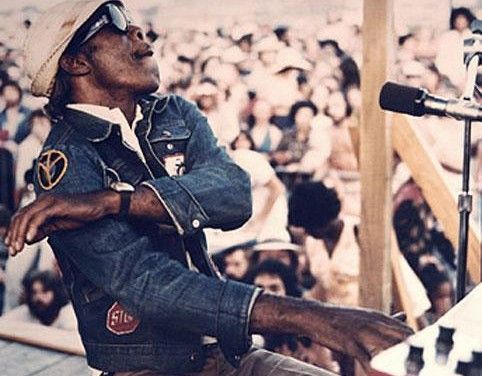
Professor Longhair born 19 December 1918


Henry Roeland "Roy" Byrd (December 19, 1918 – January 30, 1980), better known as Professor Longhair or "Fess" for short, was a New Orleans blues singer and pianist. He was active in two distinct periods, first in the heyday of early rhythm and blues and later in the resurgence of interest in traditional jazz after the founding of the New Orleans Jazz and Heritage Festival in 1970. 
His piano style has been described as "instantly recognizable, combining rumba, mambo, and calypso.”

Byrd was born on December 19, 1918, in Bogalusa, Louisiana and lived in New Orleans from the age of two onward. As a child, he learned how to play on an old piano that had been left in an alley. He seriously began to master the instrument while working at a Civilian Conservation Corps camp in 1937.

Byrd & His Blues Jumpers
After a stint in the service during World War II, he returned to New Orleans and began playing at clubs like the Caledonia, a neighbourhood bar just outside the French Quarter. He was called Professor Longhair, the “professor” part being an honorary nickname bestowed on New Orleans piano wizards.

He first recorded in a band called the Shuffling Hungarians in 1949, creating four songs (including the first version of his signature song, "Mardi Gras in New Orleans") for the Star Talent record label. Union problems curtailed their release, but Longhair scored his one and only R&B chart hit in 1950 with “Bald Head,” under the name Roy Byrd and His Blues Jumpers released on Mercury Records.  


As a vocalist, Professor Longhair was a classic blues shouter. As a pianist, he was a unique force of nature—or, more accurately, of New Orleans. It was a city whose sense of festivity he celebrated with such anthems as “Tipitina”, “Mardi Gras in New Orleans” and “Big Chief.” Longhair remained locally popular as a working 
musician from the late 1940s to the early 1960s, rarely venturing off his home turf. He lacked crossover appeal among white and wide audiences. Yet, he is regarded (and was acknowledged) as being a musician who was highly influential for other prominent musicians, such as Fats Domino, Allen Toussaint and Dr. John.

After suffering a stroke, Professor Longhair recorded "No Buts – No Maybes" in 1957. He re-recorded "Go to the Mardi Gras" in 1959. He first recorded "Big Chief" with its composer, Earl King, in 1964 after which he abandoned the music business to work odd jobs and deal cards for a living, but fell into a gambling habit.

After a few years during which he disappeared from the music scene, Professor Longhair's musical career finally received "a well deserved renaissance" and wide recognition. He was invited to perform at the New Orleans Jazz and Heritage Festival in 1971 and at the Newport Jazz Festival and the Montreux Jazz Festival in 1973. His album The London Concert showcases work he did on a visit to the United Kingdom. That significant career resurrection is best marked by the seminal album "Professor Longhair - Live On The Queen Mary", which was recorded on March 24, 1975, during an invited-only party hosted by Paul McCartney and Linda McCartney on board of the retired RMS Queen Mary.

Along with a group of fans and promoters in New Orleans, in 1977 he purchased a warehouse and converted it into a nightclub called Tipitina's, named after one of his songs. It was conveniently located close to his home. Tipitina's still operates as a jazz club today and houses a collection of Professor Longhair memorabilia.

By the 1980s his albums, such as Crawfish Fiesta on Alligator Records and New Orleans Piano on Atlantic Records, had become readily available across America. In 1974 he appeared on the PBS series Soundstage (with Dr. John, Earl King, and The Meters).

In 1980 he co-starred (with Tuts Washington and Allen Toussaint) in the film documentary Piano Players Rarely Ever Play Together which was produced and directed by filmmaker Stevenson Palfi. That documentary (which aired on public television in 1982 and was rarely seen since), plus a long interview with Fess (which was recorded two days before his sudden death), were included in the recently released project "Fess Up".

Professor Longhair died in his sleep of a heart attack while the filming of the documentary was under way (and before the live concert, which was planned to be its climax). Footage from his funeral was included in the documentary.


Professor Longhair was inducted into the Blues Hall of Fame in 1981. In 1987 Professor Longhair was awarded a posthumous Grammy Award for his early recordings released as House Party New Orleans Style. He was inducted into the Rock and Roll Hall of Fame in 1992. (Edited mainly from Wikipedia & Rockhall)