Wednesday, 22 May 2013

Kenny Ball born 22 May 1930


Kenneth Daniel Ball (22 May 1930 – 7 March 2013) was an English jazz musician, best known as the bandleader, lead trumpet player and vocalist in Kenny Ball and his Jazzmen.

Ball was born in Ilford, Essex. At the age of 14 he left school to work as a clerk in an advertising agency, but also started taking
trumpet lessons. He began his career as a semi - professional sideman in bands, whilst also working as a salesman and for the advertising agency. He turned professional in 1953 and played the trumpet in bands led by Sid Phillips, Charlie Galbraith, Eric Delaney and Terry Lightfoot before forming his own trad jazz band - Kenny Ball and his Jazzmen - in 1958. His dixieland band was at the forefront of the early 1960s UK jazz revival.


In 1961 their recording of Cole Porter's "Samantha" (Pye 7NJ.2040 - released Feb. 1961) became a hit, and at the end of 1961 they reached No. 2 on both the U.S. Billboard Hot 100 chart and the UK Singles Chart, with "Midnight in Moscow" (Pye 7NJ.2049 - released Nov. 1961) . The record sold over one million copies, earning gold disc status. Their next single "March of the Siamese Children" (Pye 7NJ.2051 - released Feb. 1962), from 'The King and I', topped the pop music magazine, New Musical Express chart on March 9, 1962, further hits followed and such was their popularity in the UK that Ball was featured, alongside Cliff Richard, Brenda Lee, Joe Brown, Craig Douglas and Frank Ifield, on the cover of the New Musical Express in July 1962, although in the U.S. they remained a 'one-hit wonder'.

In January 1963, New Musical Express reported that the biggest trad jazz event to be staged in Britain had taken place at Alexandra Palace. The event included George Melly, Diz Disley, Acker Bilk,
Chris Barber, Alex Welsh, Ken Colyer, Monty Sunshine, Bob Wallis, Bruce Turner, Mick Mulligan and Ball. The same year, Ball became the first British jazzman to become an honorary citizen of New Orleans, and appeared in the 1963 film Live It Up!, featuring Gene Vincent.

In 1968 the band appeared with Louis Armstrong during his last European tour. Ball later appeared on BBC Television's highly

rated review of the '60s music scene Pop Go The Sixties, performing "Midnight In Moscow" with his Jazzmen on the show broadcast on BBC 1, on 1 January 1970, and his continued success was aided by guest appearances on every edition of the first six series of the BBC's Morecambe and Wise Show. He later claimed that the peak of his career was when Kenny Ball and his Jazzmen played at the reception for the wedding of Prince Charles and Lady Diana.

Ball and his band enjoyed one of the longest unbroken spells of success for trad bands, and his status rivals contemporaries Acker Bilk and Chris Barber. Their joint album, The Best of Ball, Barber
and Bilk, reached No. 1 in the UK Albums Chart. He has charted fourteen Top 50 hit singles in the UK alone. All such releases were issued on the Pye record label.

In 2001 Ball was part of the recording of an album on the Decca label. It featured Don Lusher, Acker Bilk, John Chilton and the Feetwarmers, John Dankworth, Humphrey Lyttelton and George Melly, and was entitled British Jazz Legends Together.

Ball continued to tour until shortly before his death, his last scheduled concert being, aptly, with Acker Bilk and Chris Barber at Manchester's Bridgewater Hall on 21 February 2013. He died at Basildon Hospital, Essex, where he was being treated for pneumonia. (Info Wikipedia)


Tuesday, 21 May 2013

Bill Holman born 21 May 1927


Willis Leonard Holman (born May 21, 1927) Olive, California, known also as Bill Holman, is an American songwriter, conductor, composer/arranger, and saxophonist working primarily in the jazz idiom.

A number of great arrangers worked in the West Coast jazz and studio scene of the 1950s and 1960s, but one name consistently comes up as the best of all: Bill Holman. When it comes to writing for a modern big band, Bill Holman's arrangements and
compositions are held up as the pinnacle of the art.  Holman started playing tenor saxophone and clarinet while still in school, and went on to study at Westlake College of Music in Los Angeles in the late 1940s. Through an acquaintance with Gene Roland, Holman was auditioned by Stan Kenton and hired as a sax player around 1951. With Roland's encouragement, Holman began to write for Kenton's band, and by 1954, he was contributing so consistently that Kenton let him come off the bandstand, stay in Los Angeles, and work as a full-time arranger and composer. In particular, Kenton was attracted to Holman's ability to integrate counterpoint and dissonance in subtle yet distinctive ways. Soon after that, Holman became Kenton's chief arranger, and wrote much of Kenton's late 1950s repertoire.

Holman continued to perform with smaller combos at the Lighthouse in Hermosa Beach and other hot spots of the West Coast jazz scene. He also wrote for other bands, including Terry Gibb's legendary band on 1959-60, and, less often, for vocalists, including the Four Freshmen. He recorded several albums, two with a smaller ensemble and three with a big band, but these soon became rare collector's items.


                  Here's "Kissin' Bug" from above 1958 album


During the 1960s and 1970s, with the exception of Stan Kenton's "Neophonic Orchestra" and other attempts to keep the art of big band music going, Holman's work centered on studio arrangements. In the late 1960s, he provided arrangements for a number of pop groups, including the Association and the Fifth Dimension. Holman wrote the brass arrangements that accompanied Bob Alcivar's vocal arrangements for the group.

Since 1980, Holman has been increasingly active in Europe, writing, conducting and playing lengthy works for the West 
German Radio Orchestra in Cologne, Germany, and the Metropole Orchestra in Holland, that feature such soloists as Phil Woods, Sal Nistico and Lee Konitz.

In the late 1980s, nearly 30 years after his last recording, Holman
began writing and recording with his own big band. Pulling in studio musicians who admired and appreciated his work, Holman was able to release several new CDs, including Brilliant Corners which featured his arrangements of tunes written by Thelonious Monk that won a Grammy in 1997. He also provided most of the arrangements for Natalie Cole's hugely successful comeback album, Unforgettable. (info mainly mainly spaceagepop.com)

Monday, 20 May 2013

Jill Jackson born 20 May 1942


Jill Jackson, born May 20 1942, in McCaney, Texas and Ray Hildebrand, born December 21 1940, in Joshua, Texas were a pop singing duo Paul & Paula, best known for their 1963 #1 hit "Hey Paula. "Hildebrand and Jackson were students at Howard Payne College when a Brownwood, TX, DJ called for entertainers to volunteer to benefit the American Cancer Society. They volunteered and sang "Hey Paula," a song Hildebrand wrote. It went over so well that everybody encouraged them to make a record.

Major Bill Smith's LeCam label in Fort Worth, TX, had just scored a major hit with Bruce Channel, so they drove there late in 1962 hoping for an unscheduled audition. Wrong day. Smith was busy recording that Saturday, but they hung around anyway. Opportunity knocked when Amos Milburn Jr. didn't show and Smith had five musicians sitting around exchanging snaps at five dollars each. Not wanting to blow the money, he asked
Hildebrand and Jackson to sing their song. After a brief audition, Smith took them in the studio. The rest is history.

Smith offered "Hey Paula" to Vee Jay Records but Ewart Abner turned it down. So he released it on LeCam, as by Jill & Ray. (Abner realized his error and paired Jerry Butler and Betty Everett after "Hey Paula" exploded.) The hot seller caught the attention of Mercury Records' Shelby Singleton. Mercury reissued it on its Phillips subsidiary. But not before Singleton renamed them Paul & Paula, pointing out that two people name Jill & Ray singing the lyrics "Hey, hey Paula" and "Hey, hey Paul" didn't make sense. They resented -- everybody in West Texas knew them as Jill & Ray -- but later acquiesced.                                             


"Hey Paula" sold nearly two-million copies early in 1963. They followed with "Young Lovers" and "First Quarrel." A couple of albums, including one of Christmas songs, followed. "Hey Paula" originally ran more than six minutes. But Smith said it was too long, and Hildebrand used the cut parts to create "Young Lovers."Everything seemed like a fantastic dream, but by 1965 Hildebrand had second thoughts. He didn't like the traveling. Plus, he wanted to complete his college education. (His parents were schoolteachers.) The final straw came when he left Jackson in a lurch on a Dick Clark Caravan of Stars tour and Clark had to fill in.

Jill Jackson married their manager Marvin Landon and continued as a solo artist. They later divorced and she married an attorney. Hildebrand worked behind the scenes as a songwriter/producer, then left the business for a while. He returned to music in 1983 as one half of the Christian music male duo, Land & Hildebrand, who remained together into the new millennium. Hildebrand has also worked on the national staff of the Fellowship of Christian Athletes. Both he and Jackson as Paul & Paula, are members of the West Texas Music Hall of Fame.  


Hildebrand lived in Kansas, and Landon lived in California, but the two continued to perform together nationwide for special events and oldies shows. Ray Hildebrand died in Kansas City on August 18, 2023, at the age of 82.
(Info mainly All Music Guide)
 
US duo Paul & Paula performing a medley of their records on Australian TV show 'Sing, Sing, Sing', hosted by legendary Johnny O'Keefe

Sunday, 19 May 2013

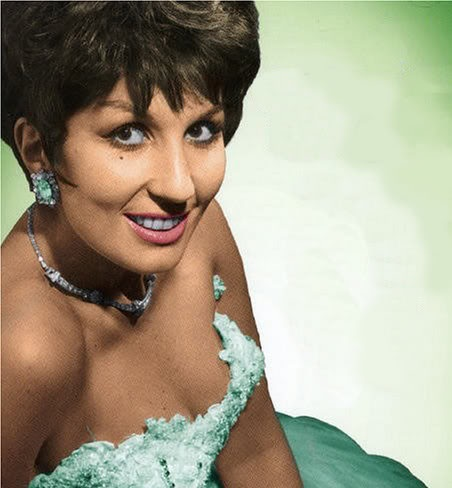
Alma Cogan born 19 May 1932


Alma Cogan (19 May 1932 - 26 October 1966) was an English singer of traditional pop music in the 1950s and early 1960s. Dubbed "The Girl With A Giggle In Her Voice", she was the highest paid British female entertainer of her era. Her 18 chart hits were a record for a female singer at the end of the 1950's in England, and despite being of the pre-rock 'n roll era, Cogan seemed capable of working with the new music when her life was cut short. 

The daughter of a haberdasher, Alma Cogan was born Alma Angela Cohen in St. John's Wood, getting her first name because her
mother liked the motion picture actress Alma Taylor. She was educated at St. Joseph' Convent School. It was Cogan's mother who pushed her toward a career as a singer and onto the stage. In 1948, at age 16, she was spotted in the chorus of High Button Shoes by EMI staff producer Walter J. Ridley (also responsible, a decade later, for signing Johnny Kidd & The Pirates), who subsequently signed her to the HMV label.

As a teenager, she had her professional debut singing at the 
Cumberland Hotel, in the dining room. Her first record was a 78rpm record of "To Be Worthy Of You" / "Would You" on the British HMV record label.


When Joy Nichols left the BBC programme "Take It From Here," Cogan replaced her as the resident singer, performing many types of songs but, most successfully, up-beat ballads and novelty songs.

In 1953 she was working on the song "If I Had A Golden Umbrella" and broke into a giggle while recording it. The people decided that they liked the sound, and that sound became her trademark style. In 1954 she had her first chart hit, a cover of Teresa Brewer's "Bell Bottom Blues."(not the Derek & The Dominoes song), which got to No. 5 on the British charts in 1954. 


A year later, she topped the charts for the first and only time with "Dreamboat." She also covered several American hits, including "The Birds and the Bees" and "Why Do Fools Fall In Love, " which was a hint of the range she would show in her later career. By the turn of the 50's into the 1960's, she was also the star of her own

television program, and she reached the apex of her success when Lionel Bart-whom, at one point, she apparently intended to marry-cast her as Nancy in Oliver! Her name receded from the pop charts somewhat in the early 1960's, as younger performers such as Helen Shapiro joined the EMI roster, but Cogan was a fixture as a concert attraction during the first half of the decade.

During the 1950's, Cogan attracted press attention as a personality, beyond her singing, for her sense of humor, and for her collection of luxurious clothes-it was said that she never wore the same dress twice, and her home was filled with an extraordinary array of fashions. By the mid-1960's, Cogan was much more celebrated in


the gossip columns for the all-night parties she threw at her Kensington High Street home, where guests included such diverse figures as Stanley Baker, Paul McCartney, Roger Moore, Noel Coward, Ethel Merman, and Lionel Bart, among many others.

If she was no longer a chart-topping star, Cogan was still a much-loved figure to her peers, and remained in touch with the cutting edge of the popular music business, recording the music of Burt Bacharach when he was still getting established, and befriending McCartney, who must've loved making the acquaintance of EMI's biggest female pop star from the period in which he was growing up. McCartney contributed percussion to the B-side of one of her mid-1960's singles, which resulted in her covering "Eight Days A Week, " as well as "Yesterday, " "
I Feel Fine, " and "Ticket To Ride."

There's no telling where that friendship might've led-Cogan could easily have been another, more mature Cilla Black, her voice serving as an outlet for McCartney songs that weren't suited to the Beatles. If her version of "Eight Days A Week"-a most startling re-thinking of the song, transforming it into a gloriously lyrical torch-number, is any indication, she might've gone wonderful, glorious things with "For No One, " "Your Mother Should Know, " and "When I'm Sixty-Four." Alas, it was not to be-Cogan had just proved capable of making the transition to a more rocking sound, or at least of embracing some components of the last few years of changes in music, when tragedy struck. In 1966, Cogan 
was diagnosed with cancer. She received treatments and planned to continue her career, even writing several songs (under the name "Al Western") that were recorded by other singers. She kept working during the year, and an album was intended. Cogan continued concertizing, and while touring Sweden, she fainted. She was diagnosed as terminally ill, and died on October 26 of that year in a London hospital.

 Her final album, Alma, was released early the following year, but Cogan was never entirely forgotten. Collections of her music have shown up throughout the CD era, including a complete triple-CD anthology (A to Z). In 1992, the BBC presented a television documentary about her life and career. (taken from Wikipedia & AMG)


Saturday, 18 May 2013

Perry Como born 18 May 1912

 
Perry Como (b. Pierino Como, 18 May 1912, Canonsburg, Pennsylvania, USA, d. 12 May 2001, Jupiter Inlet Beach Colony, Florida, USA.) Como was an accomplished popular singer with a warm baritone voice, whose repertoire included ballads, novelty numbers and singalongs.

Born into a large Italian-American family in Canonsburg, he left his home town barber shop in 1933 and toured with the local band of Freddie Carlone. His big break came in 1936 when he joined trombonist Ted Weems' band and featured on their Beat The Band radio show. He left the band when it broke up in 1942, and the
following year signed for RCA Records. After minor hits with "Long Ago And Far Away", "I'm Gonna Love That Gal" and "If I Loved You", he topped the US charts in 1945 with "'Till The End Of Time", based on Chopin's "Polonaise In A-Flat Major".

A comparatively late starter in hit parade terms, he made up for lost time in the late 40s with a string of US hits including "Did You Ever Get That Feeling In The Moonlight?", "(A Hubba-Hubba-Hubba) Dig You Later", "I'm Always Chasing Rainbows" (adapted from another Chopin theme), " "Chi-Baba, Chi-Baba, (My Baby Go To Sleep)" (number 1),
"When You Were Sweet Sixteen", "I Wonder Who's Kissing Her Now" (a 1939 recording when Como was with Ted Weems), A-You're Adorable" (a number 1, with the Fontane Sisters), "Some Enchanted Evening" (number 1) and "A Dreamer's Holiday". He also featured regularly on radio programmes, such as his own Supper Club series, and made four films, Something for The Boys (1944), loosely based on the Cole Porter Broadway show, Doll Face (1945), If I'm Lucky (1946), and the star-studded Richard Rodgers/Lorenz Hart biopic, Words And Music (1948).

The 50s were even more fruitful years for Como, mainly because of the apparent ease with which he adapted to television. His easy, relaxed singing style coupled with an engaging sense of humour proved ideal for the relatively new medium. He had made his
television debut in 1948 on NBC's The Chesterfield Supper Club, and two years later began his own show with CBS, The Perry Como Show. Later retitled Perry Como's Kraft Music Hall, his new weekly show ran on NBC from 1955-63 and is still regarded as the best television show of its kind, and featured his theme song "Sing Along With Me'. It also inspired the albums We Get Letters and Saturday Night With Mr. C. Andy Williams' successful television show owed much to the Como style.

In the early 50s, despite the onset of rock 'n' roll, the hits continued with Hoop-Dee-Doo" (number 1) and "You're Just In Love" (both with the Fontane Sisters), "Wanted" (number 1) and "Papa Loves Mambo". During the latter half of the 50s, with the advantage of the television showcase, he still registered strongly in the USA with "Ko Ko Mo (I Love You So)", "Tina Marie", "Hot Diggity (Dog Ziggity Boom)" (number 1), "Juke Box Baby", "More", "Glendora", "Round And Round" (number 1), "Catch A Falling Star" (number 1), "Magic Moments" (an early Burt Bacharach and Hal David song), and "Kewpie Doll". He also made the UK Top 10 several times, with "Magic Moments" topping the charts in 1958.


Semi-retired during the 60s, he emerged in 1970 to play "live" for the first time for over 20 years, an event celebrated by the album In Person At The International Hotel Las Vegas. He then, somewhat surprisingly, embarked on a series of world tours, and had his first hit singles for over a decade with the Mexican ballad "It's Impossible", composed by Armando Manzanero, with a new lyric by Sid Wayne, "And I Love You So" and "For The Good Times". At this time Como's record sales were estimated at over 60 million, including 20 gold discs. To many, Como's laid-back approach and many popular television specials, particularly at Christmas, bordered on parody. In the late 80s he performed occasionally in Las Vegas, and received generous media tributes in 1992 on the occasion of his 80th birthday. 


After a spell of ill health Como died in May 2001 having suffered from Alzheimer's disease. His immense commercial success was undeniable, and is perhaps one of the reasons when male song
stylists are discussed, that he is too often underrated. It is hoped that he will be remembered in the history of popular music, not only for his warming voice but for his incredibly relaxed aura, both in front of the television camera and in the company of a live audience. It is unlikely that the great Perry Como ever broke into a sweat. (info edited from NME)


The melody for Hot Diggity (Dog Ziggity Boom) is based on Emmanuel Chabrier's 1883 composition, "España."

Thursday, 16 May 2013

Liberace born 16 May 1919


Wladziu Valentino Liberace (May 16, 1919 – February 4, 1987), better known by only his last name Liberace (pronounced (lÄ­b'É™-rä'chÄ“), was an American entertainer and pianist. Liberace was an international superstar dating back to the early 1950s. He averaged $5 million a year in income for more than 35 years. The 1978 Guinness Book of World Records identified Liberace as the world's highest paid musician.

He was born Wladziu Valentino Liberace in a Milwaukee suburb in 1919 to poor parents. He was classically trained on the piano as a youth and made his concert debut as a soloist at age 11. As a
teenager during the depression, he played piano in speakeasies to make money for his family.

In 1940, Liberace moved to New York and scrounged for small-time nightclub gigs. His charm and piano playing paid off, and within seven years he was touring the hotel clubs. Liberace's story might have fizzled right there, but he got in early on two gold mines--Las Vegas and TV. In the late 1940s he began playing extended runs in Las Vegas, which was just becoming an entertainment and gambling center. He would appear at the casinos in Vegas regularly for the rest of his life. And as Vegas grew, so did Liberace's fame and his paychecks.

It wasn't until Liberace was on the tube that he ascended to superstar status. In the early 1950s, Liberace had a variety show on TV, which was in its infancy. He played his fancy piano, did a little
soft shoe, spoke to the audience in his hyper-sincere fashion, incessantly praised his mother Frances, who was always in attendance, and joked with his brother, George, the show's band leader. His television show was wildly successful and was carried by more stations than I Love Lucy.

In 1954 he played to capacity crowds at Carnegie Hall, Madison Square Garden, the Hollywood Bowl, and Soldier Field in Chicago. In 1955 he opened at the Riviera in Las Vegas for $50,000 per week, becoming the city's highest paid entertainer. 
He was bonafide superstar with over 200 fan clubs. He received 7,000 fan letters and 12 marriage proposals a week. He also received 25,000 Valentines each year. He bought lavish mansions, remodeled them extravagantly, and filled them with ornate pianos, antiques, and furniture. He even had a piano-shaped swimming
pool installed in his backyard.

Liberace's musical repertoire included a unique mix of classical, boogie woogie, movie themes, cocktail jazz, and sentimental ballads. He knew thousands of songs and could play almost any request from the audience. He freely edited long classical pieces down to four to six minutes. "I took out the boring parts," he quipped. "I know just how many notes my audience will stand for. If there's any time left over, I fill in with a lot of runs up and down the scale."


                        Here's "Tea For Two" from above LP 


This approach enraged serious music critics, who were mostly male. They wrote vicious reviews of Liberace's music, particularly in the beginning of his career. Liberace's pat response was, "I cried all the way to the bank." (However, Liberace did take a British tabloid and its writer to court for slander, where he won a modest settlement.)

Watching a kinescope of Liberace performing on television in the
1950s, you realize how jaded audiences have become forty years later. Resplendent in white tie and tails, with a beautiful head of wavy hair (the kind the Chordettes asked "Mr. Sandman" to bring their dream guy with) and brilliant white teeth, Liberace simply played and beamed. Once in a while he'd sing, once in a while he'd bring on his brother, George, to play along on violin. But that's all that went on, and people loved it. Down Beat magazine offered this left-handed compliment in 1955: "Let's get one thing straight! Liberace is a skilled artist. But his art is comedy, not music."

Ironically, as Liberace's television career faded, he became more and more flamboyant, on and off stage. The black grand piano became a white grand piano and, eventually, a glittering glass-tiled piano. The white tie and tails mutated into white tuxes and then full-length white mink capes, and Liberace went from walking onstage to being driven on in a chauffeured white Bentley. As early as 1961, Time Magazine was noting Liberace's lavish redecoration
of his Hollywood mansion, changing, in his words, "early Gloria Swanson" into "Sunset Strip Versailles."

By the 1970s, he was a staple of the Las Vegas circuit; his museum there, filled with his ornately decorated pianos, cars, and clothes, a top tourist attraction. Although he always denied them vigorously, rumors about his homosexuality dogged Liberace throughout his career and after his death.

Liberace's final stage performance was at New York's Radio City Music Hall on November 2, 1986; it was his 18th show in 21 days, and the series grossed $2.5 million. His final television appearance was on Christmas Day that same year on The Oprah Winfrey Show, which was videotaped a month earlier.

Liberace died of pneumonia caused by AIDS on February 4, 1987, age 67, at his winter home in Palm Springs, California. The cause
of death differs from those—anemia, emphysema, and heart disease—attested to by Liberace's doctor on the death certificate. The Riverside County coroner who conducted the autopsy stated that there had been a deliberate attempt to hide the actual cause of death. How and when Liberace became HIV positive has never been made public. Author Darden Asbury Pyron writes that Liberace had been "HIV-positive and symptomatic" from 1985.

Liberace's body is entombed in Forest Lawn, Hollywood Hills Cemetery in Los Angeles. In October 2010, the Liberace Museum in Las Vegas closed after 31 years of being open to the general public. (info edited from missioncreep.com & spaceagepop & Wikipedia) 


Wednesday, 15 May 2013

Gus Viseur born 15 May 1915


Gus Viseur, born Gustave-Joseph Viseur (15 May 1915 – 25 August 1974) was a Belgian/French button accordionist. Gus Viseur was a virtuoso in the musette genre, during the swing era in the 1930s. He is the only jazz accordionist who is a member of the famous Hot Club de France, conducted by Charles Delaunay.

This accordion player, composer and band leader was born in the Walloon city Lessines, aboard a barge of his parents. As a child he
learned to play the accordion, fascinated by this instrument as played by his father and two brothers. Raised in Paris on board the ship, anchored since 1921 in the river Seine, he played, with his father and their accordions, at the bars in the northern part of the city. This small family band was named “JoJoJazz”. At the age of ten he accompanied vocalists in Parisian restaurants. During the 1920s, after his father passed away, he played in cafés in Belleville and Ménilmontand and played the bandoneon in a tango-orchestra. He also performed in cabarets.

From 1930 to 1932, he became part of Les Deux V’s ( = the two V’s (Vaissade and Viseur)) at the Canari-bal together with accordion player Jean Vaissade, known for some early Django Reinhardt recordings. He also performed on some other bals-musettes. In the 1930s Gus played with Louis Ferrari and was nicknamed "Tatave." He was a sought after musician, fascinated by the manouche music of musicians like Django Reinhardt and black American jazz players.


 Here's "Jeannette" by Gus Viseur & His Ensemble from the above album.Recorded 20 December 1938 and released on Columbia CL6893.

In the late 30's Gus made records for Columbia as a member of the Orchestre Musette Victor. Thanks to the Hot Club de France, Gus developed his music from musette and java to jazz He was one of the first, together with Louis Richardet and Gorni Kramer, to play jazz on the accordion. Gus became a great improviser on his instrument, performing in clubs with his own quintet.He played together with saxophone player André Ekyan and guitar player Django Reinhardt in clubs like the Moulin Rouge, Normandie and Olympia and made more records for the Swing label. He recorded all the genres of the musette repertoire: valse, tango and paso doble. Gus also accompanied Édith Piaf in 1940.

During the last years of the Second World War Gus played a kind of “mainstream” swing, as hot jazz wasn’t allowed by the 
occupying Germanans, so Gus goes into hiding until the end of the war but doesn’t play an active roll in the upcoming new jazz music as played by the dozens of Americans in Europe. Unfortunately the public wasn't fascinated by the accordion music any more. Gus did no more concerts and only played in a few local gigs.

In 1955 he started, together with his wife, a small shop in Le Havre, but without success. They decided to leave for Canada in 1960, where he performed in a weekly TV-program in Montreal. In the late 1960s he returned to La Douce France, but it seems that his music had been forgotten, although he made some LPs, for Barclay and Vogue and played together with Jo Privat.

Gus Viseur passed away on the 25th of August 1974 leaving us some great recordings, that show that he was a great swing accordionist. (Info mainly translated from a Georg Lankester bio)