Friday, 19 February 2021

André Popp born 19 February 1924

André Charles Jean Popp (19 February 1924 – 10 May 2014) was a French composer, arranger and screenwriter.

Held in high esteem by lovers of light orchestral music, Eurovision connoisseurs and the space age pop aficionados who revived the easy listening genre in the mid-1990s, the fabulously named and fantastically talented French composer, conductor, arranger and orchestrator André Popp wrote some of the most enduring melodies of the 1960s. 

André Popp was born in the Vendée region, Western France, where he grew up in his grandparents' villa. His mother sent him to a piano teacher when he was five years old. Later onwards, at secondary school, André played the church organ after the cleric originally entrusted with this task had been enlisted into the French army upon Germany's declaration of war in 1940. During the war years, André met songwriter Jean Broussolle, with whom he travelled to Paris after the liberation of France. 
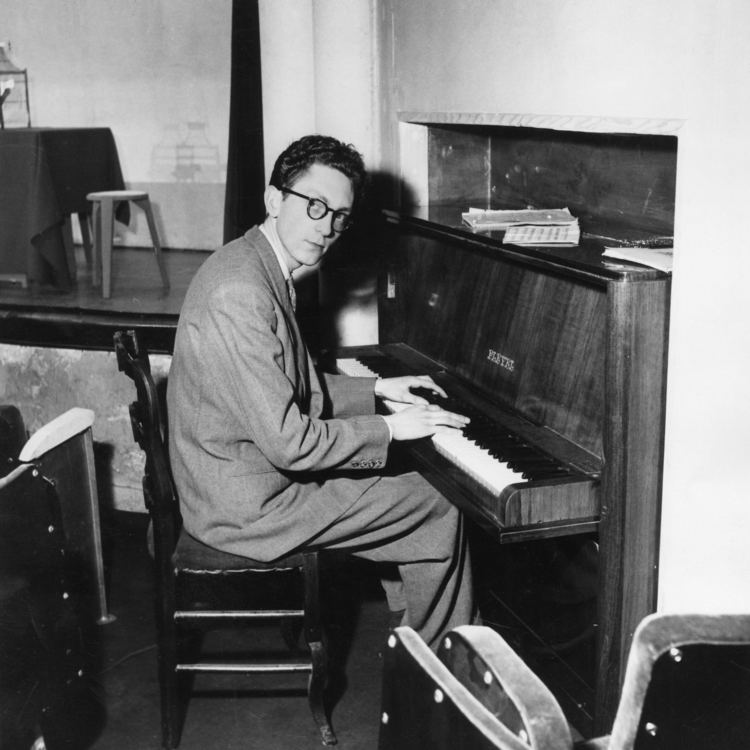
With Broussolle, Popp tried breaking into the Parisian music industry by signing many songs, most notably 'Grand papa laboureur', which was recorded by Cathérine Sauvage. In the late 1940s, Popp also worked as a piano accompanist for theatres and record companies. Later on, after a particularly well-received Christmas broadcast for which he had written the music, Popp was signed by French radio as a producer and conductor (1953). Having formed his own orchestra, he entertained nationwide audiences with his instrumental compositions and arrangements in different styles in 'La bride sur le cou', a weekly radio programme which ran for five consecutive years. 

Meanwhile, Popp continued composing songs, amongst which big (international) hit successes such as 'Les lavandières du Portugal' (Portuguese washerwomen), originally recorded by Jacqueline François (1954), Eurovision winner 'Tom Pillibi' for Jacqueline Boyer (1960), and 'Manchester et Liverpool' for Marie Lafôret (1967). As an arranger, he worked with many different artists, most notably Jacques Brel, for whom he wrote the original score to 'Quand on n'a que l'amour'. He orchestrated a number of Juliette Gréco albums in the late 1950s and early 1960s. 

Testimony to Popp's creativity is the creation of an educative symphonic work for children, 'Piccolo, Saxo et Cie.', for which he teamed up with his old friend Jean Broussolle. The first of the four ‘Piccolo, Saxo et Compagnie’ albums, released in 1956, won the Grand Prix du Disque. He also released several instrumental albums, including the innovative 'Delirium in Hi-Fi' (under the pseudonym Elsa Popping) and two LPs with ukelele virtuoso Herb Ohta. 


In the Eurovision Song Contest, after his victory with 'Tom Pillibi' (France 1960, lyrics by Pierre Cour), Popp composed three more Grand Prix entries: 'Le chant de Mallory' (Rachel, France 1964), 'L'amour est bleu' (Vicky Leandros, Luxembourg 1967), and 'Une chanson c'est une lettre' (Sophie Hecquet, Monaco 1975). For the last-mentioned song, Popp conducted the Eurovision orchestra himself. Indeed, the haunting "Love Is Blue", as it became known internationally, turned into a worldwide standard. 

In 1968 the French orchestra leader, Paul Mauriat, took an instrumental arrangement to the top of the US hit parade and battled it out with the version by guitarist Jeff Beck in the UK charts, while the following year the American vocal group the Dells recorded a successful medley combining an English adaptation by Bryan Blackburn with Arthur Hamilton's "Sing A Rainbow". 

Popp had a singular knack for writing melodies that appealed to the collective consciousness. Originally recorded by Les Compagnons De La Chanson, "Tzinerlin", with an English lyric by Jack Fishman, became "Years May Come, Years May Go", the last UK Top 10 hit for Herman's Hermits in 1970. In 1979, Popp won the Grand Prix Académie Charles Cros for the second time, on this occasion for his music to a series of audio reworkings of Hergé’s cartoon creation ‘Tintin’. In the 1970s and 1980s, Popp continued writing songs for artists such as Mireille Mathieu, Nicole Croisille, and Gérard Palaprat. He also continued writing film scores, his last being Pineapple Express in 2008. 

Popp died at his apartment in the Paris suburb of Puteaux on 10 May 2014. The day a pre-recorded interview, his last, was broadcast on the radio station France Musique. As French media remarked, this was a fitting farewell for the master of the soundscape and the composer whose series of Piccolo, Saxo Et Compagnie recordings had introduced several generations of children to the nuances of the orchestra.

(Edited mainly from “And The Conductor Is”)


Thursday, 18 February 2021

Bobby Taylor born 18 February 1934

Bobby Taylor (February 18, 1934 - July 22, 2017) was an American soul singer, songwriter, and producer active primarily in the 1960s and 1970s. He played a key role in the development of soul music over the past half century. 

Morris Wade & The Four Pharaohs

He was born Robert Edward Taylor in Washington, D.C. As a young man, he moved to New York City and sang in doo-wop groups with singers who later joined successful acts such as Frankie Lymon & the Teenagers and Little Anthony and the Imperials. In 1958 he began his music career as a member of The Four Pharaohs, who released a few locally-selling recordings in the Columbus, Ohio, area. 

In the early 1960s, while they were in San Francisco, Taylor joined Little Daddy and the Bachelors, made up of vocalist Tommie Melton, guitarist Tommy Chong, bassist Wes Henderson, pianist Bernie Sneed, and drummer Floyd Sneed. While in Calgary they were known as the Calgary Shades. The word Shades in the group's name referenced the fact that the band was interracial. Chong is half Chinese. The other members were black, white, and Aboriginal. Taylor was of American Negro, Puerto Rican, and Native American heritage. 

"Little Daddy & The Bachelors" recorded a single, "Too Much Monkey Business" / "Junior's Jerk". Melton and Chong opened a Vancouver dance hall in 1962 called the Blues Palace, which was formerly a movie theatre. They brought in the Ike & Tina Turner Revue who had never been to Vancouver before. They drew a small crowd and Melton and Chong broke even on that one. Although Little Daddy & The Bachelors built up a small following, things soured when they went with Chong's suggestion and had themselves billed as " "Four N's and a C", before taking on the moniker Bobby Taylor & the Vancouvers. 

In 1965, Supremes members Mary Wilson and Florence Ballard heard the band at the Elegant Parlour in Vancouver, and alerted Motown CEO Berry Gordy, Jr.. Gordy brought the Vancouvers to Motown Records in Detroit, Michigan, and signed them to his Gordy Records imprint. By this time the evolving line-up consisted of Taylor, Henderson, and Chong along with guitarist Eddie Patterson, organist Robbie King, and drummer Duris Maxwell (aka Ted Lewis), the latter three having come as a package when the original Vancouvers merged with another local group, the Good Shepherds. Some say that Jimi Hendrix played with them in those early days, but there is no proof except Hendrix later jammed onstage with the Vancouvers in Europe. 


The group recorded its debut album, an eponymous release, and their debut single, the Tommy Chong co-composition "Does Your Mama Know About Me," peaked at number 29 on the Billboard Hot 100, and #44 in Canada. For a July, 1968, engagement at the Regal Theater in Chicago, Bobby Taylor & the Vancouvers had a local-area family band, The Jackson 5, as their opening act. Impressed with the group, Taylor personally brought them to Detroit and the Motown offices, arranging an audition for them with Motown executive Suzanne de Passe. De Passe and Berry Gordy were impressed with the Jacksons, and the group was signed to the label within a year. 

After releasing two further singles, The Vancouvers ended up performing in support of Motown artist Chris Clark. Tommy Chong and Wes Henderson were fired by Clark and Motown producer Johnny Bristol for missing a gig to apply for Green cards. The group broke up shortly afterwards. Taylor auditioned for the then-vacant lead singer position in The Temptations, but was turned down. After the Jackson 5 signed to Motown in March 1969, Taylor became the group's first producer. He supervised the bulk of their first album, Diana Ross Presents the Jackson 5, recording the Jacksons on a number of soul covers. Berry Gordy would later move the group to California and take personal control of their sound. Although Taylor would briefly join the Jacksons in California, he did not receive credit for working on the group's early singles such as "I Want You Back" and "ABC" . In addition to those, he produced most of their covers of older rhythm and blues songs. 

As a solo artist, Taylor was shifted to Motown's V.I.P. label and continued as a solo artist. Although his "Oh, I've Been Blessed" later attained a cult status, Taylor's solo singles failed to sell well. By 1971, Taylor had departed Motown because of a financial dispute, recording sporadically into the mid-1970s.Taylor later successfully sued Motown for a substantial amount of money. Moving to the United Kingdom, Taylor started an offshoot group, Bobby Taylor & the New Vancouvers, and recorded an album for Ian Levine's Motorcity Records. 

In the eighties, he was diagnosed with throat cancer and relocated to Columbus, OH.  There, he lived with his mother before returning to the west coast and making his home in San Jose.  He would later be diagnosed with leukemia and the metastatic cancer that would ultimately take his life.  He was performing a Motown-themed show in Hong Kong under the name “The Bobby Taylor Band.”  His later musical efforts were tempered by bouts with throat cancer, which he had treated by various holistic doctors. 

As of 2014, Taylor resided in Hong Kong where he died on 22 July 2017,age 83. (Edited mainly from Wikipedia) 

Wednesday, 17 February 2021

Anne Phillips born 17 February 1935


Anne Phillips (born 17 February 1935) is an American singer, songwriter, and producer. She has worked with Burt Bacharach, Carole King, Mahalia Jackson and has arranged and produced jingles for the Four Tops and Martha and the Vandellas. 

Phillips was born Anne Latta Dinsmore in Philadelphia, Pennsylvania, USA and grew up in Wyomissing. She played piano growing up but didn't hear jazz until she was a senior in high school. Phillips studied at Oberlin College singing in her freshman year with the college big band. She had her own radio show, singing and playing on the college station, and sang with a college trio that was the supporting act on the occasion of Dave Brubeck’s famous Brubeck at Oberlin concert. 

After attending the New England Conservatory of Music, she relocated to New York City. There, she performed on a number of live television shows as a member of two of the best known choirs, the Ray Charles Singers and the Norman Luboff Choir. She also sang demonstrations for songwriters such as Burt Bacharach and Hal David, Carole King, Neil Diamond and Paul Simon. 


She made her recording debut in 1959 for Roulette Records, with Born To Be Blue, This marked shift in popular music patterns resulted in a highly successful career in the studios. Her industry was soon disrupted by rock ‘n roll and she wouldn’t record another album under her name until 2000, but Phillips now became one of the most respected and in-demand studio performers in the music business in New York City. 

Anne with Kermit Lewinsky

Throughout the 60s, she sang in backing groups on countless recording sessions, wrote, arranged and produced commercials for the American Gas Association, Kent Cigarettes, Campbell’s Soup and Sheraton Hotels. Phillips composed music for a Pepsi campaign with BBDOcalled "The Taste That Beats the Others Cold, Pepsi Pours it On. The spot included The Turtles, The Four Tops, The Hondells, and the Trade Masters. 

Anne with The Turtles

Other artists with whom she worked during these years include the Sammy Davis Jnr. ,Leslie Gore, Linda Ronstadt, Mahalia Jackson, Wilson Pickett and Martha And The Vandellas. She formed her own choir for recording and broadcasting, and became music director at St. Bartholomew’s Church on Park Avenue. She wrote book, lyrics and music for The Great Grey Ghost Of Old Spook Lane, a children’s show that has been produced by many theatrical groups and, with her husband, tenor saxophonist, Bob Kindred, created Bending Towards The Light - A Jazz Nativity, the Christmas story told through the medium of jazz. 

This work is produced annually in New York and elsewhere in America and has featured guests such as Brubeck, Al Grey, Lionel Hampton, Tito Puente and Clark Terry. She and her husband also operate a non-profit organization, the Kindred Spirit Foundation. Additionally, from the early 90s onwards, Phillips has been on the adjunct faculty of the Jazz and Contemporary Music Department at New York University, where she arranges for and directs the NYU Jazz Choir. She also directs Children’s Jazz Choirs through which she teaches inner-city kids songs from the Great American Songbook. 

In recent years she has happily been welcomed into the classical community. Her short operas have been performed at Weill Hall at Carnegie as a part of a program called “Opera Shorts,” She received a grant from Opera America for an evening of short operas entitled That ‘Certain Age’ (about aging with grace and humour.) Her songs have been recorded by soprano Monica Harte for MSR Records, and have been performed on concerts throughout the country and on concerts produced by Chelsea Opera. 

In 2001 she released her second solo album “Gonna lay My Heart on the Line” on which she performs songs she has written, both music and lyrics. Margaret Whiting said “Some of the best songs I’ve heard in years.”.”Noel Noel “followed in 2002 containing Christmas carols written for a 25 voice a cappella choir. On “Ballet Time” (2007) she sings with such jazz greats as Dave Brubeck and Marian McPartland. 

In 2019 she released “Live at the Jazz Bakery”. Comparing 1959’s “Born to be Blue” with this set her voice has held up remarkably well. Her accompaniment is jazzier now than it was then, led by husband Bob Kindred on tenor sax and joined by Roger Kellaway on piano and Chuck Berghoffer on bass. Her original compositions make up most of the album with a couple of standards thrown in. Her writing captures that mid-century moment when songs and singers were appreciated. This intimate and warm album, with its engaging monologues peppered with recognizable names spanning a half-century, feels like meeting someone special.  

Phillips was recently awarded the “Heart of Gold” award from the Best Friends Foundation in Washington DC for her work with her Children’s Jazz Choirs. 

(Edited mainly from AllMusic)

Tuesday, 16 February 2021

Patty McGovern born 16 February 1928


Patty McGovern (born 16 February 1928) is a singer, songwriter who is one of the many 50’s female vocalists that are little remembered today except for her only album “Wednesday’s Child”. 

Patricia Jean McGovern hails from St. Paul, Minnesota and was raised in a musical family. Her brother Tom, who was 12 years older than Patty, was a very talented pianist and musicians would visit the family home. As her love and desire to be in and near music grew, she began to write songs at an early age. “Even at eight or nine, I knew music was my thing. When my mother asked me to dust, I’d find myself picking out things on the piano, looking for new harmonies and chords. I didn’t have a teacher. I think I composed my first song at seven. Later when I learned to notate, I wrote it down. The song title was Why and began “Why am I blue?” I was kind of a melancholy kid”. 

Melancholy or not, singing came naturally. “We didn’t have much during the Depression and WWII, so we’d sing together around the kitchen table. I started singing with my cousins Betty and Jerri, and my sister, Elaine. I was the organiser and harmoniser. I found an old record, On The Beach At Bali-Bali and we learned the music. We’d listen to the radio a lot and sang old standards. We even sang on local radio in St Paul, Minneapolis when I was 12”. 

Here’s one of Patty’s own songs, taken from a FM  78 from circa1948/49.  She sings with Tony Grise with backing by The Velvetones with the Percy Hughes Orchestra. 


In 1948, McGovern married Minnesota broadcaster and radio personality, Leigh Kamman and had two daughters.. By this time she already had professional performing experience with her brother’s band, and partly due to Kamman’s connections, her career blossomed. 

Leigh Kamman

In 1950, she joined the Honey Dreamers, a mixed vocal quintet who were riding high at the time. “During this period, I auditioned for the Honey Dreamers and became lead singer between 1950 and 1954. The Honey Dreamers went to New York, turning down an offer to sing with the Stan Kenton band. On the road we played hotels, nightclubs and theatres. We did live commercials like Tide and Camay soap, 55 Kinescope, also CBS TV, working with Johnny Mercer and Stan Kenton”.

By now based in New York, she sang on many of the major television programmes, either solo or with the Dreamers. Guest spots included appearances with Mel Tormé and solo shots on the Eddie Fisher Show, Celebrity Time, the Steve Allen and Perry Como shows, and the Jackie Gleason Show, among others. The Honey Dreamers recorded frequently for Capitol, Decca, Mercury and RCA. 

Singing group 'The Honey Dreamers' featuring Keith Textor, Sylvia Textor and Patty McGovern perform onstage at the New York Paramount Theatre on July 4, 1951 in New York.

In 1956 independently of the quintet, Patty recorded her only solo album”Wednesday’s Child” with the inventive arrangements of Thomas Talbert. He backs the vocalist with groups ranging from a quartet to a septet that utilize such instruments as flute, French horn, clarinet and bassoon in prominent roles. With lyrical solos by trumpeter Joe Wilder and guitarist Barry Galbraith and simple but effective interpretations from McGovern on these underplayed standards. Released by Atlantic Records yet hardly gave it any promotion on its release. 

Regardless her songwriting began to attract attention. “Composing and writing continued between jobs. I got positive responses from Marian McPartland who played my songs, but didn’t record them. She particularly liked one called In October”. Two more who did record her songs were jazz pianist George Wallington and cult vocalist Jeanne Lee. Despite these successes, gender discrimination remained an unfortunate reality of show business in the 50s. “I must admit, I found more recognition as a singer and often felt underrated as a female composer. Women weren’t given any acknowledgment when it came to writing music. Women were singers who were expected to look pretty”. 

Patty and her family returned to Minnesota toward the end of the 50s, and the music continued, at least a few more years. She recorded “a rock’n’roll number “Rock Patty Rock” with Rod Aaberg & His Orchestra on the local North Star label and also a few children’s songs for the Harmony and Columbia labels.  “There were occasional club dates and collaborations with local jazz musicians. Notable artists continued to visit from near and far. Ella Fitzgerald came to town for a club date. I worked up the lead sheet for Mack The Knife. It was the first time Ella considered it, later performing it in Berlin. George Shearing sat down at our piano after hours and immediately knew: ‘This is an Acrosonic’. I continued to write music”. 

Though club gigs dried up in the 60s, Patty continued to direct singing groups, teach piano and compose”. Not to mention inspiring a younger singer in the talented Canadian Jazz singer Diana Panton. As of 2014, Ms. McGovern was still teaching voice and piano." Today she celebrates her 92nd birthday. 

(Edited mainly from correspondence from Patty via her daughter to the magazine Jazz Journal in 2020)

Monday, 15 February 2021

Frank Horrox born 15 February 1924


Frank Horrox  (February 15, 1924 - February 21, 1972) was an English jazz pianist, arranger and composer. 

Frank was born in Bolton, Lancashire, as Frank Entwistle Horrocks. He began playing piano at the age of five and later studied at Trinity College of Music, where he won three exhibitions. He turned professional at the age of seventeen with Bertini’s band, then worked with Dick Denny at the Edinburgh Palais and toured as accompanist for comedian Arthur Askey in 1942. 

He served in the Army from late 1942 until May 1947 and was featured in “Stars In Battledress” shows. After demobilization he worked as staff arranger for publishers Campbell Connelly. In 1947 he worked with Reggie Goff before joining Vic Lewis In 1948 to June 1949 (where he met his future wife trombonist Ruth Harrison). He then joined the Basil Kirchin band then a brief return with Vic Lewis before joining Paul Fenoulhet. 

He joined Ted Heath (replacing Dave Simpson) from October 1949 to July 1952. He then joined Lew Stone at the Pigalle, London for six months. He also did extensive freelance arranging and work on the film “The Blue Lamp”(with Jack Parnell). He rejoined Ted Heath from February 1953 until September 1957. Horrox also wrote arrangements for Heath and can be heard playing bop solos on Lullaby of Birdland (1953, Decca F10200) and Our Waltz, from the album Ted Heath’s 100th London Palladium Sunday Concert (1954, London LL1000), and he may be seen with Heath in the film Dance Hall (1950). 


He played with Raymond Gordon’s Orchestra at the London Hippodrome from September to November 1957 then he rejoined Heath for an American tour in 1958 and recorded at Carnegie Hall.  In 1960 Horrox released an EP on the Embassy label titled “Jazz Sesion” which comprised Don Rendell on tenor, Albert Hall on trumpet, Jeff Sothcott on bass and Don Lawson on drums. 

Thereafter he was mainly active as a freelance pianist and arranger for many musical directors including Alyn Ainsworth, Frank Chacksfield, ken Thorne etc., but also played jazz gigs with small band, sometimes playing organ.  Throughout his career he had been involved in a bit less than 100 recording sessions, some involving musical dignitaries visiting London, including drummer Louie Bellson. His own favourite pianists were American jazzmen, and Horrox took pride in his arrangements of standards such as "Love for Sale." His ensembles played regularly on British film and theatre scores.

His later session work included recordings with The Melachrino Orchestra, The Jack Nathan Orchestra, Neil Richardson & His Orchestra and the Romantic Strings Orchestra to name but a few.

Frank Horrox sadly succumbed to Cancer at the age of 48 years old, at a clinic in Bavaria, Germany on 21 February 1972. 

(Edited mainly from Who’s Who of British Jazz 2nd Edit plus snippets from AllMusic, Discogs, IMDb and Oxford Music On Line) 

Sunday, 14 February 2021

Tim Buckley born 14 February 1947


Timothy Charles Buckley III (February 14, 1947 – June 29, 1975) was an American vocalist, songwriter, guitarist and producer. 

Born on February 14, 1947, in Washington, D.C., Tim Buckley spent much of his childhood in Amsterdam, New York, before his family relocated to Southern California in 1956. Buckley was a musical omnivore from an early age; he became fascinated with his parents' jazz albums when he was five years old, and his family later introduced him to blues, country, and influential pop vocalists. 

While Buckley played football in high school, his love of music eventually took precedence, though a hand injury in one of his last games would make it difficult for him to play bar chords, which would unwittingly inform his guitar style. While in high school, he made friends with poet and musician Larry Beckett, who would become one of his songwriting partners, and Jim Fielder, a bassist who would play in two bands with Buckley, a rock group called the Bohemians and a folk combo, the Harlequin 3. Also during high school, Buckley entered into a short-lived marriage with his girlfriend Mary Guibert . A month after the couple split following a year together, she would give birth to their son, Jeff Buckley, who said he met his father only once. 

In 1965, Buckley enrolled at Fullerton College, but he dropped out after two weeks to devote himself to writing songs and playing folk clubs in Los Angeles. He gigged often enough to earn a following and some positive press, and in early 1966 he played a show where he was spotted by Jimmy Carl Black of the Mothers of Invention. Impressed, Black told Herb Cohen, the Mothers' manager, about Buckley, and Cohen took Buckley on as a client, getting him his first dates in New York City. Buckley recorded a six-song demo that made its way to Jac Holzman of Elektra Records, who wasted no time signing him to a record deal.


Recorded in just three days with Holzman and Paul Rothchild producing and Jack Nitzsche providing string arrangements, 1966's Tim Buckley tempered his folk sensibilities with rock and pop accents. Not entirely happy with the debut, Buckley was given greater creative freedom on 1967's Goodbye and Hello; a growing interest in psychedelia was clearly audible in the songs and performances, as well as more challenging and personal lyrics, and it became his first album to enter the Top 200 albums charts, peaking at 171. 

                            Paul Morrissey, Andy Warhol, Janis Joplin and Buckley

In March 1968, Buckley was featured on the final episode of the popular TV series The Monkees, performing "Song of the Siren." That same year, he set out on his first tour outside the United States, performing for audiences in Europe and the United Kingdom.

Buckley next shifted into one of his most prolific periods, releasing four albums between 1969 and 1970. Happy Sad, issued in July 1969, found him embracing his love of jazz as he stretched out on relatively lengthy pieces; it rose to 81 on the pop/rock album chart, November 1969's Blue Afternoon added vibraphone and acoustic bass to melodies that recalled the folky tone of his early work. Lorca, appearing in May 1970, took a deep dive into experimental music, with challenging, atonal vocals and arrangements that didn't sit well with many of his fans, and November 1970's Starsailor was no more accessible, further puzzling his shrinking audience, though it would go on to become a cult favourite, with Pitchfork naming it one of the 100 Best Albums of the '70s in a 2004 feature.

Making things all the more confusing, Lorca was the last album under Buckley's contract with Elektra, while Blue Afternoon, which came out six months earlier, was his first for Straight Records, a label founded by Herb Cohen and Frank Zappa. Between the daunting nature of much of the material and flooding the marketplace with four LPs in 16 months, Buckley's commercial prospects took a nosedive, and he reportedly turned to driving a taxi for a while to make ends meet. 

With his career on the downturn, Buckley began drinking and drugging in excess, and hoping to win a larger audience, he once again revamped his approach. 1972's Greetings from L.A. was produced by Jerry Goldstein  and was devoted to funk-leaning R&B, with Buckley singing sexually provocative lyrics in an affected manner. While much of his old following had no idea what to make of the album, it did manage to earn him some new followers, and 1973's Sefronia followed a similar template, though his cover of Fred Neil's "Dolphins" and the two-part title track recalled past glories. 

1974's Look at the Fool was the weakest album of Buckley's career, a strange mixture of his R&B/funk material and eccentric rock & roll that was seriously short on good songs and found his voice showing serious wear and tear. After the poor reception afforded Look at the Fool, he announced plans to return to the style of his most celebrated work and hit the road for a concert tour. Buckley had taken steps to leave alcohol and drugs behind, but following the final date of a successful tour, he relapsed upon returning to Los Angeles. After a bout of serious drinking, a friend offered Buckley some heroin; he overdosed, and died on June 29, 1975. He was only 28 years old.  (Edited from AllMusic)