Saturday, 7 April 2018

Billie Holiday born 7 April 1915


Eleanora Fagan (April 7, 1915 – July 17, 1959), better known as Billie Holiday, was an American jazz musician and singer-songwriter with a career spanning nearly thirty years.  

Billie Holiday was born Eleanora Fagan in Philadelphia, Pennsylvania. (Some sources say her birthplace was Baltimore, Maryland, and her birth certificate reportedly reads "Elinore Harris.") Holiday spent much of her childhood in Baltimore. Her mother, Sadie, was only a teenager when she had her. Her father is widely believed to be Clarence Holiday, who eventually became a successful jazz musician, playing with the likes of Fletcher Henderson. 

Unfortunately for Billie, her father was an infrequent visitor in her life growing up. Sadie married Philip Gough in 1920 and for a few years Billie had a somewhat stable home life. But that marriage ended a few years later, leaving Billie and Sadie to struggle along on their own again. Sometimes Billie was left in the care of other people. 

Holiday started skipping school, and she and her mother went to court over Holiday's truancy. She was then sent to the House of Good Shepherd, a facility for troubled African American girls, in January 1925.
 
Only 9 years old at the time, Holiday was one of the youngest girls there. She was returned to her mother's care in August of that year. In her difficult early life, Holiday found solace in music, singing along to the records of Bessie Smith and Louis Armstrong. She followed her mother, who had moved to New York City in the late 1920s, and worked in a house of prostitution in Harlem for a time. Around 1930, Holiday began singing in local clubs and renamed herself "Billie" after the film star Billie Dove. 

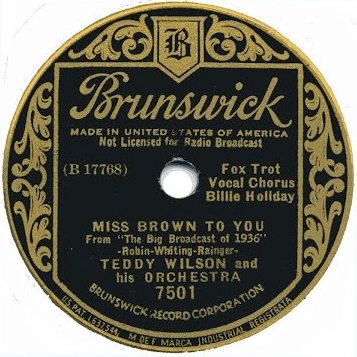
At the age of 18, Holiday was discovered by producer John Hammond while she was performing in a Harlem jazz club. Hammond was instrumental in getting Holiday recording work with an up-and-coming clarinetist and bandleader Benny Goodman. With Goodman, she sang vocals for several tracks, including her first commercial release "Your Mother's Son-In-Law" and the 1934 top ten hit "Riffin' the Scotch." Known for her distinctive phrasing and expressive, sometimes melancholy voice, Holiday went on to record with jazz pianist Teddy Wilson and others in 1935. She made several singles, including "What a Little Moonlight Can Do" and "Miss Brown to You." That same year, Holiday appeared with Duke Ellington in the film Symphony in Black. 


Around this time, Holiday met and befriended saxophonist Lester Young, who was part of Count Basie's orchestra on and off for years. He even lived with Holiday and her mother Sadie for a while. Young gave Holiday the nickname "Lady Day" in 1937—the same year she joined Basie's band. In return, she called him "Prez," which was her way of saying that she thought it was the greatest. 

Holiday toured with the Count Basie Orchestra in 1937. The following year, she worked with Artie Shaw and his orchestra. Holiday broke new ground with Shaw, becoming one of the first female African American vocalists to work with a white orchestra. Promoters, however, objected to Holiday—for her race and for her unique vocal style—and she ended up leaving the orchestra out of frustration. Striking out on her own, Holiday performed at New York's CafĂ© Society. She developed some of her trademark stage persona there—wearing gardenias in her hair and singing with her head tilted back. 

During this engagement, Holiday also debuted two of her most famous songs, "God Bless the Child" and "Strange Fruit." Columbia, her record company at the time, was not interested in "Strange Fruit," which was a powerful story about the lynching of African Americans in the South. Holiday recorded the song with the Commodore label instead. "Strange Fruit" is considered to be one of her signature ballads, and the controversy that surrounded it—some radio stations banned the record—helped make it a hit.
 
Over the years, Holiday sang many songs of stormy relationships, including "T'ain't Nobody's Business If I Do" and "My Man." These songs reflected her personal romances, which were often destructive and abusive. Holiday married James Monroe in 1941. Already known to drink, Holiday picked up her new husband's habit of smoking opium. The marriage didn't last—they later divorced—but Holiday's problems with substance abuse continued. 

That same year, Holiday had a hit with "God Bless the Child." She later signed with Decca Records in 1944 and scored an R&B hit the next year with "Lover Man." Her boyfriend at the time was trumpeter Joe Guy, and with him she started using heroin. After the death of her mother in October 1945, Holiday began drinking more heavily and escalated her drug use to ease her grief.  Despite her personal problems, Holiday remained a major star in the jazz world—and even in popular music as well. She appeared with her idol Louis Armstrong in the 1947 film New Orleans, albeit playing the role of a maid.   

Unfortunately, Holiday's drug use caused her a great professional setback that same year. She was arrested and convicted for narcotics possession in 1947. Sentenced to one year and a day of jail time, Holiday went to a federal rehabilitation facility in Alderston, West Virginia. Released the following year, Holiday faced new challenges. Because of her conviction, she was unable to get the necessary license to play in cabarets and clubs. Holiday, however, could still perform at concert halls and had a sold-out show at the Carnegie Hall not long after her release.  

With some help from John Levy, a New York club owner, Holiday was later to get to play in New York's Club Ebony. Levy became her boyfriend and manager by the end of the 1940s, joining the ranks of the men who took advantage of Holiday. Also around this time, she was again arrested for narcotics, but she was acquitted of the charges.

While her hard living was taking a toll on her voice, Holiday continued to tour and record in the 1950s. She began recording for Norman Granz, the owner of several small jazz labels, in 1952. Two years later, Holiday had a hugely successful tour of Europe.  

Holiday also caught the public's attention by sharing her life story with the world in 1956. Her autobiography, Lady Sings the Blues (1956), was written in collaboration by William Dufty.  Some of the material in the book, however, must be taken with a grain of salt. Holiday was in rough shape when she worked with Dufty on the project, and she claimed to have never read the book after it was finished.
 Around this time, Holiday became involved with Louis McKay. The two were arrested for narcotics in 1956, and they married in Mexico the following year. Like many other men in her life, McKay used Holiday's name and money to advance himself. Despite all of the trouble she had been experiencing with her voice, she managed to give an impressive performance on the CBS television broadcast The Sound of Jazz with Ben Webster, Lester Young, and Coleman Hawkins.

After years of lacklustre recordings and record sales, Holiday recorded Lady in Satin (1958) with the Ray Ellis Orchestra for Columbia. The album's songs showcased her rougher sounding voice, which still could convey great emotional intensity.Holiday gave her final performance in New York City on May 25, 1959. Not long after this event, Holiday was admitted to the hospital for heart and liver problems.  

She was so addicted to heroin that she was even arrested for possession while in the hospital. On July 17, 1959, Holiday died from alcohol- and drug-related complications. 

More than 3,000 people turned out to say good-bye to Lady Day at her funeral held in St. Paul the Apostle Roman Catholic Church on July 21, 1959. A who's who of the jazz world attended the solemn occasion, including Benny Goodman, Gene Krupa, Tony Scott, Buddy Rogers and John Hammond. Considered one of the best jazz vocalists of all time, Holiday has been an influence on many other performers who have followed in her footsteps. 

In 2000, Billie Holiday was inducted into the Rock and Roll Hall of Fame with Diana Ross handling the honours   (Edited from biography.com).


Friday, 6 April 2018

Barbara Pittman born 6 April 1938


Barbara Pittman (April 6, 1938 – October 29, 2005). Her claim to fame is that she was the only female artist signed to Sam Phillips' Sun Records -- other women recorded for the label, but only Pittman was one of the few female singers to record at Sun Studio given a contract. That alone would secure her place as a footnote in music history, but Pittman also cut one exalted rockabilly classic during her Sun years: "I Need a Man." 
Pittman was one of 12 children born to a family in Memphis, TN, in 1943. Her mother was acquainted with Gladys Presley, and Pittman attended the same school as Elvis. Pittman began thinking of a singing career when she won a high school talent contest, As a child, Pittman spent time at her uncle's pawn shop on Beale Street, where she listened to jam sessions with B.B. King. When she was 10 or 11, she auditioned for Sun Records but she was turned away because of her age. The dauntless Pittman found work with a local band (thanks to a recommendation by Elvis, Pittman says) before touring with western star Lash Larou in 1955.  


Returning to Memphis in 1956, Pittman began singing with Clyde Leoppard's Snearly Ranch Boys and found work as a demo singer for Stan Kesler, who hoped that her acquaintance with Presley would give a boost to a song he had earmarked for the popular rock & roller. The resulting demo of "Playing for Keeps" convinced Presley to record the song and brought Pittman to the attention of Sam Phillips. She cut the classic "I Need a Man" backed by members of Leoppard's band. The record was unsuccessful, but Pittman appeared on Sun package tours.


Other singles followed, including "No Matter Who's to Blame," "Two Young Fools in Love" and "I'm Getting Better all the Time." John Singleton, president of Sun Entertainment in Nashville, said Phillips used mostly male singers but liked Pittman, who continued to make recordings for Sun, many of which were not released. Pittman stated in interviews that this was due to a lack of promotion on the part of the label.
 
When other labels expressed an interest in Pittman in 1957, Phillips retaliated by offering her a contract, making her the only female artist to be honoured thusly. Phillips let her choose whether she wanted to record for Sun or his new Phillips International subsidiary, and Pittman selected the latter because she thought it had a more attractive label design.
 
She recorded several sessions with Sun players like Billy Lee Riley and Bill Justis, but her recordings ranged from teen-oriented pop to bluesy balladry, with little of the rockabilly and rock & roll for which she later would be celebrated. A one-off single with the vocal group the Sunrays also failed, and Pittman released her final Phillips single in 1960. Several radio stations deemed the flip-side, "Eleventh Commandment," blasphemous and banned it from airplay, further crippling an already doomed record.


Pittman left Phillips International for Del-Fi, but no recordings were issued. Throughout the '60s she performed on cruise ships and military bases, and sang on the soundtracks of motorcycle movies such as Wild Wheels and Wild Angels.

In the '70s she married, and with the rockabilly revival her reputation grew as her Sun recordings were reissued on compilation albums. In 1983 she formed a band in Houston, TX, and played at European rockabilly festivals.
 
From 2000 onwards Barbara did several shows for the Rockabilly Hall of Fame in Memphis and one in Las Vegas during the past 5 years. Sadly, she was often overlooked when the Memphis area Sun Tribute Shows were put together. She especially enjoyed joining Ace Cannon's band on stage for a song or two.

After a trip to England in March of 2005, Barbara’s health declined, She died at her Memphis home Oct. 29, 2005 of heart failure. She was 67.


Pittman's legacy is built upon three or four essential tracks, but the squandered opportunities surrounding this husky-voiced singer are nearly as fascinating as the records she made. 

(Compiled and edited from an AllMusic bio by Greg Adams & Wikipedia)

Here's Barbara Pittman & The Six Guns. Houston at Rockefellers - benefit for KPFT in1984.


Thursday, 5 April 2018

Billy Bland born 5 April 1932


Billy Bland (born 5 April 1932, Wilmington, North Carolina, died 22 March 2017, New York City) was an American R&B singer and songwriter.

The youngest of 19 children, Billy didn't wait any longer than necessary to achieve his goal of becoming a professional singer. Making the 600-mile trek northward to New York City at age 18, the talented and determined young singer immediately caught some breaks, landing a gig with Lionel Hampton's band, then another with Buddy Johnson in the late 1940s. But he developed a lack of discipline, a result, perhaps, of advancement coming too easily; as a result, he didn't hang onto any one job for very long.   

Billy was singing at Smalls Paradise in Harlem in 1954 when Dave Bartholomew spotted him, took him to his home base in New Orleans, and made him the lead singer of The Bees, whose "Toy Bell" was recorded at Cosimo Matassa's studio with Bartholomew producing and regular members of Fats Domino's band providing the rhythmic uptake. The record had limited success as many stations banned it for its double-entendre lyrics: 'I played with her yo-yo on the string...and she played with my ding-a-ling!' (Chuck Berry's live recording of the song became a number one hit in 1972 under the more obvious title "My Ding-A-Ling"). 

There was one other Bees single on Imperial before the group disbanded; Billy was on his own once again, having inadvertently recorded a future classic of dubious content. All the experience to this point helped land him a contract in 1956 as a solo artist with Old Town Records, a new York-based label founded three years earlier by Romanian immigrant and rhythm and blues aficionado Hy Weiss. His first two singles for the company were "chicken" songs, an unusual mutual theme, each having a vastly different sound. Bland, in fact, liked trying different things and during his seven years with Old Town his music ran the gamut from furiously-paced R&B to blues, pop ballads, doo wop and straight-ahead rock and roll. 


The "chicken" songs didn't sell, even after being paired on a Tip Top label reissue several months later. Billy composed a lot of his own material. He made some recordings that weren't released and found himself in a state of limbo for a couple of years until a late 1959 session yielded his one major hit. Titus Turner was struggling with the Carl Spencer-Henry Glover tune "Let the Little Girl
Dance. Billy took a stab at it and nailed the song in one take, considering it no more than demonstration quality despite the stellar line-up of musicians who contributed to the track including saxophonist Buddy Lucas, guitarist Mickey Baker and backing singers The Miller Sisters. Turner never did have a record issued on Old Town but Bland's quick take on "Let the Little Girl Dance" was just what Weiss and the writers had in mind. It debuted on the national charts in February 1960 and remained there through the end of June, settling into the top ten for four weeks in May. 

Billy had three more records in 1960 that made the charts, if only briefly . His best shot at a big second hit was another self-penned effort, "My Heart's on Fire," arguably his best recording; it reached the national charts in the summer of 1961 but didn't do much better than the other singles had. Old Town stayed with the talented singer for two additional years and several more singles. His final Old Town 45, in 1963, was a remake of unrelated bigger-star Bobby "Blue" Bland's 1958 hit "Little Boy Blue." Furthering some people's confusion of the two, his dynamic performance, which rivals the brilliance of Bobby's original, uses the exact same lyrics.
 
After leaving Old Town in 1963, Billy performed around town but didn't make records again until '65, when he laid down a few tracks for the St. Lawrence label of Chicago. "She's Already Married" (penned by Monk Higgins and Bessie Cook) put him right in the setting of the Windy City soul scene. After a second St. Lawrence single, "I'm Sorry About That," Billy resumed performing in clubs before quitting the music business a few years later. In the 1980s he opened a restaurant in Harlem that specialized in southern soul food. 


During his latter years he resided at an assisted living place at 108 Street and 5th Avenue across Central Park New York City. His grandson Jermain reported in a Facebook post that he died on March 22, 2017. He was 84. 

(Compiled and edited from various sources, mainly from an article by Michael Jack Kirby @ Way Back Attack)

Tuesday, 3 April 2018

Billy Joe Royal born 3 April 1942

 
Billy Joe Royal (April 3, 1942 – October 6, 2015) was an American pop and country singer. He had a long career that saw him become one of the first pop performers to successfully revive his commercial fortunes by turning to straight country music. Although he never had another hit as successful as "Down in the Boondocks," he racked up about 15 singles that hit the country charts over the
course of the 1980s.

Royal was born into a family of musical entertainers in Valdosta, Georgia, and made his debut on his uncle's radio show at the age of 11. He learned to play steel guitar and joined the Georgia Jubilee in Atlanta at 14, performing with Joe South, Jerry Reed, and Ray Stevens, among several other artists. Royal had his own rock & roll band in high school and was regularly singing around Atlanta by the age of 16. He also spent time in Savannah, where he was influenced by African-American vocal styles and began to develop his distinctive vocal sound.  
Performing at a nightclub that also booked Sam Cooke and other African-American stars, Royal observed their vocal moves and began to practice them on his own time. In 1962, he recorded an independent single that went unnoticed. Royal and South roomed together for a time, and two or three years later South contacted him with a song he wanted Royal to sing as a demo, in the hope that Gene Pitney would record it. Royal flew from Cincinnati (where he was working at the time) to Atlanta and cut "Down in the Boondocks," whose churchy echo resulted from the use during recording of a large septic tank that had been dragged into the studio.


The demo ended up at Columbia in 1965, and the label signed Royal to a six-year deal. The song became Royal's breakthrough single, reaching number nine on the pop charts and briefly making the vocalist into a teen idol. Following its success, Royal had a string of lesser hits, including "I Knew You When" (Top 20, 1965) and "Hush" (1967), also written and produced by Joe South.
Another South composition, "Yo-Yo," just missed the top 40 in Canada and charted poorly in the U.S. when Royal released it in 1967, but a later remake by The Osmonds was a much greater success. His 1969 single, "Cherry Hill Park", peaked at No. 15 on the Billboard Hot 100.In the 1970s his recording of "Heart's Desire" gained popularity among Northern soul enthusiasts and was regularly played in Northern soul nightclubs.  In 1978, he recorded a cover of "Under the Boardwalk" and scored a minor hit.

By the late 1970s, Royal had become a regular performer in Las Vegas, and also appeared as an actor in movies and on television. His last hit on the US pop charts was in 1978, when his version of "Under the Boardwalk" became a minor hit. However, he reinvented himself in the 1980s as a mainstream country star, and had his first hit on the country music chart in 1984 with "Burned Like a Rocket", released on the Atlantic label. His other country hits included "I'll Pin a Note on Your Pillow" (1987), "Tell It Like It Is", and "Till I Can't Take It Anymore" (both 1989).. In 1988, Royal was inducted into the Georgia Music Hall of Fame. His successes on the country charts continued until the early 1990s

Royal experienced a second comeback during the 2000s due to regular airplay on "oldies" radio stations. His music was further exposed to younger generations through a movement known as The Beat Army, an online music forum based on Facebook which is operated by author and music producer Paul Collins. Royal continued to tour regularly, performing concerts at casinos, music festivals and clubs in Canada, the United States, Japan and throughout Europe. His set lists included a mixture of songs representing multiple genres from the 1960s onwards. He also played Robert Ally in the indie Western film Billy the Kid (2013), co-starring country singer Cody McCarver.


Among the albums Billy Joe recorded were "Stay Close to Home," "Now and Then, Then and Now," and "His First Gospel Album," which was his last album. He died in his sleep at age 73 at his home in North Carolina on October 6, 2015. 

Monday, 2 April 2018

Leon Russell born 2 April 1942


Leon Russell (born Claude Russell Bridges; April 2, 1942 – November 13, 2016) was an American musician and songwriter. The ultimate rock & roll session man, Leon Russell's long and storied career included collaborations with a virtual who's who of music icons spanning from Jerry Lee Lewis to Phil Spector to the Rolling Stones. A similar eclecticism and scope also surfaced in his solo work, which couched his charmingly gravelly voice in a rustic yet rich swamp pop fusion of country, blues, and gospel. He was awarded six gold records.

Born Claude Russell Bridges on April 2, 1942, in Lawton, Oklahoma, he began studying classical piano at age three, a decade later adopting the trumpet and forming his first band. At 14, Russell lied about his age to land a gig at a Tulsa nightclub, playing behind Ronnie Hawkins & the Hawks before touring in support of Jerry Lee Lewis. Two years later, he settled in Los Angeles, studying guitar under the legendary James Burton and appearing on sessions with Dorsey Burnette and Glen Campbell. As a member of Spector's renowned studio group, Russell played on many of the finest pop singles of the '60s, also arranging classics like Ike & Tina Turner's monumental "River Deep, Mountain High"; other hits bearing his input include the Byrds' "Mr. Tambourine Man," Gary Lewis & the Playboys' "This Diamond Ring," and Herb Alpert's "A Taste of Honey."
 
Russell released his first solo single, "Everybody's Talking 'Bout the Young", for Dot Records in 1965. In 1967, Russell built his own recording studio, teaming with guitarist Marc Benno to record the acclaimed Look Inside the Asylum Choir LP. While touring with Delaney & Bonnie, he scored his first song-writing hit with Joe Cocker's reading of "Delta Lady," and in 1970, upon founding his own Shelter Records imprint, he also organized Cocker's legendary Mad Dogs & Englishmen tour. After the subsequent tour film earned Russell his first real mainstream attention, he issued a self-titled solo LP, and in 1971 appeared at George Harrison's Concert for Bangladesh following sessions for B.B. King, Eric Clapton, and Bob Dylan.


After touring with the Rolling Stones, Russell increasingly focused on his solo career, reaching the number two spot with 1972's Carney and scoring his first pop hit with the single "Tight Rope." While the success of 1973's three-LP set Leon Live further established his reputation as a top concert draw, response to the country-inspired studio effort Hank Wilson's Back was considerably more lukewarm, as was the reception afforded to 1974's Stop All That Jazz. The 1975 album Will O' the Wisp, however, restored his commercial lustre, thanks in large part to the lovely single "Lady Blue."
 

In June of 1975, Russell married singer Mary McCreary; the following year the couple collaborated on The Wedding Album, issued through his newly formed Paradise Records label. Also in 1976, the Russell-penned "This Masquerade" earned a Grammy Award for singer George Benson. Russell and McCreary reunited for 1977's Make Love to the Music, and upon completing the solo Americana, Russell teamed with Willie Nelson for 1979's Willie & Leon. He then spent the next two years touring with his bluegrass band, the New Grass Revival, issuing a live LP in 1981; although Paradise shut down later that year, the label was reactivated for 1984's Hank Wilson, Vol. 2 and Solid State. 

Russell spent the remainder of the decade largely outside of music and did not resurface until issuing the Bruce Hornsby-produced Anything Can Happen in 1992. The album appeared to little fanfare, however, and another long period of relative inactivity followed prior to the 1998 release of Hank Wilson, Vol. 3: Legend in My Time. Face in the Crowd appeared a year later. Moving into the new century, Russell issued Moonlight & Love Songs, an album of cover songs, in 2002, followed by Angel in Disguise five years later in 2007. A trio of releases, Almost Piano, Bad Country, and In Your Dreams appeared in 2008.

Russell's years in the wilderness ended in 2010 when long-time admirer Elton John contacted the pianist about recording a duet album. Produced by T-Bone Burnett, The Union was greeted by strong reviews and sales, reviving Russell's career in a single stroke. After playing a joint tour with John, Russell returned to the road on his own and eventually got around to recording a solo comeback called Life Journey, which appeared in April 2014.


However, Russell's health had been in decline, and he died in his sleep at his home in Nashville on November 13, 2016. Prior to his death, he completed an album of new recordings with producer Mark Lambert. These sessions came out as On a Distant Shore in September 2017.

(Compiled from an AllMusic bio by Jason Ankeny)


Sunday, 1 April 2018

Art Lund born 1 April 1913


Art Lund (April 1, 1915 in Salt Lake City, Utah – May 31, 1990 in Holladay, Utah) was an American baritone singer with rugged good looks, initially with bandleaders Benny Goodman and Harry James, and was also a television and stage actor.
 
Arthur Earl "Art" Lund  the 6-foot-4 performer, graduated from Westminster College in his native Salt Lake City and from Eastern Kentucky State Teachers' College. He also received a master's degree in aerological engineering from the United States Naval Academy in 1943. Lund was a high school math teacher in Kentucky who worked as a musician on the side. He left teaching to tour with Jimmy Ray and his band. He originally billed himself as Art London.

 He found work early on as a vocalist with a band led by clarinetist Jimmy Joy. A better-known clarinetist whom Lund would later sing with was Benny Goodman, with whom he cut several records, including “Blue Skies,” “On the Alamo,” and (in duet with Peggy Lee) “Winter Weather” and “If You Build a Better Mousetrap.” In addition to his work with the King of Swing, Lund sang and recorded with bandmaster and trumpet king Harry James.


He began a solo career in 1946, recording the song "Mam'selle" in 1947. This gramophone record was #1 in the U.S. Billboard magazine chart and earned a gold disc. Other hits for Lund were "(I'd Like to Get You on a) Slow Boat to China", "What'll I Do", "You Call Everybody Darlin'" and "Peg o' My Heart". He also recorded "Blue Skies", "My Blue Heaven" “Crying in the Chapel” and "Mona Lisa".
 
In 1956 Lund made his debut in a Broadway musical, creating the role of Joe in Frank Loesser’s ambitious musical The Most Happy Fella. Joe is the young, handsome, restless foreman man who works for the central character, Tony, a vineyard owner who marries a much younger woman, Rosabella. Though Joe and Tony are friends, Joe eventually sleeps with Rosabella and gets her pregnant, which leads to a turning point in the musical. Nominated for several Tonys, The Most Happy Fella is one of Loesser’s finest works, and the original cast recording was royally issued on three discs by Columbia.

 
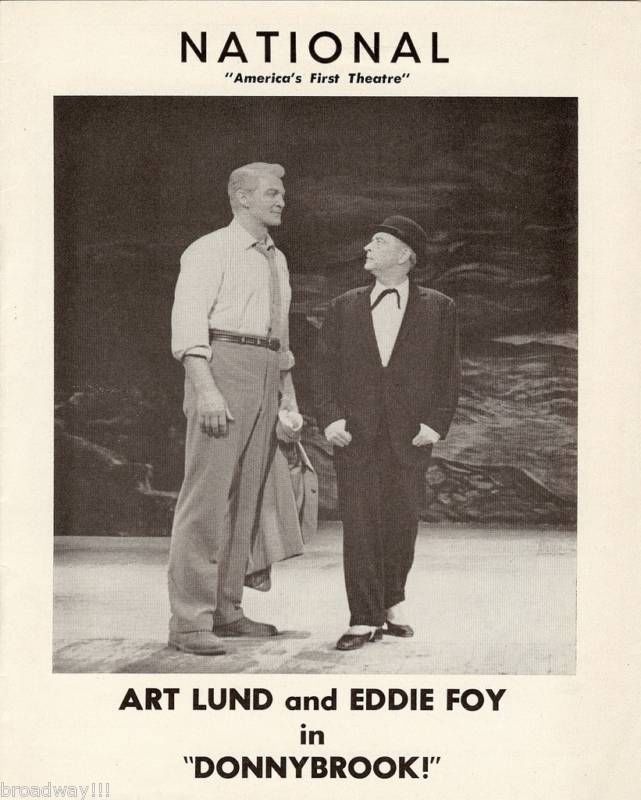
Later Broadway credits for Lund include Destry Rides Again (1959), as a replacement for the plot's villain, Scott Brady; Donnybrook! (1961); Fiorello! (1962); and Sophie (1963). Lund also worked in two shows that closed before scheduled Broadway openings, We Take the Town (1962), as Robert Preston's standby; and Breakfast at Tiffany's (1966).
 
In the 1950s, he made several guest appearances on television shows, including “Tonight!” (the forerunner of “The Tonight Show”) and “The Bell Telephone Hour.” He also acted in numerous television shows from the 1950s to the 1980s, among them “I Love Lucy,” “Wagon Train,” “The Name of the Game,” “Gunsmoke,” “The Rockford Files,” “Kojak,” “Little House on the Prairie,” “Baretta,” “The Paper Chase,” “The Winds of War,” and “Knight Rider.” 

In addition to his work on television, Lund had parts in several films, including The Molly Maguires (1970), Black Caesar (1973), The Last American Hero (1973), Bucktown (1975), Baby Blue Marine (1976), The Private Files of J. Edgar Hoover (1977) and It's Alive III: Island of the Alive (1987).
 
Lund was married nearly 30 years [1940-1969] to Kathleen Virginia Bolanz-Lund. On October 16, 1969 Kathleen Lund was killed in an automobile accident. She was a passenger in a car driven by friend and former model/actress Rosemarie Bowe (wife of actor Robert Stack), when the car veered into a culvert near Sacramento Metropolitan Airport. Lund did not remarry until the last year of his life, to Janet Burris Chytraus.
 
 
Lund was still singing the 1980s. He was a frequent guest at Big Band nights in Southern California, toured with the Harry James ghost band and  later sang in Australia. HE died May 31, 1990 of liver cancer in Holladay, Utah...not far from where he was born. He was 75.   (Compiled & edited from Wikipedia &  masterworksbroadway.com)