Sunday, 11 December 2016

Rita Moreno born 11 December 1931


Rita Dolores Moreno (born Rosa Dolores Alverío, December 11, 1931) is a Puerto Rican-American actress, dancer and singer. Her career has spanned over 70 years; among her notable acting work are supporting roles in the musical films The King and I and West Side Story, as well as a 1971–77 stint on the children's television series The Electric Company, and a supporting role on the 1997-2003 TV drama Oz.

Moreno is one of twelve performers to have won all four major annual American entertainment awards: an Oscar, an Emmy, a Grammy and a Tony. She is also one of 22 people who have achieved the so-called Triple Crown of Acting, with individual competitive Academy, Emmy and Tony awards for acting; and one of only two people who have achieved both distinctions, the other being Helen Hayes. She has also won numerous other awards, including various lifetime achievement awards. Moreno also received the Presidential Medal of Freedom, America's highest civilian honour. 

Rita Moreno was born Rosita Dolores Alverío in Humacao, Puerto Rico, on December 11, 1931, to seamstress Rosa María (Marcano) and farmer Francisco José "Paco" Alverío. She and her mother moved to New York City in 1937, where she began a professional career before reaching adolescence. The 11-year-old Rosita got her first movie experience dubbing Spanish-language versions of US films. Less than a month before her 14th birthday on November 22, 1945, she made her Broadway debut in the play "Skydrift" at the Belasco Theatre, co-starring with Arthur Keegan and s young Eli Wallach. Although she would not appear again on Broadway for almost two decades, Rita Moreno, as she was billed in the play, had arrived professionally. 

The cover of the March 1, 1954, edition of "Life Magazine" featured a three-quarters, over-the-left-shoulder profile of the young Puerto Rican actress/entertainer with the provocative title "Rita Moreno: An Actresses' Catalogue of Sex and Innocence". It was sexpot time, a stereotype that would plague her throughout the decade. If not cast as a Hispanic pepper pot, she could rely on being cast as another "exotic", such as her appearance on Father Knows Best (1954) as an exchange student from India. Because of a dearth of decent material, Moreno had to play roles in movies that she considered degrading. Among the better pictures she appeared in were the classic Singin' in the Rain (1952) and The King and I (1956).


Here,s "Bye Bye Baby" from 1959 LP "Warm Wild Wonderful"


 Director Robert Wise, who was chosen to co-direct West Side Story (1961) (the film version of the smash Broadway musical, a retelling of William Shakespeare's "Romeo & Juliet" with the warring Venetian clans the Montagues and Capulets re-envisioned as Irish/Polish and Puerto Rican adolescent street gangs, the Jets
and the Sharks), cast Moreno as "Anita", the Puerto Rican girlfriend of Sharks' leader Bernardo, whose sister Maria is the piece's Juliet. 


However, despite her talent, roles commensurate with that talent were not forthcoming in the 1960s. The following decade would prove kinder, possibly because the beautiful Moreno had aged gracefully and could now be seen by filmmakers, TV producers and casting directors as something other than the spitfire/sexpot that Hispanic women were supposed to conform to. Ironically, it was in two vastly diverging roles--that of a $100 hooker in director Mike Nichols' brilliant realization of Jules Feiffer's acerbic look at male sexuality, Carnal Knowledge (1971) (1971), and Milly the Helper in the children's TV show The Electric Company (1971) (1971)--that signalled a career renaissance. 

Moreno won a 1972 Grammy Award for her contribution to The Electric Company’s soundtrack album, following it up three years later with a Tony Award as Best Featured Actress in a Musical for "The Ritz" (a role she would reprise in the film version, The Ritz (1976)). She then won Emmy Awards for The Muppet Show (1976) and The Rockford Files (1974). 

She released an eponymous album of nightclub songs in 2000 on the Varèse Sarabande label. 

She has continued to work steadily on screen (both large and small) and on stage, solidifying her reputation as a national treasure, a status that was officially ratified with the award of the Presidential Medal of Freedom by President George W. Bush in June 2004. In 2009, President Obama awarded Moreno with the National Medal of Arts for her "remarkable achievements on stage and screen. 


In 2014 she was presented with the SAG Lifetime Achievement Award. In 2015 she released another album " Una Vez Más."
(Info edited from IMDB bio by Jon C. Hopwood & Wikipedia)

Saturday, 10 December 2016

Dorothy Lamour born 10 December 1914


Dorothy Lamour (December 10, 1914 – September 22, 1996) was an American motion picture actress. 

Fondly remembered for her beautiful, long brown hair and trademark sarong, Dorothy Lamour was an important player for Paramount Pictures in the 1940s. She is best known for her performances in the "Road" films (Road To Bali, Road To Hong Kong, Road To Morocco, Road To Rio, Road To Singapore, Road To Utopia and Road To Zanzibar), which she costarred in with Bob Hope and Bing Crosby.  

Mary Leta Dorothy Slaton was born on December 10, 1914 in New Orleans, Louisiana to Carmen and John Slaton. Her parent's marriage lasted only a few years, but Carmen later remarried Clarence Lambour, and Dorothy took his last name. The marriage also ended in divorce when Dorothy was a teenager.  

 Her career in the spotlight began in 1931, when she was crowned "Miss New Orleans." Dorothy was interested in becoming a singer, and after the contest she headed to Chicago on the last of her winnings. Dorothy's talent soon landed her a job as the female vocalist for the Herbie Kay Band. She dropped the "b" in Lambour to create her stage name of Dorothy Lamour. Dreams of making it big in the entertainment business led her to New York, where she began singing with Rudy Vallee and Eddie Duchin. In 1934, Dorothy was hired as a radio singer on "The Dreamer of Songs" program.  

Romance eventually developed between Dorothy and Herbie, and they were married in 1935. That same year, she met Metro Goldwyn Mayer head Louis B. Mayer while she was singing in a nightclub. Mayer felt she had a certain spark, and arranged for her to have a screen test. However the screen test was lost and Dorothy would need to do another if she were still interested in acting. In the meantime, she met Jack Votion, the head of talent at Paramount, and did a screen test. Her beauty and talent impressed the Paramount executives, and they immediately signed her to a contract. 

 Dorothy's first two films in 1936, "The Stars Can't Be Wrong" and "The Jungle Princess," were where she first wore her trademark sarong. With Herbie and his band touring cross-country, and Dorothy pursuing a career as an actress in California, they were apart much of the time. Their marriage ended in 1939.


 During World War II, Dorothy used her fame to help the war effort. She earned the nickname ''bond bombshell" when she toured the country and sold more than $300 million in United States War Bonds. While on the bond tour, she met William Ross Howard III, a successful frozen food businessman. The two married in 1943, and later had a baby boy named Tom in 1949. 

In 1959, the family moved to Baltimore, where Bill was planning to run for Governor of Maryland, and Dorothy settled as a housewife. Theater once again became a part of her life, and in 1951 she debuted on Broadway in "Oh! Captain." She made a comeback to films in 1952 with "The Greatest Show on Earth." During the 1950s Dorothy also made several guest appearances on television shows such as "The Colgate Comedy Hour" and "Damon Runyon Theatre." In 1961, she toured with her own nightclub act, and later with the plays "DuBarry Was a Lady" (1963) and "Hello, Dolly!" (1967).  

In the 1970s, Lamour was a popular draw on the dinner theatre circuit. In 1980, Lamour published her autobiography, My Side of the Road, and revived her nightclub act. During the remainder of the decade, she performed in plays and television shows such as Hart to Hart, Crazy Like a Fox, Remington Steele, and Murder, She Wrote. During the 1990s, she made only a handful of professional appearances but remained a popular interview subject for publications and TV talk and news programs. 

Dorothy and Bill raised three sons, including one from his previous marriage. They were happily married until Bill's death in 1978. Lamour died at her home in North Hollywood on September 22, 1996, at the age of 81.She was interred in the Forest Lawn, Hollywood Hills Cemetery in Los Angeles. 

 
For her contribution to the radio and motion picture industry, Lamour has two stars on the Hollywood Walk of Fame. Her star for her radio contributions is located at 6240 Hollywood Boulevard and her star for her motion picture contributions is located at 6332 Hollywood Boulevard. (Info edited from various sources)
 

Thursday, 8 December 2016

Johnny Gentle born 8 December 1936


John Askew (born 8 December 1936), known as Johnny Gentle, is a British pop singer best remembered for having briefly toured Scotland with the Silver Beetles – later known as the Beatles – as his backing group in 1960. 
 
John Askew was born and grew up in Liverpool. After leaving school he was apprenticed as a carpenter, and, using a borrowed book for instructions, made his own guitar. He teamed up with Bobby Crawford and the pair began performing at local clubs, singing Everly Brothers songs, before Askew took a job working on a luxury ocean liner. On his return, he entered talent competitions as a solo singer, and changed his stage name, first to George Baker and then to Ricky Damone. 

He moved to London and worked on a building site, before winning a talent competition at the Locarno Ballroom in Streatham. He was auditioned by manager Larry Parnes, who won him a recording contract with Philips Records in 1959, and gave him the stage name Johnny Gentle. 

Gentle released two singles on Philips in 1959 – the self-penned "Wendy", followed by "Milk From The Coconut" – but they did not make the charts, and nor did an EP, The Gentle Touch, combining the two singles. In early May 1960, Parnes co-promoted, with Allan Williams, a show at Liverpool Stadium starring Gene Vincent supported by local groups Cass and the Cassanovas, Rory Storm and the Hurricanes and Gerry and the Pacemakers. 

 Parnes thought it would be a good idea to use Liverpool groups as backing bands for his artists, who included Billy Fury, and held auditions on 10 May 1960. This resulted in the Silver Beetles being selected to back Gentle on a short Scottish tour. 

George Harrison on stage with Johnny 1960
The tour, between 20–28 May 1960, included performances at Alloa, Inverness, Fraserburgh, Keith, Forres, Nairn and Peterhead. At the time, the group comprised John Lennon, Paul McCartney, George Harrison, Stuart Sutcliffe and drummer Tommy Moore.

Although the group themselves were not specifically credited in tour publicity, being billed as "Johnny Gentle and his group", informally McCartney used the pseudonym Paul Ramon, Harrison called himself Carl Harrison, Lennon was "Long John", and Sutcliffe was known as Stuart de Staël. Their repertoire included "It Doesn't Matter Anymore", "Raining in My Heart", "I Need Your Love Tonight", "Poor Little Fool", "(I Don't Know Why) But I Do", "C'mon Everybody" (a tribute to Eddie Cochran, who had died while on tour with Gene Vincent a few weeks earlier), and "He'll Have to Go".


Gentle wrote a song on the tour, "I've Just Fallen For Someone", reputedly with help from Lennon. The song was later recorded by Adam Faith on his second album. Gentle also claims to have suggested that Parnes sign the group, but Parnes at the time was only interested in managing solo singers. After their return to 
Johnny with Billy Fury
Liverpool, Gentle sang onstage with the group at one of their performances, but, by the time he next needed a band to tour with, they were unavailable as they had travelled to Hamburg.
 

Johnny Gentle released three further singles on the Philips label – "Darlin' Won't You Wait", "After My Laughter Came Tears" (both 1960) and "Darlin'" (1961). He also made several appearances on TV and radio shows. Changing his stage name to Darren Young, he released his own version of "I've Just Fallen For Someone" on Parlophone in 1962, again without success. By 1964, he had joined the Viscounts. 

 
He later moved to Jersey, where he worked as a joiner. He is now retired and lives in Kent, and has made occasional appearances at Beatles fan conventions. In 1998 he co-wrote a book, Johnny Gentle & the Beatles: First Ever Tour.  (Info Wikipedia)

Tuesday, 6 December 2016

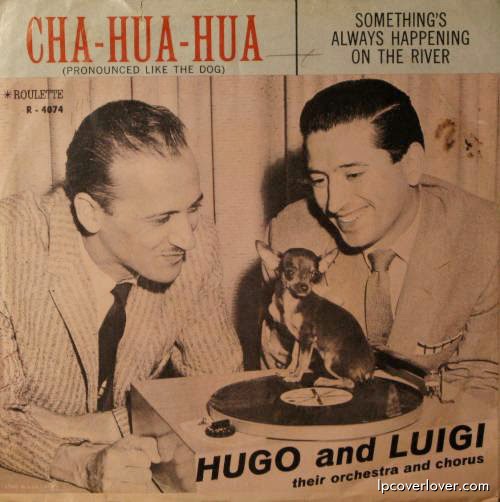
Hugo Peretti born 6 December 1916


Hugo E. Peretti (December 6, 1916 – May 1, 1986) was an American songwriter and record producer. 

Born in New York City, Peretti began his music career as a teenager, playing the trumpet in the Borscht Belt in upstate New York. He graduated to playing with orchestras, then in the 1950s partnered with his cousin Luigi Creatore to form the Hugo & Luigi songwriting team that evolved to producing records. In 1957 they bought into Roulette Records, where they wrote songs for various artists such as Valerie Carr, and produced major hits for Jimmie Rodgers, including "Honeycomb" (Billboard # 1), "Kisses Sweeter Than Wine" (Billboard # 3), "Oh-Oh, I'm Falling in Love Again", and "Secretly".


 Two years later, Peretti and Creatore signed a contract with RCA Records, where they produced recordings for crooner Perry Como. They also produced recordings for Sam Cooke and Ray Peterson and wrote English lyrics for the South African composer Solomon Linda's song "The Lion Sleeps Tonight", which became a hit for The Tokens.With George David Weiss they co-wrote "Can't Help
Hugo Peretti, Sam Cooke & Luigi Creatore

Falling in Love" for RCA's mega-star Elvis Presley. Peretti and Creatore also wrote Presley's hit single Wild in the Country.
 
In 1964, Peretti and Creatore left RCA to join Weiss in writing Maggie Flynn, a 1968 Broadway musical about the American Civil War. Titled Maggie Flynn, it ran on Broadway in 1968. The family of South African composer Solomon Linda reached a settlement in the lawsuit over his world-famous song "The Lion Sleeps Tonight," in 2006.  

In the 1970s, Peretti and Creatore owned part of Avco Records and then established H&L Records, which they operated until retiring at the end of the decade. They produced several recording artists, among them was the 70’s soul vocal group, The Stylistics also The Softones. In 1975, they also worked on Van McCoy’s #1 disco hit “The Hustle.”  Later that year, Avco was renamed with their initials, H&L Records. They operated the recording company until they retired from the industry at the end of the decade. They also won the 1977 Grammy Award for Best Musical Theatre Album as producers of Bubbling Brown Sugar. 
 
Peretti met and married singer June Winters in 1943. They formed a children's record label, Mayfair Records, in 1946 and released a series of bestselling albums featuring Winters as the "Lady in Blue". They had two daughters, Kathy and Tina Marie. Winters died on March 29, 2015 at the age of 96.

Peretti died in 1986 in Englewood, New Jersey, aged 69.  (Info Wikipedia)


Sunday, 4 December 2016

Deanna Durbin born 4 December 1921


Edna Mae Durbin (December 4, 1921 – c. April 20, 2013), known professionally as Deanna Durbin, was a Canadian actress and singer, who appeared in musical films in the 1930s and 1940s. With the technical skill and vocal range of a legitimate lyric soprano, she performed many styles from popular standards to operatic arias. 

The girl who one day would be known as "Winnipeg's Sweetheart" was born born Edna Mae Durbin on December 4, 1921, in Winnipeg, Manitoba, Canada. Her British-born parents moved to California while she was still young, and her singing voice soon had talent scouts knocking at her door.  

She signed a contract with MGM in 1936, at the age of 14, which resulted in her appearance in Every Sunday (1936), a short that also starred Judy Garland. Deanna was dropped by MGM but was immediately picked up by Universal Pictures, which cast her in the role of Penny Craig in Three Smart Girls (1936). While preparing for the role she was coached intensely by director Henry Koster; it's doubtful she would have been the star she was had it not been for Koster. The profits from this film and its follow-up, One Hundred Men and a Girl (1937), rescued Universal from bankruptcy. The studio quickly capitalized on these hits, casting Deanna in two successive and highly acclaimed films, That Certain Age (1938) and Mad About Music (1938). With these films Deanna became Hollywood's darling. She reprised her role of Penny Craig in Three Smart Girls Grow Up (1939).


Deanna was such a hit that she shared the Academy Award's 1939 Juvenile Award with Mickey Rooney "for their significant contribution in bringing to the screen the spirit and personification of youth, and as juvenile players, setting high standards of ability and achievement". Deanna's singing and acting ability had the world talking. There was no doubt she was the most popular performer of her day. She was, however, by nature a very private individual, never comfortable with the glitz, glamour and publicity that came with stardom. Despite her uneasiness, she continued to churn out hits and kept the public enthralled. In 1943 she played Penny Craig again, for the third time, in Hers to Hold (1943).  

She was the number one female box office star in Britain for the years 1939- 1942 inclusive. She was so popular that in 1942 a seven day "Deanna Durbin Festival" was held during which her films were screened exclusively on the Odeon Theatre Circuit throughout Britain, a feat that has never been duplicated for any

other star. According to reports from the BBC over the past three decades, it receives more requests from the public for Durbin's films and recordings, than for those of any other star of Hollywood's Golden Age. 

In 1946, Durbin was the second-highest paid woman in the United States, just behind Bette Davis, and in 1947, she was the top-salaried woman in the United States. Her fan club ranked as the world’s largest during her active years. 

By 1948, however, her box-office clout began to diminish. In private life, Durbin continued to use her given name, Edna; salary figures printed annually by the Hollywood trade publications listed the actress as "Edna Mae Durbin, player". On August 22, 1948, two months after completing her final film, Universal-International announced a lawsuit which sought to collect from Durbin $87,083 in wages the studio had paid her in advance. Durbin settled the complaint by agreeing to star in three more pictures, including one in Paris. The studio allowed Deanna's contract to expire on August 31, 1949, so the three films were never made. 


Durbin, who obtained a $200,000 ($1,992,448 in 2015), severance payment, chose to retire from movies. Her former producer Joe Pasternak tried to dissuade her, but she told him: "I can't run around being a Little Miss Fix-It who bursts into song—the highest-paid star with the poorest material." 

She retired from public life in 1950, after her marriage to Charles David, who had directed her in Lady On A Train. The couple moved to Paris, France, with Durbin vowing that she would never return to show business, and raised Durbin's second child, Peter David. Since then she has resisted numerous offers to perform, including several by Mario Lanza, and has granted only one brief interview in 1983, to film historian David Shipman, steadfastly asserting her right to privacy.

 
Durbin's husband of more than 48 years, Charles David, died in Paris on March 1, 1999. On April 30, 2013, a newsletter published by the Deanna Durbin Society reported that Durbin had died "in the past few days", quoting her son, Peter H. David, who thanked her admirers for respecting her privacy. No other details were given. According to a family friend, Durbin died on or about April 20 in Neauphle-le-Château, France. (Info edited from IMDB bio by Denny Jackson & Wikipedia)


Saturday, 3 December 2016

Connee Boswell born 3 December 1907


Constance Foore "Connee" Boswell (December 3, 1907 - October 11, 1976) was an American female vocalist born in Kansas City, Missouri but raised in New Orleans, Louisiana. With her sisters, Martha and Helvetia "Vet" Boswell, she performed in the 1930's as The Boswell Sisters and became a highly influential singing group during this period via recordings and radio. 
 
The Boswells came to be well known locally while still in their early teens, making appearances in New Orleans theaters and radio. They made their first recordings for Victor Records in 1925, which included "Cryin' Blues" where Connee is featured singing in the style of her early influence, the African American singer Mamie Smith. 

The Boswell Sisters became stage professionals that year when they were tapped to fill in for an act at New Orleans' Orpheum Theatre. They received an invitation to come to Chicago and perform in 1928 and honed their act on the Western Vaudeville Circuit. When their tour ended they travelled to San Francisco. The hotel that had been recommended had a less than savoury reputation, and the man at the desk suggested that these three young ladies might be better off in another hotel. That man, Harry Leedy, would later become their manager on a handshake and become a permanent part of Connee's life. 

The Boswell Sisters travelled to Los Angeles where they performed on local radio and "side-miked" for the soundies, including the 1930 production "Under Montana Skies." did not attain national attention, however, until they moved to New York City in 1930 and started making national radio broadcasts. After a few recordings with Okeh Records, they made numerous recordings for Brunswick Records from 1931-1935. In 1935, the sisters had a #1 hit with "The Object of My Affection", the biggest of twenty top 20 records they would enjoy.  


In 1936, the group signed to Decca Records and after just three releases called it quits (the last recording was February 12, 1936). Connee Boswell continued to have a successful solo career as a singer for Decca. She had changed the spelling of her name from Connie to Connee, reputedly because it made it easier to sign autographs.

Connee sang from a wheelchair - or seated position - during her 
entire career, due to either a childhood bout with polio or a childhood accident (sources differ). The general public was not aware of her condition although Boswell herself did not keep this secret. During World War II, she tried to get involved with the U.S.O. but was not given permission to travel overseas, the "powers that be" apparently thought it might not be a morale-booster to have a "cripple" perform for the troops.  

Connee Boswell was a favorite duet partner of Bing Crosby and they frequently sang together on radio as well as recording several hit records as a duo in the 1930's and 1940's. Connee  also had several dozen solo hits, including "Moonlight Moon" in 1942. Boswell's career slackened in the 1950's but she still recorded occasionally and would be featured on a number of television broadcasts including a regular stint on the 1959 series "Pete Kelly's Blues". 

In 1954, Connee recorded her last charted hit, “If I Give My Heart to You.” The song was a smash hit for Kitty Kallen but Boswell’s version rose to the #10 spot in September, 1954, and spent 11 weeks on the charts. In April of 1956 Connee was back in Decca’s recording studios in NYC with Sy Oliver and His Orchestra. The subsequent recordings were issued as her second album, simply named “Connee.” This is her last recording session with Decca records, ending a twenty-five year collaboration that had yielded many hit recordings. 

In 1958 Connee unfortunately made her last album "Connee Boswell Sings The Rodgers & Hart Songbook" on the Design Record label. It is unfortunate that Verve never signed Connee as they did Ella Fitzgerald. Connee still had an amazing voice in the 1950s.

Connee moved on to more causes that are dear to her heart by the 1960s. She was on the board of an organization called, “Comeback, Inc,” whose focus is rehabilitation of the chronically ill, aged and handicapped. By 1962 she decided to limit her performances to some occasional television work and club dates and stays much closer to home to care for her husband Harry. She continued in her humanitarian work and volunteer appearances at children’s hospitals, and in her hobby of training dogs. 

On January 1, 1975 After nearly forty years of marriage, Harry Leedy died in New York City. Connee began to make more frequent appearances in clubs and even appears with Benny Goodman in an anniversary concert. However, before long, it is clear to all that Connee was also ill. She has always had a very healthy appetite, saying herself that she could “eat like a horse.” She experienced severe stomach pain so she sought medical attention. On February 11, 1976 Connee underwent surgery at Mount Sinai Hospital in NYC to remove a tumour from her stomach. Doctors were optimistic that they could remove the tumor successfully. 

 Sometime afterward though, they discovered that the cancer had returned and began chemotherapy. By the early fall, she was confined to her hospital room at Mt Sinai and finally asked doctors to stop all treatments. On October 12, 1976 Constance Foore Boswell Leedy died at Mount Sinai Hospital in New York City. She was 68 years old. She was buried in Ferncliff Cemetery, Hartsdale, New York, next to her husband Harry. (Info edited from Wikipedia & an article by David Lobosco)


Thursday, 1 December 2016

Lou Rawls born 1 December 1933


Louis Allen "Lou" Rawls (December 1, 1933 – January 6, 2006) was an American soul, jazz, and blues singer. He was known for his smooth vocal style: Frank Sinatra once said that Rawls had "the classiest singing and silkiest chops in the singing game". Rawls released more than 70 albums, sold more than 40 million records, appeared as an actor in motion pictures and on television, and voiced-over many cartoons. He
had been called “The Funkiest Man Alive”.
Lou Rawls, who learned of gospel music through his grandmother in Chicago, became a successful singer, primarily from the 1950s through the 1980s. He was a high school classmate of music giant Sam Cooke, and they sang together in the Teenage Kings of Harmony, a ’50s gospel group.
After graduating from Chicago’s Dunbar Vocational Career Academy, Rawls enlisted in the U.S. Army as a paratrooper in the 82nd Airborne Division. He left the “All-Americans” three years later as a sergeant, and hooked up with The Pilgrim Travelers as he travelled to Los Angeles. In 1958, while touring the South with the Travelers and Sam Cooke, Rawls was in a serious car crash. Rawls was pronounced dead before arriving at the hospital, where he stayed in a coma for five and a half days. It took him months to regain his memory, and a year to fully recuperate. Rawls considered the event to be life-changing.
Alongside Dick Clark as master of ceremonies, Rawls was recovered enough by 1959 to be able to perform at the Hollywood Bowl. He was signed to Capitol Records in 1962, the same year he sang the soulful background vocals on the Sam Cooke recording of “Bring it on Home to Me.” Rawls' first Capitol solo release was Stormy Monday (a.k.a. I'd Rather Drink Muddy Water), a jazz album, in 1962. On August 21, 1966, he opened for The Beatles at Crosley Field in Cincinnati.
 
                             
Though his 1966 album Live! went gold, Rawls would not have a star-making hit until he made a proper soul album, appropriately named Soulin’, later that same year. The album contained his first R&B #1 single, “Love Is a Hurtin’ Thing”. In 1967 Rawls won his first Grammy Award for Best R&B Vocal Performance, for the single “Dead End Street.”
In 1969, the singer was co-host of NBC’s summer replacement series for the Dean Martin Show along with Martin’s daughter, singer Gail Martin.
After leaving Capitol in 1971, Rawls joined MGM, at which juncture he released his Grammy-winning single “Natural Man.” He had a brief stint with Bell Records in 1974, where he recorded a cover of Hall & Oates’ “She’s Gone.” In 1976, Rawls signed with Philadelphia International Records, where he had his greatest album success with the million-selling All Things in Time. The album produced his most successful single, “You’ll Never Find Another Love Like Mine”, which topped the R&B and Adult Contemporary charts and went to number two on the pop side, becoming Rawls’ only certified million-selling single in the process. In 1982, Rawls received a star on the Hollywood Walk of Fame.
On the night of September 29, 1977, Rawls performed the national anthem of the United States prior to the Earnie Shavers-Muhammad Ali title fight at Madison Square Garden. He would be requested to sing the anthem many times over the next 28 years, and his final performance of it came on October 23, 2005. The crowd at that performance may not have known that Rawls was extremely ill with cancer, but he reportedly delivered an electrifying performance to kick off Game Two of the 2005 World Series between the Chicago White Sox and Houston Astros.
In January 2004, Rawls was honoured by the United Negro College Fund for his more than 25 years of charity work with the organization. Instead of hosting and performing as he usually did, Rawls was given the seat of honor and celebrated by his performing colleagues, including Stevie Wonder, The O’Jays, Gerald Levert, Ashanti, and many others. His final television performance occurred during the 2005-2006 edition of the telethon, honouring Stevie Wonder in September 2005.
It was also announced in December 2005 that Rawls was being treated for cancer in both his lungs and brain. With his wife by his side, Lou Rawls succumbed to his illness on January 6, 2006, at Cedars-Sinai Medical Centre in Los Angeles, California.   (Info edited from Wikipedia)