Tuesday, 8 November 2016

Nina Miranda born 8 November 1934


Nina Miranda (née, Nelly María Hunter; November 8, 1925 - January 1, 2012) was an Uruguayan tango singer and composer who settled in Argentina in the early 1950s. She is known for the songs, "Maula", "Garufa", "Mamá, yo quiero un novio", "La tigra", and the popular "Fumando espero".
Born in Aguada, Montevideo, Miranda moved several times as a child. She spent her teen years in the Cerrito de la Victoria neighborhood of Montevideo at 3463 Bruno Méndez Street. At the age of eight,she entered and won a singing contest after a schoolmate's father heard her sing.
In 1939, Libertad Lamarque was the most popular of the female singers, with their tangos and movies. In Montevideo, (Uruguay´s capital) was announced the premiere of "Puerta Cerrada" (Closed Door), perhaps the biggest and best drama filmed in Lamarque's career. In the film, the protagonist's name was Nina Miranda, a tango singer who suffers from an impossible love. That afternoon, Nelly Mary Hunter and her mother went to the movies. When leaving, the 14-year-old girl said "when I'm an artist I will adopt the name that Libertad used in the film".
Three years passed when the young woman with singer attitudes won a contest in 1942 on CX 36 Radio Centenario, she received a three-month contract to join a ladies' orchestra, and the name NINA MIRANDA appeared. The women's orchestra, “Las Golondrinas”, was led by Teresita Añón, and featured tangos, milongas and waltzes in its songbook. They toured the south of Brazil, up to Porto Alegre. A subsequent tour took the orchestra to a nightclub in São Paulo named Okey. Back in Montevideo, they performed at the Palacio Salvo's Café Palace.
Miranda performed with Francisco Reinares, Emilio Pellejero, Roberto Luratti before making her first recording, which was with Juan Cao. Thereafter, she sang as a duo with Alberto Bianchi. By 1948, she appeared at the Hotel Rambla with the Emilio Pellejero Orchestra. In 1952, she recorded the song Maula which became a hit, and was aired daily on the radio stations.
 

                          Here’s “ Garufa” from above album


 In August 1955, she arrived in Buenos Aires to expand her artistic opportunities, aided by the journalist Augusto Bonardo, director of Montevideo's Radio El Espectador. At Radio Centenario, she recorded with the Donato Racciati orchestra for Sondor and with Graciano Gómez for Odeon Records. Initially, she recorded fourteen songs. On the radio, she performed twice a week with the Lucio Demare Orchestra.
After Juan Perón left office and the borders with Uruguay were reopened, she flew back and forth between Buenos Aires and Montevideo to perform on Radio El Espectador with a sextet which was led by Oldimar Cáceres. Her split with Graciano Gómez occurred after touring northern Argentina. Another tour followed, this time with the orchestra led by Héctor Norton. Thereafter, she toured with her own ensemble which was led by Fernando Córdoba.
In the middle of her success, in late 1957, she got married and her husband forbade her to continue her singing career. From 1958 to 2004, Miranda was again Nina Nelly Hunter.


After his death in 2004, she returned to tango, touring France, England, China and Brazil. She died in Buenos Aires in 2012. (Info edited from Wikipedia and various sources)
 

Monday, 7 November 2016

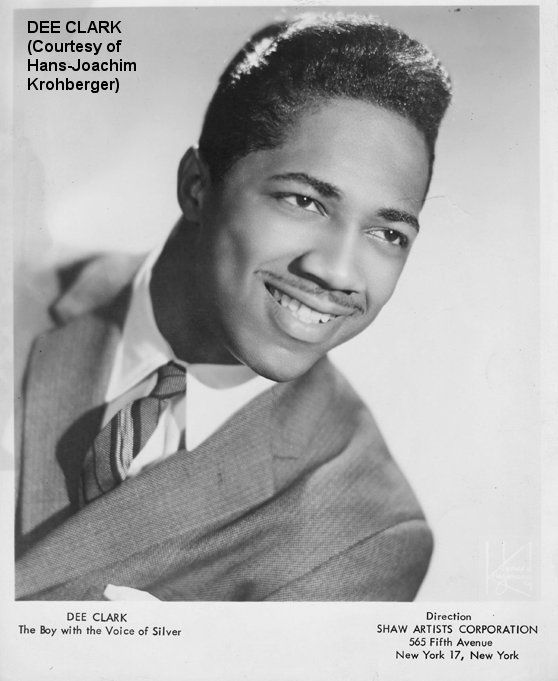
Dee Clark born 7 November 1938


Dee Clark (7 November 1938 - 7 December 1990) was an African-American soul singer best known for a string of R&B and pop hits in the late 1950s and early 1960s, including the ballad "Raindrops," which became a million-seller in the United States in 1961.
He was born Delectus Clark in Blytheville, Arkansas, and moved to Chicago in 1941. His mother, Delecta, was a gospel singer and encouraged her son to pursue his love of music.
Clark made his first recording in 1952 as a member of the Hambone Kids, who scored an R&B hit with the song "Hambone." In 1953, he joined an R&B group called the Goldentones, who later became the Kool Gents and were discovered by Chicago radio DJ Herb Kent upon winning a talent competition. Kent got the Kool Gents signed to Vee-Jay record label, subsidiary Falcon/Abner. The group changed its name once again, to "The Delegates," and recorded for Falcon/Abner in 1956.
Clark embarked on a solo career in 1957 and over the next four years landed several moderate hits, two of which ("Just Keep It Up" and "Hey Little Girl") reached the top 20 on the Billboard Hot 100). His biggest single, "Raindrops," a power ballad augmented by heavy rain and thunder sound effects and Clark's swooping falsetto, hit in the spring of 1961 and became his biggest hit, soaring to number two on the pop chart (behind only Gary U.S. Bonds' "Quarter to Three") and number three on the R&B charts. The narrator of the song tries to convince himself that the tears he has cried since his love left him are raindrops, since "a man ain't supposed to cry."


 "Raindrops" sold over two million copies and remains a staple on oldies radio station playlists to this day, and has also been covered by several other artists in the years since, including David Cassidy, Tony Orlando and Dawn, and most notably Narvel Felts, who took the song to number 30 on the country chart in 1974. Clark himself recorded an updated version of "Raindrops" in 1973.
However, Clark's biggest hit was also his last. The follow-up to "Raindrops," "Don't Walk Away From Me," was a flop, and he made the pop charts in America only twice more, with "I'm Going Back to School" (1962) and "Crossfire Time" (1963). By the time "Crossfire Time" came out, Clark had moved from Vee-Jay to the Constellation label.
Clark's Constellation tenure is a study in frustration -- between 1964 and 1966, he released eight singles for the label, none of which charted. (Some were nevertheless excellent, in particular the Bob Gaudio-penned "Come Closer," "Warm Summer Breeze," and "T.C.B.") In the wake of "Old Fashion Love," issued in mid-1966, Constellation folded and Clark spent the remainder of his career hopscotching from label to label, never again releasing more than one single on any given imprint -- these efforts include 1967's "In These Very Tender Moments" (Columbia), 1968's "Nobody But You" (Wand), 1970s "24 Hours of Loneliness" (Liberty) and the self-explanatory "Raindrops '73," which appeared on the Warner subsidiary Rocky. Throughout this period he lived in almost as many cities, making a living by headlining local lounges and nightclubs during extended stays in Los Angeles, Atlanta, and Orlando.
Though he continued to record for Constellation through 1966, none of his records charted. Clark had a brief revival in 1975 when his song "Ride a Wild Horse" became a surprise top 30 hit in the UK Singles Chart, becoming his first chart hit in the UK since "Just Keep It Up."


Afterward, Clark performed mostly on the oldies circuit. By the late 1980s, he was in dire straits financially, living in a welfare hotel in Toccoa, Georgia. Despite suffering a stroke in 1987 that left him partially paralyzed and with a mild speech impediment, he continued to perform until his death on 7 December 1990, , from a heart attack in Smyrna, Georgia, at the age of 52. (info edited from Wikipedia & All Music)

Sunday, 6 November 2016

Guy Clark born 6 November 1941

 
Guy Charles Clark (November 6, 1941 – May 17, 2016) was an American Texas country and folk singer, musician, songwriter, recording artist, and performer. He released more than twenty albums, and his songs have been recorded by other artists including Jerry Jeff Walker, Jimmy Buffett, Lyle Lovett, Ricky Skaggs, Steve Wariner, and Rodney Crowell. He won the 2014 Grammy Award for Best Folk Album: My Favorite Picture of You.
Clark helped create the progressive country and outlaw country genres. His songs "L.A. Freeway" and "Desperados Waiting for a Train" that helped launch his career were covered by numerous performers. The New York Times described him as "a king of the Texas troubadours", declaring his body of work "was as indelible as that of anyone working in the Americana idiom in the last decades of the 20th century.

Clark was born in the West Texas town of Monahans. His mother worked and his father was in the Army, so he was raised mostly by his grandmother, who ran the town hotel. One of her residents was an oil well driller who would later end up the subject of one of Clark's most moving and stunningly beautiful songs, "Desperados Waiting for a Train." Many of Clark's songs, in fact, cantered 
Guy and Townes Van Zandt
around his days growing up in West Texas, including "Texas 1947" (from his debut album) and the 1992 song "Boats to Build," which harked back to a summer job he once had as a teenager on the Gulf Coast.
The first songs Clark learned were mostly in Spanish. Later, when he moved to Houston and began working the folk music circuit, he met fellow songwriter Townes Van Zandt (the two often toured together until Van Zandt's death in 1997) and blues singers Lightnin' Hopkins and Mance Lipscomb. It was here that Clark began playing and writing his sturdy brand of folk- and blues-influenced country music.
In the late '60s, Clark moved to California, living first in San Francisco (where he met and married his wife Susanna, a painter and songwriter) and then in Los Angeles, where he worked in the Dopyera brothers' Dobro factory. Tiring quickly of Southern California (sentiments he expressed in another of his classics, "L.A. Freeway"), he and Susanna packed up and headed for Nashville in 1971, where he picked up work as a writer with publishing companies and, eventually, a recording contract with RCA.
 Clark's first album, Old No. 1, came out in 1975, a few years after Jerry Jeff Walker had turned "L.A. Freeway" into a minor hit. By this time Clark was considered one of the most promising young writers in country music, and while he didn't live in Texas anymore, the state's influence still ran thick in his blood.


 Clark recorded one more album for RCA, Texas Cookin', before switching to Warner Bros. for his next three albums, released between 1978 and 1983. Three of his songs from these albums cracked the Top 100. By the mid-'80s, however, a number of his songs had been made into hits by country stars such as Johnny Cash, David Allan Coe, Ricky Skaggs (who took "Heartbroke" to number one), George Strait, Vince Gill, and the Highwaymen.

 
Clark continued to work as a writer but didn't record again until 1988's Old Friends, released by Sugar Hill. He then switched labels once more, this time to Asylum, which released his 1992 album Boats to Build as part of their acclaimed American Explorer series.
His eighth album, Dublin Blues, came out in 1995, and among its finely crafted moments was a rereading of one of his most enduring songs, "Randall Knife," about the death of his father. Clark next released a pair of albums for his old label Sugar Hill, Cold Dog Soup in 1999 and Dark in 2002. He moved to Dualtone beginning with 2006's Workbench Songs, and received great reviews, both for it and the follow-up Somedays the Song Writes You in 2009. The year 2011 found Clark releasing Songs and Stories (recorded live at the Belcourt Theatre in Nashville), an intimate recap of his 40 years as a singer, songwriter, and storyteller.
Clark's wife Susanna passed in 2012. A year later in 2013, her memory figured heavily on his first new studio album in four years, My Favourite Picture of You. It was an intimate set of songs showing that Clark at the age of 71 was still a master songwriter, as good and as elegantly moving as ever. It was the final album he released during his life; years of illness, including a bout with cancer, finally claimed him on May 17, 2016. (Info edited from All Music & Wikipedia)


Guy Clark performs an unreleased new song during his Music Fog session at Marathon Recorders. Filmed in Nashville, Tennessee, just a few weeks before his 70th birthday (Nov.6th), during the 2011 Americana Music Festival & Conference. (10/14/11)

Saturday, 5 November 2016

Mike Clifford born 5 November 1943


Mike Clifford, (born November 5, 1943), is an American singer, songwriter and actor. He is best known for his 1962 pop hit, "Close To Cathy", which reached number 12 on the Billboard Hot 100.
Mike Clifford was born in Los Angeles, California. His father, Cal Clifford, was a professional trumpeter, who took him to many of his engagements. Mike soon developed an interest in music and began taking voice lessons.
While in school, Mike began to entertain at school and community functions, and by the age of 15 was performing at local nightclubs in Los Angeles. After singing for just a short time period, Clifford signed with Liberty Records in 1959. He recorded his first single that year, titled "Should I". The song was mixed by Mark McIntyre and featured additional vocals from Patience and Prudence and Eddie Cochran on guitar.
Clifford met Helen Noga through an introduction by a friend and she agreed to become his personal manager after hearing him sing. Helen Noga and her husband John managed the career of Johnny Mathis, and were able to get Mike signed to Columbia Records. Later, after much hard work and rehearsing, Helen Noga brought Mike to meet Ed Sullivan who was so impressed with Mike’s poise and stage presence that he booked him for his TV debut, the first of three appearances on The Ed Sullivan Show.
Mike Clifford's first taste of success came at age 18 when "Bombay" became a hit in Venezuela. He appeared on the state owned Venevision in his own TV special.
 
 
 However, Clifford's recordings for Columbia received little buyer’s attention, and in July 1962, Clifford signed with United Artists Records. Jerry Leiber and Mike Stoller produced several songs for Clifford, including his biggest hit "Close To Cathy", written by Earl Shuman and composed by Bob Goodman. The song reached number 12 in September of that year, and stayed there for 2 weeks and remained on the charts for 12 weeks. On December 29, 1962, "What To Do With Laurie" entered the Billboard Hot 100 and peaked at number #67. "One Boy Too Late" entered the Billboard Hot 100 on May 11, 1963 and was to be his last nationally charted record. He subsequently, had several songs that were regional hits in the U.S.A.
He had hit records in Argentina, Brazil, Canada, Germany as well as "It Had Better Be Tonight" in Chile, "See You In September" in the Philippines and "How To Murder Your Wife" in Japan.
In 1965, United Artists released Mike Clifford’s debut album For The Love Of Mike which was reviewed and a spotlight pick in the February 13, 1965 issue of Billboard.
Mike appeared in the films Village of the Giants in 1965, Lord Of The Rings in 1978, In the 1978 film Sextette, Mike Clifford sang "Love Will Keep Us Together" with Mae West, while actor Timothy Dalton lip synched the words.
The 60's and 70's saw Mike Clifford tour over one hundred cities during 1964 and 1965 with the Dick Clark Caravan Of Stars and perform in Canada, France, Puerto Rico and Mexico. He did commercials for Black Cow and Slowpoke suckers, Ortho Mattress and MJB coffee. American International Pictures purchased cartoon films from Japan and had the dialogue and songs translated into English. Mike recorded the Guy Hemeric-produced song "Rose Colour Sky" and another song for the soundtracks. They were released to movie theatres and television.
The 1970s also saw Clifford play the dual role of Teen Angel and Johnny Casino in the first national tour of the Broadway musical, Grease that also starred John Travolta.
Mike Clifford continues to have a very successful nightclub and concert career that began on his 18th birthday at the Elegante Club, Brooklyn, New York co-starring with Totie Fields.

 
He currently tours with his singing partner Sandy Zacky. The two released a collaborative album in 2007, titled Love Is Everything. In 2010, Mike Clifford recorded a brand new mp3 release, "Mack The Knife", on the Hired Gun Records label  (Info edited from Wikipedia)


American Bandstand. November 21, 1964

Thursday, 3 November 2016

Clifford Curry born 3 November 1936


Clifford Curry Jr.(November 3, 1936 – September 7, 2016) was an American beach music and R&B singer. Born into Gospel, raised on Rhythm & Blues, and singing and writing Rock & Roll until he was crowned “The King of Beach Music”, Clifford Curry’s musical contributions have touched the hearts and souls of millions of fans throughout the world.
Curry was born on November 3, 1936 in Chicago, Illinois. Clifford Curry grew up in rural East Tennessee in the 1940’s. During his boyhood he listened to his father’s collection of 78 records on an old RCA Victrola in their rustic home, along with his father, Clifford (Senior), his mother, Anna Mae Johnson Curry and younger brother, Floyd “Bud” Curry.
After grade school at Lyon’s Elementary, Curry attended Austin High School in Knoxville, Tennessee, where he was well known for three things: playing baseball, caddying at the exclusive Cherokee Country Club, and being an outstanding singer.
The Knoxville, TN, native joined the Echos while he still attended Austin High School in Knoxville; they had been around four years before Curry joined and backed Faye Adams on her number one R&B smash "Shake a Hand." The revamped group cut two records as the renamed Five Pennies for Savoy Records ("Mr. Moon" and "My Heart Trembles" in 1955 and 1956 respectively) and also waxed unreleased sides for Herald Records. Royalties, money, and the lack of, caused the group to splinter in different directions.
Curry and some other Knoxville cronies formed the Bingos, who cut a deal with Ernie Young's Excello Records. Excello issued the single on its Nasco subsidiary and renamed them the Hollyhocks; as before, nothing happened and the members disbanded into other ventures.
Curry found a stable gig with the Bubba Suggs Band in 1959, staying until 1964. The band played around their home base, Clarksville, TN, and backed up the major R&B acts that wheeled into their neck of the woods. He left after five years because Bubba couldn't vision much outside of Clarksville, neither could the other band members.


As Sweet Clifford he recorded for the Nashville-based Excello Records label, before beginning work with the Fabulous Six and the Contenders. In 1967, he had a hit on the US R&B chart with "She Shot A Hole In My Soul", which was written by Mac Gayden and performed by Mac and his band mates Kenny Buttrey and Norbert Putnam. They did the song just like the demo Mac had produced. Buzz Cason produced.
From 1967-69 Curry recorded seven more singles on Elf Records. None charted as high as his first success. Between 1970-73 he recorded three songs each on Abbott Records, Caprice and SSS but was most well known as one of thee voices of the Carolina Beach Music scene. In 1977, Curry recorded two singles on Buddah Records, “Body Shop” and “Moving In The Same Circles”. What made Curry’s music memorable was his cut in 1980, “Shag With Me” on Woodshed Records, followed by “Let’s Have A Party” (Archie Jordan).
Known as "The King Of Beach Music," Curry continued to play in the South-eastern United States with his brand of Carolina Beach Music, and was inducted into the Beach Music Hall of Fame in 1995, along with his peers Maurice Williams and Bill Pinkney. Curry regularly toured cities along the Carolina coast until medical problems curtailed his touring schedule.
Curry lived in Nashville for more than 20 years, but returned to Knoxville to be closer to family. In 2010, Curry was hospitalized for blood clots in his lungs and spent two months in the University of Tennessee Medical Centre. He later moved to Knoxville permanently.


In his later years he suffered from prostate cancer and diabetes and was hospitalized with a stroke. He died at the University of Tennessee Medical Centre in Knoxville on September 7, 2016 at the age of 79. 

(Info various, mainly edited from an article by Patricia Albrecht  & All Music)

Wednesday, 2 November 2016

Pearl Carr born 2 November 1921


Pearl Lavinia Carr (born 2 November 1921) and Edward Victor "Teddy" Johnson (born 4 September 1919) are an English husband-and-wife team of entertainers, popular during the 1950s and early 1960s.
Carr was born in Exmouth, Devon, while Johnson was born in Surbiton, Surrey. They were both successful solo singers before their marriage in 1955.
Pearl’s father owned a fish and chip shop, but her mother was a singer and dancer who also ran a private dancing school. Pearl soon discovered she had a talent for tap-dancing. She joined the troupe “Terry’s Juveniles” and later became a “Cochran Young Lady” and appeared at His majesty’s Theatre in “Big Top” with Beatrice Lillie , Fred Emney and Patricia Burke.
Following this, Pearl moved to the Palladium as one of Dorothe Morrow’s Three In harmony, to appear in the Tommy Trinder revue “Best Bib & Tucker.” Pearl also started touring the Astoria Cinema chain doing solo work with various bands includingLew Stone, Phil Green and Laslie Douglas.
It was with Douglas’s orchestra that Pearl made her first recording in 1947 of two music hall songs. She was also increasingly busy with broadcasting work, appearing with bands of Maurice Winnick and Cyril Stapleton. She was voted top female singer of the year 1950/51 with the popular music magazine Melody maker. She also appeared on 'Educating Archie' in 1951.
Carr had been lead singer with the Keynotes, who had two British hits in 1956 with Dave King: "Memories Are Made of This" (#5) and "You Can't Be True To Two" (#11). She also was a popular radio singer and comedian on Bernard Braden's Bedtime With Braden radio show.
Johnson had led his own teenage band, was a professional drummer and a recording artist for Columbia in the early 1950s. He also was a DJ on Radio Luxembourg and later on BBC Radio 2, and had appeared in television shows such as the BBC's children's
Crackerjack.
The pair were frequently on British television light entertainment programmes, such as The Winifred Atwell Show as well as Big Night Out and Blackpool Night Out. They represented the United Kingdom in the Eurovision Song Contest 1959 and finished second with the song "Sing, Little Birdie". This peaked at #12 on the UK Singles Chart. 
 
They also tried to represent the United Kingdom again in 1960 entering two songs into the pre-selection, "Pickin' Petals" and "When The Tide Turns", the latter making the final. It was up against Johnson's own brother, Bryan. In the end Bryan won and went on to represent the United Kingdom in the Eurovision Song Contest 1960. He also came second, with the song "Looking High, High, High". Carr and Johnson released another single the following year entitled, "How Wonderful To Know", which charted at #23 in the UK.


  They remained a popular act on the variety circuit into the 1980s. In 1983 they were recipients of the Gold Badge of merit from the British Acadamy of Songwriters, Composers and Authors. In 1986, the two were the subject of an edition of This Is Your Life. After this success finished, they appeared in a West End revival of the Stephen Sondheim musical Follies. playing the roles of "Wally and Emily Whitman" and performing the song "Rain on the roof" 

Pearl Carr (now 95) and Teddy Johnson (now 97) both live in Brinsworth House, a home for retired entertainers.

(Info various, mainly edited from Wikipedia & an article from the British Music Hall Society by Geoff Bowden)

Pearl Carr & Teddy Johnson sing a host of Cockney songs including "My Old Man Said Follow The Van". 1961


Tuesday, 1 November 2016

Bill Anderson born 1 November 1937


James William Anderson III (born November 1, 1937), known as Bill Anderson, is an American country music singer, songwriter and television personality.
One of the most successful songwriters in country music history, Bill Anderson was also a hugely popular singer in his own right, earning the nickname "Whispering Bill" for his gentle, airy vocal style and occasional spoken narrations.
Anderson was born in Columbia, SC, in 1937 and grew up mostly in Atlanta. He studied journalism at the University of Georgia, with an eye toward sports writing, and worked his way through school as a radio DJ, during which time he first tried his hand at song writing and singing. His composition "City Lights," written when he was just 19 years old, was recorded by Ray Price in 1958 and went all the way to the top of the country charts. Anderson took full advantage of his big break, moving to Nashville and landing a record contract of his own with Decca.
His first chart hit came with 1959's "That's What It's Like to Be Lonesome," and he had his first Top Ten entry with 1960's "Tip of My Fingers." Early hits like "Po' Folks" (1961), "Mama Sang a Song" (his first number one, from 1962), and "8 X 10" (number two, 1963) still remain among his best-known. Anderson recorded his biggest hit and signature song, the partly spoken ballad "Still," in 1963, and it not only topped the country charts, but crossed over to the pop Top Ten as well.


Anderson remained a regular visitor to the country Top Ten through the late '70s, and reached the Top Five a total of 19 times through 1978. Among the highlights were the number ones "I Get the Fever" (1966), "For Loving You" (a 1967 duet with regular partner Jan Howard), "My Life (Throw It Away if I Want To)" (1969), "World of Make Believe" (1974), and "Sometimes" (1976). By that point, Anderson was working often with a new duet partner, Mary Lou Turner. He had also penned numerous hits for other artists, including Connie Smith, Hank Locklin, Porter Wagoner, Jim Reeves, and Faron Young, among many others.
His final Top Ten country hit came with 1978's disco-tinged "I Can't Wait Any Longer," and by 1982, Anderson's inability to score a follow-up hit led him away from both song writing and recording. Instead, he became a regular presence on television, hosting game shows (ABC's The Better Sex, TNN's Fandango) and spending several years in the cast of the soap opera One Life to Live; he also hosted the TNN talk show Opry Backstage.
When Steve Wariner hit the Top Five in 1992 with his cover of "Tip of My Fingers," Anderson was galvanized into a return to song writing. He partnered with various Nashville pros and saw his songs new and old recorded by Kenny Chesney, Lorrie Morgan, Collin Raye, John Michael Montgomery, Mark Wills, Brad Paisley, Vince Gill, and many others. In 1998, Anderson returned to recording as well, signing with Reprise for one album Fine Wine. In 2001 Anderson moved to the Varese label and released A Lot of Things Different, which featured Anderson's version of the title track (a hit for Kenny Chesney). The Way I Feel followed four years later.
On November 5, 2002, BMI named him its first country song writing Icon, placing him alongside R&B legends Little Richard, Chuck Berry, Bo Diddley and James Brown as the only recipients of that award.

July 15, 2006, marked Anderson's 45th year as a member of the Opry. He also hosts a show on Sirius XM radio entitled Bill Anderson Visits with the Legends where he interviews various country music legends. On August 29, 2008, Anderson performed "Whiskey Lullaby" at the Opry.
(Info mainly from All Music)