Thursday, 8 August 2013

Jimmy Witherspoon born 8 August 1920


Jimmy Witherspoon (August 8, 1920 – September 18, 1997) was an American jump blues singer.

James Witherspoon was born in Gurdon, Arkansas. He first attracted attention singing with Teddy Weatherford's band in Calcutta, India, which made regular radio broadcasts over the U. S. Armed Forces Radio Service during World War II. Witherspoon made his first records with Jay McShann's band in 1945. In 1949, recording under his own name with the McShann band, he had his first hit, "Ain't Nobody's Business," a song which came to be regarded as his signature tune.


In 1950 he had hits with two more songs closely identified with him: "No Rollin' Blues", "Big Fine Girl", as well as "Failing By Degrees" and "New Orleans Woman" recorded with the Gene Gilbeaux Orchestra which included Herman Washington and Don Hill on the Modern Records label. These were recorded from a live performance on May 10, 1949 at a "Just Jazz" concert Pasadena, CA sponsored by Gene Norman. Another classic Witherspoon composition is "Times Gettin' Tougher Than Tough".

Witherspoon's style of blues - that of the "blues shouter" - became unfashionable in the mid-1950s, but he returned to popularity with his 1959 album, Jimmy Witherspoon at the Monterey Jazz Festival, which featured Roy Eldridge, Woody Herman, Ben Webster, Coleman Hawkins, Earl Hines and Mel Lewis, among others. He
later recorded with Gerry Mulligan, Leroy Vinnegar, Richard "Groove" Holmes and T-Bone Walker.

In 1961 he toured Europe with Buck Clayton and returned to the UK on many occasions, featuring on a mid-sixties live UK recording Spoon Sings and Swings (1966) with tenor sax player Dick Morrissey's quartet. In 1970, he appeared on Brother Jack McDuff's London Blue Note recording To Seek a New Home together with British jazz musicians, including Dick Morrissey, again, and Terry Smith.

In the 1970s he also recorded the album Guilty! (later released on CD as Black & White Blues) with Eric Burdon and featuring Ike White & the San Quentin Prison Band. He then toured with a band of his own featuring Robben Ford and Russ Ferrante. A recording from this period, Spoonful, featured 'Spoon accompanied by
Robben Ford, Joe Sample, Cornell Dupree, Thad Jones and Bernard Purdie.

Other performers with whom Witherspoon recorded include Jimmy Rowles, Earl "Fatha" Hines, Vernon Alley, Mel Lewis, Teddy Edwards, Gerald Wiggins, John Clayton, Paul Humphrey, Pepper Adams, Kenny

Burrell, Harry "Sweets" Edison, Jimmy Smith, Long John Baldry, Junior Mance, Ellington bassist Jimmy Woode, Kenny Clarke, Gerry Mulligan, Jim Mullen, Count Basie, Van Morrison, Dutch Swing College Band, Gene Gilbeaux and others.

In the 1995 film Georgia, Witherspoon portrayed a traveling, gun-collecting blues singer, Trucker, who has a relationship with
the troubled character Sadie, played by Jennifer Jason Leigh.

By the early '80s, Witherspoon was diagnosed with throat cancer. Although he remained active and was a popular concert attraction, the effect of the disease on his vocals was obvious. He continued performing and recording into the 1990s.

Witherspoon passed away on September 18, 1997, at the age of 77. in Los Angeles, California on September 18, 1997.
(Info mainly Wikipedia)


Wednesday, 7 August 2013

Stan Freberg born 7 August 1926


Stanley Victor Freberg (born August 7, 1926 in Los Angeles) is an American author, recording artist, animation voice actor, comedian, puppeteer and advertising creative director.

Stan was born in Pasadena, California in 1926. When he was 11 he worked on stage in his uncle's magic show. Beginning in 1943 he did voice impersonations on Cliffie Stone's radio show. Following World War II Stan did cartoon voices for some of the major
animated film studios such as Paramount, Warner Brothers, Disney, and Lantz. He landed a spot on the kids' TV show Time For Beany with Daws Butler.

In 1950, Stan put his first satire piece on a record for Capitol with John and Marsha, which was a take-off on radio soap operas. In 1953 he turned his attention to the radio/television show Dragnet. Using the famous dumm-de-dum-dum line, some of Jack Webb's sayings such as "Just the facts, m'am," great comedic timing, some outrageous puns, and help from Daws Butler, June Foray and musical director Billy May, Freberg came up with his biggest hit in St. George and the Dragonet. Sales of the record skyrocketed.


Stan Freberg then turned his attention to send-ups of well-known pop songs of the day. In 1955 he took on Mitch Miller's The Yellow Rose Of Texas. The following year the Platters had a number one song with The Great Pretender; in Freberg's version, the pianist refused to play "that kling-kling-kling jazz." Harry Belafonte's top ten song, Banana Boat [Day-O] became a target. The conflict in Freberg's version took place between the calypso singer and the hipster bongo player who said everything was "too loud, man". On another occasion, in a parody of a folk singer trying to sing and do a folksy monologue on Lonnie Donegan's Rock Island Line, Peter Leeds took the role of straight man; he played an A&R man who was constantly interrupting to try to eliminate the singer's dialect. Another ripe performer of the day that Freberg took on was Lawrence Welk. Still with Capitol, he released Wun'erful, Wun'erful! [Sides uh-one & uh-two]. The payola scandals became topical in the music business leading Freberg to produce The Old Payola Roll Blues.

In 1957 Stan Freberg’s Radio Show for CBS  made him “the last network radio comedian in America.” Here he demonstrated his satirical nature by poking fun at everything from censorship to advertising to the excesses of Las Vegas.


In 1960, Freberg perceived the music business as one which persistently hyped performers who were short on talent, leading him to create his character Clyde Ankle. In the era just before the Beatles emerged, he began to feel that there was little left to satirize and looked to turn his attentions elsewhere.

He found a new challenge in the advertising world. Freberg would produce such things as commercials for instant coffee that were very funny. In the early 60's he became very much in demand from advertisers and did very well at it. Stan Freberg won more than twenty Clio awards, which are given for outstanding achievement
in the radio/television advertising industry.

Following his success in comedy records and television, Freberg was often invited to appear as a featured guest at various events. Each time has been memorable, such as his skit at the 1979 Science Fiction Awards, again playing straight man to Orville in his UFO. He innocently asks why there is a hole in the end of the spacecraft, only to be told, "That's where the swamp gas comes out."


In the 1990s, Freberg produced a daily series of commentaries, Stan Freberg Here. Freberg was inducted into the National Radio Hall of Fame in 1995. From 1995 until October 6, 2006, Freberg hosted When Radio Was, a syndicated anthology of vintage radio shows. Freberg was the announcer for the boat race in the movie version of Stuart Little. 


 Stan Freberg and his wife Hunter were married in Orange County in 2001, with author Ray Bradbury serving as the best man.

In 2007 Freberg won the New York Festivals (NYF) Radio Broadcasting Lifetime Achievement. In 2008, he guest starred as Sherlock Holmes in two episodes of The Radio Adventures of Dr. Floyd. Since 2008, Freberg has been doing the voices of numerous characters, including Doctor Whipple and Fluffykins on The Garfield Show. (Info edited from various sources mainly Wikipedia)
Tuesday, 6 August 2013

Mike Sarne born 6 August 1940


Mike Sarne (born 6 August 1940) is a British actor, director and former pop singer.

Sarne was born Michael Scheuer in Paddington, London. Took his professional name from his mother's maiden name, De Sarne.He moved back to the family home in Czechoslovakia soon after the war to retrieve some of their property. During the following years
he learnt to speak fluent Czech, German and French and then returned to England at the age of 18 to enter London University. Being a brillant linguist, Mike was soon speaking fluent Russian, Italian and Spanish. His multilingual skills would not only serve him later as an actor but also brought him into the music industry. Sarne was responsible for providing the phonetic transcriptions that were used to guide such singers as Adam Faith, Billy Fury and John Leyton in cutting German versions of their hits for that market.


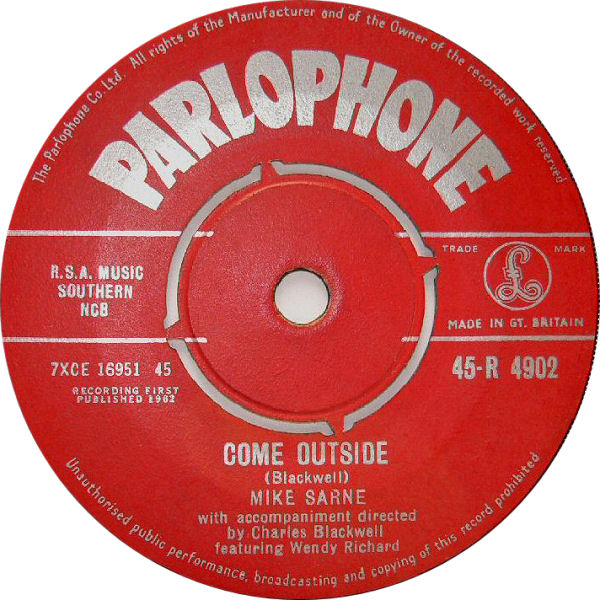
Sarne, who also played guitar and sang, was signed by Leyton's manager, Robert Stigwood. His first record, for Parlophone in 1962, was an immediate # 1 in the UK. Few people on hearing 'Come Outside' would have believed that the 'cockney lad' singing it was an expert in Russian. This first disc featured the voice - though not the singing - of 15-year old Wendy Richard, who would later become a familiar TV actress (Are You Being Served?, Eastenders). Mike's second disc 'Will I What' (which peaked at # 18) featured another girl, Billie Davis. She was on her way to become a pop star in her own right when she was involved in a serious car accident with her then-boyfriend, Jet Harris, in September 1963.

Mike's attempts to repeat his success using the same cockney novelty formula gradually grew less successful, but he squeezed four chart appearances from it, staying in the public eye for just
about one year. Even a change of accent and the addition of another girl - this time (Liverpudlian Vernons Girl) Margo't Quantrell - on the supposedly Beatles sounding 'Hello Lover Boy' didn't help. In the mid 1960s Sarne introduced the ITV children's quiz series, Junior Criss Cross Quiz. Although he would appear on records again, he turned his career towards the stage and films.

Films he has directed include: Joanna (1968) and most notably Myra Breckinridge (1970), an adaptation of Gore Vidal's book of the same name, starring Raquel Welch, Rex Reed, Mae West and
Farrah Fawcett in her first big screen role. A more recent film is The Punk And The Princess (1994) an adaptation of Gideon Sams' young adult novel The Punk, about the romance between a teenage punk rocker and an upper-class Sloane Ranger girl. He also directed a documentary about the Glastonbury Music Festival in 1995.

As an actor, he has appeared mainly on television, in British series including The Avengers, Man in a Suitcase, Jonathan Creek, and The Bill. Fluent speaker of several Eastern European languages - hence, is often cast as Russians or Germans in TV episodes.He also spent some years as a director of commercials. His brother, David Scheuer, had a brief acting career in the 1960s and 1970s.

In 2007 Mike appeared as Valery in the crime thriller, "Eastern Promises". In 2011 Sarne was the voice of "Karla" in the spy film
Tinker Tailor Soldier Spy and in 2012 he played Father Mabeuf in the film of Les Miserables.

Mike Sarne has five children, two of whom born from the first marriage with Tanya Sarne (1969-1978) founder of the designer label Ghost (Claudia and William) His other three (Emma, Abigail and Sarah) were born of his second marriage with Anne Musso. Sarne and Musso married in 2004 in Kensington and Chelsea, London.
(Info edited from Wikipedia & Rockabilly.nl)

Here's Mike Sarne, John Leyton, Michael Ripper & Ron Moody plus Liz Fraser and Nicholas Parsons in "Every Day's A Holiday" (1964). Great chemistry between Ron and Michael. Holiday camps aren't like this anymore - but they used to be. 
Songs are "Cor Blimey" with Ron & Michael, "Say You Do" with Mike, John and company.   

Sunday, 4 August 2013

Timi Yuro born 4 August 1940


Rosemary Timothy Yuro, professionally known as Timi Yuro (August 4, 1940 – March 30, 2004), was an American singer and songwriter. Sometimes called "the little girl with the big voice," she is considered to be one of the first blue-eyed soul stylists of the rock era. According to one critic, "her deep, strident, almost masculine voice, staggered delivery and the occasional sob created a compelling musical presence." Yuro possessed a contralto vocal range.

Rosemary Yuro was born in Chicago, Illinois in 1940, into an Italian-American family whose original name may have been Aurro. By the time of her birth, however, the family used the spelling Yuro. Young Rosemary moved with her family to Los Angeles in 1952. There, she sang in her parents' Italian restaurant and, despite her family's opposition, in local nightclubs before catching the eye and ear of talent scout Sonny Knight. Signed to Liberty Records in 1959, she had a U.S. Billboard No. 4 single in 1961 with "Hurt", an R&B ballad that had been an early success for Roy Hamilton.                          


Yuro's recording was produced by Clyde Otis, who had previously worked with Brook Benton and Dinah Washington. Later that year she recorded as a duo with Johnnie Ray. She charted some further minor hits, including "Smile" (No. 42), and opened for Frank Sinatra on his 1962 tour of Australia.

In 1962 Phil Spector produced Yuro's single, "What's a Matter
Baby (Is It Hurting You?)", which went to No. 12 on the Billboard pop chart. On both "Hurt" and "What's a Matter Baby", Yuro showed an emotional but elegant vocal style that owed a debt to Washington and other black jazz singers. Many listeners in the early 1960s thought Yuro was black.Her single "The Love of a Boy" reached No. 44 in 1962. It was arranged and co-written by Burt Bacharach, but Yuro refused to record his suggested follow-up, "What the World Needs Now Is Love".

In the following year, Liberty released Make the World Go Away, an album of country and blues standards. The singer at her vocal peak, this recording includes the hit title song (later a bigger hit for Eddy Arnold, with whom the song is usually associated), a version of Willie Nelson's "Permanently Lonely", and two different blues
takes of "I'm Movin' On". Yuro was also known for soulful reworkings of popular American standards, such as "Let Me Call You Sweetheart", "Smile", and "I Apologize". She toured Europe in 1963, and appeared on the British TV show Ready Steady Go!. However, in the U.S. her image became established as a cabaret performer rather than as a soul singer.

By 1964, Yuro had moved to Mercury Records, but her first record for the label, "You Can Have Him", arranged by Jack Nitzsche, only just scraped into the chart and was her last hit. Nevertheless, her album The Amazing Timi Yuro, produced by Quincy Jones,
was an artistic success. Subsequent records were unsuccessful, although a B-side, "Can't Stop Running Away," was later popular on the UK's Northern Soul circuit. In the 1960s, Yuro made two TV appearances on The Ed Sullivan Show and was a guest on American Bandstand, Where the Action Is, and The Lloyd Thaxton Show. In 1967, she appeared in a black-and-white film in the Philippines as a guest star alongside Filipino comedians Dolphy and Panchito in a comedy titled Buhay Marino (Life of a Sailor), a film released by Wag-Wag Productions, Inc. At that time, the singer was very popular in the Philippines. She re-signed for Liberty Records in 1968, and recorded in London.

By the late 1960s, Yuro had performed in venues from London to Las Vegas. However, her career lost its early momentum, and she
quit the music business altogether after her marriage in 1969.

In 1980, she was diagnosed with throat cancer, but recovered to cut several LPs for the Dutch market. In 1981, Yuro attempted a 
comeback in the Netherlands, performing as a guest of honor on Dutch national television. She rerecorded a version of "Hurt" that reached No. 5 on the Dutch pop charts. She also signed to the Dutch record label Dureco to record a new album, All Alone Am I; it went to No. 1 on the Dutch album charts and was eventually certified as a gold record. With these successes, Yuro moved to the Netherlands and continued with a string of hit singles and albums. After her record sales began to decline there in the mid-1980s, Yuro returned to the United States. Her last recording was the vinyl album Today, which was released in 1982 by Ariola and produced by her old friend and collaborator Willie Nelson. In 1990, the disc was reissued as a CD, remastered and remixed by Yuro herself on her own label Timi and titled Timi Yuro Sings Willie Nelson.

In 1984 she was forced to undergo a tracheotomy operation effectively ending her singing career. She died March 30, 2004, at the age of 63.

Saturday, 3 August 2013

Gordon Stoker born 3 August 1924


Hugh Gordon Stoker, singer (born Gleason, Tennessee 3 August 1924 died Brentwood, Tennessee 27 March 2013) was the leader of the Jordanaires vocal group, who were billed alongside Elvis Presley on many of his hit records including "All Shook Up", "It's Now Or Never" and "Are You Lonesome Tonight". Elvis went as far as telling them, "Let's face it, if it hadn't been for you guys, there might not have been a me."

Gordon Stoker's mother, Willie, was one of the operators and his father, Ambus, the repairman for the telephone system in Gleason, Tennessee, where he was born in 1924. They encouraged his
musical talent, so much so that he was playing organ at the Tumbling Creek Baptist Church when he was only eight.

He played piano for a family group, the Clement Trio, and in 1937 he was spotted at the Snead Grove Picnic by the John Daniel Quartet. He became their pianist when he left school at 15 and often played on the Grand Ole Opry.

During the war, Stoker worked as a teletype operator at an air base and then studied music at Oklahoma Baptist University. He rejoined the John Daniel Quartet and then became the pianist for the gospel group, the Jordanaires. With some changes in line-up, he became their lead tenor and by 1953, the vocal quartet was Stoker, Neal Matthews (second tenor), Hoyt Hawkins (baritone) and Cully Holt (bass), the last named being replaced by Ray Walker in 1958.


The Jordanaires recorded in their own right for Capitol Records, but they sang behind Ferlin Husky on his million-seller, "Gone", in 1953. They accompanied Eddy Arnold and Red Foley and had regular session work.

"Elvis loved the sound we had and he'd been hearing us on the Grand Ole Opry for years," Gordon Stoker said in 1991. "We met him in Memphis in 1955. He was wearing a pink shirt and I had never seen a man in a pink shirt before! He was on Sun Records and he told us that if he ever got a major recording contract, we were going to sing with him. When RCA signed him, he asked for us and we were on his sessions in January 1956." 


Those RCA records like "Don't Be Cruel", "Teddy Bear" and "A Fool Such As I" are enhanced by the Jordanaires with their oohs and aahs and bop-she-wahs. Stoker sang harmony duet with Elvis on "All Shook Up" and "Good Luck Charm" and he played piano on "Hound Dog" when the original pianist had to leave. The Jordanaires worked with Elvis on The Ed Sullivan Show in which he was filmed from the waist up. They appeared in his films, notably in the train sequence in GI Blues, where they perform "Frankfurt Special".

Soon, every act in Nashville wanted the Jordanaires on their records. They sang "Crazy" with Patsy Cline "The Battle Of New Orleans" with Johnny Horton and "Big Bad John" with Jimmy Dean, and also with Presley's biggest rival, Rick Nelson, on "Lonesome Town".

Stoker recalled, "Jim Reeves was an old maid. He watched the clock and he wanted complete attention at all times. Elvis was never concerned about getting three numbers down in three hours, but Jim knew the longer it took, the less he got in royalties."


The Jordanaires had a busy life of recording sessions and TV commercials and they chose not to work with Presley when he returned to live performance in 1969. "You had to do what was best for you and your family, said Stoker, "and we took the right decision. I think that two shows a night in Vegas is what killed him. He wanted that second show to be as good as the first and so he took uppers to get him going again and then downers to put him to sleep."

The Jordanaires sang with Don McLean on his No l "Crying" (1980), and they became a touring act in their own right. They were featured in a long-running tribute show for Patsy Cline and in 1991 toured the UK with an Elvis interpreter, Johnny Earl.


Among their albums is The Jordanaires Sing Elvis' Gospel Favourites (1986). Stoker was a modest man who was proud of his time with Presley. He said, "People will be talking about these records 200 years from now."

The Jordanaires were inducted into the Country Music Hall of Fame in 2001. In 2002, they received a Grammy award for their participation on They Called Him Mr. Gospel Music: The James Blackwood Tribute Album. 


Stoker in 2011 at the Country Music Hall of Fame® and Museum’s celebration of drummer D.J. Fontana. Pictured (L-R): D.J. Fontana, Jerry Chesnut, Country Music Hall of Fame member Gordon Stoker, David Briggs, Scotty Moore and program host Bill Lloyd. Photo: Donn Jones


Gordon Stoker passed away at the age of 88 on Wednesday, March 27,2013, at a hospoce in Nashville. His son Alan said that Gordon passed away after a long illness. (Info mainly Independent obit)

Art Greenhaw of The Light Crust Doughboys and The Jordanaires have been awarded Grammys and 6 Grammy Nominations for their albums together. here's a video of "Crying In The Chapel". 


Friday, 2 August 2013

Julie Dawn born 2 August 1920


Julie Dawn, (2 Augst 1920 - 18 May 2000) sang with some of the best-known dance bands of the 1940s, including those of Carroll Gibbons and Geraldo; later she presented a successful programme for penfriends on Radio 2.

She was born Juliana Rosalba Maria Theresa Mostosi on August 2 1920 in London. Dawn was the daughter of Italian immigrants; her father was the Savoy hotel's head waiter. She sang in her convent school choir and, from 13 to 15, took a piano and music course at the Guildhall School of Music. She sang popular songs in English,

Italian and French, which her father taught her; from the broadcaster Maurice Elwin she learnt microphone technique.

She got her break as a singer in 1939 when her violinist brother Ubaldo (known as Mossie) took her to a party. Singing J'attendrai in French, and accompanying herself on the piano, she was spotted by Ernest Quaglino, who invited her to appear at his famous restaurant in St James's. Collie Knox, the Daily Mail entertainment columnist, advised her to anglicise her name, and thus did Juliana Mostosi become Julie Dawn. In late 1939, she made her first studio broadcast. In 1939 she made her first record for Van Straten and her broadcasting debut from the BBC's Bristol studios, with Billy Ternent and His Sweet Rhythm Orchestra.

The entry of Italy into the war brought difficulties for the Mostosi family. Although Julie and her brother Ubaldo had been born in England, their parents were not naturalised. Her mother was sent to Holloway and her father, then manager of the Branksome Towers Hotel in Bournemouth, to Dorchester prison. Both were interned for five years.

In 1940, Julie Dawn joined the Harry Roy Orchestra, touring

variety theatres in England and Scotland. But after a falling-out with Roy in 1941 (she had taken to singing in Italian), she joined the Eric Winstone Quartet. After he formed his big band in 1942, she recorded frequently with him, as she did with with Harry Leader and Billy Thorburn. Meanwhile her brother Ubaldo, a violinist, played with the Mantovani Orchestra.

While working with Carroll Gibbons and the Savoy Orpheans in 1944, she was called up. But the authorities suggested that instead of working in a factory she should contact the bandleader Geraldo, who had been asked by Field Marshal Montgomery to undertake a three-week tour of France, Belgium and Holland to entertain the troops. Julie Dawn sang with Geraldo's orchestra at six gala performances in Paris and one at Versailles, and then with them at Eindhoven and Tilberg in Holland.

During the last few months of the war she was again with Eric Winstone. His swing band, on the advice of the War Office,
consisted only of volunteers, for it was playing in very advanced positions during the bitterly fought push into Germany.

After the war, she married Eddie Mordue, who was a saxophonist with Winstone's band. (The couple went on to record and perform with the likes ofGene Kelly, Sammy Davis, Jr and Frank Sinatra). She sang with Art Thompson at the Embassy Club, then with the Lew Stone Band and was featured at Hatchetts, Lansdowne House and the Copacabana. She broadcast with Sam Donahue's US Navy Band and the Robert Farnon Orchestra and in the early 1950s had a two-year residency at the Celebrity Club, off Bond Street.


There followed almost two years with the BBC Show Band, led by Cyril Stapleton, making three two-hour broadcasts each week. She was much in demand on the variety circuit and was featured on The Goon Show.

Her career later changed direction when Radio 2 gave her a twice-weekly spot. This was to continue successfully for five years. She was the only woman to appear on Charlie Chester's Soap Box, and she also broadcast on Night Ride and Music Thru' Midnight.

In 1977, she was invited to broadcast three times a week to listeners who lived alone. The idea was to put them in touch with others living in similar circumstances. She read out their letters, which soon topped 1,000 a week. Once a week, accompanied by a quartet, she sang for the audience. Julie Dawn's Penfriend Programme ran
for 10 years, and owed its popularity to her sympathetic approach to her correspondents' problems and her soothing voice.

During her later years, she entertained meetings of the Harry Roy Appreciation Society and was one of the founder members of the musicians' rendezvous, the Coda Club.

Julie Dawn died in Chelsea, London aged 79, 18 May 2000. She was twice married. Her second husband, David, predeceased her in 1992.(Info from Telegraph, Guardian & Independent obits)

Thursday, 1 August 2013

Leon Chappel born 1 August 1909


Leon Chappel (b. Horace Leon Chappelear, 1 Aug. 1909; d. 22 Oct. 1962) was one of the founders of what would become known as "Western Swing."

Leon Chappel remains a sadly unrecognized progenitor of Western swing, later recording a clutch of singles for Capitol that are fascinating for their mutant hillbilly-blues approach. Born

Horace Leon Chappelear in Gilmer, TX, on August 1, 1909, he dropped his first name by 1929, when he teamed with friends Joe and Bob Shelton to form the Lone Star Cowboys. After launching their career at Tyler, TX, station KGKB, the three relocated to Shreveport, LA, where they signed to station KWKH.
 
  
 Left to right: Slim Harbert, Buck Fields, Chris Herrington, Leon Chappelear.  (Photo postcard postmarked April 16, 1935.)

Sans his fellow Lone Star Cowboys, Chappelear made his recorded debut for the Gennett label with 1932's Jimmie Rodgers-inspired "Trifling Mama Blues" before reuniting with the Sheltons in mid-1933 to back singer Jimmie Davis on a session for Bluebird. Davis helped land the Lone Star Cowboys a deal with Victor, resulting in seminal early Western swing sides like "Deep Elm Blues" and "Just Because." Musical differences nevertheless prompted Chappelear to split with the Sheltons soon after, and after forming a new group he christened Leon's Lone Star Cowboys, his music swerved even closer to jazz, spearheaded by the kinetic fiddle playing of Lonnie Hall and a series of clarinetists.


Leon's Lone Star Cowboys signed to Decca in mid-1935, recording just a handful of sides for the label before tragedy struck: while returning from a September live date, the vehicle carrying Chappelear crashed, and he was hospitalized with severe head injuries. Although he survived the incident, there is much conjecture that he never fully recovered, as evidenced by the erratic course of his remaining years; nevertheless, within six months Leon's Lone Star Cowboys were again recording for Decca and playing live on KWKH, although the group relocated to Shreveport station KRMD soon after, reportedly due to subpar performances.


 Chappelear took the opportunity to shuffle the roster, creating a new 12-piece lineup that was in many respects his tightest and most dynamic, but after a final 1937 session, Decca terminated the band's contract. The next decade of Chappelear's life is in large part a mystery — he effectively retired from music to become a policeman, but his law enforcement career ended in ignominy when he was convicted of accepting bribes, possibly resulting in a prison sentence. From there, he worked for several years as a pipe fitter.

By the time he resurfaced in the late '40s, Chappelear had abbreviated his surname to "Chappel," and was playing in a new honky tonk outfit called the Lone Star Ramblers. Somehow he reconnected with Jimmie Davis, fresh off his first stint as governor of Louisiana, and was invited to join Davis' backing band, the Sunshine Boys. After signing to Capitol, Davis called in a few favors and landed Chappel a Capitol deal of his own.


Beginning with his 1951 label debut, "Slow Down Sweet Mama," his latter-day music boasted an almost anachronistic sound marrying bluesy, boozy juke-joint country with trace elements of his Western swing roots. "I'm a Do-Right Daddy" followed that summer, but Chappel did not issue his third and ultimately final Capitol single, "Don't Dog Me 'Round," until late 1953 — by most accounts, he spent the long layoff as a truck driver and pipe layer, and after Capitol dropped his contract, he returned to Shreveport, working at as a superintendent at the city dog pound. Health problems dating back to his earlier car crash continued to plague Chappel throughout his life, and after the disintegration of his marriage, he slipped into a deep depression, finally committing suicide while visiting his sister in Gladewater, TX, on October 23, 1962.
(Info rocky-52. Ist scan & mp3 from shreveportsongs. blogspot. )