Monday, 10 June 2013

Judy Garland born 10 June 1922


Judy Garland (born Frances Ethel Gumm; June 10, 1922 – June 22, 1969) was an American Academy Award-, Tony Award-, Grammy Award-, and Golden Globe-winning actress (film and stage) and singer. Considered by many to be the 'World's Greatest Entertainer. Through a career that spanned 45 of her 47 years, Garland attained international stardom as an actress in both musical and dramatic roles, as a recording artist and on the concert stage.

Judy Garland was born Frances Ethel Gumm on June 10, 1922, in Grand Rapids, Minnesota, and immediately nicknamed "Baby." Her father managed the town movie theatre; her mother accompanied
silent films on the piano. Both parents performed, as did Baby's two older sisters, and she joined the family act on December 26, 1924, in a song-and-dance routine with her sisters and her own solo, a scheduled one-chorus arrangement of "Jingle Bells." To the delight of the audience, Baby refused to leave the stage and went into reprise after reprise of the latter number; her grandmother finally had to walk on from the wings and carry the child offstage as she protested, "I wanna sing some more!"

The family moved to California in 1926, and over the next nine years, "The Gumm Sisters" made hundreds of stage and radio appearances. In 1929, they were seen in The Big Revue (Mayfair
Pictures) and then sang in three other "Vitaphone Varieties" shorts for First National: A Holiday in Storyland, The Wedding of Jack and Jill, and Bubbles. By 1932, Baby was the center of the act, drawing astounded, astounding response from the public and critics alike. In 1934, the Los Angeles Evening Express compared the scope and depth of her talent to that of legendary actress Sarah Bernhardt and offered, "Little Frances...sang in a way that produced in the audience sensations that haven't been equaled in years. She must have the divine spark to be able to sing as she did...."

In 1935, the group split up due to marriage by the oldest sister in the group. This was not exactly unwelcome news, since reviews of
the trio always singled out the youngest, Judy, with lofty praise. She was billed as "the little girl with the big voice," and soon drew the attention of casting agents. In September of 1935, she signed with MGM, and went on to be their biggest female star. Her time at MGM produced the studio's greatest musicals, such as "The Wizard of Oz," "Meet Me In St. Louis," and "Easter Parade." She also appeared with Mickey Rooney in a dozen films. She was the first celebrity to offer her services as an entertainer in World War two, and was the first female to be named an Honorary Corporal for her war efforts.


Between 1937 and 1950 her films grossed over one hundred million dollars. In 1950, Garland asked to be released from her film contract, and the release was granted. She was the first film performer in history to cross over from film to live performances. She would go on to make some critically acclaimed films (such as the 1954 remake of "A Star Is Born"), but her first love remained the live concert stage, despite making over 30 films in her lifetime. Judy Garland was nominated for two Academy Awards, and won a special Academy Award for her performance in "The Wizard of Oz." She won five Grammy awards, a Tony award, and was nominated for ten Emmy awards. Of her audiences, Judy said, "I just want them to know that I have been in love with them for all my life, and I tried to please. I hope I did."

From 1963-64 she hosted her own weekly television series. From 1964-69 she became primarily a live performer, peppering her live concerts with television appearances. In the last two years of her life she completed 120 concerts.

On June 22, 1969, Garland was found dead by Mickey Deans (her 5th and final husband) in the bathroom of their rented house at 4 Cadogan Lane in Chelsea, London. At the subsequent inquest,
coroner Gavin Thursdon stated that the cause of death was "an incautious self-overdose" of barbiturates. Thursdon stressed
that the overdose had been unintentional and that there was no evidence to suggest she had committed suicide. She had turned 47 just twelve days before her death. Her Wizard of Oz costar Ray Bolger commented at her funeral, "She just plain wore out."

On June 26, Deans took Garland's remains to New York City, where an estimated 20,000 people lined up for hours at the Frank E. Campbell Funeral Chapel in Manhattan to pay their respects.  She
was interred in a crypt in the community mausoleum at Ferncliff Cemetery, in Hartsdale, New York.


 Garland's legacy as a performer and a personality has endured long after her death. The American Film Institute named her eighth among the Greatest Female Stars of All Time. She has been the subject of over two dozen biographies since her death and was posthumously awarded the Grammy Lifetime Achievement Award in 1997. Several of her recordings have been inducted into the Grammy Hall of Fame. These include "Over the Rainbow", which was ranked as the number one movie song of all time in the American Film Institute's "100 Years...100 Songs" list. (info edited from various sources but mainly by: Eric Hemphill)


Friday, 7 June 2013

Beryl Booker born 7 June 1927


Beryl Booker (June 7, 1922** – September 30, 1978) was an American swing pianist of the 1950s.

Raised in the mecca of African-American artistic expression in Philadelphia in the 1920's, Beryl Booker was a pianist prodigy who never learned to read music. After landing her first professional gig with Slam Stewart's trio in 1945, she recorded half-a-dozen excellent albums under her own moniker, many of which she performs lead vocalist duties in addition to pianist.
As one of only a handful of female players at the time, Beryl was accustomed to having to prove herself in the jazz world of the forties and fifties. Sadly, jazz history has largely overlooked many illustrious contributions of female instrumentalist's.

Beryl played with an elite list of world renown jazz figures including, Billie Holiday, Dinah Washington, Count Basie, Miles Davis, Don Byas, and Slam Stewart. At the behest of ardent promoter Leonard Feather, Beryl formed her own historic, integrated, all female trio that included drummer, Elaine Leighton, and bassist, Bonnie Wetzel. They toured Europe in 1954 as part of the historic Jazz Club USA package, where the trio opened nightly for Billie Holiday, and other jazz legends.


Beryl Booker recorded as a leader for Victor (1945), SIW (1948), Mercury/EmArcy (1952), Discovery (1953), Vogue (with Don Byas) and Cadence (1954).

After another stint with Dinah Washington in 1959, she slipped into obscurity. In the 1970's she continued to play and record with small
groups. On September 30, 1978, swing pianist Beryl Booker died of a heart attack in Berkeley, California at age 56.

There are several unusual facets to Beryl Booker's work. Unlike many jazz soloists, she constantly retains a suggestion of the melody instead of adlibbing simply on the chords. There are also flashes of a rare sense of humor, reflecting her personality away from the keyboard. And often, very often there is a suggestion that her thinking is rooted in the blues.

Though she’s little known today outside jazz circles, she is still played today on jazz and public radio stations across America. Her piano work on Billie Holiday’s posthumous ladylove album will be a lasting testament to her work.

(Info various, mainly Kent Brown 2008)

**(Footnote) One other source gives birthdate as June 23, 1923


Here's a clip from Boy! What A Girl! (1947)

Slam Stewart Trio:
Slam Stewart - bass, vocal
Beryl Booker - piano, vocal
John Collins - guitar

Thursday, 6 June 2013

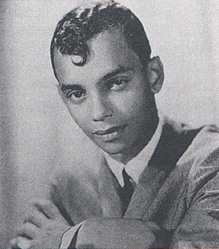
Gary U.S. Bonds born 6 June 1939


Gary U.S. Bonds (born Gary Levone Anderson, June 6, 1939, Jacksonville, Florida) is an American rhythm and blues and rock and roll singer. He is also a prolific songwriter.

He was born in Jacksonville, Florida and moved at a young age to Norfolk, Virginia, where he sang in the Church choir. In high school Gary joined a group called the Turks and eventually he came to the attention of Norfolk record shop owner Frank Guida. Guida owned the fledgling Legrand Records and arranged a session for
Gary Anderson to record a song called New Orleans. But first, the singer's name was changed to Gary U. S. Bonds, a name that was inspired by a poster in a Norfolk shop urging Americans to "Buy U. S. Bonds." The shop was Codd's Deli on Princess Anne Road.

New Orleans became a smash hit record, reaching the top ten in the Fall of 1960. As a singer, Gary U. S. Bonds had a good, strong voice and Guida would intentionally record his songs to sound somewhat raunchy; the combination resulted in hit songs for both producer and singer. Local Norfolk
group the Church Street Five had combined with a musician known as Daddy G to produce a song they called A Night With Daddy G. When Bonds recorded his version of it, backed by the Church Street Five and Daddy G, it was re-titled Quarter To Three. The rousing, frenetic recording became a huge hit and topped the charts in the Summer of 1961. Although it has been said that the group was unaware that the song was being recorded at the time they performed it, Bonds himself has said that this is not true and that he was fully aware that the tape was running as they were singing. "Quarter To Three" sold one million records, earning a gold disc.


Bonds followed with three more top ten hits within a year: School Is Out, Dear Lady Twist, and Twist, Twist Senora. In a 1963 tour of Europe, he headlined above The Beatles. His hits often featured solos by the saxophonist Gene Barge. Then his career headed into a twenty-year decline, although he did write Friend Don't Take Her, a song that was recorded by country-western artist Johnny Paycheck in 1972.


In the early 80's, rock superstar/Gary U. S. Bonds-fan Bruce Springsteen began to use Quarter To Three as his encore when he performed in live concerts. Together with rocker Miami Steve Van
Zandt, Springsteen helped to revive Bonds' career. Bonds was given some good material and good musicians with whom to work, and began recording songs and making live performances again. One of the songs he brought back at this time was Ritchie Valens' Come On Let's Go. In the early 80's Bonds once again put a couple of songs in the top forty.

Bonds released an album in 2004 called Back in 20, the title referencing his repeated sporadic pop-ups of popularity (his first hits were in the 1960s, then again in the 1980s, and now another significant album in the early 2000s, each 20-odd years apart). The album features guest appearances by
Springsteen and Southside Johnny. Bonds was also inducted into the Long Island Music Hall of Fame on October 15, 2006.

Bonds is a member of Global Village Champions Foundation. Global Village Champions has provided over 417 million meals over the past 17 years. He was presented with the Global Village Champion of the Decade award in 2009. That same year he released a new album Let Them Talk and toured the UK as a special guest of Bill Wyman's Rhythm Kings. Most recently, in 2010, Bonds contributed duet vocals on the song "Umbrella In My Drink" on Southside Johnny's album Pills and Ammo. Bonds is an honoree of the Rhythm & Blues Foundation and is also an accomplished golfer, often playing celebrity PGA Tour events. 


Gary U. S. Bonds continues to this day to be a good rock-and-roll singer, and today is a mainstay of the nostalgia concert circuit. Here's a link to his website: 

http://www.garyusbonds.com

(info edited from tsimon.com & Wikipedia)

Wednesday, 5 June 2013

Charles Dornberger born 5 June 1893


Charles F Dornberger (b. Jun. 5, 1898, New York, NY; d. Feb. 8, 1944, Reno, NV), was a saxophonist and band leader and director in the 1920's and 30's.

The Dornberger family was originally from Germany, and made a good living at the Dornberger Linen Factory before World War 1. Charles' mother, Pauline, was from Alsace Lorraine. Charles was the youngest of three children,

The career of Charles Dornberger included early and important participation in the reed section of the Paul Whiteman band. But he also had a fair amount of success in the '20s and '30s leading the
Charles Dornberger Orchestra, particularly in Canada. Descending from hard-working German stock, Dornberger was
said to have been a skilled musician who could get around fairly well on many of the instruments in the orchestra. Family members have been unable to recall any formal training, meaning he picked up these abilities on his own and did it well enough to pass muster with Whiteman, his first and historically most important employer as a professional musician. The two had met during service in the U.S. Navy in 1918; Dornberger was a pilot and Whiteman was training musicians for various service bands. In December of 1919, Dornberger joined Paul Whiteman's Orchestra and played saxophone with the orchestra during Whiteman's engagement at The The Alexandria Hotel in Los Angeles.

By 1923 Dornberger had stepped out of both the cockpit and the
reed section to start up his own band, leading to a contract with Victor as well as the creation of a series of musical shorts for Warner Brothers. Discographer Tom Lord lists Dornberger's final recording sessions as having taken place in 1929, but he continued leading bands for at least another decade, sometimes fronting as many as 35 musicians. Dornberger's band was popular at theatres, hotels, restaurants, and ballrooms such as those in the Congress Hotel in Chicago and Signal Mountain Inn in Chattanooga, Tennessee; at Roseland Ballroom in New York; and the Hollywood Restaurant.

A series of skilled players and arrangers emerged from his organization -- such as Frank Ventre, who went on to create hit material for Fats Waller. Dornberger orchestra recordings have continued to be of great interest to collectors of nostalgia, but by the early '40s the bandleader himself could have hardly understood the long-range appeal of his projects.                


He made 54 recordings (most of them for Victor) 1922-32 but quite a lot of them were never issued. Some of his recordings are hot (For example "Oh, Sister! Ain't That Hot" and "Tiger Rag"), but several are rather straight or even waltzes. The original 78s turn up quite often on auctions which is good since almost nothing by Dornberger has been reissued on CD or LP.

After retiring from the music business, Charlie opened a bar in Santa Ana, CA. called "The Circus Tent". He was killed when the plane he was piloting crashed. He was reported to have been with his girlfriend who also died. Other sources cite that he was instructing a woman who survived the crash. It is generally believed she was his girlfriend though the newspaper lists her as a flying student. There are no obituaries available to prove either story. Dornberger was married, but his wife had left him and they had no children. (info from various sources mainly AMG)

                        Reno Evening Gazette - 7 Feb 1944


Tuesday, 4 June 2013

Morgana King born 4 June 1930


Morgana King (born Maria Grazia Morgana Messina DeBerardini on June 4, 1930) is a jazz singer who has recorded over thirty albums to date.

King was born in Pleasantville, New York of Sicilian descent, although classically trained, King made the shift to singing jazz-inflected standards with surprising ease. Her appeal embraced both the popular audience and many jazz musicians, who hold her work in high regard. She toured extensively giving memorable
concerts in Rome, São Paulo and Rio de Janeiro. She was married to jazz trombonist Willie Dennis.

Morgana King recordings can be divided into several periods. It took her almost eight years to peak at whatever commercial success she was going to have with the 1964 A Taste of Honey album, in which she sung in a high, intense, floating voice, she has used this style as a future basic mannerism of her singing, thus ending the early years. 


She then was absorbed into the Atlantic and Reprise Corporation. 1965's The Winter of My Discontent is regarded as her masterpiece. Later in the 1970’s she launched the mature period of her career, though, once again recording as more of a jazz-flavored artist for Muse, a label which in itself indicates a disinterest in pop culture. The label was loyal to her, regularly recording her through the following decade. This material was reissued in the late '90s by the 32 Jazz label.

“Where most jazz voices can be likened to trumpets, saxophones or
clarinets, Morgana King has cultivated a vocal sound that most closely resembles a jazz violin. Her refined, vaporous tone is so meticulously manufactured that at times it almost seems to be emanating from a source beyond the body.” (New York Times, July 1984)

Her father had been a performer of folk and popular music on voice and guitar, and she had begun singing in nightclubs such as Basin Street in New York City when she was in her mid-twenties. Only a few years earlier, she had been immersed in classical studies at the Metropolitan School of Music. Basin Street may have been in the same city, but it must have seemed like a completely different musical world. The formal training undoubtedly filled in aspects of her musical walk where some of her peers might have had to limp. For this reason alone, some listeners find her efforts the most swinging of the '60s
generation of pop singers. It meant much critical acclaim during her career, if not great commercial success.
 
None of the more than 30 albums recorded by singer Morgana King since the mid-'50s have been embraced by the size of the audience that bought tickets to see the first two chapters of The Godfather film trilogy, in which King acted in the role of Mama Corleone. But it would be wrong to assume she has had more impact as an actress than as a vocalist. Her acting roles, few and far between, are chosen with care, but do not have the resonance of some of her finest recordings. Millions saw her onscreen in The Godfather films, but her performance was certainly overshadowed by performers such as Robert DeNiro and Al Pacino, not to mention the famous turn by Marlon Brando as her husband. She later continued with her singing career, making occasional records which emphasized her commercial leaning.

King announced her retirement from performing during an engagement at the Cotton Club in Chicago on Friday, December 10, 1993, and added that her recording would not be affected by the decision.[88] She continued to perform after that date at the Ballroom,[89] Maxim's,[90] Mirage Night Club (a benefit jazz session),[91] and Roosevelt Hotel's Cinegrill. Her last film appearance was in the film A Brooklyn State of Mind (1987), she has also appeared in several television productions.
(Info various, edited mainly from AMG)


Here's Morgana on The Hollywood Palace show in October 1964 singing Corcovado. The host is Donald O'Connor.

Footnote: King died, aged 87, of non-Hodgkin's lymphoma in Palm Springs, California on March 22, 2018.

Sunday, 2 June 2013

Jimmy Jones born 2 June 1937


James "Jimmy" Jones (June 2, 1937 – August 2, 2012) was an American singer-songwriter who moved to New York while a teenager. Best known for his 1960 R&B smash, 'Handy Man,' Jones sang in a smooth yet soulful falsetto modeled on the likes of Clyde McPhatter and Jackie Wilson.

Jimmy Jones was born in Birmingham, Alabama, and his first brush with show business was tap dancing, although he got interested in singing through his church. When he was about
twelve, he moved to New York with his older sisters and subsequently attended George Washington High School.

Jones joined a doo-wop group named The Berliners in 1954. They later changed their name to Sparks Of Rhythm. In 1955 he wrote "Handy Man" which was recorded by the Sparks Of Rhythm in 1956 (after Jones left the group).

After recording with other groups, he went solo and in 1959 he teamed up with Otis Blackwell who reworked "Handy Man" which Jones recorded on the MGM record label, Cub subsidiary. When the flute player did not show up for the session, Blackwell whistled on the recording. "Handy Man" went to #2 on the Billboard Hot 100 in 1960.

In 1959 the song was released, and Jimmy Jones had his first U.S.
and UK hit single with the free-running, and all-time classic track. Later, in 1960 his recording "Good Timin'", went to Number 1 on the UK Singles Chart and #3 in the U.S. His subsequent career was low key, although it included three more UK chart entries in the following twelve months. That proved to be the full extent of his major commercial success, although he kept recording through most of the '60s. He remained with Cub until 1962, scraping the lower reaches of the charts with "That's When I Cried" and "I Told You So." He recorded for Ro-Jac and Vee Jay over the next two years, and his work gradually took on a New York-style uptown soul flavor. From 1965-1967, he cut sides for Roulette, Parkway, and Bell, none of which restored his commercial standing despite some fine performances. "Handy Man," however, remained an enduring favorite, as Del Shannon and James Taylor each found significant chart success with their own versions.


Although Jones had but two Top 40 hits, both smash million sellers, he was able to keep active in the music industry as both a songwriter and recording artist, making personal appearances when he wanted to. His importance on singing can not be overstated as Del Shannon has cited both Jones and The Ink Spots as an influence. Other singers who later used falsetto included Lou Christie and Barry Gibb, the latter who has cited Shannon in turn as an influence for his disco vocalizations with the Bee Gees.

On April 25, 1985, Jimmy Jones was a member of the "Vintage Doo-Wop Rockers," who recorded Arthur Crier’s "Don’t Let Them Starve" for African famine victims. More recently, Jimmy was part of the famed June 6, 1999 photo session in Harlem.

Jones released Grandma's Rock & Roll Party in the 1990s on CD, perhaps in part to his popularity in the UK Northern Soul

music circle, which included new versions of "Handy Man" and "Good Timin'". In 2002, thanks to Jones' continued popularity on Britain's Northern soul circuit, Castle/Sanctuary issued a double-disc anthology titled Good Timin': The Anthology.
Jimmy Jones had a great voice which gave us some wonderful R&B music, as well as some classic hits from the dawn of the 60s. 

Jimmy Jones died in Aberdeen, North Carolina, on August 2, 2012, aged 75. He is survived by his wife Mattie, two daughters, a son, four grandchildren and a number of great-grandchildren.(Info edited from Last fm & Wikipedia)
 
The only video I can find is this poor quality clip of  a rather energetic Jimmy singing Handy Man.

Saturday, 1 June 2013

Pat Boone born 1 June 1934


Charles Eugene "Pat" Boone (born June 1, 1934) is an American singer, actor, and writer. He was a successful pop singer in the United States during the 1950s and early 1960s.

In the years immediately prior to the British Invasion, only one performer rivaled the chart dominance of Elvis Presley, and that was Pat Boone. With his trademark white buck shoes, perfectly combed hair and gleaming smile, Boone was the very essence of
wholesome American values, and at a time when the rise of rock & roll was viewed as a sign of the apocalypse, he made the music appear safe and non-threatening, earning some 38 Top 40 hits in the process.

It's fitting that his achievements rank closest to those of Presley; after all, both claimed the sound of the black R&B culture for their own, in the process straddling both sides of the color line and popularizing a form of music which otherwise might never have gained widespread acceptance. Of course, while Elvis -- with his flashy suits, swiveling hips and suggestive leer -- remained persona non grata throughout many corners of mainstream America, Boone was embraced by teens and parents alike; his music polished rock's rough edges away, making songs like "Tutti
Frutti" and "Ain't That a Shame" palatable to white audiences raised on the soothing pop traditions of a vanishing era.

Charles Eugene Patrick Boone was born June 1, 1934 in Jacksonville, Florida; a descendant of American frontier hero Daniel Boone; he attended high school in Nashville, and was voted student body president. After graduating, Boone married Shirley Foley, the daughter of country star Red Foley, and after a period at Nashville's David Lipscomb College, he transferred to North Texas State University. There, after taking top honors at a local talent show, he earned the right to appear on the The Ted Mack Amateur Hour, leading to a
year-long tenure on The Arthur Godfrey Show.

In 1954, Boone made his first recordings for the small Republic label, followed a year later by his Dot Records debut "Two Hearts, Two Kisses." As 1955 drew to a close, he notched his first number one hit, a sedate rendition of Fats Domino's aforementioned "Ain't That a Shame"; in the years to come he would record numerous cover versions of songs first credited to black performers, among them Little Richard, the El Dorados, the Flamingos and Ivory Joe Hunter -- indeed, to the chagrin of purists, for many listeners Boone's records remain better-known than the original performances.


Between 1956 and 1963, Boone made some 54 chart appearances, many of them with two-sided hits; his biggest smashes included the number one records "Don't Forbid Me," "Love Letters in the Sand" and "April Love," all three issued in 1957. That year he also began hosting his own ABC television series, The Pat Boone-Chevy Showroom; he also conquered film, starring in 15 features including 1957's Bernadine and April Love. Although his TV program ceased production in 1960, Boone remained a major star as the new decade dawned, and in 1961 again topped the charts with "Moody River." He even became an author, writing a series of self-help books for adolescents including Twixt Twelve and Twenty, Between You, Me and the Gatepost and The Care and Feeding of Parents. Although the rise of Beatlemania put the brakes on Boone's run as a teen idol -- after 1962, he failed to again crack the Top 40 -- he continued recording for Dot through the late

1960s, and in his live performances regularly appeared with his wife and their four daughters, further reinforcing his family-friendly image.

By the 1970s, Boone had shifted almost exclusively to recording gospel material, although he later scored a handful of country hits (on, of all places, Motown); in 1977, his daughter Debby topped the charts with a smash of her own, the wedding perennial "You Light Up My Life." In 1981, Boone published Pray to Win, and in 1983 he began hosting a long-lived contemporary
Christian syndicated radio show, all in addition to his extensive charity work.

While his recording career continued to taper off, he did issue "Let Me Live," which became an anthem for the anti-choice movement. By and large, Boone spent much of the 1980s and 1990s out of the secular media spotlight, but in 1997 he made a splash with the LP No More Mr. Nice Guy, a tongue-in-cheek collection of covers of heavy metal tunes like "Smoke on the Water" and "Stairway to Heaven." Much of the singer's Christian contingent failed to get the joke, however, and after Boone appeared at the American Music Awards clad in black leather and sporting temporary tattoos, he was dismissed from his Trinity Broadcasting Network program Gospel America.  (Info mainly Jason Ankeny, All Music Guide)