
Ralph Earl Sutton (November 4, 1922 – December 30, 2001)
was an American jazz pianist born in Hamburg, Missouri.
Ralph Sutton was one of the greatest stride pianist to
emerge since World War II, with his only close competitors being the late Dick
Wellstood and the very versatile Dick Hyman. Nearly alone in his
 generation,
Sutton kept alive the piano styles of Fats Waller and
generation,
Sutton kept alive the piano styles of Fats Waller and
James P. Johnson, not as mere museum pieces but as devices for exciting improvisations. Although sticking within the boundaries of his predecessors, Sutton infused the music with his own personality; few could match his powerful left hand.
 generation,
Sutton kept alive the piano styles of Fats Waller and
generation,
Sutton kept alive the piano styles of Fats Waller and James P. Johnson, not as mere museum pieces but as devices for exciting improvisations. Although sticking within the boundaries of his predecessors, Sutton infused the music with his own personality; few could match his powerful left hand.
Raised in the tiny village of Howell, Missouri (later
destroyed when the government took the land for a TNT plant), Sutton trained in
classical piano and played the organ in the Presbyterian church as a young boy.
By the age of 11 was playing in his builder father's country dance band. As a
teenage he would
 listen to the Harlem Rhythm radio show which first introduced
him to "stride" piano; the style he would play for the rest of his
life.
listen to the Harlem Rhythm radio show which first introduced
him to "stride" piano; the style he would play for the rest of his
life.
 listen to the Harlem Rhythm radio show which first introduced
him to "stride" piano; the style he would play for the rest of his
life.
listen to the Harlem Rhythm radio show which first introduced
him to "stride" piano; the style he would play for the rest of his
life.
Jack Teagarden heard Sutton play around 1940 at a college
and recruited him for his band. Sutton played with Teagarden until he was
drafted into the Army in 1943. After the conclusion of World War II, in 1945,
Sutton returned to St. Louis and worked with the Joe Schirmer Trio. Sutton then
journeyed to New York rejoining Jack Teagarden's band. When he opened at the
Famous Door on New York's 52nd street with Teagarden it helped put Sutton on
the map, leading to a regular slot on Rudi Blesh's famed This Is Jazz radio
 show, and to the formation of Sutton's own trio, featuring the fine New Orleans
clarinettist Albert Nicholas.
show, and to the formation of Sutton's own trio, featuring the fine New Orleans
clarinettist Albert Nicholas.

In 1948, Sutton took on the select gig of intermission
pianist at Eddie Condon's Greenwich Village club, where he stayed for eight
years, also taking part in Condon's radio and TV shows, recording regularly and
attracting international interest. In 1952 Sutton was asked to London to play
the Royal Festival Hall. This was the start of his many European tours which
would continue until his death.

By 1956 Sutton had moved his family to San Francisco,
where he continued his work as an intermission pianist and combo performer,
also subbing for Earl Hines when the latter was on tour in Britain. He joined
trumpeter Bob Scobey's bright Dixieland band, recorded
yet more albums and seemed destined for a steady if locally
 confined career until the impresario
Dick Gibson invited him to Colorado to play at a jazz party.
confined career until the impresario
Dick Gibson invited him to Colorado to play at a jazz party.
yet more albums and seemed destined for a steady if locally
 confined career until the impresario
Dick Gibson invited him to Colorado to play at a jazz party.
confined career until the impresario
Dick Gibson invited him to Colorado to play at a jazz party.
Here he met his second wife Sunnie, who operated the
Rendevous club in the ski resort of Aspen. With the help of bassist Milt Hinton
and drummer Gus Johnson, Sutton turned it into a jazz centre, attracting star
players like Ruby Braff, and appeared himself as part of the World's Greatest
Jazz Band. While the WGJB's working title may have seemed over-blown to some,
the all-star line-up produced a marvellous sound, bolstered by bassist Bob
Haggart's superior arrangements, many of pop songs rather than of the usual
Dixieland staples.
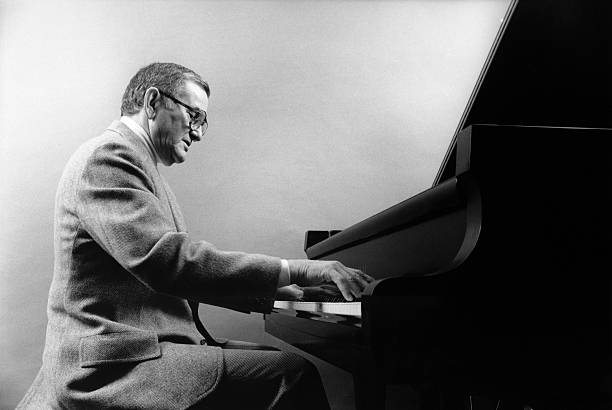
 Despite suffering a stroke in the early '90s, Sutton kept
a busy schedule through the mid-'90s, playing at jazz parties and festivals.
Despite suffering a stroke in the early '90s, Sutton kept
a busy schedule through the mid-'90s, playing at jazz parties and festivals.
He died suddenly on December 29, 2001, in his car outside
a restaurant in Evergreen, CO. Although he would have received much greater
fame if he had been born 20 years earlier and come to maturity during the 1930s
rather than the 1950s, at the time of his death it was obvious that Ralph Sutton
had earned his place among the top classic jazz pianists of all time.
(Compiled and
edited from Wikipedia, George Borgman blog, AllMusic & The Guardian)
Ralph plays two of his favourite tunes: Love Lies & Viper's Drag. Jerry Cherry from St Louis is on the bass at the 1994 Mid-America Jazz Festival in St. Louis.
Ralph plays two of his favourite tunes: Love Lies & Viper's Drag. Jerry Cherry from St Louis is on the bass at the 1994 Mid-America Jazz Festival in St. Louis.

