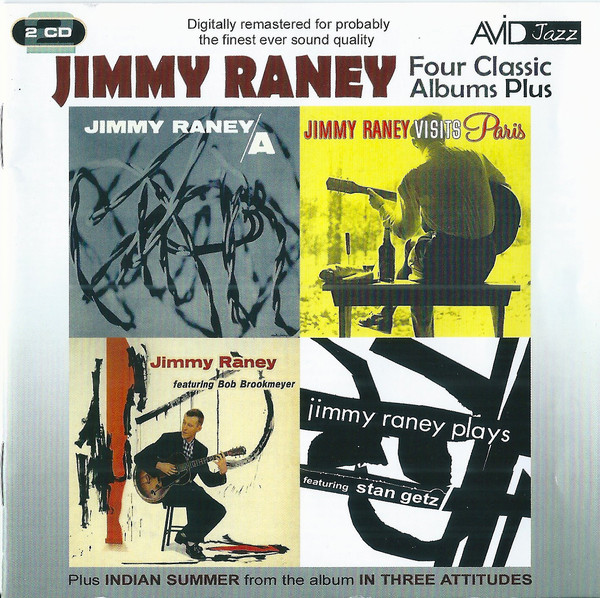
Jimmy Raney (August 20, 1927 – May 9, 1995) was an American jazz guitarist born in Louisville, Kentucky, known for his work from 1951 to 1952 and then from 1953 to 1954 with the Red Norvo trio (replacing Tal Farlow) and, during the same time period, with Stan Getz. In 1954 and 1955, he won the Down Beat Critics' Poll for guitar. Raney worked in a variety of jazz mediums, including cool jazz, bebop, post bop, hard bop, and mainstream jazz.


Jimmy was happy with being in a major big band, but he
began to feel restless with having few solos and playing mostly rhythm guitar.
Nevertheless, Jimmy practiced a ton and band mates often noted this. He was
rapidly becoming a new voice for bebop guitar. He would take his first trip to
the studio in 1948 with Al Haig and Stan Getz which produced a series of
exceptional recordings and brought Mr. Raney's playing to a wider audience. He
maintained a busy recording schedule, also working with the pianists Sonny
Clark and Hall Overton.


Although Jimmy played and recorded with Stan Getz
earlier, he didn’t officially join his band until after finishing up with Artie
Shaw’s bands and cutting a few more records. During the early 50’s Jimmy
replaced Tal Farlow in the Red Norvo
trio which
 was a popular touring band since the early fifties. The first gig
with Red was at The Embers in New York in 1953. The first tracks were recorded
in March of 1953. He then toured with Red going to Toronto, the midwest,
Colorado and San Francisco. His most notable tour was however his famous one to
Europe from Jan-Feb 1954 (organized by record producer, Leonard Feather) where
the trio was joined up with Buddy DeFranco and Sonny Clark to accompany Billie
Holiday in Mustermesse, Basil (Switzerland).
was a popular touring band since the early fifties. The first gig
with Red was at The Embers in New York in 1953. The first tracks were recorded
in March of 1953. He then toured with Red going to Toronto, the midwest,
Colorado and San Francisco. His most notable tour was however his famous one to
Europe from Jan-Feb 1954 (organized by record producer, Leonard Feather) where
the trio was joined up with Buddy DeFranco and Sonny Clark to accompany Billie
Holiday in Mustermesse, Basil (Switzerland).

 Jimmy recorded several albums – a quintet date in Sweden
with tenor saxophonist Gosta Theselius and Sonny Clark and two albums in Paris
with a French rhythm section (as well as Bobby Jaspar on tenor) and the other
with Mitchell, Clark and drummer Bobby White. These two albums were Jimmy’s
famous Jimmy Raney Visits Paris (vol 1 and 2). In the 1960's Mr. Raney moved to New York and did a
substantial amount of playing in recording and television studios, but in 1967
alcoholism and other professional difficulties led him to return to his native
Louisville.
Jimmy recorded several albums – a quintet date in Sweden
with tenor saxophonist Gosta Theselius and Sonny Clark and two albums in Paris
with a French rhythm section (as well as Bobby Jaspar on tenor) and the other
with Mitchell, Clark and drummer Bobby White. These two albums were Jimmy’s
famous Jimmy Raney Visits Paris (vol 1 and 2). In the 1960's Mr. Raney moved to New York and did a
substantial amount of playing in recording and television studios, but in 1967
alcoholism and other professional difficulties led him to return to his native
Louisville. In the 70's, his career picked up, especially in Europe
and Japan. He recorded several fine albums for the Xanadu label, and in the
1980's he kept a fairly consistent touring and recording schedule, performing
with his son Doug (who has a very similar sound on guitar). Raney was less
active in the late '80s and '90s, up until his 1995 death.
In the 70's, his career picked up, especially in Europe
and Japan. He recorded several fine albums for the Xanadu label, and in the
1980's he kept a fairly consistent touring and recording schedule, performing
with his son Doug (who has a very similar sound on guitar). Raney was less
active in the late '80s and '90s, up until his 1995 death.
Raney suffered for thirty years from Ménière's disease, a
degenerative condition that led to near deafness in both ears, although this
did not stop him from playing. His last series of recordings, uniformly strong,
were made for the Criss Cross label in the Netherlands. He died of heart
failure in a nursing home in Louisville, Kentucky May 9, 1995. He was 67.

His obituary in the New York Times called him "one of the most gifted and influential post-war jazz guitarists in the world".
(Edited from Wikipedia, New York Times &
jonraney.com)

