
Earl Eugene Scruggs (January 6, 1924 – March 28, 2012) was
an American musician noted for popularizing a three-finger banjo picking style,
now called "Scruggs style", that is a defining characteristic of
bluegrass music. His three-finger style of playing was radically different from
the ways the five-string banjo had been historically played. He popularized the
instrument in several genres of music and elevated the banjo from its role as a
background  rhythm instrument, or a comedian's prop, into featured solo status.
The youngest of five, Scruggs was born in rural Cleveland
County, North Carolina, and lived on a
farm which he helped tend after his father died. As a teenager, he attended
high school in Boiling Springs, North Carolina. With his school, farm work and
other chores, his past time became the five-string banjo and he spent every
spare moment playing it. He was fascinated with the instrument. He played his
father's banjo and one his older brother owned until he was around eleven or
twelve years old. rhythm instrument, or a comedian's prop, into featured solo status.
 in Shelby. He worked for the Lily Mills textile mill near
his home until the draft restriction of World War II was lifted. And his mother
encouraged him to pursue music as a career.
in Shelby. He worked for the Lily Mills textile mill near
his home until the draft restriction of World War II was lifted. And his mother
encouraged him to pursue music as a career.
Scruggs joined Bill Monroe's Blue Grass Boys in late 1945
and devised a picking method in which the thumb and two fingers of the right
hand led a breathtaking dance, its leaps and rolls transforming the sound of
the rural stringband into an intricately engineered high-performance music.
Critics would call him the Segovia of the five-string banjo, the Paganini of
bluegrass.
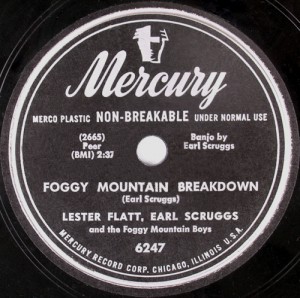
In 1948, Flatt and Scruggs set out on their own, jointly
leading the Foggy Mountain Boys The
group made sparkling recordings such as Flint Hill Special, named after
Scruggs's home town; Randy Lynn Rag, for his eldest son; Foggy Mountain
Breakdown and The Ballad of Jed Clampett, the theme tune of the popular TV show
The Beverly Hillbillies and a No 1 on the country chart in 1962.

The instruction book Earl Scruggs and the Five-String Banjo
was published in 1968; it went on to sell more than a million copies. But
Scruggs became, as he said later, "bored and unhappy doing the same things
for over 20 years", and in 1969 he broke with Flatt and formed the Earl
Scruggs Revue with his sons Gary and Randy, and later Steve. Their embrace of
amplified instruments, drums and repertoire outside the bluegrass canon lost
Scruggs some of his original audience, but he found another on the college
campuses of the 1970s, and he participated in the Nitty Gritty Dirt Band's 1972
 triple LP Will the Circle Be Unbroken, which opened the ears of many rock fans
to connections with earlier forms.
triple LP Will the Circle Be Unbroken, which opened the ears of many rock fans
to connections with earlier forms.
 triple LP Will the Circle Be Unbroken, which opened the ears of many rock fans
to connections with earlier forms.
triple LP Will the Circle Be Unbroken, which opened the ears of many rock fans
to connections with earlier forms.
Technically gifted (he was also a very fine guitarist) and
musically open-minded, Scruggs stepped easily across the borders of genre, and
when, in 1975, he celebrated 25 years at Columbia Records with an anniversary
album, he was joined by Leonard Cohen, Billy Joel and dozens of other musicians
from backgrounds unlike his own.
From the 1980s onwards he played less often, but the awards
for his innovation rolled in: election to the Country Music Hall of Fame in
1985, a National Heritage fellowship in 1989, the National medal of arts in
1992. On the album Earl Scruggs and Friends (2001) he remade Foggy Mountain
Breakdown, sharing the banjo part with the comedian Steve Martin, and the tune
won its second Grammy. In 2008 Scruggs received a Grammy lifetime achievement
award.

(Info edited mainly from an article by Tony Russell @ The
Guardian & Wikipedia)

